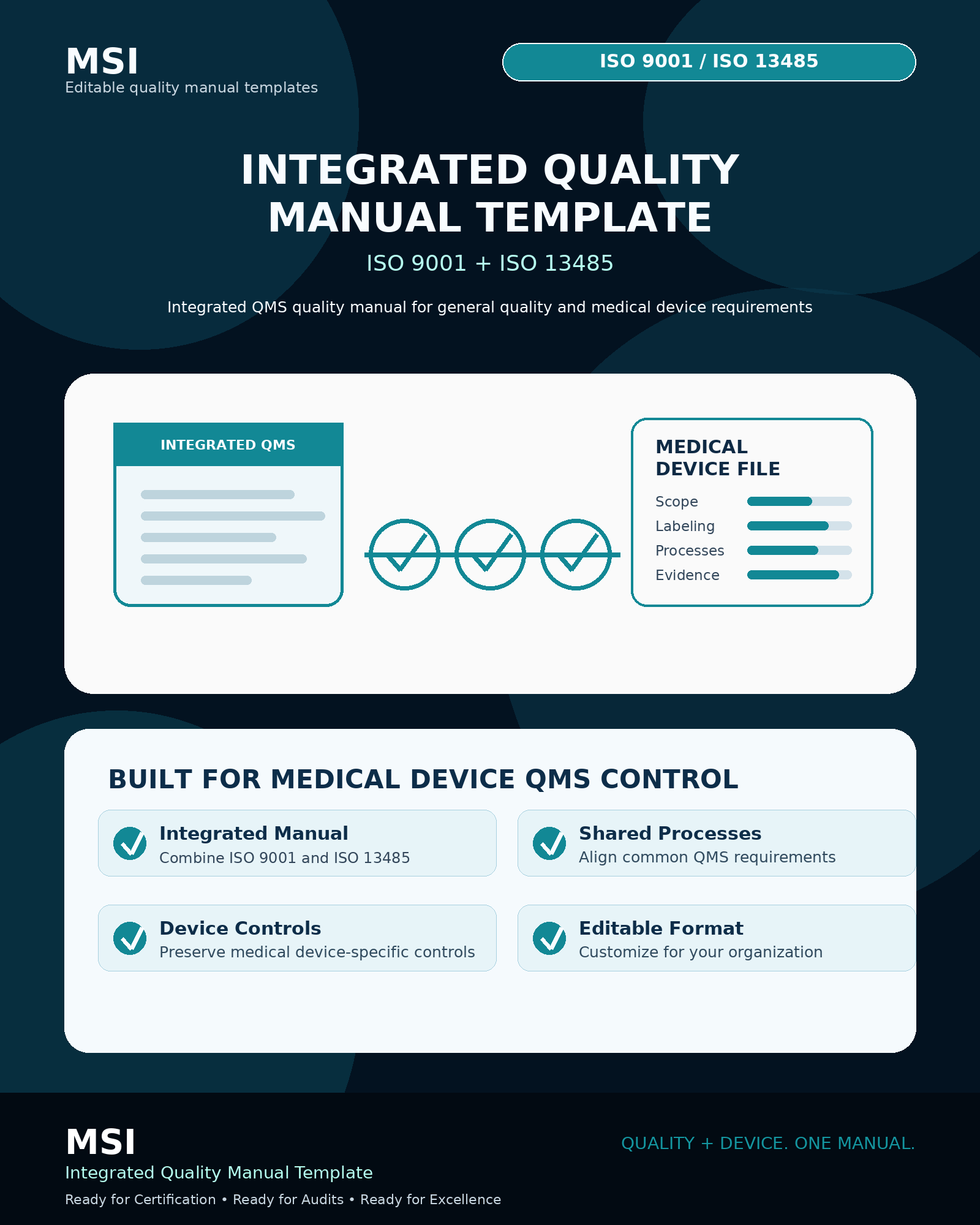
Each ISO 13485 quality manual template here is a worked manual, for ISO 13485:2016 alone or for combined ISO 9001 / ISO 13485 systems — with the scope statement written, every non‑application justified, and the process interaction drawn. Editable Microsoft Word.
Why the manual still matters
The first document a registrar opens, and the last one anybody rewrites.
Scope. Justify. Defend.
ISO 9001 dropped the term in 2015. ISO 14001 and ISO 45001 never had it. ISO 13485:2016 Clause 4.2.2 still requires a quality manual, which means every certified device organization maintains one — and most maintain a document nobody has read carefully since it was written.
Since February 2, 2026, that document carries regulatory weight as well. The FDA's Quality Management System Regulation amended 21 CFR Part 820 to incorporate ISO 13485:2016 by reference, making conformance a legal requirement rather than a voluntary one. A quality manual stopped being purely a certification artifact and became something an FDA investigator can assess you against.
These are not blank forms. Each is a complete, worked manual you edit down to your facts, in three parts: instructions you delete, the manual you keep, and a toolkit you work through and then delete. Every place a decision is genuinely yours is marked in square brackets. Nothing else is left blank.
Choose
Which manual does your system need?
The answer turns on which standards you hold and whether you place medical devices on the market. If you are adding a device line to an existing ISO 9001 system, the combined manual is the starting point rather than a second document.
Your situation
What to start with
ISO 13485 only
ISO 13485 Quality Manual Template — scope, exclusion and non‑application settled first, because everything below inherits those decisions.
Five quality manual templates, built to work together.
Every cross‑reference in every document is a unique token with a complete find‑and‑replace table, so you adopt your own numbering in one pass — across the manual and the device file at the same time.
Clause 4.2.2
ISO 13485 Quality Manual Template
Roles undertaken under applicable regulatory requirements — the Clause 4.1.1 table most manuals skip
Exclusion stated separately from non‑application, each with its own test
A table recording what is confirmed applicable — 6.4.2, 7.5.2, 7.5.3, 7.5.4 and 8.2.3, with the reasoning
Process interaction diagram plus a table of what passes between 24 processes
Eight worked scope statements and ten worked justifications, plus eight that get rejected and why
44 pages · editable Word · five organization‑type adaptations
The Combined ISO 9001 + ISO 13485 Quality Manual, built to sit alongside the Medical Device File.
Bundle · save
ISO 13485 Quality Manual + Medical Device File
Both system‑level documents ISO 13485 requires, in one purchase. The manual references the device file by name; both use the same token‑based renumbering, so one find‑and‑replace pass adopts your document numbering across the pair.
Everything a dual‑certified device organization needs at the top of its documentation structure. If you are adding a device line to an existing ISO 9001 system, these are the two documents to settle before anything below them is written.
A template that reads well and cannot be adopted is a document you pay for twice. These are written to be edited by someone under time pressure who did not write them.
01
Renumbering in one pass
Every cross‑reference is a unique token with a complete find‑and‑replace table. Adopt your own document numbering without hunting through 45 pages for the reference you missed.
02
Document control already in place
Title in the header on every page, ownership statement in the footer, a live print‑date field, and page‑of‑total numbering — the details that get flagged on a first audit of a new manual.
03
The reasoning written down
Where a decision was made, the alternative is recorded alongside it. That record is what lets a later editor change a position without quietly deleting something load‑bearing.
No, and it has not since 2015. The 2015 revision removed the term entirely, replacing "quality manual" with requirements to maintain documented information. ISO 13485:2016 Clause 4.2.2 still requires one, which is why a device organization certified to both standards still maintains a manual while a general manufacturer certified only to ISO 9001 need not.
What is the difference between exclusion and non‑application in ISO 13485?
Two different mechanisms with two different tests. Exclusion reaches design and development controls only, and only where applicable regulatory requirements permit it — a regulatory question, not an operational one. Non‑application reaches requirements within Clauses 6, 7 and 8 only, on grounds of the activities you undertake or the nature of your device. Clauses 4 and 5 admit neither. Using the words interchangeably is one of the most common findings in a quality manual.
Can I exclude design and development controls because we outsource design?
No. Outsourcing a process does not remove it from your quality management system. Clause 4.1.5 is explicit that where a process affecting product conformity is outsourced, the organization retains responsibility for conformity and the controls include written quality agreements. Outsourcing changes how you control a process, not whether you are answerable for it.
Can one manual serve both ISO 9001 and ISO 13485?
One manual is both possible and preferable, provided the divergences are recorded rather than smoothed over. Two manuals means two places where the scope, the policy and the process descriptions are stated, and two places they can drift apart. The risk with one manual is different: over years of editing, content that existed to satisfy one standard gets trimmed as redundant. That is precisely what the integration record prevents.
Are these usable if we do not manufacture anything?
Yes. The ISO 13485 manual includes five organization‑type adaptations covering specification developers using contract manufacture, contract manufacturers with no design authority, design services firms, distributors and importers, and servicing or refurbishment organizations. Each names the specific sections to edit.
Do I need the procedures as well?
The manual states what the system covers and where each requirement is discharged. The procedures are what discharge it. MSI's ISO Procedure Templates and Guides are written to the same architecture, so the manual's clause map and the procedure set line up rather than having to be reconciled.
Twenty‑eight years of audits, written down
Written by the consultants who sit in the audits.
Management Systems International is a veteran‑owned, female‑owned ISO consulting firm founded in 1998. Across 28 years we have certified 80+ companies through implementations, attended 200+ audits, and trained 600+ professionals. The defects these templates are built to prevent are the ones we watch organizations answer for.
Templates are provided for guidance and are not legal or regulatory advice. Conformity to ISO 13485:2016 and ISO 9001:2015, and compliance with applicable regulatory requirements including 21 CFR Part 820 as amended by the Quality Management System Regulation, remain the responsibility of the adopting organization. Scope, exclusion, non‑application and device family determinations can only be made by the adopting organization and must be verified against the current text of the standard and of every applicable regulation before release. Licensed for use within the purchasing organization. Not for resale or redistribution.
0%
Client success rate on first-attempt certification
0+
Companies certified via the SurePath approach
0+
Employees trained across regulated industries
0
Years serving medical device, aerospace & federal sectors
In Their Words
Built around the business, not bolted on.
MSI didn't hand us a binder. They sat with our engineering team, learned how we actually design and transfer product, and built a QMS our people wanted to use. We passed certification on the first attempt with zero major findings.
— Operations Principal, Medical Device Design House
After Certification
Getting certified is the start. Staying certified is the work.
Certification isn't a finish line — it's annual surveillance audits, management reviews, internal audits, and documentation that drifts the moment the registrar leaves. SureResults™ is MSI's maintenance program: a dedicated consultant who already knows your system and handles the internal audits, registrar coordination, and ongoing improvements year-round, so nothing slips between audit cycles.
MSI clients average 0–1 findings at surveillance audits — and 85% of the systems we implement stay with SureResults.
Twenty-eight years of practice, written down. New: complete ISO procedure templates and guides. 15 procedure topics, five standards and combos, editable Word — with the judgment calls already made. See the templates →
Buy any Template Packages and the price is credited 100% to ISO Consulting Projects, SurePath or SureResults Online or Traditional. Terms apply