ISO Procedure Templates and Guides
ISO 9001 · 13485 · 14001:2026 · 45001 · 7101
You’ve seen a hundred ISO templates.
They all look the same for a reason.
They’re outlines — a title page, a table to fill in, the clause restated. The hard part, the part you were actually looking for help with, is left blank. Ours arrive with the judgment already made and explained — 28 years of consulting practice, written into complete, editable procedures you adapt in days.
Complete standard packages from $497, or one procedure at a time. The maturity checks are free and need no sign-up.
What actually makes these different
The judgment is already made
Not a blank to fill — a complete worked example with the decisions forced and explained, marked only where a choice is genuinely yours.
Written to your standard, not adapted to it
ISO 13485, 14001:2026, 45001 and 7101 each carry requirements ISO 9001 does not. Every variant is written to its own clauses, not relabeled.
Annotated from 200+ audits
MSI notes throughout — where each element usually fails, why it fails structurally, and what a working version actually looks like.
Building or Transitioning a Whole System
ISO procedure templates, as a full standard set
Complete. Coherent. Discounted.
105 procedure templates across fifteen families, plus nine complete packages — every standard, and every integrated combination.
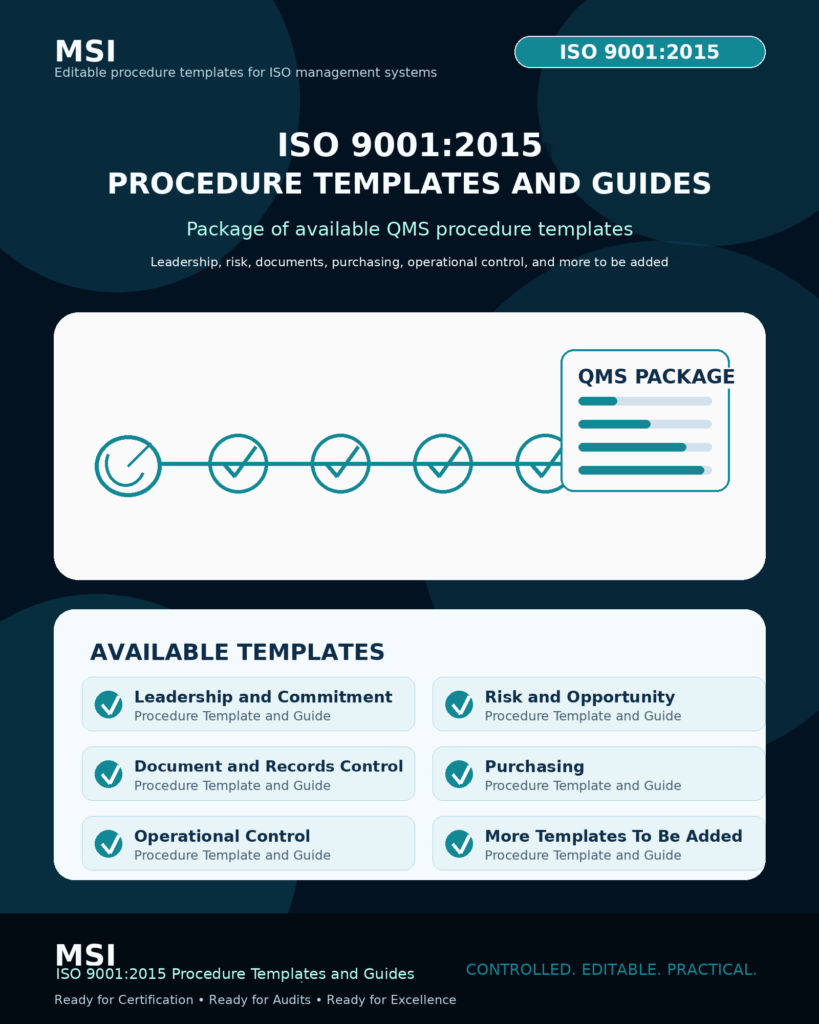
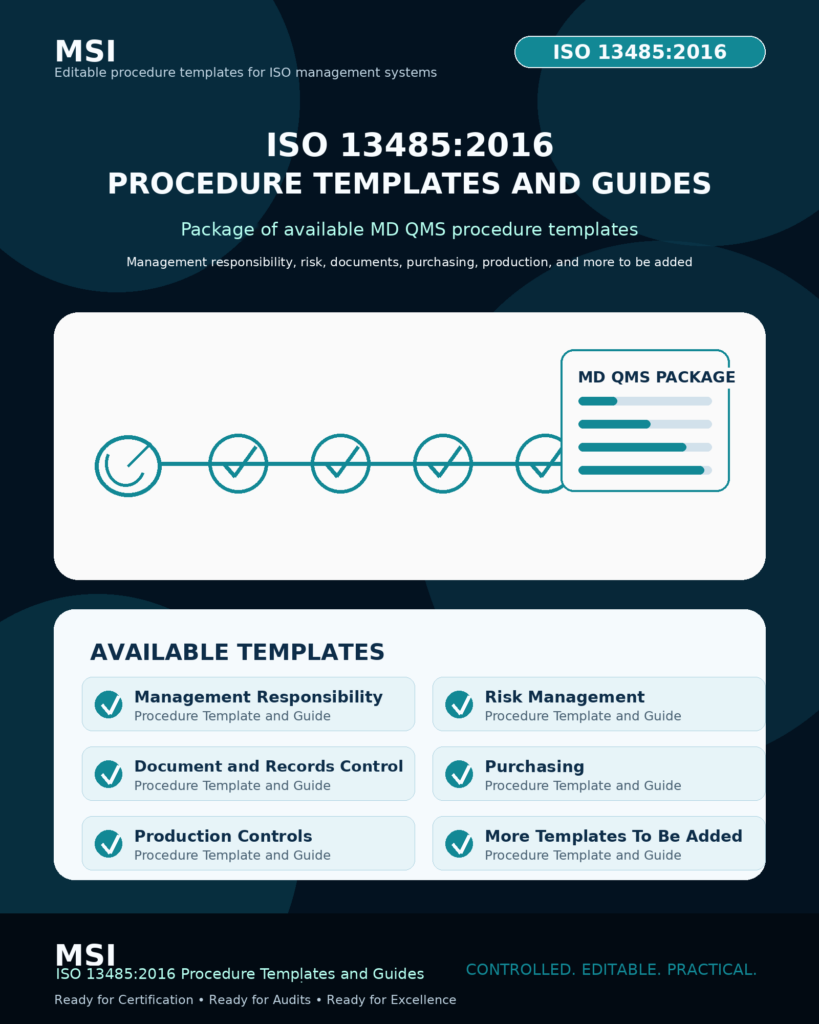
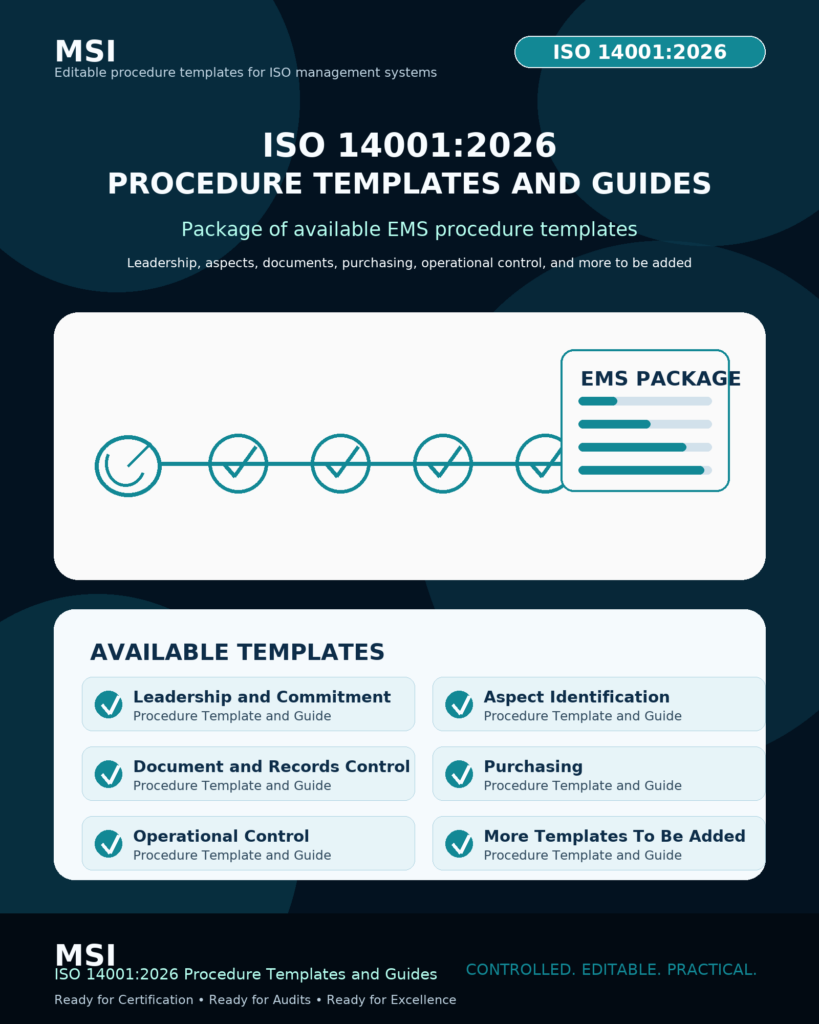
If you are documenting or transitioning an entire management system rather than fixing one process, the packages below give you every procedure for a standard in one purchase — each built to the same sixteen-section architecture so they interlock, at less than buying the pieces individually. The quality packages include the Launch Mastery course; the ISO 14001:2026 package includes the transition course.
Learn about each standard: ISO 9001 · ISO 13485 · ISO 14001 · ISO 45001 · ISO 7101 · Integrated systems
Single-standard systems
Integrated systems — running more than one standard
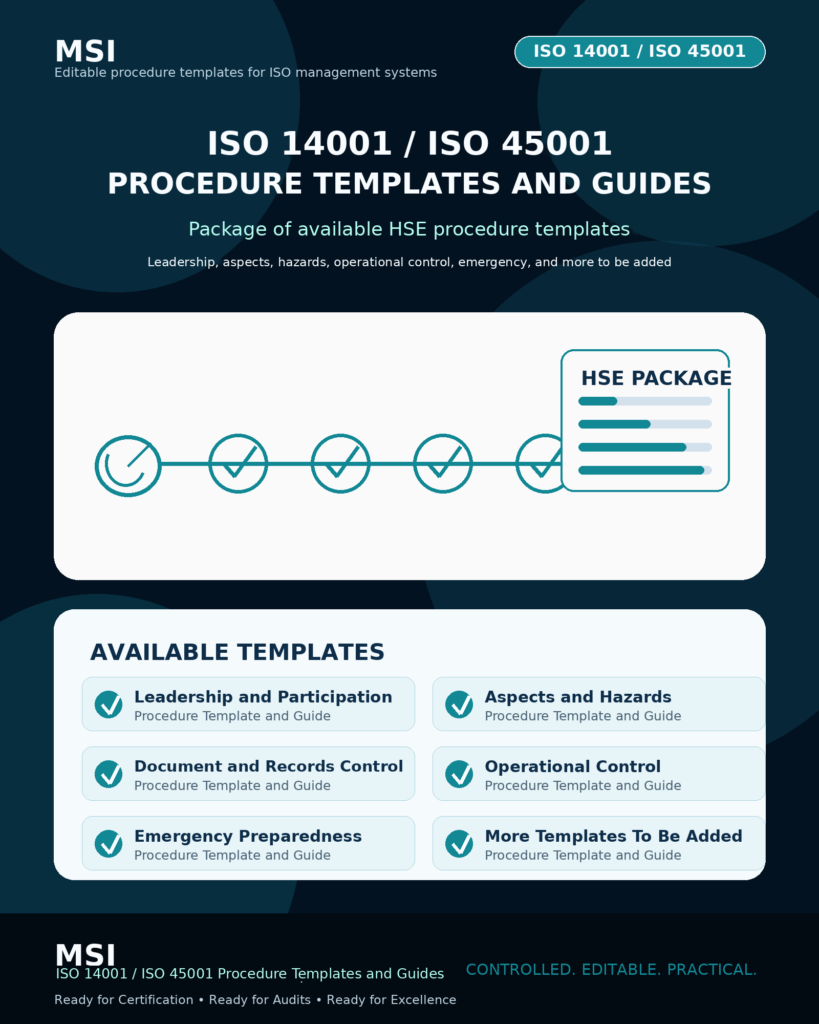
The first ten package buyers get a half day of consulting with Diana, free.
Not a discovery call and not a sales conversation — a working half day. Bring the procedures you have just bought and we will go through your scope, the decisions the templates ask you to make, and the ones your registrar is most likely to test. Twenty-eight years of audit-room experience, applied to your system rather than to a generic one.
It applies to any documentation package on this page, and it is in addition to the 100% credit below — taking the half day does not spend it.
Ten packages only, first come. The session must be scheduled within 30 days of purchase, though it can be held later if that suits your project better. MSI will be in touch after your purchase to arrange it.
Your package is the first phase of your project — so it counts as the first payment.
Buy any documentation package, and if within 30 days you decide you would like MSI working alongside you, 100% of what you paid is credited toward a SurePath implementation, five or more days of ISO consulting or training, Online SureResults, or your first year on the SureResults annual program. The procedures you bought become the backbone of the work — you do not pay twice for the same documents. SureResults can even carry your transition for you, on top of the quarterly internal audits and management reviews it runs year-round.
Not sure a whole set is what you need? Start with a single procedure from the families below, or score your system free first — every package is built from the same procedures, so nothing you buy individually is wasted if you scale up later.
New download · ISO 9001:2026
The Leadership & Commitment QuickStart
Decide. Document. Demonstrate.
A six-page companion to the full procedure. It lists the twenty-five decisions Clause 5 actually requires — across five stages, in the order that lets each one build on the last — and points you to the section of the procedure where each is explained.
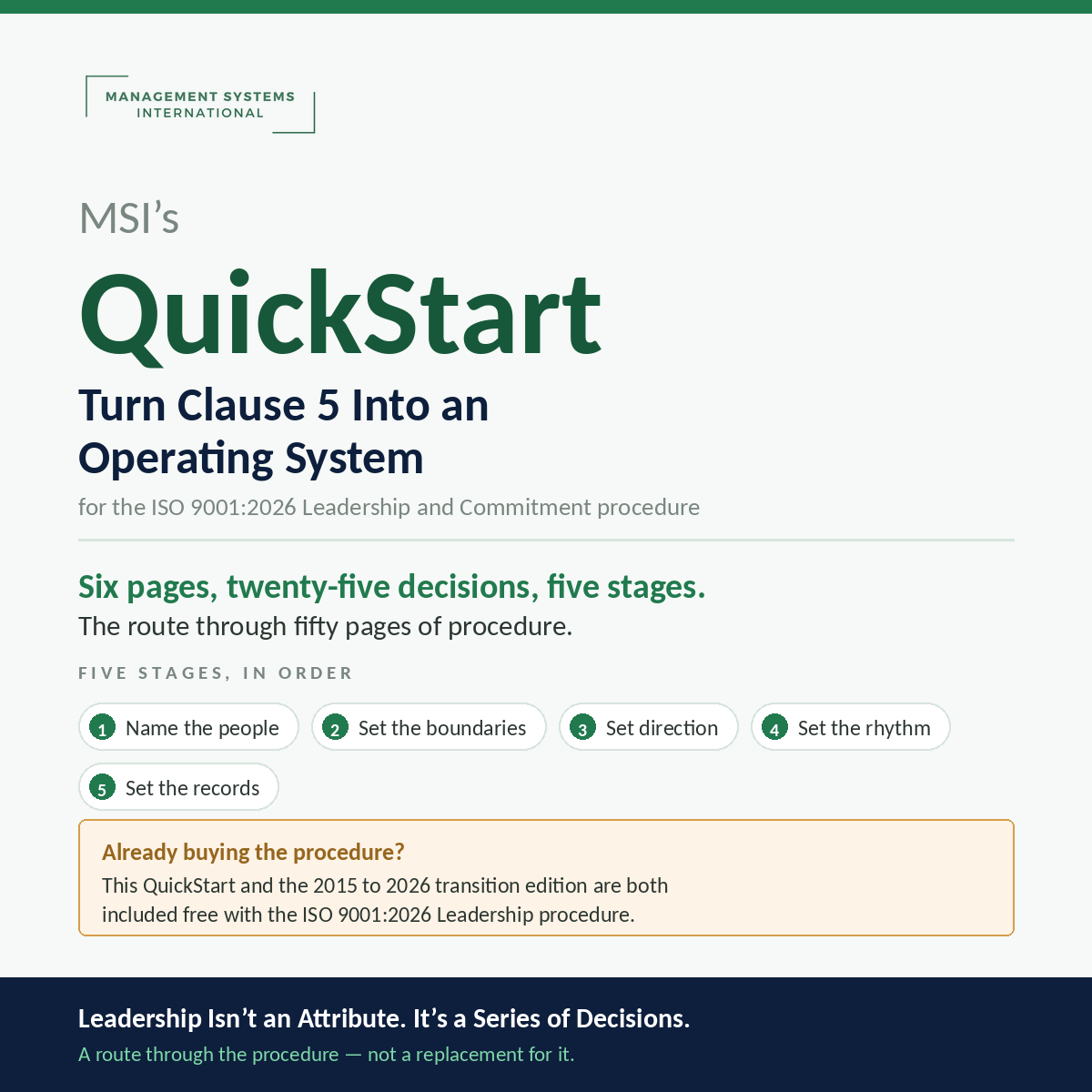
- Twenty-five decisions, five stages — name the people, set the boundaries, set direction, set the operating rhythm, set the records.
- Each decision points to its section in the procedure, so you read the reasoning before you decide.
- What “leadership” means in a standard vs. a boardroom — a six-point comparison of why the clause reads as vague and why it isn’t.
- What changed in the 2026 edition — including the Clause 5.3 “understood” drop that reads as a relaxation and is actually a trap.
Want the document it routes through? The QuickStart is included free with the ISO 9001 Leadership & Commitment Procedure Template & Guide — the filled-in, worked procedure with the MSI notes at every decision. More ISO 9001:2026 QuickStarts are on the way over the coming weeks.
Hear about it first. New QuickStarts, course specials and training dates go to our email list before they’re public — including ISO 9001:2026 releases as each one lands.
Join the email list →Individual Procedures · Available Now
Need an individual procedure rather than the whole set?
Complete. Editable. Bought one at a time.
Every procedure below is sold on its own, written to your standard — buy just the one your system is missing, and it interlocks with the rest if you add more later. Fifteen families, each with a variant for every standard it applies to, plus the integrated combinations.
Search the procedures →Find it fast
Search the ISO procedure template library
Every procedure template and package MSI publishes, in one list. Type what you are looking for, or filter by the standards you actually hold.
Prices shown are current list prices. Packages include every procedure for their standard set.
The Problem
Why most template libraries disappoint
Structure. Silence. Stalemate.
A template library is easy to sell and hard to use — and unless you have spent years in industry, you do not find that out until you are halfway through the documentation project — kit already bought, the easy procedures behind you, and every hard decision still ahead. The documents are structurally complete and substantively empty: a scope statement, a responsibilities table with role names to fill in, a records table with retention periods left as TBD, and a procedure body that restates the clause rather than telling anyone what to do on a Tuesday.
The result is predictable, and MSI has watched it happen inside client systems for nearly three decades. The document passes its first audit because it exists. The generic fields are still sitting there at the third surveillance visit, because nobody knew what to put in them and nothing forced the decision. What the buyer paid for was a shape. What they needed was the judgment.
The hard part of a procedure is not its structure. It is knowing which decisions have to be made, and what a good answer to each one looks like.
What a Template & Guide Does
Written for whichever standard you run
Decide. Document. Demonstrate.
Every MSI procedure is written as a filled-in worked example, then handed to you with the organization-specific values marked. You can see what a finished version looks like before you change a word of it. That holds whatever your industry, whatever your size, and whichever standard you are certified to.
The judgment is already made
Structure is the easy part — any vendor can sell you a shape. The hard part is knowing which decisions the procedure has to force, and what a defensible answer to each one looks like. That is already in the document.
Written to your standard, not adapted to it
Each variant is built to its own standard's clause structure and obligations. Nothing is find-and-replaced from a quality base, which is why the device and environmental variants carry requirements a generic document has no place to put.
The evidence layer is in the price
The record form built to work as the release gate, the log or register, the desk-level work instruction, the worked examples. Not sold separately — a procedure without its records is a document that cannot be audited.
No blanks anywhere
Every record carries a location, an owning role and a retention period. Every criterion that needs a number has one. An undetermined field reads, to anyone examining it, as a decision never made.
The second one costs nothing to learn
Every procedure follows the same sixteen-section architecture. Adopt one and your people already know how to read the next, which is what makes a library compound rather than accumulate.
Annotated from 200+ audits
MSI notes throughout — not a restatement of the requirement, but where this element usually fails, why it fails structurally rather than through carelessness, and what a working version looks like.
That last one is why these are called templates and guides. A template gives you the structure. A guide tells you what to put in it and why. You are buying the annotation as much as the document.
Want to see exactly what’s inside a procedure?
Open the full anatomy of one — every numbered section, the interaction map, the maturity ladder, and a finished worked example you can read before you change a word. It also shows why one purchase covers one standard, and where the standards genuinely differ.
Learn the details →The maturity ladder is the same instrument as the free check
Section 13 rates eight elements across four levels — Documented, Controlled, Measured, Anticipatory — described as observable behavior rather than intention. It is the same ladder the free maturity checks score you against. The check tells you which rung you are on; the procedure contains the rung above it, written out. Conformity is a threshold, not a destination, and the ladder says outright that Controlled is a legitimate place to stop.
Written as a worked example, not a blank
The document is completed throughout for Perennia Corp, a fictional design-and-build firm. That sector was chosen deliberately: it generates the full range of controlled information a management system has to govern — customer specifications it did not write, supplier manuals it cannot revise, design records it must retain, inspection results that evidence release, and procedures that change faster than anyone updates them. You can see a finished version before you change a word of it.
Appendix C is the desk-level instruction for the person who actually does the work, so nobody has to read the procedure to perform the task. Its worked example turns on a point worth the price on its own: the smallest, most routine document in the queue carried the largest regulatory exposure — which is why any control based on apparent significance misses it.
The test applied throughout: could a competent person who has never seen your system create, approve, release, find, change and retire a controlled document using only this procedure? If not, it is a description of document control rather than an instrument that performs it.
Five Standards
One purchase covers one standard — because the requirements genuinely differ
Choose. Download. Adapt.
Choose ISO 9001:2015, ISO 13485:2016, ISO 14001:2026, ISO 45001:2018 or ISO 7101:2023 and you get a variant written to that standard rather than translated into it. The clause numbering differs in every one, and so do the obligations.
- ISO 13485 predates the harmonized ten-clause structure, so its clause numbers do not map across — and it carries requirements with no ISO 9001 counterpart at all, including user training determination and advisory notices.
- ISO 14001:2026 distributes some requirements across clauses rather than giving them a dedicated home, and asks you to address what you influence as well as what you control.
- ISO 45001 adds contractor management and non-managerial worker consultation, which reshape who has to be involved before a decision counts as made.
- ISO 7101 separates clinical from non-clinical supply and expects disqualification criteria set in advance.
- ISO 9001 carries obligations the others do not, notably the contingency requirement that arrived with the 2015 revision and was mapped from nothing.
Where an obligation comes from regulation rather than from the standard, the procedure says so and covers it anyway. A clause checklist will never point you at it.
Who These Are For
Wherever your system is right now
Build. Hold. Extend.
Starting from nothing
Documenting a process for the first time, with or without certification in view. This is the draft you would otherwise spend three weeks writing — every decision already forced, every record already designed, written to the current edition of your standard. You are not learning what a good procedure contains and building one at the same time; you adopt a finished one, change what does not fit your operation, and move to the next process.
Certified and holding
The gaps that survive surveillance year after year are the ones nobody knew how to fill. The maturity ladder in each procedure names them as observable behavior, so you can see which element is actually costing you something.
Consultants and multi-site
The license permits the buying organization to edit, rebrand and adopt the procedure across its own sites and issue it to employees, contractors and auditors — and permits consultants to adapt it for engagements they deliver.
Not sure which procedure is the one that’s failing?
Buying the right template is easy once you know where the work is actually breaking down. Finding that out from inside the organization is the hard part. The Portrait is an independent operational assessment that traces a real work order through every hand and names the exact handoff where the problem was visible and did not move.
If You Are Growing
You cannot scale what only exists in one person's head
Write. Repeat. Delegate.
Growth does not break your process. It reveals that you never wrote one. The person who knows how it works becomes the bottleneck for everything, onboarding takes months because there is nothing to hand a new hire, and two people do the same job differently until a customer tells you.
None of that is a certification problem. It arrives whether or not you ever pursue a standard, and it costs you at exactly the point you are trying to grow.
Onboarding in weeks, not months
A new person follows the procedure instead of shadowing whoever is least busy. The desk-level work instruction exists so they never have to read the procedure to do the job.
You stop being the escalation path
Every decision the process requires is defined, with an owner, a named alternate, and criteria that have numbers in them. "Ask Dave" becomes something a new hire can answer in week two.
The same output on a bad week
Same result whether it is your best people or a Tuesday in August with half the team out. That is what a procedure is actually for, and it is what an outline with blanks in it cannot give you.
Where to start if you are scaling
Start with Sales Management, because it is the one that touches revenue. It is built around the decision most growing companies have never made explicitly: the exact moment you become bound to supply.
While one person sells, that decision lives in their judgment and it is usually sound — they know what the company can actually deliver. Add four more people who can say yes to a customer and it stops being judgment and starts being exposure. The procedure enumerates every channel an order can arrive by, including the verbal commitment at a trade show and the contractor booked over the phone, and it defines light and full review routing so that small orders are not slowed down by the controls that exist for large ones.
It also builds in the question set most teams skip — the requirements a customer has not stated but genuinely needs — turned into questions a reviewer can actually answer before you commit rather than after.
And if you certify later, you are not starting over. These are already written to ISO 9001, ISO 13485, ISO 14001, ISO 45001 and ISO 7101. Pick the standard when you need it rather than before — nothing you write now has to be redone when you do.
Start Free
Find out where you actually stand
Score. Diagnose. Decide.
Each procedure has a maturity check built from it — the same eight elements, scored on coverage and on whether the process works on a busy week. Your score and band appear immediately, without entering anything. There is a genuine Controlled band that tells you to stop, because an assessment that fails everyone is not an assessment.
Fourteen checks covering all fifteen families — service user access is scored inside the customer feedback check, and the healthcare paths sit inside the checks they belong to. If the result is useful on its own, take it and act on it. You do not need to buy anything to do that.
Available Now
Fifteen procedure families
Complete. Editable. Included.
Each is a complete working procedure in editable Word, with every appendix, form and worked example part of the document. Select your standard on the product page.
Buy any ISO 9001 template now, get the ISO 9001:2026 rebuild free. These are built to ISO 9001:2015 — the edition in force and the one your certificate is issued against. When the new edition publishes, expected around September 2026, MSI rebuilds it against the 2026 standard and sends it to you at no charge. Nothing for you to do.
Control of Monitoring & Measuring Equipment
All five standards, plus integrated variants
A complete calibration procedure written as a working document. It carries the calibration record built to function as the release gate, the equipment register column set, and the out-of-tolerance impact assessment almost no procedure has.
Why that last one matters: calibration is rarely cited for a missed due date. It is cited for the register nobody walked and the result nobody assessed — the equipment found out of tolerance, and no record of what was measured with it in the meantime.
Sales Management & Contract Review
ISO 9001 Clause 8.2 · ISO 13485 Clause 7.2
An ISO 9001 sales procedure, with an ISO 13485 variant, covering customer communication, determining requirements, review before commitment, and changes after it. Built around the one decision most procedures never define — the exact moment you become bound to supply.
Appendices: requirements review record, customer communication and complaint log, desk-level contract review work instruction.
ISO 9001 or ISO 13485? Both are variants of the same product — open the template below and select your standard on the product page.
See the template — ISO 9001 or ISO 13485 →
See the integrated ISO 9001 + ISO 13485 version →
Document & Records Control
All five standards
Creation, approval, the release point, distribution, change, retention and withdrawal — including documents of external origin, the category most systems handle by accident.
Appendices: change notice, master documented information register, work instruction with worked example, readiness bridge to the next edition of your standard.
Purchasing & Supplier Control
All five standards
Criticality, evaluation and selection, purchasing information, verification and re-evaluation — rated on effect rather than spend, because the exposure in a cheap item has no relationship to its price.
Appendices: external provider evaluation and control record, approved provider list, desk-level work instruction, outsourced process control record.
All of it is in the price. Every appendix, every worked example and every form is part of the document. Some template vendors sell the record forms separately from the procedure that requires them, so it is worth checking what is included before comparing prices.
Newest Family — Risk, Hazard & Aspect
One requirement. Five standards. Five genuinely different documents.
Identify. Assess. Record.
Every management system standard makes you identify what could go wrong before it does. None of them asks for the same thing, and this is where generic templates fail most visibly — a risk register built for quality has nowhere to put a psychosocial hazard, a life cycle stage, or a clinical incident.
Each of these is written to its own clause, with its own registers, its own criteria and its own outputs. Not one document with the standard's name swapped at the top.
ISO 9001
Risk and Opportunity Management
Clause 6.1
Criteria-setting worksheet, the process interaction map, and the opportunity route almost no register has — because 6.1 asks for both and most systems only ever record the risks.
ISO 13485
Risk Management
Clause 7.1
A risk assessment template and procedure for device product risk across the realization lifecycle, with the criteria anchors and registers written for a regulated product rather than adapted from a quality register.
ISO 14001:2026
Aspect Identification
Clause 6.1
Five registers, life cycle perspective, significance judged against the receptor rather than against volume, and the separate risks and opportunities output the 2026 edition now requires.
ISO 45001
Job Hazard Identification
Clause 6.1.2
The full scope of 6.1.2.1 including psychosocial hazards, the documented methodology 6.1.2.2 requires, worker participation, and the OSHA written certification no ISO clause asks for.
ISO 7101
Risk Management
Clause 6.1.2 e)
Clinical and non-clinical risk in one register, a risk criterion per objective type, and a working instrument for the risk awareness culture measurement the clause requires and almost nobody operationalizes.
Running two standards?
Integrated versions
Both scopes, separate registers
ISO 9001 + 13485 — quality system risk and device product risk in one procedure, two scopes determined, registers kept apart, ten divergences decided and recorded.
ISO 45001 + 14001 — what the work does to people and what it does to the environment, scopes reconciled, twelve divergences decided.
Each integrated version carries an integration decision record. Every point where the two standards diverge is named, the decision is stated, and the reason is recorded — so when an auditor asks why one requirement was followed and not the other, the answer is already written down rather than reconstructed in the room.
Newest Family — Production & Operational Control
Controlling the work itself, in whichever language your standard speaks
Define. Control. Evidence.
Clause 8 is where every standard stops describing intent and starts governing the work. But they do not ask the same question. ISO 9001 and ISO 13485 ask whether the output conforms, and gate it at release. ISO 14001 and ISO 45001 ask whether the process is controlled so that its performance is what you intended — and there is no gate at the end at all.
That is why one operational control procedure cannot serve both. Nothing here is released in an environmental system. Nothing is inspected against an acceptance criterion. The control lives in the operating criteria, and in whether the process actually runs to them.
ISO 9001
Control of Production and Service
Clauses 8.5 and 8.6
Built to carry intellectual service as well as tangible output — the case most production procedures quietly assume away.
ISO 13485
Control of Production and Service
Clauses 7.5 and 8.2.6 · 57 pages
Clause 7.5 is the largest single clause in the standard — eleven subclauses against ISO 9001's six, five with no ISO 9001 counterpart. Carries the labeling and UDI obligations that come from QMSR rather than the standard, and a release section with no override field, because 8.2.6 provides no early-release route.
ISO 14001:2026
Operational Control
Clauses 8.1 and 8.2 · 45 pages
Operating criteria at the center, with a table converting intentions into criteria a person can run to. All four life cycle obligations, the control-or-influence determination, and the waste duty decided at the machine before mixing.
ISO 45001
Operational Control
Clauses 8.1.1 to 8.2 · 50 pages
The hierarchy of controls as a shall, five named levels, with anything resting at administrative or PPE approved with a recorded reason. Adapting work to workers — a lettered obligation in no other standard. And the guarding-to-lockout boundary stated as a criterion, where the injuries concentrate.
ISO 7101:2023
Operational Control
Healthcare quality management
The same operational control architecture written to ISO 7101's own clauses, for healthcare organizations running clinical and non-clinical processes under one system — where the process criteria have to hold for care delivery, not only for product.
Integrated · ISO 9001 + 13485
Control of Production and Service
Quality and medical device in one procedure
Both scopes determined and kept distinct, with the release gate written once and the device obligations that have no quality counterpart carried where they belong.
Integrated · ISO 14001 + 45001
Operational Control
Environmental and safety together
The natural pairing — both are criteria-based with no release gate, so one procedure can carry both provided the aspect and hazard determinations stay separate and the hierarchy of controls is applied where 45001 requires it.
Integrated · ISO 9001 + 14001 + 45001
Operational Control
All three, without collapsing them
The hardest of the set: a conformity gate and two criteria-based systems in one procedure. Release stays where ISO 9001 needs it, operating criteria govern the environmental and safety scopes, and neither is quietly folded into the other.
The most common finding against operational control is not an absent control. It is a control with no criterion behind it — a procedure that says solvent use shall be minimized, a work instruction that says waste shall be segregated appropriately. Each of those is an intention. None can be audited, and none tells the person doing the work what to do differently.
Newest Family — Management Review & Leadership
Management review and leadership — where eight clauses feed one meeting
Govern. Review. Improve.
The management review is the meeting every standard requires and most organizations struggle to prepare. Clause 9.3 lists the inputs it must consider, and every one of them is produced somewhere else in the standard. That is why reviews are hard to prepare and why the record is usually shorter than the clause requires. Each of these procedures assigns every required input a producing role, a frequency, and a place the record lives before the review opens.
And the naming is not cosmetic. ISO 9001 and ISO 45001 call this leadership. ISO 13485 calls it management responsibility and keeps a management representative that ISO 9001 removed in 2015. A procedure adapted from a quality base loses that role — which is exactly how it goes missing.
ISO 9001:2026 · Available now
Leadership and Commitment
Clauses 4.1 to 9.3 · rewritten to the 2026 edition
The whole governance layer, now written to ISO 9001:2026 — the twelve leadership obligations at 5.1.1, including the new quality-culture and ethical-behavior duty; records as available rather than retained; and the seven-part planning of changes. Every purchase includes the 2015-to-2026 transition edition and the implementation QuickStart, both free.
ISO 13485
Management Responsibility
Clause 5, all twelve inputs · 32 pages
Not leadership — ISO 13485 predates the harmonized structure. Twelve review inputs rather than ten, including the two regulatory ones most reviews miss: reporting to regulatory authorities, and monitoring new or revised requirements. Carries the management representative role ISO 9001 dropped, and maps obligations across 21 CFR Part 820.
ISO 14001:2026
Leadership
Environmental governance
Leadership and management review written to the 2026 edition, with the environmental policy commitments and the review inputs specific to an environmental management system.
ISO 45001
Leadership
Clause 5, worker participation
Leadership carrying the obligation no other standard has: non-managerial worker consultation and participation, which cannot be satisfied from a back office. Written so the participation requirement lands in the procedure rather than as an afterthought.
ISO 7101
Management Review
Healthcare governance
The governance layer written to ISO 7101's own clauses, for healthcare organizations governing clinical and non-clinical quality under one leadership system.
Running more than one?
Integrated versions
One governance layer, each scope kept whole
ISO 9001 + 13485 — leadership and management responsibility in one procedure, the management representative preserved, device inputs marked.
ISO 14001 + 45001 — environmental and safety leadership together, worker participation carried.
ISO 9001 + 14001 + 45001 — one management review governing quality, environment and safety without collapsing three input sets into one.
ISO 9001 + 13485 →
ISO 14001 + 45001 →
ISO 9001 + 14001 + 45001 →
Eight clauses feed one meeting. The reason a management review is hard to prepare is that its ten required inputs are each produced elsewhere — audit results, customer feedback, process performance, corrective action status, and the rest. Name the producing role and the source record for each, and the review stops being a deck assembled the week before.
Newest Family — Design & Development
The clause most organizations postpone — written to a finish
Plan. Verify. Transfer.
Design and development is the clause people put off, because the procedure has to describe work that is genuinely different every time. It is also where the standards diverge most: ISO 9001's single controls clause fans out into ten sub-clauses in ISO 13485, and ISO 7101 calls it service design and puts thirteen considerations in one clause. Each of these is written to its own structure, not renumbered from a quality base.
If you would rather be walked through building one, the Design & Development video course teaches the method and produces the procedure. These templates are the finished document.
ISO 9001
Design and Development
Clause 8.3, all six sub-clauses · 46 pages
Built around the requirement most output packages miss: 8.3.5(c) says outputs shall include acceptance criteria, yet those get reconstructed downstream weeks after the designer moved on. This asks the verification question at input capture, so criteria land on outputs and Clause 8.6 release has something authoritative to check against.
ISO 13485
Design and Development
Clause 7.3, all ten sub-clauses · 49 pages
This is where the two standards differ most. Design transfer (7.3.8) and the design and development file (7.3.10) have no ISO 9001 counterpart, so a converted procedure simply lacks them. Carries the sample-size rationale the clause asks for, and the FDA cybersecurity obligations no clause points at — now a regulatory document under QMSR since 2 February 2026.
ISO 7101
Service Design
Clause 8.7, all thirteen considerations · 50 pages
Healthcare's version, and it carries what the others cannot: engaging service users while options are still open, workforce wellbeing as a design input, and the point at which a pilot becomes permanent by decision rather than by drift. Includes Clause 8.6 — five confirmations top management makes before AI informs a clinical decision.
Integrated · ISO 9001 + 13485
Design and Development
Clause 8.3 and 7.3 in one document · 56 pages
For one engineering function designing both general product and devices. Scope is assigned at initiation — uncertain runs as device until Regulatory says otherwise, because the two errors are not symmetrical. Appendix D is eighteen rows of genuine divergence, each with the decision taken and the alternative, so the merge is deliberate rather than accidental.
Told Clause 8.3 does not apply to you? It is the single most commonly outdated statement in a quality manual. A customer-specific variant, a configured product, a service offering or a software tool sold to customers all bring it back — if any part of what you supply is specified by you rather than handed to you, design and development applies. The free maturity check will tell you where you actually stand.
Newest Family — Compliance Obligations
The register that proves you are meeting the law — not just conforming to the standard
Determine. Evaluate. Evidence.
Certification and legal compliance are assessed by different bodies, against different criteria, on different cycles. An organization that treats them as the same thing has one assurance and believes it has two. These procedures build the register, the evaluation record and the compliance status that let you demonstrate the second — each written to how its standard actually treats compliance, which is not the same in any two of them.
ISO 14001:2026
Compliance Obligations
Clauses 6.1.3 and 9.1.2
One register that separates the legal duties you must meet from the other requirements you have chosen to adopt, a severity model that routes a finding to the right response, and an effectiveness check with a defined interval rather than an annual habit.
ISO 45001:2018
Legal Requirements & Evaluation of Compliance
Clauses 6.1.3 and 9.1.2
The safety register, carrying the worker-participation obligation that reshapes who has to be involved in an evaluation, and the same severity model and defensible frequency — so a compliance finding lands on a named owner with a record, not in a spreadsheet nobody reopens.
ISO 7101:2023
Evaluation of Compliance
No compliance clause — ten clauses that impose one
ISO 7101 has no compliance obligations clause and no evaluation clause, yet ten separate clauses impose a statutory duty, and 5.1 q) makes top management responsible for producing evidence the standard never says how to produce. Healthcare is the most regulated sector any standard is applied to; a 7101-certified organization with no register is conforming and exposed at the same time. This is the register, and the section that answers the surveyor's clause question.
Integrated · ISO 14001 + 45001
HSE Compliance Obligations
One register, both scopes
For organizations running environment and occupational health & safety together: one register with a scope field rather than two that drift apart, the hierarchy of controls applied to both, environment-only and safety-only content marked, and every divergence recorded.
Why not ISO 9001 or ISO 13485? Because neither carries a compliance obligations clause — ISO 9001 asks you to determine applicable statutory and regulatory requirements for your product, not to maintain a compliance register. This family is written for the three standards that genuinely require one: environment, safety, and healthcare quality.
Newest Family — Human Resource Management
Competence, training and awareness — the clause auditors reach for first
Determine. Develop. Evidence.
Competence is the most-audited clause in any management system, because it is where a paper system and a real one diverge fastest — the training matrix that has not been updated since two people left, the induction that happens verbally, the "competent by experience" with nothing recorded behind it. Each of these procedures builds the determination, the record and the awareness evidence to the standard that actually governs your people, and the standards do not ask for the same thing.
ISO 9001
Human Resource Management
Clauses 7.2 and 7.3
Competence and awareness — plus the four competence requirements ISO 9001 places outside Clause 7.2, which almost no competence procedure covers because you have to read the whole standard to find them.
ISO 13485
Human Resource Management
Clause 6.2
The documented process the clause demands, with the evaluation method set by risk, competence recorded against four bases rather than one, and the personnel qualification that process validation quietly depends on — the link an auditor follows straight from a validation record back to a training file.
ISO 14001:2026
Human Resource Management
Clauses 7.2 and 7.3
Built so the aspect register is the actual input to the competence determination — the requirement at Clause 7.2 c) that most systems never implement, because they treat environmental competence as a training list rather than as something the significant aspects define.
ISO 45001
Human Resource Management
Clauses 7.2 and 7.3
Competence driven by the hazard and risk determination rather than a generic matrix, so the people doing the most dangerous work are demonstrably the most competent to do it — and the awareness obligation covers the incident-reporting and stop-work rights 45001 requires every worker to hold.
ISO 7101:2023
Human Resource Management
Clause 7.2, plus ten further clauses
Healthcare's version, and the broadest: recruitment, orientation, credentialing and privileging, ongoing education, documented performance evaluation and consent training — together with the workforce numbers and named training topics ISO 7101 scatters across ten further clauses that a Clause 7.2 reading alone would miss.
Integrated · ISO 9001 + 13485
Human Resource Management
One procedure, twelve divergences
Competence, qualification and awareness for both standards in one document — with twelve genuine divergences identified, and the counter-intuitive finding stated plainly: four of them exist only in ISO 9001, not in the device standard, which is not what most people expect.
Integrated · ISO 14001 + 45001
Human Resource Management
Environment and safety, one determination
One competence determination serving both the aspect register and the hazard register, environment-only and safety-only content marked, and every divergence recorded — so a single training file answers to both systems instead of two that disagree about the same person.
Integrated · ISO 9001 + 14001 + 45001
Human Resource Management
All three, one determination across three registers
The full QHSE competence procedure: sixteen genuine divergences identified, the stricter requirement taken in each case, and the reasoning recorded at Appendix E — one determination run across the quality, aspect and hazard registers rather than three that quietly contradict each other.
"Competent by experience" is not a record. The most common competence finding is not an untrained person — it is a competent one with nothing on file proving it, evaluated against no stated criteria, by no named assessor, on no date. Each of these procedures makes competence a decision with a basis and a record behind it, which is the difference between passing the audit and passing it every time.
Newest Family — Internal Audit
The program that runs on time but stopped being the right program
Plan. Audit. Verify.
Most internal audit programs run on schedule and have not changed since certification — which is itself the finding. Clause 9.2.2 a) requires the program to consider process importance, changes in the organization, and previous results; a schedule that has not moved in four years is evidence on its face that none of the three was considered. Management review examines audit results, but nothing routinely examines the audit plan, so the plan persists unchallenged.
Each of these procedures turns those inputs into triggers that reopen the program, and each is written to how its standard actually treats the audit — which, across these five, is not the same clause, the same criteria, or the same records. All are structured to the ISO 19011:2026 clause architecture.
ISO 9001
Internal Audit
Clause 9.2 · 33 pages
The audit program built as a controlled document with defined re-planning triggers rather than a rolling calendar, correction separated from corrective action, and the climate amendment (Amd 1:2024) as a legitimate line of inquiry most plans do not list.
ISO 13485
Internal Audit
Clause 8.2.4 · 36 pages
The only standard in the family that mandates a documented audit procedure by name — so the document is itself an inspectable artifact, and since 2 February 2026 the FDA exemption that shielded audit reports is gone. Carries the verification-reporting step almost every device system omits, and the auditors-shall-not-audit-their-own-work rule as a declaration. Includes an audit plan template (Appendix A) and audit program register.
ISO 14001:2026
Internal Audit
Clause 9.2
Written to the 2026 edition, auditing against the compliance obligations and the life-cycle scope the environmental standard adds — not a quality audit with an environmental label, but an audit that tests whether the operating criteria actually hold.
ISO 45001
Internal Audit
Clause 9.2
The safety audit, carrying the worker-participation obligation into the audit program itself, and testing the hierarchy of controls and the legal-compliance evaluation rather than treating the audit as a documentation review.
ISO 7101
Internal Audit
Healthcare quality
The audit written to ISO 7101’s own structure, for healthcare organizations auditing clinical and non-clinical processes under one program — where the statutory duties the standard scatters across its clauses become part of what the audit tests.
Integrated · Device (9001 + 13485)
Internal Audit
Clause 9.2 and 8.2.4 resolved
One audit program for an organization holding both, with the divergences between Clause 9.2 and Clause 8.2.4 resolved explicitly — the documented-procedure mandate, the independence rule, and the verification-reporting step all carried, every decision recorded at Appendix D.
Integrated · HSE (14001 + 45001)
Internal Audit
Environment and safety, one program
One audit program covering environmental and occupational health & safety, so a single audit tests both the aspect controls and the hazard controls without auditing the same operation twice against two disagreeing plans.
Integrated · IMS (9001 + 14001 + 45001)
Internal Audit
One integrated management system audit
The full IMS audit — quality, environment and safety audited as one management system rather than three, with the criteria for each standard kept distinct so nothing is passed on one scope by being tested on another.
A schedule is not a program. The most common internal-audit finding is not a missed audit — it is a program that runs perfectly and hasn’t been re-thought since certification, auditing low-risk and high-risk processes on the same annual slot with the same checklist. Each of these makes the three Clause 9.2.2 a) inputs into conditions that reopen the plan, so the program stays current between management reviews instead of persisting by inertia.
Newest Family — Nonconformity & Corrective Action
The corrective action procedure that removes the root cause, not just the finding
Contain. Correct. Confirm.
Most corrective action procedures pass their audit. The harder question is whether anything in them has ever removed a root cause. The usual pattern is a log that closes actions on time, effectiveness checks with no defined interval, and the same nonconformity reappearing under a new number.
Each of these corrective action procedure templates uses one register, a severity model that routes each issue to the right response, and an effectiveness check with a set interval. Each is written to how its own standard treats nonconformity, which is not the same in any two of them.
ISO 9001
Nonconformity and Corrective Action
Clause 8.7 and all of Clause 10 · 37 pages
Covers control of nonconforming outputs and the whole improvement clause in one working document, built so a closed action can be traced to a root cause that was actually removed.
ISO 13485
Nonconformity, Corrective and Preventive Action
Clauses 8.3 and 8.5 · 42 pages
Covers product found before and after delivery, rework, concessions, advisory notices, the regulatory-impact check, and preventive action as a live requirement rather than a leftover heading.
ISO 14001:2026
Nonconformity, Corrective Action and Continual Improvement
Written to the 2026 edition
Uses the same register, severity model and effectiveness interval, applied to environmental nonconformities and compliance failures.
ISO 45001
Incident, Nonconformity and Corrective Action
Clause 10.2 · 40 pages
Treats incidents and nonconformities together, as the standard does. Worker participation and the hierarchy of controls are built into the investigation, not added afterward.
ISO 7101
Nonconformity and Corrective Action
Healthcare quality · 38 pages
Brings all nine nonconformity sources the standard requires into one register, so clinical and non-clinical findings are handled the same way.
Integrated · Device (9001 + 13485)
Nonconformity, Corrective Action and Continual Improvement
Clause 10 and 8.5 together · 48 pages
One register for an organization supplying both general product and medical devices, with the device-only obligations kept where they belong.
Integrated · Q/EMS (9001 + 14001)
Nonconformity, Corrective Action and Continual Improvement
Both Clause 10s in one document · 45 pages
Quality and environmental nonconformities in one register, routed by the same severity model.
Integrated · HSE (14001 + 45001)
Incident, Nonconformity and Corrective Action
Environment and safety together · 47 pages
Environmental nonconformities and safety incidents in one register, with worker participation carried where ISO 45001 requires it.
Integrated · IMS (9001 + 14001 + 45001)
Nonconformity, Corrective Action and Continual Improvement
All three standards · 51 pages
Quality, environment and safety in one corrective action system, without collapsing three sets of requirements into one.
Each integrated version includes an integration decision record that states where the standards differ and what was decided. Not sure where your process stands? The free Nonconformity & Corrective Action maturity check scores it in about 6 minutes.
Newest Family — Customer Feedback & Complaint Handling
What your satisfaction score is actually a score of
Listen. Determine. Respond.
Every standard in this family asks you to gather how the customer or service user perceives what you delivered — and every one asks a different question behind that. ISO 9001 wants perception against a comparison basis it never names. ISO 13485 does not ask for satisfaction at all; it asks whether complaint information feeds risk management, and since 2 February 2026 it asks it as federal regulation. ISO 7101 asks whether every group was equitably included, which an aggregate score cannot answer. A single procedure adapted across them gets at most one of these right.
Each of these is written to its own clause and its own hard question, with the comparison basis, the response population, or the reportability clock made explicit rather than assumed.
ISO 9001
Customer Satisfaction & Feedback
Clauses 9.1.2 and 9.1.3 · 32 pages
Clause 9.1.2 asks for perception relative to something, and never says what — so most scores move for reasons nobody can name. This forces the comparison basis and the response population into writing before a method is chosen, and treats warranty, returns and on-time data as evidence of perception rather than a substitute for asking. Complaints, comments, compliments and surveys through one process, because a customer does not categorize before speaking.
ISO 13485
Customer Feedback & Complaint Handling
Clauses 8.2.1–8.2.3 · 41 pages
13485 does not require satisfaction measurement — it requires feedback to feed risk management, the most commonly missing link in a device system. Built to 21 CFR Part 820 as amended 2 February 2026: the seven 820.35(a) record fields, reportability placed before investigation because Part 803 clocks run from awareness, and a dated comparison of complaint rates against the ISO 14971 occurrence estimates.
ISO 7101
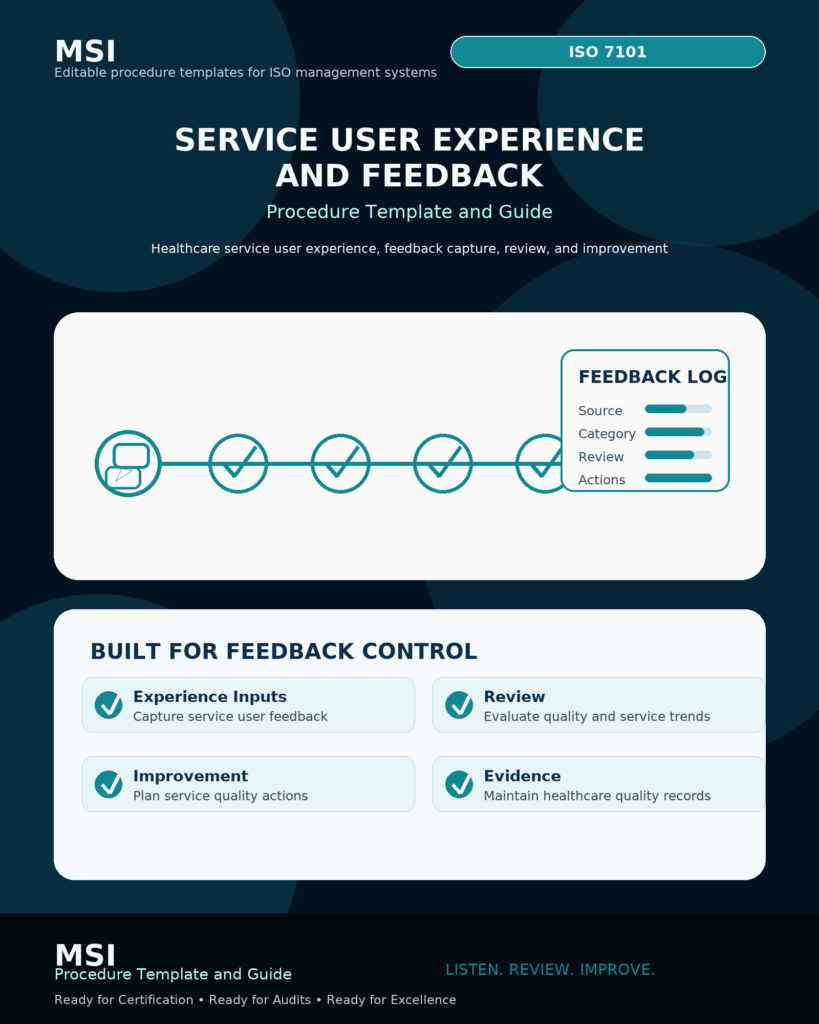
Service User Experience & Feedback
Clauses 8.10.2 and 7.4.2 · 40 pages
Clause 8.10.2.1 a) requires a representative sample with all groups equitably included — the phrase almost nobody implements, because every cheap survey route selects. An aggregate score inverts an equality question: if the people saying no are concentrated in one group, a high overall number hides the exact finding the clause exists to surface. This sets a response floor per group against population share, and makes disaggregation a step, not good practice.
Integrated · Device (9001 + 13485)
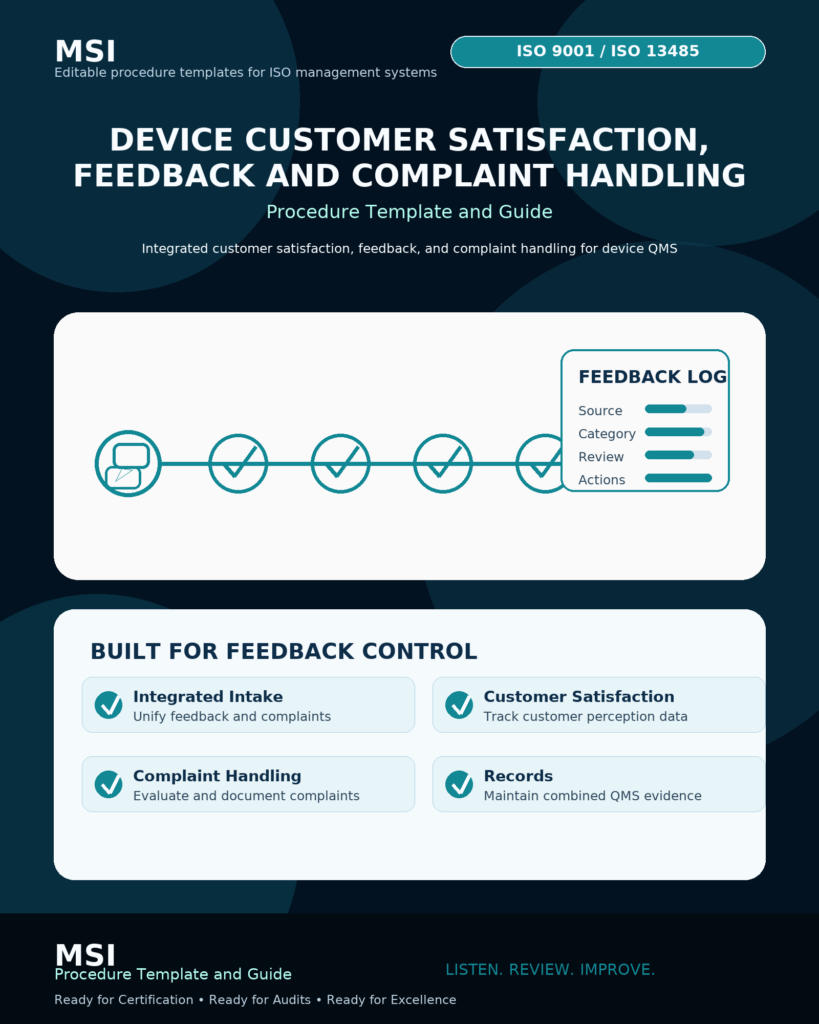
Customer Feedback & Complaint Handling
Quality perception and device reportability in one
For an organization holding both: the ISO 9001 satisfaction question and the ISO 13485 regulatory complaint obligations in one procedure, with the two kept from collapsing into each other — the survey-and-comparison-basis work where 9001 needs it, the 820.35(a) fields, reportability clock and risk link where the device standard demands them, every divergence recorded.
A high score from the wrong sample is worse than no score. It reports as success the exact failure each of these standards is built to surface — the lost account that never complained, the device signal that never reached the risk file, the group whose experience the survey never reached. Each procedure makes the sample, the basis and the routing explicit, so the number means what the clause intended it to mean.
Section By Section
What is already written for you
Complete. Consistent. Cross-referenced.
Every procedure follows the same sixteen-section architecture, so once you have adopted one the next needs no re-learning.
The procedure itself
- Purpose, scope, and a trigger listing every channel work can arrive by
- References naming the operative clauses, not just the leadership clause
- Definitions, so two people reading it reach the same conclusion
- Responsibilities: one accountable owner, contributors, and a named alternate for every gating role
- The procedure body, step by step, with the decision points defined explicitly
- Resolution of differences — named routes, each with an owner and a record
- Exception and contingency paths, bounded, authorized and logged
- Changes after the commitment or release point
The parts that prove it works
- A records table with a location, owning role and retention period for every record — no blanks
- Risks specific to the process, with the control that addresses each one
- Key performance indicators with a target, a method, an owner and a reporting route
- Training and competence requirements for the roles that gate the process
- Review triggers that are event-based, with the calendar as a backstop only
- A maturity ladder: eight elements, four levels each, described as observable behavior
- A clause cross-reference mapping every obligation to where this procedure satisfies it
- A process interaction map showing inputs, outputs, governing and supporting processes
The working documents
- A record form built to function as the release gate, not a report filed afterwards
- A log or register, ready to use
- A desk-level work instruction for the person actually doing the work
- Worked examples, including a case where the smallest item carried the largest exposure
- A fourth appendix specific to your standard, where one is needed
- Document control block and revision history for your own system
- MSI notes throughout — the pattern observed in practice, not a restatement of the clause
- License, disclaimer, and a template revision record so you know which edition you hold
The Library
A growing library, organized by topic
Published. Guided. Growing.
Each topic ships as a complete procedure for every standard it applies to, plus the integrated versions for organizations running more than one — so a single topic is already several documents. New topics are added in the order our clients actually need them, not in clause order: design and development, corrective action, internal audit, management review, nonconforming output, complaint handling, competence, risk, calibration, production control, traceability, and the rest. Each gets the same treatment — a free maturity check, a free framework, and a complete procedure with the judgment written in.
That is the argument for starting now rather than waiting. Every procedure is built to the same sixteen-section architecture, so adopting one teaches your people how to read every one that follows. The interfaces between them are named on both sides, which means the library compounds instead of accumulating. Buying the third procedure costs you a fraction of the effort the first one did.
Purchasers also receive the updated template at no charge whenever the standard it is built to is revised.
Another Route to the Same Document
These courses build the procedures with you
Learn. Draft. Adopt.
A template hands you the finished document. A course walks you through producing it — the better route when you are writing several related procedures at once, or when the people who will run the process need to understand why it is built the way it is. These three do not just teach the clause; each one ends with real documentation in your hands. The maturity check and the framework behind each topic apply here too, so you can start free either way.
Catch. Correct. Continually Improve.
Four procedures from one course
The ISO 9001 corrective action and nonconformity course. It takes you through building four connected procedures rather than one:
- Risk management — Clause 6.1
- Nonconformity — Clauses 8.7 and 10.2
- Corrective action — Clause 10.2
- Continual improvement — Clause 10.3
These four are the ones most often written in isolation and then found, at the third surveillance visit, not to talk to each other. Building them together is what stops findings recurring.
You finish with: four connected, adopted procedures.
Design & Development Video Series
The complete design and development procedure
Starts with an assessment, then design branding, the ISO 9001 requirements, design planning, risk and opportunities management, phases, and design reviews — closing with detailed questions to compare against your current process or to build the procedure from it.
Design and development is the clause most organizations postpone, because the procedure has to describe work that is genuinely different every time. This walks you to a finished one.
You finish with: a complete design and development procedure.
QMS Interviews
The majority of your QMS documentation
Documented processes are the foundation of an ISO 9001 system, and most of them cannot be written without asking the people who do the work. This course walks you through the majority of your QMS documentation using targeted question sets and structured worksheets.
It covers procedural development end to end — from securing executive buy-in through involving key managers across every major department.
You finish with: the majority of your QMS documentation, drafted.
Beyond these three, MSI's catalog covers awareness training, standard overviews, launch programs, internal auditing and workshops across all five standards. Organizations training more than a handful of people usually find the annual seat-based license the better route.
Browse all courses →
LearningPaths™ Corporate Training License →
Who Writes These
The documents MSI writes on engagements
Practiced. Proven. Published.
Diana Lynn is the President at Management Systems International, a consulting firm she founded in 1998. Across 28 years MSI's track record includes 80+ guiding companies to certification and through implementations, 200+ audits attended, and 600+ professionals trained across manufacturing, technology, medical device, government, healthcare and other regulated industries. Today MSI implements ISO 9001, ISO 13485, ISO 14001 and ISO 45001, with an expanding focus on ISO 7101 healthcare quality. MSI is veteran-owned and female-owned.
These are not documents written to be sold. They are the documents MSI writes on engagements, de-identified, generalized and annotated so that an organization can use them without us.
However You Move Forward
We are here to help — whether or not you ever buy anything
If a template is not what you need, say so and we will tell you honestly.
- Call 760-434-9141 and ask for Diana. A conversation about where your procedures actually stand costs nothing and carries no obligation.
- Watch the ISO Executive Decision Briefs — leadership-level videos on what a management system is supposed to produce. Free, no form.
- Ask about a planning session if you want structured help mapping your own procedures, or SurePath if you are building a system from the ground up.
And if you would rather build it yourself, do that. We would rather you end up with a procedure that works than a purchase you did not need.
Questions
Common questions
Ask. Answer. Apply.
What is the difference between a template and a template and guide?
A template gives you the structure. A guide tells you what to put in it and why. Every MSI procedure carries notes throughout that describe the pattern observed in practice rather than restating the requirement — where an element usually fails, why it fails structurally rather than through carelessness, and what a working version looks like. It also carries a maturity ladder describing four levels of each element as observable behavior, so you can see where you are before you decide how far to go.
Do these work for my industry?
Yes. The procedures are written to the standard, not to a sector, and the standards themselves are sector-neutral. Where a sector obligation does exist — medical device regulation, healthcare supply, contractor safety — it is carried in the variant for that standard. MSI has supported organizations across manufacturing, technology, medical device, government, healthcare and other regulated industries, and the same architecture has held across all of them.
Do I need to buy a separate template for each standard?
Usually yes, but not always. One purchase covers one standard, because the requirements genuinely differ — ISO 13485 predates the harmonized clause structure and carries obligations with no ISO 9001 equivalent, and ISO 14001 distributes some requirements rather than giving them a dedicated clause. Most families offer integrated versions covering ISO 9001 with 13485, ISO 14001 with 45001, ISO 9001 with 14001, and all three of quality, environment and safety. Each one carries an integration decision record naming every point where the standards diverge, the decision taken, and why. Use the search above to see every version of a procedure at once before buying two separately.
Are the appendices included?
Yes, all of them. The record form built to work as the release gate, the log, the desk-level work instruction and the worked examples are part of the document, not sold separately. Some template vendors price appendices as separate purchases, so it is worth checking before you compare prices.
Can a consultant use these with clients?
Yes. The license allows the buying organization to edit, rebrand and adopt the procedure across its own sites and issue it to its own employees, contractors and auditors, and allows consultants to adapt it for engagements they deliver. It may not be resold or redistributed as a template.
What happens when a standard is revised?
Purchasers receive the updated template at no charge when it publishes. Each document states on its cover which template version you hold and which edition of the standard it was built to, so you always know where you stand. This matters right now for ISO 9001: the new edition is expected around September 2026, and every ISO 9001 template you buy today is rebuilt to ISO 9001:2026 and sent to you free when it publishes. The ISO 14001 variant is already written to the 2026 edition.
Do I have to buy anything to get value from the maturity checks?
No. The score, the band and the band guidance are shown immediately without entering anything, and the checks include a genuine Controlled band that tells you a well-implemented certified system is a legitimate place to rest. If the result is useful on its own, take it and act on it. The element-by-element breakdown and priority order open after you enter your details, and a scoring worksheet is emailed to you.
Start Here
Find out where you stand first.
The checks are free, take about five minutes, and give you a straight answer about your own process whether or not you ever buy anything from us.
Or call 760-434-9141 and ask for Diana. No obligation attached.