Metacognition training is reshaping how organizations turn new procedures into lasting workplace habits — and the science proves exactly why outdated methods fall short.
Workplace Learning Science
Metacognition Training: Why It Wins Where Lectures Fail
Plan. Monitor. Master.
Most companies still rely on training methodologies designed in the 1950s — passive lectures, one-time slide decks, and click-through e-learning modules that employees forget before their morning coffee gets cold. The result is predictable: new hires stumble through their first 90 days, procedure rollouts never take hold, and compliance training becomes a checkbox exercise instead of a competency-building one.
There is a better way — and ISO 9001, ISO 13485, ISO 14001, ISO 45001, and ISO 7101 all quietly require it. Every major management system standard demands that organizations evaluate the effectiveness of training actions, not just document that training happened. The methodology that makes effectiveness possible is grounded in five decades of cognitive science research, validated by neuroscience, and used by the companies whose procedures actually work in practice — not just on paper. It is called metacognition, and it is the missing layer in nearly every corporate training program operating today.
The Foundation
What Is Metacognition and Why Does It Matter for Employee Training?
Think. Learn. Master.
Direct Answer
Metacognition is the awareness and regulation of one’s own learning. In employee training, it means giving workers the tools to actively monitor what they understand, identify what they don’t, and adjust their approach until new concepts become automatic. It is the difference between training that fades within a week and training that becomes second nature.
The term was introduced by developmental psychologist John Flavell in 1979 to describe the human capacity to think about thinking. Decades of research since then have confirmed four phases that turn passive learners into independent problem-solvers:
- Priming — activating prior knowledge before new content arrives, connecting upcoming material to existing mental frameworks, and creating the cognitive hooks where retention will attach. Without priming, new content has no place to land.
- Planning — deciding what needs to be learned, what is already known, and how to approach the material.
- Monitoring — tracking comprehension in real time, noticing confusion, and flagging gaps before they harden into mistakes.
- Evaluating — reflecting on performance after applying the new skill and adjusting future practice based on what worked.
When training programs activate all four phases, employees stop being passive consumers of content and start becoming active operators of their own learning. That shift is what turns a procedure document into a workplace habit.
The Analogy
What Does Metacognition Look Like in Real Life? The Piano Lesson
Listen. Diagnose. Adjust.
Metacognition can sound abstract. The fastest way to ground it is to think about how a person learns to play a musical instrument — say, the piano.
Imagine two students taking their first piano lesson on the same day. Both want to learn the same Chopin nocturne. Both have the same teacher and put in the same number of practice hours each week. Six months later, one is playing the piece confidently. The other is still struggling through the first page. What was different?
The faster learner used metacognition. Before each practice session, she primed by listening to a professional recording — getting the music into her ear before her fingers touched the keys, connecting the upcoming work to what she already knew about Chopin’s style. Then she planned: Which measures gave me trouble yesterday? What am I going to focus on today? During practice, she paused frequently — Was that note right? Why did my left hand stumble there? — and isolated the trouble spots instead of restarting the piece from the beginning every time. After each session, she evaluated what improved and what still needed work. She was thinking about her own thinking.
The slower learner played the piece from start to finish, over and over, hoping repetition alone would solve the problem. He did not pause to diagnose what was breaking down. He practiced the mistakes at the same volume as the correct notes, and after six months those mistakes were habits. Habits are far harder to unlearn than to learn correctly the first time.
Practice does not make perfect. Practice makes permanent. Only metacognitive practice makes correct.
Decades of research on expert skill acquisition — from Anders Ericsson’s work on deliberate practice to studies of elite musicians, surgeons, and athletes — converge on the same finding: the people who reach high skill levels fastest are not the ones who put in more hours. They are the ones whose practice is structured around continuous self-diagnosis. They stop. They listen. They identify what is wrong. They isolate it, fix it, and only then move on. Sheer repetition without metacognition produces a plateau. Metacognitive practice produces growth.
Every employee learning a new workplace procedure is the same person at the piano. Without metacognition, they repeat the procedure mechanically — practicing the right moves and the wrong ones at equal volume — until the wrong moves become permanent. With metacognition, they pause, diagnose, isolate, and rebuild. The science of skill acquisition does not care whether the skill is a Chopin nocturne or a corrective action workflow. The brain does not know the difference. It only knows whether the learner stopped to think.
The Problem
Why Are Traditional Training Methodologies Failing Modern Workforces?
Sit. Watch. Forget.
Direct Answer
Traditional training relies on one-time, lecture-based delivery that ignores how the human brain actually retains information. Within 24 hours, employees forget approximately 70% of what they were taught. Within a week, that figure climbs above 90%. Without active reflection, scenario practice, and spaced reinforcement, training is an expensive performance — not an investment.
The research case against legacy training is overwhelming. Hermann Ebbinghaus first mapped the forgetting curve in 1885, and modern studies have replicated his findings hundreds of times. Yet most corporate training programs continue to behave as if information, once delivered, somehow stays delivered.
Five specific failure patterns show up in nearly every outdated program:
- Passive consumption. Lecture videos and click-through modules treat employees as receivers of information rather than active processors of it. The brain retains roughly 5% of content delivered through lecture alone.
- One-and-done events. A single 45-minute session is treated as the end of training. Without spaced repetition, neural pathways never consolidate.
- No reflection prompts. Employees finish training without ever being asked what they understood, what they didn’t, or how they will apply it.
- Compliance theater. Programs are designed to satisfy a checkbox rather than to build competency. Completion certificates measure attendance, not capability.
- No measurement of retention. Quizzes immediately after training measure short-term recall, not whether the procedure will hold up six weeks later when it actually matters.
Consider a real-world pattern that plays out across the manufacturing sector every quarter. A company rolls out a revised corrective action procedure through a 45-minute slide deck. Operators sign the training log. Three weeks later, when a real nonconformity surfaces on the floor, half the team can’t remember which form to use and the other half routes the issue straight to the supervisor. The procedure exists in the quality manual but not in the workflow. Training was delivered. Behavior never changed.
A procedure that lives only on paper is not a procedure. It is a wish. Training that lives only in the LMS is not training. It is documentation.
The Mechanism
How Does Metacognition Turn New Concepts Into Habitual Behavior?
Prime. Plan. Monitor. Evaluate.
Direct Answer
Metacognition turns new concepts into habits through a four-phase cycle repeated across spaced intervals: priming the brain to receive new information, planning the learning before it begins, monitoring comprehension as it happens, and evaluating performance after applying the skill. When employees consciously cycle through these phases — rather than passively consuming content — new procedures move from short-term memory into ingrained workplace behavior within six to eight weeks.
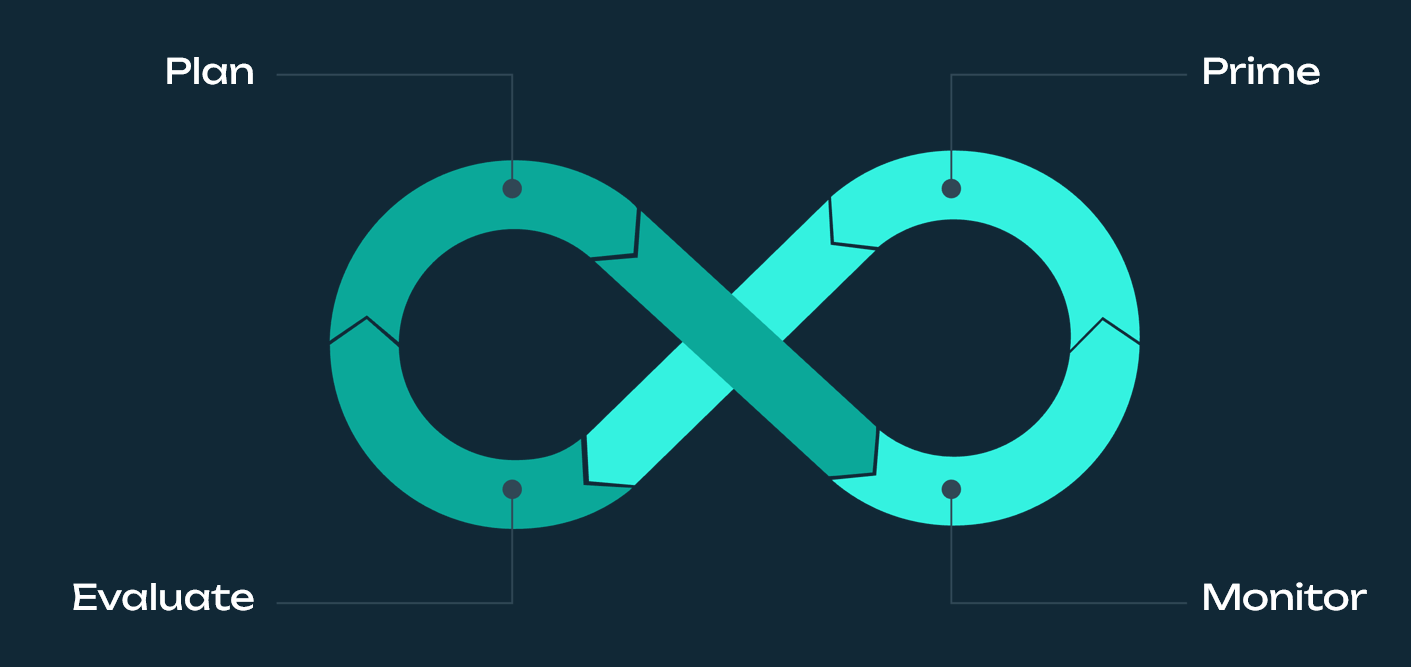
Neuroscientists describe this loop as active recall plus reflective practice, and it is the only proven path to lasting behavior change. Each phase forces a different type of mental work, and each type of work strengthens a different neural pathway. Skip one phase and the chain breaks.
Here is what the cycle looks like when it is built into a training program correctly:
Phase 1 — Prime
Before any new content arrives. Learners activate what they already know about the topic, surface assumptions that may need correcting, and connect the upcoming material to existing mental frameworks. Without priming, new information has no place to land — the brain has no reference points for the content to attach to. Priming is what turns “I have to learn this” into “I have a place for this.”
Phase 2 — Plan
Just before training begins. Employees set the goal: What do I want to walk out of this session knowing? Which parts will I focus on? What will success look like? Planning narrows attention so the brain attends to the right information instead of drifting.
Phase 3 — Monitor
During the training itself. Employees track their own understanding. Where am I confident? Where am I confused? What needs review before I apply this on the floor? Embedded checkpoint questions force the brain to encode meaning, not just words.
Phase 4 — Evaluate
After applying the new skill. Employees ask: What worked? What didn’t? What will I do differently next time? Reflection journals, peer debriefs, and short structured prompts move learning from explicit memory into automatic action.
Consider how this plays out in a medical device sterilization protocol rollout. Instead of a 30-minute video, operators (1) prime by self-assessing their existing knowledge of the prior protocol and surfacing assumptions that may need correcting, (2) plan by identifying what is genuinely new and where the highest-stakes changes are, (3) monitor through scenario-based simulations with embedded reflection prompts, (4) apply the protocol on the floor under supervision, (5) evaluate by journaling what went smoothly and where they hesitated, and (6) revisit the training weekly with new edge-case scenarios. The protocol becomes habitual within six to eight weeks.
The same content delivered through a single video produces inconsistent behavior even after six months. The information was the same. The delivery method was not.
The same pattern holds across every type of management system MSI implements. An environmental management system (EMS) rollout under ISO 14001 — say, a new aspect-and-impact identification procedure or a revised waste-handling workflow — fails the same way without metacognitive structure: employees attend the training, sign the log, and within weeks revert to assessing waste, energy, and emissions through their old lens. The environmental aspects register stays accurate on paper while reality drifts. An occupational health and safety management system (OH&S MS) rollout under ISO 45001 — a revised lockout/tagout procedure, a new permit-to-work process, an updated hazard identification protocol — carries even higher stakes. When shortcuts quietly replace the procedure because it never became habitual, the consequences are not paperwork findings. They are injuries. Quality, environmental, and OH&S training all fail or succeed for the same reason. Metacognition is what makes them succeed.
The Application
How Should Companies Apply Metacognition Training to Onboarding and New Procedure Rollouts?
Onboard. Reinforce. Retain.
Direct Answer
Effective metacognition training applies three principles to every onboarding program and every procedure rollout: spaced repetition over weeks rather than hours, reflection prompts that force comprehension checks, and scenario-based practice that mirrors real workplace situations. These principles work across manufacturing, technology, aerospace, medical device, government, and regulated industries — anywhere procedures need to function reliably under real-world pressure.
Step Zero — The Interview as Competence Assessment
Effective metacognition training does not start on the new hire’s first day. It starts during the interview — and ISO Clause 7.2 actually requires this, even though most organizations do not connect the two.
The clause begins with two requirements that come before the effectiveness measurement most organizations focus on: first, determine the competence necessary for the role, and second, ensure the person is competent on the basis of education, training, or experience. The interview is where both of those requirements are operationalized — or quietly skipped. A culture-fit conversation does not satisfy the standard. A structured competence assessment does.
A metacognitive hiring process treats the interview as a structured competence assessment with a specific output: a documented gap profile. Before the interview, the role’s required competencies are mapped explicitly — technical skills, regulatory knowledge, procedural fluency, domain experience, behavioral expectations. During the interview, the candidate’s existing competence is assessed against that map, not just through claims on a résumé but through scenario-based questions that surface what they actually know how to do. The output is not just a hire/no-hire decision. It is a clear picture of where this person already meets the role and where they will need development:
- Strong existing competence — areas where the candidate brings depth and can begin contributing immediately.
- Partial competence — areas where the candidate has foundational knowledge but needs targeted development to reach the required level.
- Full development required — areas where the role demands skills the candidate does not yet have, and where structured training will need to close the gap from zero.
That gap profile becomes the blueprint for an onboarding program tailored to the actual learner — not a generic curriculum that wastes weeks re-teaching what the new hire already knows while glossing over what they actually need. It is the difference between training a person and training a profile.
The cost of skipping this step shows up later. Generic onboarding bores experienced hires while overwhelming developing ones. Both groups disengage. The competent ones tune out modules they have already mastered; the developing ones never get the depth they need on the topics that actually require attention. By month three, neither has the competence the role demands, and the organization wonders why retention is poor and procedures are inconsistent. The root cause is rarely the people. It is the absence of Step Zero.
Targeted gap-closing is metacognition training applied to onboarding itself. The same four phases apply: prime (the gap profile from your interview is itself the priming step — it tells you exactly which mental hooks already exist and which ones we are about to build), plan (here are your specific gaps and how we will close them), monitor (here are the checkpoints where we will verify progress against the gap profile), and evaluate (here is the competency demonstration that proves the gap is closed). The new hire is not a passive recipient of a generic curriculum. They are an active partner in closing a defined gap — and they know exactly what success looks like from day one.
Onboarding new hires
Most onboarding programs front-load information into the first three days, then go quiet. Metacognitive onboarding spreads learning across the first 90 days and embeds reflection at every checkpoint:
- Day 1: Pre-assessment. What does the new hire already know? What assumptions need to be surfaced and addressed?
- Week 1: Foundation modules with built-in self-check questions every 8 to 10 minutes.
- Weeks 2 to 4: Scenario-based practice paired with short reflection journals.
- Weeks 5 to 8: Application on the job with weekly metacognitive check-ins from a manager or mentor.
- Week 12: Competency demonstration — not a quiz score, but observed performance on a realistic scenario.
New procedure rollouts
Procedure rollouts fail more often than they succeed because they are treated as announcements rather than as learning events. The metacognitive alternative looks like this:
- Pre-launch: Employees identify how the new procedure differs from the old. Where will their existing habits work against them?
- Launch: Scenario-based modules with embedded reflection prompts replace the slide deck.
- Weeks 1 to 2 post-launch: Daily 5-minute check-ins anchored to real situations encountered that day.
- Weeks 3 to 8: Weekly application reviews, peer debriefs, and edge-case practice.
- 90 days: The procedure is habitual, not just learned. The team performs it the same way under pressure as they do on a calm Tuesday.
The cost difference between this approach and a traditional one-and-done rollout is small. The behavioral difference is enormous.
The ISO Requirement
How Do Companies Prove Training Effectiveness — and Why Every ISO Standard Demands It?
Measure. Verify. Prove.
Direct Answer
Every major ISO management system standard — ISO 9001, ISO 13485, ISO 14001, ISO 45001, and ISO 7101 — requires organizations to evaluate the effectiveness of training actions, not just document that training occurred. Effectiveness is measured across four levels: reaction, learning, behavior change, and business results. Attendance logs and quiz scores prove completion. They do not prove effectiveness.
The exact language varies slightly by standard, but the requirement is identical:
- ISO 9001:2015 Clause 7.2 (Competence) — requires organizations to take action to acquire necessary competence and to evaluate the effectiveness of the actions taken.
- ISO 13485:2016 Clause 6.2 — same effectiveness requirement, with explicit emphasis on retained records of competence verification.
- ISO 14001:2015 Clause 7.2 — the same competence and effectiveness language, applied to environmental responsibilities.
- ISO 45001:2018 Clause 7.2 — the same requirement, with the additional expectation that effectiveness ties back to occupational health and safety risk reduction.
- ISO 7101:2023 Clause 7.2 — the first international standard for healthcare quality management, published in October 2023. It applies the same competence and effectiveness requirements to clinical and non-clinical healthcare workforce, with additional explicit requirements for orientation, ongoing education, performance evaluation at defined intervals, and credentialing where applicable.
The phrase that does the work in every one of those clauses is evaluating the effectiveness of the actions taken. Internal auditors across QMS, EMS, and OH&S management systems — and external surveillance audits across all of them — look for this evidence consistently. A signed training log proves attendance. A passing quiz score proves short-term recall. Neither proves that the trained skill is now operational on the floor.
The Kirkpatrick Four-Level Model — The Industry Standard for Effectiveness
Donald Kirkpatrick first published his four-level evaluation model in 1959, and it has been refined for over six decades. It remains the most practical framework for satisfying the ISO effectiveness requirement because it forces organizations to measure outcomes at progressively deeper layers:
- Level 1 — Reaction. Did learners find the training relevant, engaging, and well-paced? Measured through structured feedback, not generic smile sheets.
- Level 2 — Learning. Did knowledge or skill actually increase? Measured through pre/post assessments and scenario-based comprehension checks.
- Level 3 — Behavior. Are learners doing the work differently 30, 60, and 90 days later? Measured through observation on the job.
- Level 4 — Results. Did the training move a business metric — defect rate, nonconformity rate, customer complaint volume, time-to-competency, internal audit findings? Measured through trended process data.
Most organizations stop at Level 1, occasionally reach Level 2, and almost never measure Levels 3 or 4. The ISO effectiveness requirement effectively starts at Level 3. Anything shallower is a paperwork exercise.
Practical Methods That Satisfy Both the Auditor and the Real World
A defensible effectiveness program does not require expensive software or a dedicated learning analyst. It requires a stack of simple, repeatable methods used in combination:
- 30/60/90-day knowledge retention checks with spaced testing — measures Level 2 over time, not just at the moment of training.
- Behavioral observation checklists completed by supervisors or peers during normal work — direct Level 3 evidence.
- Competency demonstrations against documented criteria — observed task performance, scored against a rubric.
- Self / peer / supervisor triangulation — three perspectives on whether the skill is now operational. Disagreement among the three is itself useful data.
- Process metric correlation — track NCR rates, defect rates, internal audit findings, customer complaints, and recurrence rates before and after training.
- Reflection journals reviewed at intervals — both a metacognitive learning artifact and effectiveness evidence in one document.
A medical device manufacturer rolling out a revised corrective action procedure can document effectiveness using this stack: pre-training assessment scores, post-training comprehension checks, supervisor observation checklists completed at 30 and 90 days, and CAPA closure-time and recurrence-rate metrics tracked monthly. That evidence package satisfies ISO 13485 Clause 6.2 and produces a procedure that holds up under real conditions — not just under audit conditions.
Why Employees Struggle With Effectiveness Measurement at First — and How to Fix It
Effectiveness measurement asks employees to do something most workplaces have never asked them to do: think honestly about their own competence and surface their own gaps. That is harder than it sounds, for predictable reasons:
- Confusion feels like incompetence. Most workplace cultures quietly punish “I don’t know yet” and reward visible certainty. Employees learn to perform confidence even when they don’t have it.
- Self-assessment is genuinely difficult. The Dunning-Kruger effect describes how people new to a domain are also the least equipped to evaluate their own limits accurately. Early learners often overestimate how much they have absorbed.
- Reflection feels unproductive. In task-oriented cultures, sitting still and thinking can feel like wasted time. Employees default to action over reflection until reflection is normalized.
- Effectiveness measurement can feel like surveillance. Until trust is built, “how well did this training work for you” sounds like the setup for a performance review.
The remedies are structural, not motivational. Telling employees to “be more reflective” does nothing. Designing the program so reflection is the path of least resistance does everything:
- Normalize confusion as data, not as failure. Build explicit confusion checkpoints into every module. “Mark anything you’d want re-explained” becomes routine instead of risky.
- Use anonymous and structured reflection prompts early. Anonymity removes the social cost of honesty during the first few weeks, when trust is still forming.
- Tie reflection to program improvement, not to personnel evaluation. Frame check-ins as “what would you change about how this is taught” rather than “did you learn this.” Both questions surface the same data; only one feels safe to answer.
- Show employees their input changing the next module. When workers see their honest feedback shaping the program, trust builds quickly and the quality of reflection rises.
- Train the trainers and supervisors first. Effectiveness culture starts at the top of the line. Managers who model “I’m still working that out” give their teams permission to do the same.
The first three to four weeks are the hardest. Reflections are short and defensive. Confusion checkpoints get marked “all clear” even when they aren’t. By week six, if the program is well-designed, the quality of reflection rises sharply. By week twelve, employees are using effectiveness language to describe their own work without prompting. That shift — from compliance to ownership — is the goal of metacognitive effectiveness measurement, and it is what separates an ISO-compliant training program from an ISO-effective one.
The Standard
What Separates Effective Online Training From the Rest?
Build. Test. Sustain.
Online training is not the problem. The problem is that most online training is a video library wearing a learning management system as a costume. Effective online training is a designed learning system, not a content delivery vehicle.
When evaluating an online training program — whether building it internally or selecting a partner — look for these six markers:
- Pre-assessments that surface what learners already know.
- Embedded reflection prompts at regular intervals throughout the content.
- Scenario-based practice built around real workflow situations, not abstract examples.
- Spaced repetition across weeks, not minutes.
- Competency demonstrations that measure capability rather than seat time.
- Reflection journals or structured debriefs that close the metacognitive loop.
If a training program lacks four or more of these markers, it will produce documentation, not behavior. The completion rate will look good. The procedure will not.
The Procedure
How Do You Build All of This Into Your Documented Training Procedure?
Document. Measure. Improve.
Direct Answer
A metacognition training procedure is not longer than a traditional one — it is structured differently. It defines required competencies before hiring, treats the interview as a competence assessment, builds a personalized gap-closing plan for each learner, embeds reflection at every checkpoint, measures effectiveness across all four Kirkpatrick levels, and builds in its own improvement loop. The result satisfies ISO Clause 7.2 across QMS, EMS, OH&S, and healthcare quality contexts — and produces actual behavior change at the same time.
Every ISO management system requires a documented training procedure. Most companies already have one. Most of those procedures are not effective. The difference between a procedure that satisfies an audit and a procedure that builds operational competence is structural — and six targeted elements, written in the right order with clear ownership, are what turn the document from compliance theater into living practice.
A metacognition training procedure should explicitly cover the following six elements. Each one closes a gap that traditional procedures leave open.
1. Define Required Competence Before You Hire
The procedure begins where ISO Clause 7.2 begins: by determining the competence necessary for each role. This is operationalized through a documented Competency Matrix mapping technical skills, regulatory knowledge, procedural fluency, and behavioral expectations — plus any standard-specific requirements (clinical competencies under ISO 7101, environmental aspects awareness under ISO 14001, hazard recognition and risk awareness under ISO 45001, regulatory compliance under ISO 13485). The matrix is reviewed and updated when a new role is created, when an underlying procedure changes, when equipment changes, or when a regulatory requirement shifts. Owner: hiring manager and function lead, with HR support.
2. Treat the Interview as a Structured Competence Assessment
The procedure must require that interviews assess competence against the matrix, not just culture fit. Scenario-based questions tied to each required competency are prepared in advance. Candidate responses are scored against the matrix during or immediately after the interview. The output is not just a hire/no-hire decision — it is a documented competence gap profile categorizing each required competency as strong, partial, or full development. This profile becomes the formal input to the training plan. Owner: hiring manager, with the role’s supervisor.
3. Build a Personalized Training Plan from the Gap Profile
The procedure specifies that every new hire’s onboarding plan is derived from their individual gap profile, not from a standard curriculum. The plan is spaced over 90 days, not crammed into week one. Each module includes a pre-assessment, scenario-based practice, embedded reflection prompts, and a competency demonstration tied back to the matrix. The same logic applies to existing employees when a procedure or competence requirement changes — the gap is reassessed and a targeted closure plan is built, rather than re-running everyone through identical refresher training. Owner: training coordinator, with subject matter experts owning module content.
4. Measure Effectiveness Across All Four Kirkpatrick Levels
The procedure must specify how effectiveness is measured, not leave it to assumption. All four Kirkpatrick levels are required, and the procedure names the data sources for each:
- Level 1 (Reaction) — structured feedback forms, not smile sheets.
- Level 2 (Learning) — pre and post assessment scores, scenario comprehension results.
- Level 3 (Behavior) — supervisor observation checklists at 30, 60, and 90 days.
- Level 4 (Results) — trended process metrics tied to the management system the training supports: nonconformity and customer complaint rates for QMS, environmental incidents and aspect-register accuracy for EMS, near-miss and incident rates for OH&S, patient safety indicators for healthcare quality.
The Level 4 metrics are the proof that training drove behavior change. They are also the data internal audits and management reviews actually need. Owner: training coordinator, supervisors, and management review committee.
5. Specify the Records the Procedure Retains
ISO documented information requirements (Clause 7.5.3 across the management system standards) demand evidence of competence and training effectiveness. The procedure should explicitly list what is retained: competency matrix per role, interview competence assessment with gap profile, personalized training plan, pre and post assessment scores, reflection summaries, behavioral observation records, competency demonstration outcomes, and trended process metrics correlated to training events. These records are both the audit trail and the input to the next improvement cycle. Owner: training coordinator, with document control oversight.
6. Build a Review Cycle Into the Procedure Itself
This is the element most procedures miss. The procedure must define when it reviews itself: when effectiveness data shows declining trends, when employee feedback flags module gaps, when audit findings relate to competence, when the underlying operational procedure being trained changes, or when a new regulation or standard is adopted. Findings from each review feed back into module design and matrix updates. The procedure is not a static document — it is metacognitive at the organizational level. The training program thinks about its own thinking and adjusts. Owner: management review committee.
A training procedure built this way is not a longer document. It is the same five to ten pages. What changes is what it commits the organization to do — and what it commits the organization to measure.
A procedure structured around these six elements satisfies ISO competence and effectiveness requirements on paper. More importantly, it produces actual behavior change in practice — across QMS, EMS, OH&S, and healthcare quality contexts alike. That is the bar a modern training procedure has to clear.
The MSI Approach
How Does MSI Help Clients Own Their Management System Journey?
Train. Own. Sustain.
Direct Answer
MSI’s goal is not to sell management systems. Our goal is to help organizations build systems they own — and then to step back so the journey is theirs to lead. After 28 years implementing ISO 9001, ISO 13485, ISO 14001, ISO 45001, and ISO 7101 across manufacturing, technology, aerospace, medical device, healthcare, government, and regulated industries, the principle has not changed: a system you cannot run without your consultant is not your system.
MSI was founded in 1998 on a principle that has shaped every engagement since: organizations deserve management systems they own, not systems they rent from a consultant. We write your management system with you — whether it is a quality management system, environmental management system, occupational health and safety management system, or healthcare quality management system. We train your people in it. We measure its effectiveness against the standard. And then we make ourselves unnecessary, because the journey from compliance to ownership is yours — and it is the only journey worth taking.
A management system you cannot run without your consultant is not your system. It is a rental.
That is why metacognition training is not a feature of our approach. It is the foundation of it. Ownership at the organizational level looks exactly like ownership at the individual level: the people running the system have to think about their own thinking, monitor their own competence, and adjust their own practice. A management system without metacognitive operators is a binder on a shelf. A management system with them is a living, learning organism that improves itself.
Our flagship corrective action course, Catch. Correct. Continually Improve. — The ISO 9001 Nonconformity & Corrective Action Procedure Course, is built on this principle. The course is structured around the four-phase cycle of priming, planning, monitoring, and evaluating. Learners begin by surfacing their existing approach to nonconformities — the priming step that connects the new training to what they already do every day. They then plan the new approach, work through realistic scenarios drawn from manufacturing, medical device, aerospace, and healthcare settings, and complete reflection prompts that connect each module back to their own workplace. The training does not produce certificate-holders. It produces operators who can run a corrective action system without checking the manual — and who improve it as they run it.
This commitment to priming runs through every MSI course. Almost all of our training begins before the course itself does. When a client enrolls in our Design and Development course — focused on ISO 13485 Clause 7.3 — they receive a pre-course assessment in advance of the first session. The assessment surfaces what they already know about design controls, where their existing practices align with the standard, and where the new material will need to do its work. By the time the live training begins, learners arrive primed: prior knowledge activated, gaps identified, attention focused. The first session does not start with introductions. It starts with learning, because the priming has already happened. We design our own courses the way we tell our clients to design theirs.
Where Ownership Matters Most: Healthcare and ISO 7101
The same ownership-based principles apply across our work in ISO 9001, ISO 13485, ISO 14001, ISO 45001, and our expanding work in ISO 7101 healthcare quality. Healthcare may be the clearest case for ownership-based training: when a clinical procedure fails to become habitual, patients are harmed. ISO 7101’s competence requirements are explicit about this risk, demanding orientation, ongoing education, performance evaluation at defined intervals, and effectiveness measurement that ties directly to patient safety outcomes. The metacognitive effectiveness loop is what closes the gap between a written healthcare procedure and a procedure that actually protects patients on the floor.
For a healthcare organization implementing ISO 7101, ownership is not a nice-to-have. It is the difference between a quality manual that satisfies an audit and a quality culture that protects lives. A consultant can write the document. Only the organization can own the practice.
The Outcome: A System You Run Without Us
Whether we are supporting onboarding for a manufacturing client, rolling out a revised CAPA procedure for a medical device team, helping an industrial operation implement an environmental management system under ISO 14001, building an occupational health and safety program under ISO 45001, or guiding a healthcare organization through ISO 7101 from scratch, the goal is the same: training and systems that produce behavior, not paperwork — and ownership that lasts long after we are gone. The mark of a successful MSI engagement is not the certificate on the wall. It is the moment our clients no longer need us in the room.
Related Reading
Continue Building Procedures That Work in Practice
The ISO 9001 Nonconformity & Corrective Action Procedure Course
A metacognitive online course that turns corrective action from a paperwork exercise into a workplace habit. Catch. Correct. Continually Improve.
ISO 9001 Context of the Organization
Why understanding your organization’s context is the foundation of every procedure that holds up under real-world pressure.
Building a Quality Management System That People Actually Use
How to design management system documentation — quality, environmental, or OH&S — that becomes operational behavior, not shelf decoration.
REFERENCES & FURTHER READING
- Flavell, J. H. (1979). Metacognition and cognitive monitoring: A new area of cognitive-developmental inquiry. American Psychologist, 34(10), 906–911.
- Ebbinghaus, H. (1885/1913). Memory: A Contribution to Experimental Psychology. Translated by Ruger & Bussenius. Teachers College, Columbia University.
- Kirkpatrick, D. L., & Kirkpatrick, J. D. (2006). Evaluating Training Programs: The Four Levels (3rd ed.). Berrett-Koehler Publishers.
- Kruger, J., & Dunning, D. (1999). Unskilled and unaware of it: How difficulties in recognizing one’s own incompetence lead to inflated self-assessments. Journal of Personality and Social Psychology, 77(6), 1121–1134.
- Brown, P. C., Roediger, H. L., & McDaniel, M. A. (2014). Make It Stick: The Science of Successful Learning. Harvard University Press.
- Karpicke, J. D., & Roediger, H. L. (2008). The critical importance of retrieval for learning. Science, 319(5865), 966–968.
- Kornell, N., & Bjork, R. A. (2008). Learning concepts and categories: Is spacing the enemy of induction? Psychological Science, 19(6), 585–592.
- Knowles, M. S. (1980). The Modern Practice of Adult Education: From Pedagogy to Andragogy. Cambridge Adult Education.
- Schraw, G., & Moshman, D. (1995). Metacognitive theories. Educational Psychology Review, 7(4), 351–371.
- Ericsson, K. A., Krampe, R. T., & Tesch-Römer, C. (1993). The role of deliberate practice in the acquisition of expert performance. Psychological Review, 100(3), 363–406.
- ISO 9001:2015, Quality management systems — Requirements, Clause 7.2 (Competence). International Organization for Standardization.
- ISO 13485:2016, Medical devices — Quality management systems — Requirements for regulatory purposes, Clause 6.2 (Human resources). International Organization for Standardization.
- ISO 14001:2015, Environmental management systems — Requirements with guidance for use, Clause 7.2 (Competence). International Organization for Standardization.
- ISO 45001:2018, Occupational health and safety management systems — Requirements with guidance for use, Clause 7.2 (Competence). International Organization for Standardization.
- ISO 7101:2023, Healthcare organization management — Management systems for quality in healthcare organizations — Requirements, Clause 7.2 (Competence). International Organization for Standardization.
About MSI International
Building Management Systems That Work in Practice — for 28 Years
Management Systems International (MSI) is a veteran-owned, female-owned ISO consulting and online training firm founded in 1998 with 80+ organizations certified. We implement ISO 9001, ISO 13485, ISO 14001, and ISO 45001, with an expanding focus on ISO 7101 healthcare quality. Our online training programs are designed around metacognitive learning principles so that new procedures become operational habits — not shelf documentation.
Our work spans manufacturing, technology, aerospace, medical device, government, and regulated industries.
msi-international.com • 760-434-9141
