Direct Answer: A contingency plan is the documented arrangement an organization relies on when it can no longer operate the way its management system assumes — capacity lost, systems down, supplier failed, records unavailable. ISO 9001 Clause 8.2.1 e) requires contingency actions to be addressed where relevant, and ISO 13485, ISO 14001, ISO 45001 and ISO 7101 each add their own obligations. The requirement almost every organization satisfies on paper and fails in practice is validation: until a contingency plan has been exercised against real conditions, it is a claim about capability, not a control.
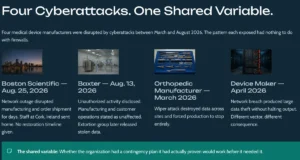
Four medical device manufacturers were disrupted by cyberattacks between March and August 2026. The pattern each one exposed had nothing to do with firewalls.
On August 25, 2026, Boston Scientific identified unauthorized activity on its network. By August 28 the company remained in a network outage, with its ability to manufacture products and to process and ship customer orders still disrupted and no timeline for full restoration. At the company's manufacturing site in Cork, Ireland, staff were sent home. Weeks earlier, on August 13, Baxter disclosed unauthorized activity involving certain third-party applications and stated in its own public statement that manufacturing, customer operations and business continuity were unaffected. The extortion group behind it later released the stolen data. Two very different outcomes from broadly similar events.
Earlier in the year the same industry absorbed two more. A wiper attack in March destroyed data across sites at one orthopedic manufacturer and forced production to stop. A network breach in April at another device maker produced a large data theft without halting output. Different vectors, different consequences, one shared variable: whether the organization had a contingency plan it had actually proven would work before it needed it.
That variable is not an information technology question. It is a management system question, and it sits in clauses most organizations have never seriously implemented. This article is about those clauses, what a defensible contingency plan contains, and the validation step that separates the organizations that recover in days from the ones still explaining themselves to customers a month later.
Diana Lynn has spent 28 years watching this specific gap open. Across 200+ audits attended and 80+ certifications supported, the pattern repeats in manufacturing, technology, medical device, government, healthcare and other regulated industries: the plan exists, the plan is current, the plan has never been run. Capture. Prove. Test.
Start With the Procedures, Not a Blank Page
Writing contingency arrangements from scratch is where most projects stall. MSI's ISO Procedure Templates and Guides give you the documented structure — contingency provisions, change planning, documented information control and emergency response — already written to clause and ready to adapt to how your operation actually runs.
DEFINITION
What is a contingency plan in a management system context?
Operate. Deliver. Recover.
Direct Answer: In a management system, a contingency plan is the set of arrangements that keep committed outputs flowing — or that govern how you stop and notify — when normal operating conditions are unavailable. It is narrower than a business continuity management system and broader than an emergency response procedure. Its subject is the promise you made to a customer or a regulator, and whether you can still keep it.
The phrase gets used loosely, and the looseness causes real damage. In finance and project management a contingency is a reserve — money or schedule held back against the unknown. That is not what a contingency plan means in ISO 9001, ISO 13485, ISO 14001, ISO 45001 or ISO 7101, and organizations that import the financial meaning end up with a budget line where they needed an operating procedure. In a management system the subject is operational capability, not reserve.
Three things are frequently confused, and separating them is the first useful step in any contingency plan project.
| Arrangement | What it governs | Where it lives |
|---|---|---|
| Emergency response procedure | Immediate life-safety and environmental response — releases, fires, injuries, evacuation. Protects people and the environment during the event. | ISO 14001:2026 Clause 8.2, ISO 45001 Clause 8.2. Covered in MSI's guide to the emergency preparedness and response procedure. |
| Contingency plan | Continuity of committed output — can you still make it, release it, ship it, and if not, what happens and who is told. Protects the obligation. | ISO 9001 Clause 8.2.1 e), ISO 7101 Clause 8.2.2, and the change and documented-information clauses in every standard. |
| Business continuity management system | A whole certifiable management system for organizational resilience, with its own impact analysis, recovery objectives and exercise regime. | ISO 22301, a separate standard that was amended in 2024 for climate action changes. |
Most organizations need the middle one and reach for either of the outer two. They either write an evacuation procedure and believe operational continuity is covered, or they scope a full ISO 22301 project and abandon it as disproportionate. The middle arrangement is smaller than certification and larger than a fire drill, and it is the one the standards you are already certified to actually require.
Why the distinction decides whether the plan gets tested
Emergency response gets tested because a clause says to test it and because failing to evacuate a building is visibly unacceptable. A contingency plan for operational continuity has no equivalent testing clause in ISO 9001 or ISO 13485. Nothing in either standard tells you to rehearse operating without your enterprise resource planning system, or to prove you can release product when the electronic record system is unavailable. So the exercise never gets scheduled, and the first live run of the plan is the incident itself.
That is the whole argument of this article in one sentence. The obligation to have a contingency plan is written down. The obligation to prove it works is not, which is precisely why an experienced ISO consulting engagement treats validation as the deliverable rather than the document.
EVIDENCE
Why does an untested contingency plan fail exactly when it is needed?
Written. Filed. Unproven.
Direct Answer: An untested contingency plan fails because it encodes assumptions nobody has ever checked — that the backup is restorable, that the alternate supplier is qualified, that the paper fallback satisfies the same record requirements, that someone owns the decision to invoke it. Each assumption is individually reasonable. Under disruption they fail together, and the organization discovers the dependencies in the worst possible order.
The 2026 medical device incidents are useful precisely because they were public, close together and varied in outcome. Read as a set, they show where the recovery time actually goes.
Network restoration is the fast part. Rebuilding a server is a known engineering task with a predictable duration. What takes weeks in a regulated operation is proving that what comes back can be trusted. As one assessment of the Boston Scientific disruption put it, software involved in producing and tracking regulated devices sits inside a validated quality system, so restoring a server and establishing that its data can still be trusted are two different problems. You cannot ship an implantable device on trust alone.
That second problem is a quality system problem, and a contingency plan that never contemplated it offers no help at all. Consider the questions that arrive on day three of an outage in any regulated operation:
- Which records were open and in-flight when the systems went down, and can their state be reconstructed?
- Was the restored application the validated version, and does the validation evidence still apply after the restore method used?
- Were electronic signatures, audit trails and time stamps preserved through the restoration, or does a population of records now lack attribution?
- Did anyone operate on paper during the outage, and if so, under what authority and with what review before those records enter the permanent file?
- Which lots moved during the gap, and can identification and traceability be demonstrated across it?
- What was released to customers on the basis of records that cannot now be verified?
None of those are answerable at speed unless the answers were designed in advance. Designing them in advance is what a contingency plan is for, and rehearsing them is what turns the document into a capability.
The failure is structural, not technical
It is tempting to read these incidents as security failures and respond with security spending. That response is incomplete in a specific and expensive way. Two organizations with identical security postures can experience the same intrusion and diverge sharply in recovery, because recovery speed is governed by preparation inside the management system rather than by the perimeter around it.
The security team decides whether you get hit. The management system decides how long you stay down.
MSI client experience suggests that organizations who have exercised a contingency plan at least once treat the first forty-eight hours very differently. They already know who declares the disruption, which processes have manual fallbacks and which do not, what evidence the manual fallback must generate, and which customers have contractual notification windows measured in hours. Organizations meeting those questions for the first time spend the first forty-eight hours discovering the questions.
This is not a medical device phenomenon. The same structure applies to any operation with committed outputs and controlled records, which is to say every organization certified to a management system standard. The device sector is simply where the consequences surface fastest, because medical device cybersecurity obligations already force the interaction between security events and quality records into the open.
CLAUSE MAP
Which ISO clauses actually require a contingency plan?
Clause. Obligation. Evidence.
Direct Answer: No ISO management system standard has a clause titled “contingency plan.” The obligation is distributed. ISO 9001 Clause 8.2.1 e) carries the core requirement for contingency actions, ISO 7101 Clause 8.2.2 makes contingency planning explicit, and the documented-information, change-planning, traceability and nonconforming-output clauses in every standard supply the rest. Auditors find the gap by following those clauses, not by looking for a document with the right name.
This distribution is why so many organizations believe they are covered when they are not. There is no single checkbox to miss. The requirement is assembled from parts, and each part looks satisfied in isolation. Organizations running one system against several standards meet it in compounded form, which is why MSI treats continuity as an integrated management systems question rather than a single-standard one.
ISO 9001 — Clause 8.2.1 e), the requirement that fell through transition
ISO 9001:2015 Clause 8.2.1 e) requires the organization to establish specific requirements for contingency actions, when relevant, as part of determining requirements for products and services. It was new in the 2015 revision with no predecessor in the 2008 edition. During transition there was nothing to map it from, so on most correspondence tables it simply had no source row — and in a very large number of organizations it was never implemented at all. A decade later the contingency plan obligation is still, in MSI's audit experience, among the most commonly unaddressed requirements in an otherwise mature ISO 9001 system. MSI's ISO 9001 quality standard page sets out where the clause sits in the wider system.
Four further ISO 9001 clauses complete the picture, and they are the ones auditors actually walk when they probe continuity:
| Clause | What it obliges | Contingency consequence |
|---|---|---|
| 6.1 Actions to address risks and opportunities | Determine risks that affect the ability to deliver conforming product and achieve intended results. | Loss of a system, site, supplier or competence is a risk to conformity. If it is not on the register, no contingency plan will be planned. |
| 6.3 Planning of changes | Carry out changes to the management system in a planned manner, considering resources and responsibilities. | Invoking contingency arrangements is a change to how work is done. Unplanned change during an incident is where nonconformities are created. |
| 7.5.3 Control of documented information | Ensure documented information is available where needed and adequately protected, including from loss of integrity. | Protection is not only confidentiality. Availability of records during and after disruption is an explicit obligation. |
| 8.5.2 Identification and traceability | Identify outputs and control unique identification where traceability is a requirement. | Traceability must survive the gap. A period during which lots moved untracked is a nonconformity discovered later, at scale. |
| 8.7 Control of nonconforming outputs | Identify and control outputs that do not conform, including after delivery. | Product released against records that cannot be verified has to be assessed. This is the recall-adjacent decision most plans never anticipate. |
The ISO 9001:2026 revision is scheduled for publication on September 16, 2026, and organizations planning a transition will want their contingency plan work aligned to the same cycle rather than run as a separate project. Doing both at once is materially cheaper than doing them a year apart, which is the sequencing MSI's SurePath turnkey certification approach is built around.
ISO 13485 — the validated-system problem
ISO 13485 uses the pre-Annex SL structure, so it does not share the harmonized ten-clause layout of the other standards discussed here, and it has no equivalent to ISO 9001 Clause 8.2.1 e). What it has instead is a set of obligations that make the recovery half of a contingency plan far harder and far more consequential for device manufacturers.
- Clause 4.1.6 requires validation of computer software used in the quality management system, proportionate to risk, with records of that validation. After a restore, the question is whether the validated state was preserved — and if it cannot be shown, the software is unvalidated until it is revalidated.
- Clause 4.2.4 and Clause 4.2.5 govern control of documents and records, including retrieval, protection from loss and defined retention. Records that cannot be retrieved during an outage are a live nonconformity, not a temporary inconvenience.
- Clause 7.5.6 requires validation of processes where output cannot be verified by subsequent monitoring, including validation of the software used in those processes. Contingency operation of a validated process is a change to that process.
- Clause 7.5.8 and Clause 7.5.9 require identification and traceability throughout realization, with traceability records retained. There is no allowance for a gap.
- Clause 8.3 governs control of nonconforming product, including product detected after delivery — the clause the organization lands in if release decisions were made on unverifiable records.
Layered on top for United States manufacturers is the regulatory position. The FDA's Quality Management System Regulation amended 21 CFR Part 820 to incorporate ISO 13485:2016 by reference, which means these clauses now carry regulatory force rather than certification force alone — the mechanics of which MSI covers in its breakdown of the QMSR rule and Part 820 alignment. Where electronic records and signatures are in play, 21 CFR Part 11 adds audit trail, attribution and record-integrity obligations that a paper fallback has to satisfy on re-entry, not merely approximate.
The practical reading for a device manufacturer is uncomfortable but clarifying. Your contingency plan is not finished when it explains how to keep making product. It is finished when it explains how you will demonstrate, afterward, that everything made during the disruption conforms — and what you will do about anything you cannot demonstrate. MSI's overview of the ISO 13485 standard sets out how those clauses interact in a working system.
ISO 14001:2026 — protection from loss of integrity, and the new audit objective
The fourth edition of ISO 14001 was published in April 2026, cancelling and replacing the 2015 edition, with the transition deadline set for April 30, 2029. Three of its requirements bear directly on a contingency plan, and the environmental management standard is more explicit than ISO 9001 on two of them. MSI's ISO 14001 environmental standard page covers the fourth edition in full.
- Clause 7.5.3 requires documented information to be controlled so that it is available and suitable for use where and when needed, and adequately protected — the standard names loss of confidentiality, improper use and loss of integrity. It then requires the organization to address distribution, access, retrieval and use; storage and preservation including legibility; control of changes; and retention and disposition. That is a records contingency specification in everything but name.
- Clause 8.2 requires processes to prepare for and respond to potential emergency situations, including periodically testing the planned response actions where practicable, and periodically reviewing and revising them — particularly after an occurrence or a test.
- Clause 9.2.2 now requires the organization to define the audit objective, criteria and scope for each audit. An internal audit of contingency arrangements with no stated objective no longer satisfies the clause.
Clause 6.3, planning of changes, closes the loop: the annex guidance explicitly lists business disruption from supply chain issues, labour disputes, natural disasters and similar events among the circumstances that give rise to change requiring planned management. An environmental management system that has never considered how it operates during disruption has an unaddressed Clause 6.3 obligation.
Transitioning to ISO 14001:2026 Without Losing a Quarter
MSI's ISO 14001:2026 Procedure Templates and Guides were built for experienced EHS managers who need to move an existing 2015 system to the 2026 edition in about a week — including the documented-information controls, emergency response and change-planning provisions that a contingency plan depends on. Every procedure is written to the new clause structure and ready to adapt.
If your team also needs the change map and the auditing rework, MSI runs an ISO 14001:2026 Transition course and a companion ISO 14001:2026 Internal Auditing course that trains auditors against the updated clauses rather than the retired checklist.
ISO 45001 — the one standard that makes testing unqualified
ISO 45001 Clause 8.2 requires processes to prepare for and respond to potential emergency situations, and its testing requirement is not softened by a practicability qualifier. It also requires the organization to communicate relevant information to workers, contractors, visitors, emergency response services and authorities, and to involve workers in developing the planned response.
That last requirement is the one worth borrowing for the wider contingency plan. The people who will operate the fallback are the people who know whether it can be operated. A continuity arrangement written by management and handed down is the one that fails at three in the morning, because the assumptions embedded in it were never checked against the work. Leadership teams getting up to speed quickly often start with the ISO 45001 Executive Brief, or MSI's ISO 45001 safety standard page.
ISO 7101 — contingency planning named outright
ISO 7101, the healthcare quality management standard and an expanding focus area for MSI, is the most direct of the five. Clause 8.2.2 addresses contingency planning explicitly, and Clause 7.5.4 f) adds a requirement bearing on the contingency of information systems — an obligation that, in most healthcare organizations, has no natural owner because it sits between clinical operations and information technology and is claimed by neither.
For hospitals and clinics that is the single highest-value finding in this whole clause map. An information-system contingency plan with no assigned owner is not a plan; it is an expectation. MSI's ISO 7101 Overview covers where these requirements sit in the healthcare quality management system as a whole, alongside the ISO 7101 healthcare standard page.
Worth knowing: Management review is required across ISO 9001, ISO 13485, ISO 14001 and ISO 45001 — it is not an ISO 9001 exclusive. That matters for a contingency plan because the disruption, the corrective actions taken, the resources found to be inadequate and the resulting changes are all mandatory review inputs. A plan invoked and never reviewed at top-management level leaves an open obligation in every standard the organization holds.
Turn the Incident Into a Management Review That Counts
Post-disruption is when management review stops being a formality. MSI's ISO Management Review Toolkits give you the agenda, input templates and output records that capture what the event revealed — resource adequacy, corrective action status, interested-party communication and the decisions leadership actually has to make — so the review produces changes instead of minutes.
SECOND SOURCE
Why can't a critical manufacturer just have a backup site?
Transfer. Validate. Register.
Direct Answer: Because standing up a second manufacturing site is a design transfer, a process validation and a regulatory registration exercise — not a purchasing decision. ISO 13485 Clause 7.3.8 governs how design outputs move to manufacturing, and every one of those steps has to be completed before the disruption. A second site established after the flood is a recovery project. A second site established in advance is a contingency plan.
Cyberattacks make the news, but they are not the most reliable way to lose a plant. Water is, and any contingency plan that only contemplates intrusion is scoped too narrowly. The single best illustration of what single-site concentration costs happened to the same company that appeared at the top of this article, two years before its network incident.
Eleven months: what one flooded plant did to a national supply
Hurricane Helene made landfall on Florida's Gulf Coast on September 26, 2024 and moved north through the southeastern United States. In western North Carolina it flooded Baxter's North Cove manufacturing site at Marion. The company had a hurricane preparedness plan in place, and rain and storm surge nonetheless caused a levee breach that put water inside the site and destroyed a bridge serving the plant. North Cove produced roughly 60% of the intravenous fluids supplied to hospitals in the United States.
Late September 2024 · Operations halt. Flooding stops production at a site supplying the majority of a national essential-supply category.
October 2024 · Allocation. Direct customers are cut to 40% of normal volume and distributors to 10%. Hospitals delay non-urgent surgeries and substitute oral electrolytes. The FDA declares multiple products in shortage.
October 2024 · Federal intervention. The Defense Production Act is invoked to speed materials to the site — an extraordinary measure, triggered by a single facility's unavailability.
February 2025 · Lines fully operational. Roughly five months after the water.
August 2025 · Shortage declared resolved. Eleven months from landfall to the FDA calling it over.
2026 · Demand has not returned. The company reported IV fluid demand still down by roughly a tenth to a seventh, attributed in part to customers who stockpiled during the uncertainty, with normal patterns not expected to resume until later in the year.
Read the last item again, because it is the one that matters commercially. The plant recovered in five months. The market position did not recover in two years. Customers who found another way through the shortage did not all come back, and competitors who could supply during the gap kept some of what they won. No contingency plan is more expensive than that outcome.
The plant came back in five months. The market share did not come back in two years. That gap is the actual cost of single-site concentration.
And the concentration was visible in advance. A single site producing the majority of a national supply of an essential product is not a hidden risk; it is a documented fact that appears in every capacity review. It was accepted because concentration is efficient, and efficiency is the thing that gets measured every quarter while resilience is the thing that gets measured once, retrospectively, after it is missing. A contingency plan is the instrument that puts resilience on the quarterly agenda instead.
ISO 14001:2026 made this a required planning input
Organizations that treat extreme weather as bad luck rather than as a planning input now have a clause problem as well as an operational one. ISO 14001:2026 Clause 4.1 requires the organization to determine external and internal issues, and states that these issues shall include environmental conditions being affected by the organization or capable of affecting the organization — naming pollution levels, availability of natural resources, climate change, biodiversity and ecosystem health.
The annex removes any ambiguity about what that means in practice. Among its examples of risks with potential adverse effects, ISO 14001:2026 lists climate change impacts such as increased flooding, drought, extreme temperatures and wildfires that affect the organization's assets, along with water scarcity affecting the ability to operate emission control equipment and resource constraints that impact production. Those are not environmental impacts the organization causes. They are environmental conditions acting on the organization, and the fourth edition requires you to consider them.
So the reasoning runs cleanly through the standard. Clause 4.1 requires you to determine the condition. Clause 6.1.4 requires you to determine the resulting risks. Clause 6.1.5 requires you to plan action. Clause 6.3 requires the resulting changes to be managed in a planned manner. An environmental management system that has never considered site concentration against extreme weather has an unaddressed obligation sitting at the very front of the standard — which is why MSI's ISO 14001 work now starts context determination there rather than with the aspects register, and why a weather-exposed contingency plan starts at Clause 4.1 rather than at the emergency response procedure.
The ISO 14001:2026 Procedures That Carry This
Context determination, risks and opportunities, planning of changes and emergency response are the four procedures a weather-exposed operation depends on — and all four changed in the fourth edition. MSI's ISO 14001:2026 Procedure Templates and Guides were built so an experienced EHS manager can move an existing 2015 system to the 2026 edition in about a week, with the judgment calls already made.
ISO 13485 Clause 7.3.8 — why the backup site cannot be arranged afterward
Worth knowing: ISO 13485 Clause 7.3.8 requires documented procedures for transferring design and development outputs to manufacturing, ensuring those outputs are verified as suitable for manufacturing before they become final production specifications, and that production capability can meet product requirements — with the results and conclusions of the transfer recorded. That clause is the reason a second manufacturing site belongs in the contingency plan months before it is needed, not in the recovery plan afterward.
This is the mechanism most continuity discussions skip. “We should have a backup manufacturer” is a sound instinct and an incomplete instruction, because in a regulated environment the backup has to be brought into existence through a controlled sequence. Each step below has a duration measured in weeks or months, and none of them can be compressed by urgency.
| Step | Requirement | Why it cannot wait |
|---|---|---|
| Design transfer | ISO 13485 Clause 7.3.8 — outputs verified as suitable for manufacturing before becoming final production specifications, with production capability confirmed and results recorded. FDA's design transfer requirement runs through the same obligation under the QMSR. | Transfer is a verification activity with recorded conclusions, not a document handover. It cannot be performed retrospectively on product already made. |
| Process validation at the new site | ISO 13485 Clause 7.5.6 — validation of processes whose output cannot be verified by subsequent monitoring, including the software used in them. | Validation is site-specific and equipment-specific. Validation at site A says nothing about site B. |
| Supplier controls, if contract manufactured | ISO 13485 Clause 7.4 — evaluation, selection, monitoring and re-evaluation of suppliers against defined criteria, proportionate to risk. | A contract manufacturer has to be qualified before it produces, and qualification records are the evidence that it was. |
| Establishment registration and listing | United States device establishments register and list under 21 CFR Part 807. | A site that is not registered for the activity cannot lawfully perform it, whatever the emergency. |
| Certification and audit scope | Sites are audited within a defined scope, and multi-jurisdiction manufacturers commonly work through the Medical Device Single Audit Program. | Adding a site to a certificate is an auditable change with lead time set by the certification body's schedule, not by yours. |
Add these together and the honest answer to “why don't they just have a backup plant” becomes clear. They could have. It would have taken most of a year and cost real money against a risk that had not yet materialized. The decision not to do it was rational on the day it was made and catastrophic the day the levee failed — which is the general shape of every contingency plan decision anyone will ever face. The purpose of a contingency plan is to make that decision deliberately, with the cost of both options written down, rather than by default.
What a proportionate answer looks like
Full duplicate manufacturing is the most expensive option and rarely the right one. The useful question is not whether to build a second plant but how far along the readiness ladder to climb, and the ladder has rungs at very different price points.
- Documented single-point-of-failure map. Which products depend on one site, one line, one tool, one supplier, one qualified operator. Costs a week and is the input to every decision below.
- Design transfer package kept transfer-ready. Outputs maintained in a state where transfer under Clause 7.3.8 could begin immediately rather than starting with document archaeology. Cheap, and it cuts months off any future transfer.
- Identified and evaluated alternate site or contract manufacturer, evaluated under Clause 7.4 but not yet producing. Costs an evaluation cycle. Removes the longest lead item from the critical path.
- Qualified alternate, dormant. Transfer complete, validation done, registration in place, producing nothing or producing a small qualifying volume. Expensive, and the only option that genuinely delivers continuity in weeks rather than quarters.
- Dual production as standard. Both sites run continuously. Highest cost, lowest risk, and reserved for the products where unavailability is a public health event rather than a commercial one.
Most organizations should be on rung two or three and are on rung zero. Moving from zero to two is inexpensive and can be done inside a quarter; it is the single highest-return continuity investment available to a device manufacturer, it requires no capital, and it belongs in the contingency plan rather than in a capital request. Teams that need the design and development discipline underneath it start with MSI's ISO 9001 design and development process training and the companion design and development video series, both of which cover the transfer step that Clause 7.3.8 formalizes.
The clause map from a contingency plan perspective is worth stating plainly. ISO 14001:2026 tells you the weather is a planning input. ISO 13485 tells you what standing up an alternate site actually requires. ISO 9001 Clause 8.2.1 e) tells you to capture what you promised the customer about continuity. Nothing tells you to test the arrangement, and nothing tells you when the concentration risk becomes unacceptable. Those two judgments belong to leadership, informed by the system — which is the entire argument for keeping continuity inside the management system across every industry MSI serves rather than parking it with facilities or with information technology.
Six Weeks to a System That Holds
SureFinish is MSI's six-week ISO advising engagement for organizations that know what they need to fix and want an experienced hand on it rather than a year-long project. Contingency arrangements, design transfer readiness and the procedures underneath both fit inside that window. Call 760-434-9141 and ask what six weeks would cover in your operation.
CAPTURE
What has to be captured before a contingency plan can be validated?
Promise. Owner. Record.
Direct Answer: Before a contingency plan can be tested, the organization has to know what it has actually promised. Continuity commitments enter through sales contracts — dual sourcing, safety stock, defined recovery times, notification windows, resilience attestations — and in MSI client experience they very often never enter the management system. The result is a contractual capability that no procedure describes, no role owns, and no audit samples.
This is the least technical and most valuable step in the whole exercise, and it usually takes a week. Continuity demands that were rare before 2020 are now routine in customer contracts across manufacturing, technology, medical device, government, healthcare and other regulated industries. Procurement organizations ask for them. Sales teams sign them. The commitment lands in a contract file and stops there.
A commitment that exists only in a contract has three properties that make it dangerous. Nobody maintains the underlying capability, because maintaining it was never assigned. Nobody re-verifies it when the supplier, site or inventory policy changes, because no trigger exists. And nobody discovers the gap until the customer invokes the clause, which by definition happens on the worst day.
The contingency obligations register
The remedy is a single controlled record. Every contingency plan MSI helps build starts with one, because it converts a scattered set of promises into something a management system can act on.
| Field | Why it belongs there |
|---|---|
| Customer or interested party | Identifies who can invoke the commitment and on what contractual basis. |
| The obligation, in operating language | “Two qualified sources for the housing” is actionable. “Supply chain resilience” is not. |
| Owning role, not owning person | Roles survive resignations. Named individuals do not, and orphaned commitments are the most common finding. |
| Verification method and evidence | How the organization demonstrates the capability still exists — second-source qualification records, inventory reports, restore test results. |
| Re-verification trigger | Supplier change, site change, capacity change, system change, or a fixed interval. Without a trigger the record decays silently. |
| Notification window | The contractual time inside which the customer must be told. This is frequently measured in hours and frequently unknown to the people who would have to act. |
Where contingency is genuinely not relevant to a transaction or to the business, record that determination and the basis for it. An undocumented decision that something does not apply is indistinguishable, from the outside, from never having considered it. A defensible contingency plan either addresses an obligation or states plainly why it does not — and the second option takes one sentence.
The mirror image nobody writes down
ISO 9001 Clause 8.2.1 e) obliges you to capture the contingency the customer requires. It says nothing about the far more common event: you cannot deliver what you promised. Capacity lost, supplier failed, test failed the week before shipment, systems down. Because no clause demands it, almost no sales or order handling procedure contains it, and the abnormal case gets handled by whoever notices, at whatever speed they choose — which is exactly the vacuum a contingency plan exists to fill.
Customers forgive the failure far more readily than they forgive the silence. Notification speed is the variable you actually control.
A complete contingency plan treats this in three parts: capture what the customer requires, confirm you can meet it before committing, and define what happens when you cannot. The third part is where reputations are made or lost, and it is the part that is almost always missing.
The Procedures That Make Capture Repeatable
MSI's ISO Procedure Templates and Guides include the order handling, change planning and documented-information procedures where continuity commitments have to be captured, confirmed and owned. Written to clause, adaptable to your operation, and structured so the obligation cannot be signed without landing somewhere in the system.
PROVE
How do you prove a contingency plan still works after the disruption?
Restore. Requalify. Release.
Direct Answer: Proving a contingency plan worked means demonstrating that the records, software and processes that carried the organization through the disruption still meet the same requirements as in normal operation. In a validated environment that is a requalification exercise, not an IT sign-off, and it is the phase that determines how long the organization stays down.
The sequence below is the one MSI walks with clients, and it is deliberately ordered. Each step depends on the one before it, which is why organizations that improvise the order lose weeks. Building the sequence into the contingency plan in advance is what makes it executable under pressure.
1 · Establish the boundary of the gap. Fix the exact start and end of degraded operation. Every subsequent question is scoped by these two timestamps, and getting them wrong contaminates the whole assessment.
2 · Inventory what was in flight. Open work orders, batches in process, records mid-approval, shipments in transit, complaints and corrective actions in progress. This is the population that requires individual judgment.
3 · Confirm the restored software is the validated software. Version, configuration and the validation evidence that applies to the restore method used. Where the evidence does not carry over, the application is unvalidated until revalidated.
4 · Verify record integrity across the boundary. Audit trails, attribution, time stamps and approval chains. Records that lost attribution are not merely inconvenient; they may not satisfy the retention requirement they were created to meet.
5 · Reconcile the manual fallback into the permanent record. Paper generated under contingency has to enter the system under defined authority, with review, and without backdating. This is where well-intentioned teams create findings.
6 · Decide on product released against unverifiable records. Assess conformity, and where it cannot be established, treat it under the nonconforming output clause. This decision belongs to defined authority, not to whoever is available.
Steps three and four are the ones that surprise people. Restoring a server is an engineering task with a predictable duration. Establishing that the data coming out of that system can still be trusted is a quality task with no predictable duration at all, unless the method was designed in advance. Designing it in advance is the single highest-return item in any contingency plan.
What the paper fallback has to be able to do
Almost every plan names a manual fallback. Very few specify what it has to produce. A fallback that keeps the line moving but generates records that cannot enter the permanent file has converted a systems outage into a records nonconformity, which is a worse problem and a longer one.
- Every field the electronic record captured, including the ones nobody looks at until an investigation.
- Attribution — who performed the act, not merely who wrote it down afterward.
- Contemporaneous timing, recorded at the time and not reconstructed.
- A defined review and entry path back into the system, with the reviewer identified by role.
- A retention arrangement for the physical originals that matches the retention requirement for the electronic record they substitute for.
Organizations that already think in terms of design rationale find this easier, because the discipline is the same one applied in medical device threat modeling: capture the reasoning at the moment of the decision, because reconstructing it later is expensive and rarely convincing. Software and digital health organizations face the same demand at the regulatory boundary, which MSI covers in its work on digital health FDA compliance.
NOTIFY
What notifications does a contingency plan have to trigger?
Regulator. Customer. Record.
Direct Answer: A contingency plan should name every notification the disruption could trigger and who owns each one — customer contractual windows, regulatory supply notifications, securities disclosure where the organization is publicly traded, and breach reporting where personal data is involved. The failure mode is not refusing to notify. It is discovering the obligation on day nine.
Regulatory supply notification and the trap inside it
For device manufacturers, Section 506J of the Federal Food, Drug, and Cosmetic Act requires notification to the FDA of a permanent discontinuance or an interruption in manufacturing likely to lead to a meaningful disruption in domestic supply. The FDA maintains a 506J Device List by product code and uses the notifications to publish its shortage list and prioritize reviews and inspections that could relieve a shortage.
The trap is the trigger. The mandatory duty applies during or in advance of a declared public health emergency. Outside one, Section 506J(h) permits voluntary notification at any time but does not compel it — so a disruption that halts shipments in an ordinary month is not, on the face of the statute, a mandatory notification event. The FDA nonetheless encourages voluntary notification, and the final guidance confirms that voluntary submissions may be made at any time, unrelated to any emergency declaration.
A second trap sits alongside it. The statutory trigger is an interruption in manufacture, not in distribution. An organization that can still make product but cannot process or ship orders faces an awkward fit with the statutory language — a question regulatory affairs should answer on day two of an incident, not day twenty. Deciding it in advance costs an hour. Deciding it during an incident costs a week and produces a worse answer. Every regulatory position a disruption could raise belongs in the contingency plan, resolved in advance and owned by a named role.
Securities disclosure, where applicable
Publicly traded organizations carry a parallel obligation. Under rules the Securities and Exchange Commission adopted in July 2023, a registrant must disclose a cybersecurity incident it determines to be material on Item 1.05 of Form 8-K, generally within four business days of that determination, and the compliance guide notes the clock runs from the materiality determination rather than from discovery, with that determination to be made without unreasonable delay.
The management system connection is direct. Materiality assessment depends on operational facts — what cannot be made, what cannot be shipped, for how long — and those facts come from the same people executing the contingency plan. If the plan does not name who supplies them and how fast, the determination is made on guesswork.
The notifications organizations forget
- Customer contractual windows. Frequently measured in hours, frequently unknown to operations, and frequently the first obligation breached.
- Certification body notification. Many certification agreements require notice of significant changes affecting the management system or its scope. Check yours before you need it; accreditation expectations are set through Global ACI, which replaced the prior international arrangements on January 1, 2026.
- Notified body or regulator for site-level disruption where the disruption affects a registered activity or a validated process.
- Breach reporting where personal or health data is involved, on statutory timelines independent of any operational recovery.
- Interested parties under the environmental and safety standards, whose communication requirements do not pause because the systems are down.
Every entry above should appear in the plan with an owning role, a trigger condition and a time limit. Building that list is a two-hour exercise that repeatedly proves to be the highest-value two hours in the whole project — the kind of structural work an ISO consulting engagement should insist on before any document is drafted.
FRAMEWORK
What does the MSI Contingency Validation Gate require?
Five. Gates. Proof.
Direct Answer: The MSI Contingency Validation Gate is a five-gate test that separates a documented contingency plan from a proven one. A plan that clears all five has been exercised, owned, evidenced, reviewed and re-verified. A plan that clears fewer than five is an expectation, and the number of gates it clears predicts how long recovery will take.
The gates are ordered by how often they fail. Gate one fails least; gate five fails most. Score honestly — the value of the framework is entirely in refusing to credit yourself for a gate you have not passed.
| Gate | The question | What passing looks like |
|---|---|---|
| 1 · Scope | Does the plan name the specific disruptions it covers, and the ones it does not? | A written list of scenarios with a stated basis. Generic “major disruption” language fails this gate, because it cannot be tested. |
| 2 · Ownership | Does every arrangement have an owning role, and does a defined role declare the disruption? | Roles, not names. A single accountable declaration authority. Deputies defined. Transfer on role change is a documented step. |
| 3 · Evidence | Does the fallback generate records that satisfy the same requirements as normal operation? | A specimen of every fallback record, reviewed against the clause the electronic record satisfies, with the re-entry path defined. |
| 4 · Exercise | Has the plan been run under conditions that could actually fail? | A dated exercise with a scenario, an objective, participants who were not warned of the detail, findings raised, and corrective actions closed. |
| 5 · Re-verification | Is the plan re-verified when the underlying capability changes? | A trigger list — supplier, site, capacity, system, key competence — wired into change planning, with the last re-verification date visible. |
Gate four is where nearly everyone stops. A tabletop discussion in a conference room is a useful start and is not an exercise, because nothing in it can fail. An exercise has an objective, a scenario the participants cannot see the whole of, and a real possibility of a bad outcome that gets written down. If your last contingency plan test produced no findings, it was not a test.
Gate five is where plans quietly die. The arrangement was sound when written and the sole-source supplier changed eighteen months ago. Wiring re-verification into change planning — ISO 9001 Clause 6.3, ISO 14001:2026 Clause 6.3 — is the only mechanism that keeps a contingency plan current without heroics, and it is the reason continuity work belongs inside the management system rather than beside it. Organizations that would rather not carry that maintenance internally use MSI's SureResults year-round maintenance program to keep it live between audits.
Talk Through Where Your Plan Actually Stands
A short planning session with MSI puts your current arrangements against the five gates and tells you which ones you clear today. No preparation required, no document to send in advance — the conversation itself surfaces most of what you need to know. Call 760-434-9141 and ask for a contingency planning session.
PATTERNS
Where do contingency plans break down most often?
Assume. Orphan. Drift.
Direct Answer: Six failure patterns account for most of what goes wrong with a contingency plan: the untested backup, the unqualified alternate, the orphaned obligation, the undefined declaration authority, the records-blind fallback, and the plan that no longer matches the operation it describes. Each is cheap to fix in advance and expensive to discover live.
1. The backup nobody has restored
Backups are monitored for completion, not for restorability. The distinction only becomes visible under pressure. A restore test with a stated objective, a defined success criterion and a written result is the cheapest single item in this entire article, and in MSI's audit experience it is performed far less often than organizations believe.
2. The alternate supplier who was never qualified
A named second source is not a qualified second source. Qualification means the evaluation, the approval record, and where the process is validated, evidence that the alternate's output meets the same specification. Organizations typically report discovering the difference at the moment they try to place the first order, which adds weeks to a recovery that the contingency plan assumed would take hours.
3. The orphaned obligation
A continuity commitment with no owning role decays from the day it is signed. This is the pattern the obligations register exists to prevent, and it is worth auditing on its own: pull five contracts signed in the last two years, extract every continuity commitment, and ask who maintains each capability. The answer is instructive.
4. The undefined declaration authority
Someone has to say the words that switch the organization from normal operation to contingency operation. If that authority is undefined, the switch happens late, partially, or in several places at once with different assumptions. Every contingency plan should name the declaring role, the deputies, and the criteria that make declaration mandatory rather than discretionary.
5. The records-blind fallback
Covered above at length because it produces the most expensive findings. The fallback keeps output moving and generates records that cannot enter the permanent file, converting a temporary outage into a durable documentation problem that surfaces at the next audit or the next investigation.
6. Drift between the plan and the operation
The plan describes a line that was reconfigured, a system that was replaced, a site that closed, or a role that no longer exists. Drift is not a failure of diligence; it is the default behavior of any document not connected to a change trigger. The remedy is Gate five, and the audit that catches drift is a scoped internal audit — MSI runs internal audits against exactly this kind of cross-clause question, and trains client teams to do it through its ISO 9001 internal auditing training.
Corrective action closes the loop on all six. Findings from a contingency exercise are findings, and they belong in the corrective action process with cause analysis and effectiveness review rather than on an action list — the discipline MSI teaches in its corrective action and nonconformity procedure course.
SELF-CHECK
How ready is your contingency plan today?
Ten. Honest. Answers.
Direct Answer: Score one point for each statement you can evidence today, not each one you intend to be able to evidence. Eight or more means your contingency plan is a control. Four to seven means it is a document with gaps you can name. Three or fewer means it is an expectation, and the first live run will be the incident.
- We can produce a register of every continuity commitment made to customers, with owning roles.
- A defined role declares the disruption, with named deputies and written criteria.
- We have restored from backup, deliberately, within the last twelve months, with a written result.
- Every alternate supplier named in the plan is qualified, with the approval record on file.
- We have a specimen of every manual fallback record, reviewed against the requirement it substitutes for.
- The re-entry path from paper back into the system is defined, with the reviewing role named.
- We know which regulatory and contractual notifications the disruption triggers, and who owns each.
- We have run an exercise in the last twelve months that produced findings.
- Those findings went through corrective action with effectiveness review, not an action list.
- The plan is re-verified on supplier, site, capacity, system and competence change.
Two related MSI assessments extend this into adjacent territory. The production, service and operational control maturity check scores how well your operational controls hold up under real conditions, and the risk, aspect and job hazard process check scores the risk determination that should be feeding your contingency plan in the first place. Both are free and neither requires an email address to see your result.
Build It Once, Properly
MSI's ISO Procedure Templates and Guides cover the full set of procedures a contingency plan depends on — order handling and contingency provisions, change planning, documented information control, emergency response, corrective action and management review. Adapt them to your operation in days rather than drafting from nothing over months.
FAQ
Frequently asked questions about the contingency plan requirement
Ask. Answer. Act.
Is a contingency plan actually required by ISO 9001?
Yes, conditionally. ISO 9001 Clause 8.2.1 e) requires the organization to establish specific requirements for contingency actions where relevant, as part of determining requirements for products and services. The clause was new in the 2015 revision with no 2008 predecessor, which is why many transitioned systems never implemented it. Where the organization judges contingency not to be relevant, that determination should be recorded with its basis rather than left unaddressed.
What is the difference between a contingency plan and a business continuity plan?
A contingency plan in a management system context governs continuity of committed output — whether you can still make, release and ship what you promised, and what happens if you cannot. A business continuity management system under ISO 22301 is a separate certifiable system covering organizational resilience as a whole, with its own impact analysis, recovery objectives and exercise regime. Most certified organizations need the former and are not obliged to implement the latter.
Does ISO 13485 require a contingency plan?
ISO 13485 has no clause equivalent to ISO 9001 Clause 8.2.1 e). What it has instead are obligations that make contingency operation and recovery materially harder: Clause 4.1.6 on validation of software used in the quality management system, Clause 4.2.5 on control of records including retrieval and protection, Clause 7.5.6 on process validation, and Clauses 7.5.8 and 7.5.9 on identification and traceability. A device manufacturer needs a contingency plan to satisfy those clauses through a disruption, even though no clause uses the word.
How often should a contingency plan be tested?
At least annually, and again whenever the underlying capability changes — supplier, site, capacity, system or key competence. ISO 45001 Clause 8.2 requires periodic testing of emergency response actions without a practicability qualifier, and ISO 14001:2026 Clause 8.2 requires periodic testing where practicable plus review and revision after any occurrence or test. Neither clause covers operational continuity directly, which is why the interval has to be set deliberately rather than inherited.
What does it mean to validate a contingency plan?
Validation means exercising the plan under conditions that could fail, and recording what happened. A discussion that cannot produce a bad outcome is not validation. A valid exercise has a stated objective, a scenario the participants cannot see in full, findings raised against what did not work, and corrective actions closed with effectiveness review. An exercise that produces no findings should be treated as evidence that the exercise was too easy, not that the plan is sound.
Who should own the contingency plan?
Ownership belongs to a role rather than a person, and it should sit with operations rather than information technology, because the obligations being protected are operational and contractual. A defined role declares the disruption; individual arrangements carry their own owning roles; and transfer on role change is a documented step. Orphaned ownership is among the most common findings when contingency arrangements are audited seriously.
Does a cyberattack trigger an FDA notification?
Not automatically. Section 506J of the Federal Food, Drug, and Cosmetic Act requires notification of an interruption in manufacturing likely to cause a meaningful disruption in domestic supply, but the mandatory duty applies during or in advance of a declared public health emergency. Outside one, Section 506J(h) permits voluntary notification at any time. The statutory trigger is also an interruption in manufacture rather than distribution, so an organization that can make product but cannot ship it should resolve its position with regulatory affairs in advance.
Should a critical medical device manufacturer have a backup manufacturing site?
Where a single site produces a product whose unavailability would be a public health event rather than only a commercial one, yes — but the useful question is how far up the readiness ladder to climb rather than whether to build a duplicate plant. The rungs run from a documented single-point-of-failure map, through keeping the design transfer package transfer-ready, to an evaluated alternate, a qualified dormant site, and finally dual production. Most organizations should be on the second or third rung and are on none of them. Moving from none to the second costs a quarter and no capital.
What does ISO 13485 require for design transfer to a new manufacturing site?
ISO 13485 Clause 7.3.8 requires documented procedures for transferring design and development outputs to manufacturing. Those procedures have to ensure the outputs are verified as suitable for manufacturing before they become final production specifications, and that production capability can meet product requirements, with the results and conclusions of the transfer recorded. FDA's design transfer requirement runs through the same obligation under the Quality Management System Regulation. Because transfer is a verification activity with recorded conclusions rather than a document handover, it cannot be performed retrospectively — which is why an alternate site has to be arranged before a disruption, not after one.
How long does it take to build a defensible contingency plan?
Capturing existing continuity commitments into a register typically takes about a week. Drafting the arrangements from adaptable procedures takes days rather than months. The exercise and the corrective actions that follow take a quarter to work through properly. Organizations that treat the document as the deliverable finish in a week and stay exposed; organizations that treat the exercise as the deliverable finish in a quarter and are genuinely covered.
References and primary sources
- ISO 9001 — Quality management
- ISO 13485 — Medical devices
- ISO 14001 — Environmental management
- ISO 45001 — Occupational health and safety
- ISO 22301 — Business continuity management systems
- ISO 22301:2019/Amd 1:2024 — Climate action changes
- FDA — Medical Device Supply Chain and Shortages
- FDA — Notify the FDA About a Medical Device Supply Issue
- Federal Register — Section 506J final guidance, January 7, 2025
- FDA — Quality Management System Regulation
- eCFR — 21 CFR Part 820
- eCFR — 21 CFR Part 11, electronic records and signatures
- SEC — Cybersecurity disclosure rules adopted July 2023
- SEC — Small entity compliance guide, cybersecurity incident disclosure
- CISA — StopRansomware
- NIST — Cybersecurity Framework
- HHS 405(d) — Health Industry Cybersecurity Practices
- Global ACI — accreditation
- ASQ — Quality resources
- ANAB — Accreditation services
- Baxter — Statement regarding cybersecurity incident
- MedTech Dive — Boston Scientific cyberattack disrupts manufacturing, August 28, 2026
- Medical Economics — When a device maker goes dark
- Security Magazine — Boston Scientific faces cyberattack
- HIPAA Journal — Baxter International data breach
- Medical Device Network — Boston Scientific impacted by ongoing cyberattack
Related reading from MSI
- Emergency preparedness and response procedure — the life-safety and environmental companion to this article, covering ISO 14001:2026, ISO 45001 and ISO 7101 Clause 8.2.
- Medical device cybersecurity as a quality management system shift — where security obligations enter the QMS rather than the network.
- ISO 13485 Gap Analysis — MSI's assessment of where a device quality system stands against the standard today.
- SurePath — turnkey ISO certification for organizations building the system and the contingency arrangements together.
- QMS 9001 Launch Mastery and ISO 13485 Launch Mastery — kickoff frameworks for organizations starting from zero.
- EMS 14001 Launch Mastery — the environmental equivalent, for teams standing up an EMS from the beginning.
- ISO Management Review Toolkits — the review structure that turns an incident into documented leadership decisions.
Your Contingency Plan Deserves One Honest Hour
MSI has spent 28 years inside management systems in manufacturing, technology, medical device, government, healthcare and other regulated industries — 80+ certifications supported, 200+ audits attended and 600+ professionals trained. Bring your current arrangements to a planning session and we will tell you which of the five gates you clear today and what the shortest path to the rest looks like. Call 760-434-9141, or start with the procedures below.
About Management Systems International (MSI)
Diana Lynn is President and Principal ISO Consultant at Management Systems International (MSI), a veteran-owned, female-owned consulting firm she co-founded in 1998. With 28 years of experience including extensive AS9100 work in MSI's early years, MSI's track record includes 80+ certifications supported, 200+ audits attended, and 600+ professionals trained across manufacturing, technology, medical device, government, healthcare, and other regulated industries.
Today MSI implements ISO 9001, ISO 13485, ISO 14001, and ISO 45001, with an expanding focus on ISO 7101 healthcare quality.
msi-international.com · 760-434-9141
