
Direct answer: Continuous improvement and innovation are two halves of one managed loop, not competing priorities. Improvement raises the floor by removing causes of failure in work you already do; innovation raises the ceiling by creating value that did not exist before. ISO 9001 Clause 10 supplies the machinery for the first, ISO 56001 supplies it for the second, and both run on the same evidence: measurable objectives, analysed data, and reviewed results.
Ask ten executives to choose between running a tighter operation and building the next big thing, and most will tell you they want both. Ask them which one gets the budget when the quarter tightens, and the answer is nearly always the same — and nearly always wrong. The organizations that compound advantage year after year do not choose. They treat continuous improvement and innovation as a single system with two outputs, and they build the plumbing that makes both repeatable.
That plumbing already has a name. Most companies simply do not recognize it, because it is sitting inside a management system they think of as paperwork. In 28 years of ISO consulting across manufacturing, technology, medical device, government, healthcare, and other regulated industries, the pattern holds with uncomfortable consistency: the businesses that innovate reliably are the ones whose improvement discipline was already working. Creativity is not the constraint. The capacity to capture, evaluate, resource, and measure a good idea is the constraint — and that capacity is exactly what a management system builds.
The timing matters right now. ISO 9001:2026 publishes on 16 September 2026, and the revision leans harder into culture, ethics, and demonstrated performance than any previous edition. Meanwhile ISO 56001:2024 — the first certifiable innovation management system standard — has quietly given the innovation half of the equation the same structural rigour quality has had since 1987. For the first time, an organization can run continuous improvement and innovation on one harmonized architecture rather than two disconnected initiatives.
The Core Distinction
What Is Continuous Improvement and Innovation — and Why Are They One System?
Floor. Ceiling. One Building.
Direct answer: Continuous improvement and innovation differ in where the value comes from. Improvement extracts more value from an existing process by removing variation, waste, and root causes. Innovation creates value from something new — a product, a service, a process, or a business model. They are one system because both depend on the same four capabilities: the ability to see performance honestly, decide what to change, resource the change, and prove it worked.
The vocabulary is worth getting right, because the standards are precise about it. ISO uses continual improvement — recurring activity with intervals of interruption — where common business language uses continuous. The distinction is not pedantry. Continual acknowledges that improvement happens in cycles with gaps between them, which is how real organizations actually work. MSI’s deeper treatment of the clause itself is in the guide to continual improvement as the engine ISO 9001 demands; this article is about what happens when you pair that engine with a deliberate innovation capability.
Improvement Raises the Floor
The improvement half of continuous improvement and innovation is bounded work. You have a process, it produces an outcome, and the outcome varies more than you would like or costs more than it should. The corrective-action loop finds why, removes the cause, and confirms the cause stayed removed. Nothing about that is glamorous. It is also the highest-return activity most organizations have available, because the gains compound and rarely reverse. A root cause that is genuinely eliminated does not come back next quarter asking for more budget.
Innovation Raises the Ceiling
The innovation half is unbounded and therefore uncertain. You are not optimizing a known process; you are betting resources on a hypothesis about value that does not exist yet. Most of those bets fail, which is the entire reason innovation needs a management system. Without one, failure is indistinguishable from waste, so leadership stops funding it. With one, failure is a documented result that narrows the next hypothesis — the same logic that makes a corrective-action record valuable rather than embarrassing.
“An organization that cannot reliably fix what is broken will not reliably build what is new. The discipline is the same discipline.”
This is why treating continuous improvement and innovation as rival budget lines is a category error. They draw on one shared capability stack: honest measurement, a working escalation path for problems and ideas, leadership attention that does not evaporate after the kickoff meeting, and a review cadence where decisions actually get made. Build that stack once and both outputs improve. Neglect it and neither does, no matter which one you fund.
The Failure Pattern
Why Do Most Continuous Improvement and Innovation Programs Stall?
Launched. Applauded. Abandoned.
Direct answer: Continuous improvement and innovation programs usually stall for structural reasons, not cultural ones — no owner, no measurement baseline, no resourcing decision, and no forum where ideas convert into commitments. Suggestion boxes and innovation workshops fail because they generate input into a system that has no capacity to process it.
The diagnosis usually offered is cultural: people are not engaged, leadership is not committed, the organization is risk-averse. Sometimes that is true. Far more often the culture is a symptom and the structure is the cause. MSI’s analysis of overcoming innovation paralysis traces the same finding: employees stop contributing ideas within roughly one quarter of learning that contributed ideas go nowhere. That is a rational response to a broken process, not a character flaw.
Four structural failures account for most stalled efforts:
- No baseline. If you cannot state today’s performance in a number, you cannot demonstrate that anything improved. Enthusiasm substitutes for evidence, and enthusiasm has a short half-life.
- No owner with authority. Improvement assigned to a committee is improvement assigned to nobody. Someone must be able to commit resources, not merely convene discussion.
- No triage. Every organization generates more ideas than it can fund. Without explicit criteria for what advances, the loudest voice wins and the best idea waits.
- No closure. Actions that are never verified as effective quietly reopen. Recurrence is the clearest signal that a loop was never actually closed.
Each of those four failures maps directly onto a requirement in a management system standard — which is the quietly useful point of this article. Organizations rebuilding continuous improvement and innovation from first principles usually end up reinventing, badly, a structure that has been internationally standardized for decades. MSI’s work on building a quality improvement culture and on risk, corrective, and improvement management both start from the same recognition.
The Requirement
Where Does ISO 9001 Actually Require Continuous Improvement and Innovation?
Clause. Evidence. Result.
Direct answer: ISO 9001 requires continuous improvement and innovation across five interlocking clauses: 6.1 determines risks and opportunities, 6.2 sets measurable objectives, 9.1 analyses performance data, 9.3 reviews it at leadership level, and 10 requires the organization to determine opportunities for improvement and continually improve the system’s suitability, adequacy, and effectiveness. Clause 10.2 supplies the corrective-action mechanism that makes gains permanent.
Read in isolation, Clause 10 sounds like an aspiration. Read alongside Clauses 6 and 9, it becomes a closed loop with mandatory inputs and outputs. ISO 9001 does not ask whether you intend to get better; it asks for documented objectives, measured results, and evidence that the system changed as a consequence. That is a materially higher bar than a slogan on a wall, and it is the bar that makes continuous improvement and innovation auditable rather than decorative.
Clause 6.1 Is the Innovation Clause Nobody Reads That Way
Risk-based thinking is routinely reduced to a risk register full of things that might go wrong. But Clause 6.1 is symmetrical — it requires the organization to determine risks and opportunities, and to plan actions to address both. An opportunity, in the standard’s own framing, is a potential beneficial effect. A new service line, a process redesign, a partnership, a technology adoption: all of these are opportunities the clause expects you to have considered and made a deliberate decision about. MSI’s guide to risk-based strategy implementation and the companion risk management procedure template both treat the opportunity half as equal weight, because the standard does.
Clause 10.2 Is What Makes Gains Permanent
Correction fixes the instance. Corrective action eliminates the cause so the instance does not recur, and then verifies that the action was effective. That verification step is the one most organizations skip, and skipping it is why the same problem reappears with a new ticket number every eighteen months. A disciplined 10.2 process is the difference between a business that accumulates improvements and one that relitigates them. Structured problem-solving methods — 8D, Five Whys, cause-and-effect diagramming — belong here, and ASQ’s continuous improvement resources document each of them in depth.
Clause 9.3 Is Where Decisions Get Made or Lost
Management review is the forum where improvement data meets resourcing authority. Its required outputs include decisions on improvement opportunities and on changes to the system, including resources. If your management review produces minutes but not decisions, the loop for continuous improvement and innovation is open. Note that management review is required by ISO 9001 (9.3), ISO 13485 (5.6), ISO 14001 (9.3), ISO 45001 (9.3), and ISO 7101 alike — it is not a quality-only obligation, and dual-certified organizations gain considerably by running one review rather than several.
Stop Rebuilding What Already Exists
Twenty-Eight Years of Judgment Calls, Already Written Down
Most organizations spend three months drafting an improvement process that a standard already specifies. MSI’s ISO Procedure Templates and Guides cover 15 procedure topics across five standards and integrated combinations, in editable Word format — with the interpretation decisions already made. Clause mapping done. Worked examples included. Yours to brand and deploy.
The Missing Half
How Does ISO 56001 Complete the Innovation Half of Continuous Improvement and Innovation?
Structured. Certifiable. Overdue.
Direct answer: ISO 56001:2024 is the first certifiable innovation management system standard, and it completes continuous improvement and innovation by giving innovation the same architecture quality has had for decades — an innovation policy, an innovation intent that defines scope, measurable innovation objectives, a managed innovation portfolio, and evaluation against results. Because it follows the harmonized structure, it integrates with ISO 9001 rather than competing with it.
Published in 2024, ISO 56001 is the requirements standard in a family that also includes ISO 56002 for guidance and ISO 56000 for vocabulary. What makes it consequential is the shift from advice to auditable requirement. Innovation management had plenty of frameworks; it had no way to demonstrate the capability existed. ISO 56001 changed that, and it did so using clause architecture that anyone who has implemented ISO 9001 will recognize immediately: context, leadership, planning, support, operation, performance evaluation, improvement.
Innovation Intent — the Concept Worth Stealing Even Without Certification
ISO 56001 asks the organization to state its innovation intent as part of determining scope. In practice this forces a conversation most leadership teams have never had explicitly: what kind of innovation are we actually pursuing? Incremental process improvement, adjacent product extension, or genuine new-market creation? These require different funding horizons, different tolerance for failure, and different measures of success. Organizations that skip this conversation routinely judge a new-market bet by the payback period of a process tweak, then conclude that innovation does not work.
Portfolio Thinking Replaces Project Thinking
The standard treats innovation initiatives as a managed portfolio rather than a queue of projects. That framing matters because individual innovation bets have poor expected value while balanced portfolios do not. A single failed initiative is a data point; a portfolio with no failures is evidence that the organization is only funding safe work. This is the single most useful mental model that continuous improvement and innovation borrows from ISO 56001, and it is available whether or not certification is ever pursued. MSI’s overview of how ISO standards support innovation and expansion develops the integration argument further, and the practical convergence with AI-driven development is examined in the analysis of semiconductor AI innovation under ISO 9001.
A practical caution: MSI does not implement ISO 56001, and certification bodies are still scaling capacity for it. The value for most organizations today is not the certificate. It is borrowing the structure — intent, policy, objectives, portfolio, evaluation — and running it inside the ISO 9001 system already in place.
September 16, 2026
What Does ISO 9001:2026 Change for Continuous Improvement and Innovation?
Culture. Ethics. Evidence.
Direct answer: ISO 9001:2026 publishes on 16 September 2026 and shifts emphasis from documentation toward organizational culture, ethics, and demonstrated performance. For continuous improvement and innovation the practical consequence is that improvement will increasingly be evidenced by behaviour and results over time — speak-up data, participation records, trend lines — rather than by the existence of a procedure.
For continuous improvement and innovation, the practical preparation starts now. At the time of writing the new edition has not yet published, and nothing below should be treated as final clause text. What is already clear from the draft stages and from the direction of the wider standards portfolio is the trajectory: toward culture as an auditable subject and toward performance that is demonstrated rather than asserted. Auditing quality culture is the discipline this creates, and it is the one with the longest lead time, because a culture evidence trail accumulates through real behaviour over months.
Two related revisions frame the same shift. ISO 14001:2026, published 15 April 2026, kept its improvement clause largely intact while sharpening everything that feeds it — the trend line became the evidence. And ISO 19011:2026, published 27 May 2026, now treats audit objectives as a requirement and addresses artificial intelligence and digital technology as legitimate auditor tools. Organizations holding more than one certificate should read these together; MSI’s analysis of the combined ISO 9001 and 14001 transition makes the case that running the updates as one project costs meaningfully less than running them as two.
The direction of travel across ISO 9001:2026, ISO 14001:2026, and ISO 19011:2026 is identical: improvement is no longer something an organization claims. It is a number that moved, a cause that stayed dead, and a baseline that reset higher.
The Improvement Loop, Already Built
One Procedure That Closes the Loop Across Three Standards
The nonconformity, corrective action, and continual improvement procedure written to cover ISO 9001 Clause 8.7 and Clause 10, ISO 14001:2026 Clause 10, and ISO 45001 Clause 10 in full — with a triple cross-reference mapping every obligation to where it is addressed, a process interaction map, and three worked examples. Editable Word. Placeholders where the values are yours to set.
Measurement
How Do You Measure Continuous Improvement and Innovation Credibly?
Baseline. Trend. Proof.
Direct answer: Measure continuous improvement and innovation with paired leading and lagging indicators against a stated baseline. Leading indicators show whether the loop is running — corrective-action cycle time, participation rate, portfolio balance. Lagging indicators show whether it worked — repeat-nonconformity rate, cost of poor quality, revenue from offerings launched in the last three years.
The most common failure in measuring continuous improvement and innovation is counting activity and calling it performance. Number of suggestions submitted, number of improvement events held, number of projects opened — these describe effort, not result. They are worth tracking as leading indicators precisely because they predict the lagging ones, but they cannot substitute for them. An organization reporting a rising suggestion count and a flat defect rate has an engagement metric and a performance problem.
Indicators Worth Running
- Corrective-action close-out time — median days from raise to verified effective. Leading. Falls when the loop is genuinely staffed.
- Repeat-nonconformity rate — share of findings recurring within twelve months. Lagging. The single most honest measure of whether root causes are actually being eliminated.
- Cost of poor quality — scrap, rework, warranty, and concessions as a share of revenue. Lagging, and the number that converts improvement into boardroom language.
- Improvement objective attainment — share of Clause 6.2 objectives met on schedule. Directly auditable.
- Innovation vitality — revenue from products or services launched within the past three years. Lagging, and the clearest evidence that the ceiling is rising.
- Portfolio balance — distribution of initiatives across incremental, adjacent, and new-market horizons. Leading, and the guard against funding only safe work.
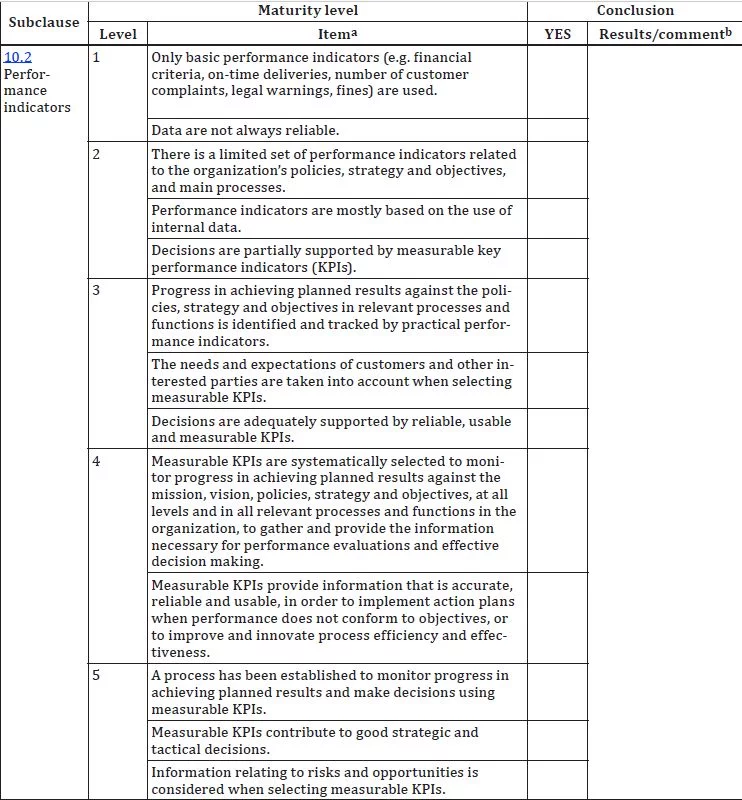
For organizations that want a structured maturity view rather than a metric list, ISO 9004 provides self-assessment tooling aimed at the sustained success of an organization, and ISO 10010:2022 gives quality culture a primary-source evaluation method. The Baldrige Excellence Framework offers a complementary criteria-based self-assessment, and the NIST Manufacturing Extension Partnership provides Lean resources that pair well with a formal system. MSI’s guide to process optimization skills covers the leadership competencies that make these measures usable rather than merely collected.
Performance Indicators Self-Assessment (Adapted from ISO 9004)
Worked Example
What Does the Loop Look Like Over Two Surveillance Cycles?
Baseline. Intervention. Result.
The following composite illustrates the continuous improvement and innovation pattern MSI client experience suggests is typical. Perennia Corp is a fictional mid-sized manufacturer used here to keep the example concrete without naming any real organization. The numbers are illustrative of commonly reported movement, not validated industry statistics.
Baseline — Month 0
Median corrective-action close-out: 84 days. Repeat findings within twelve months: roughly one in three. Improvement objectives: four stated, none with a numeric target. Innovation: an annual ideas campaign with no triage criteria and no owner after week two.
Intervention — Months 1 to 6
A single owner assigned with resourcing authority. Every Clause 6.2 objective rewritten with a baseline number and a target. Corrective actions given a mandatory effectiveness-verification step with a named verifier. Ideas routed into the same review forum as improvement actions, with published triage criteria and a standing quarterly funding decision.
Result — Two Surveillance Cycles Later
Median close-out under 30 days. Repeat findings roughly halved. All six objectives measurable, four met on schedule and two formally re-scoped with documented rationale. Two funded initiatives from the idea pipeline reached launch. The system did not become more elaborate — it became decisive.
Nothing in that sequence required new software, a transformation office, or a culture campaign. It required an owner, a baseline, a verification step, and a forum where decisions were actually made. Organizations typically report that the discipline of confronting real data at management review — rather than the certificate itself — is what changes how the business is run, and that continuous improvement and innovation begin behaving like one system at roughly the point the second cycle closes.
Where Decisions Actually Get Made
Turn Management Review Into the Forum That Funds Improvement
If your review produces minutes instead of decisions, the improvement loop never closes. MSI’s ISO Management Review Toolkits supply the agendas, input templates, and output records that make required inputs and required results explicit — across ISO 9001, ISO 13485, ISO 14001, ISO 45001, and ISO 7101, so dual-certified organizations can run one review instead of several.
Methods That Earned Their Reputation
What Do Lean, Kaizen, and Six Sigma Add to Continuous Improvement and Innovation?
Method. Not. Substitute.
Direct answer: Lean, Kaizen, and Six Sigma supply method for continuous improvement and innovation; a management system supplies governance. Lean removes waste, Kaizen distributes improvement responsibility across everyone, and Six Sigma reduces variation statistically. None of them specifies who decides, who funds, or how results are reviewed — which is precisely the gap ISO 9001 fills, making the two genuinely complementary rather than competing.
The Toyota Production System remains the most-cited example, and it is worth being accurate about what it actually demonstrates. TPS is built on two pillars — just-in-time and jidoka — supported by standardized work, and its improvement culture rests on genchi genbutsu: go to the source and see the facts for yourself. That principle is the operational ancestor of evidence-based decision-making in ISO 9001. Toyota did not succeed because it held a suggestion campaign; it succeeded because standardized work gave every suggestion a baseline to improve against.
Kaizen’s contribution is distribution. When improvement responsibility sits with a dedicated team, capacity is capped at that team’s size. When it sits with everyone, capacity scales with headcount — but only if the routing and triage exist to absorb the volume. Six Sigma’s contribution is statistical rigour for problems where intuition misleads, and it is formalized internationally in the ISO 13053 series. ASQ’s Six Sigma resources and the Deming Institute’s treatment of PDSA are the primary places to go for method depth.
The failure mode to avoid is method-shopping — adopting a new improvement methodology every eighteen months in place of building the governance that would have made any of them work. Method without governance produces trained people with nowhere to route their findings. Governance without method produces decisions made on opinion. Continuous improvement and innovation need both, and the sequencing matters: governance first, because it survives the departure of whoever championed the method.
Across the Portfolio
How Does Continuous Improvement and Innovation Work Across Other ISO Standards?
Same. Skeleton. Different Scoreboard.
Direct answer: Continuous improvement and innovation follow the same clause skeleton in ISO 9001, ISO 14001, ISO 45001, and ISO 7101 because all four share the Harmonized Structure — what changes is the scoreboard. ISO 13485 is the exception: it uses the older pre-Annex SL architecture and emphasizes maintaining effectiveness over open-ended improvement language, reflecting its regulatory posture.
The Harmonized Structure — the correct current term for the shared ten-clause architecture, contained in Annex SL of the ISO/IEC Directives Part 1 — means an organization that has built the improvement loop once has built it for every standard sharing that skeleton. What differs is what counts as a result.
- ISO 14001: the scoreboard is measurable environmental performance — emissions, resource intensity, waste — not the health of the system. The 2026 edition made that emphasis explicit throughout.
- ISO 45001: adds mandatory worker participation in cause evaluation and the hierarchy of controls at action selection. Improvement here is inseparable from consultation. OSHA’s recommended practices for safety and health programs align closely.
- ISO 13485: pre-Annex SL structure, management review at Clause 5.6, competence at 6.2, and the medical device file at 4.2.3 as the documented knowledge base. Since 2 February 2026 the FDA’s Quality Management System Regulation has incorporated ISO 13485:2016 into 21 CFR Part 820, which raises the stakes on evidence considerably.
- ISO 7101: healthcare quality management makes continual improvement one of three commitments the quality policy must state explicitly, and substitutes PDSA for PDCA to suit patient-safety risk.
For organizations certified to more than one standard, the practical consequence for continuous improvement and innovation is worth stating plainly: run one improvement process, one management review, and one set of objectives spanning all scopes. Running parallel systems doubles the administrative load without doubling the result, and it is one of the most common sources of avoidable cost MSI encounters. The guide to mastering management systems and the piece on defining roles and authorities as you scale both address the integration question directly. Accreditation status for any certificate can be verified through Global ACI, which replaced the previous international accreditation bodies on 1 January 2026.
Implementation
Seven Steps to Build Continuous Improvement and Innovation Into How You Operate
Start. Small. Stay.
Direct answer: Build continuous improvement and innovation in this order: establish baselines, assign an owner with resourcing authority, publish triage criteria, add effectiveness verification to corrective action, route ideas and improvements into one forum, set measurable objectives with targets, and report a trend line to leadership every cycle. Governance first, method second, tooling last.
- Establish the baselines first. Pick four to six indicators and record today’s number before changing anything. Without a baseline every later claim is unfalsifiable, and unfalsifiable claims lose executive attention fast.
- Name one owner with resourcing authority. Not a committee, not a steering group. One person who can say yes to a spend without convening anybody.
- Publish the triage criteria. State openly how an idea or a finding gets prioritized — impact, effort, risk, strategic fit. Published criteria convert “nothing happened to my suggestion” into “my suggestion ranked below these three.”
- Add effectiveness verification to every corrective action. A named verifier, a defined interval, and a documented conclusion. This single step does more for repeat-nonconformity rates than any other change available.
- Route improvements and ideas into one forum. Two separate processes create two separate backlogs and one confused workforce. Effective rollout leadership depends on people knowing where things go.
- Write objectives with baselines and targets. “Improve on-time delivery” is not an objective. “Raise on-time delivery from 88 percent to 95 percent by Q3, owner named, measured monthly” is.
- Report the trend, not the activity. Every management review sees the same indicators over time. Trend lines make progress and stagnation equally visible, which is the point.
Organizations pursuing a first certification usually build continuous improvement and innovation into implementation from the start, which is what SurePath is structured to deliver. Organizations already certified more often need the loop maintained year-round rather than reconstructed before each surveillance visit — the role SureResults plays. Either way, the sequencing above is the same, and MSI’s broader material on integrating improvement philosophies from the start, on sustaining excellence as a quality director, on the ISO 9001 design and development process, and on the business case for certification fills in the surrounding detail.
Talk It Through
A Planning Session, Not a Sales Call
Bring your current indicators and your last management review output. In one conversation you will know which part of the loop is open and what closing it would take. MSI’s track record includes 80+ certifications supported, 200+ audits attended, and 600+ professionals trained — the judgment comes from having watched this work and fail at close range for 28 years. Call 760-434-9141 or start with the ISO consulting overview.
Questions Leaders Ask
Continuous Improvement and Innovation: Frequently Asked Questions
Asked. Answered. Applied.
What is the difference between continuous and continual improvement?
Continuous means without interruption; continual means recurring with intervals between cycles. ISO standards deliberately use continual because organizations improve in cycles, not without pause. In business usage the terms are interchangeable, and this article uses continuous improvement and innovation as the everyday phrase for what ISO 9001 Clause 10 calls continual improvement.
Does ISO 9001 certification restrict innovation?
No — and the assumption behind the question is what blocks continuous improvement and innovation in most companies. The objection assumes standardization and creativity are opposed, but standardized work is what gives an improvement a baseline to beat and a new idea a stable platform to launch from. ISO 9001 requires you to control changes, not to avoid them — Clause 6.1 explicitly asks you to determine opportunities, and Clause 8.3 governs design and development of new offerings.
How long before continuous improvement and innovation show measurable results?
Leading indicators such as corrective-action close-out time typically move within one or two quarters because they respond to process changes directly. Lagging indicators such as repeat-nonconformity rate and cost of poor quality generally need two surveillance cycles to produce a trend anyone should trust. MSI client experience suggests the second cycle is where continuous improvement and innovation stop looking like a project and start looking like how the business runs.
Do we need ISO 56001 certification to manage innovation properly?
Not for most organizations today. Certification capacity is still developing, and the immediate value lies in borrowing the structure — innovation intent, policy, measurable objectives, a managed portfolio, and evaluation — and running it inside your existing ISO 9001 system. MSI does not implement ISO 56001; its current service lines are ISO 9001, ISO 13485, ISO 14001, ISO 45001, and ISO 7101.
What should we do before ISO 9001:2026 publishes on 16 September 2026?
Start accumulating culture and performance evidence now, because that evidence trail takes the longest to mature — it depends on real behaviour recorded over months. Objectives with baselines, participation records, speak-up data, and verified corrective actions all become more valuable the earlier they start. Transition arrangements will follow publication; the preparation that pays off is the kind that cannot be manufactured near a deadline.
Who should own continuous improvement and innovation in a mid-sized company?
One named individual with budget authority, reporting into top management, supported by process owners who hold the indicators for their own areas. The failure pattern is ownership by committee, where convening substitutes for deciding. ISO 9001 Clause 5.3 requires responsibilities and authorities to be assigned and communicated for exactly this reason.
How do we make improvement stick when the champion leaves?
Put continuous improvement and innovation into documented procedures, standing agendas, and required records rather than in one person’s initiative. That is precisely what a management system is for — governance that outlives its champion. If the process only runs because someone pushes it every week, it is a habit, not a system.
The Bottom Line
Continuous Improvement and Innovation Compound — If You Build the Loop
Measure. Decide. Repeat.
The organizations that pull away from their competitors are rarely the ones with the best single idea. They are the ones whose systems reliably convert ordinary ideas into implemented change, cycle after cycle, while their competitors are still deciding who owns the suggestion box. Continuous improvement and innovation are not a talent question. They are an architecture question, and the architecture is already written down in standards most organizations already hold a certificate against.
With ISO 9001:2026 arriving on 16 September 2026 and ISO 14001:2026 already in transition, the next eighteen months are an unusually good moment to rebuild the loop properly rather than patch it. Start with the baseline. Name the owner. Close the loop. The rest compounds.
References and Further Reading
- ISO 9001 — Quality management systems, Requirements
- ISO — Quality management and ISO 9001 overview
- ISO 56001:2024 — Innovation management system, Requirements
- ISO — Environmental management and ISO 14001
- ISO — Occupational health and safety and ISO 45001
- ISO — Medical devices and ISO 13485
- ASQ — Continuous improvement resources
- ASQ — Six Sigma resources
- The W. Edwards Deming Institute — PDSA cycle
- NIST — Baldrige Performance Excellence Program
- NIST — Manufacturing Extension Partnership
- Toyota — Toyota Production System
- OSHA — Recommended Practices for Safety and Health Programs
- Global ACI — accreditation body verification
- U.S. FDA — Medical Devices
About Management Systems International (MSI)
Diana Lynn is President and Principal ISO Consultant at Management Systems International (MSI), a veteran-owned, female-owned consulting firm she founded in 1998. With 28 years of experience, MSI’s track record includes 80+ certifications supported, 200+ audits attended, and 600+ professionals trained across manufacturing, technology, medical device, government, healthcare, and other regulated industries.
Today MSI implements ISO 9001, ISO 13485, ISO 14001, and ISO 45001, with an expanding focus on ISO 7101 healthcare quality.
msi-international.com · 760-434-9141
