
People Engagement · Quality Culture · ISO 9001:2026
Direct Answer
Engagement of people is one of the seven ISO quality management principles, and it describes a workforce that is competent, empowered, and genuinely invested in the work. When engagement of people is real, teams surface problems early, improve processes because they want to, and support one another through hard seasons. ISO 9001:2026, published September 16, 2026, now requires top management to promote quality culture and ethical behavior, which makes engagement of people a leadership deliverable rather than a hope.
Think about the last time Sunday evening felt like a countdown. The laundry is folded, the week ahead is loaded, and a quiet dread settles in because Monday means returning to a place that drains more than it gives. A recent post making the rounds on LinkedIn put it simply: work should lift you up and help you grow, and nobody is meant to stay somewhere that empties them out. It struck a nerve with thousands of readers, because almost everyone has worked in both kinds of places.
Diana Lynn, founder of Management Systems International (MSI), reposted it because it matched what she has watched for 28 years inside certified organizations. Where people love what they do, performance is better. Improvement ideas arrive without being begged for. New hires catch the enthusiasm from the people around them. And when an employee is hit by a family tragedy, coworkers close ranks around that person instead of looking away. That pattern has a name in the ISO world. It is called engagement of people, and it is not a perk. It is a principle the entire management system depends on.
This article explains what engagement of people means in ISO terms, why the 2026 edition of ISO 9001 raises the stakes, how engaged teams make a management system safer and faster to improve, and how to measure engagement of people with evidence your system already produces. It closes with a practical 90-day path and the tools MSI built to help.
The Principle
What Is Engagement of People in ISO Terms?
Competent. Empowered. Engaged.
The ISO quality management principles are the foundation under ISO 9001 and the rest of the ISO 9000 family. ISO lists seven of them in its quality management principles brochure: customer focus, leadership, engagement of people, process approach, improvement, evidence-based decision making, and relationship management. The new edition of ISO 9001 repeats that list in Clause 0.2 and builds the entire standard on it. MSI’s overview of the seven principles that form the foundation of your company’s quality walks through each one.
Engagement of people is the third principle, and ISO describes it as competent, empowered, and engaged people at all levels creating and delivering value. Each word carries weight. Competent means people have the skills the work demands. Empowered means they have the authority to act on what they see. Engaged means they care enough to use both. Remove any one of the three and the principle collapses: skilled people without authority grow frustrated, empowered people without skill create risk, and skilled, empowered people who no longer care simply do the minimum.
ISO takes this seriously enough to publish dedicated guidance. ISO 10018:2020, Quality management — Guidance for people engagement, gives organizations a framework for engaging people in the quality management system and strengthening their involvement and competence within it. When ISO announced the revision, it noted that staff often struggle to see how a quality system relates to their daily work, and positioned the standard as a way to help people feel like a valued part of the organization (ISO news release). A companion document, ISO 10010:2022, provides guidance on understanding, evaluating, and improving organizational quality culture, with a specific focus on people engagement and leadership.
That is the key insight many organizations miss. Engagement of people is not an HR initiative bolted onto a quality system. It is the fuel the quality system runs on. Procedures, objectives, audits, and corrective actions all assume that someone, somewhere, is paying attention and cares about the outcome.
Why Now
Why Does Engagement of People Matter More in 2026?
Measured. Required. Overdue.
Two forces are converging this year. The first is a global engagement slump. Gallup’s State of the Global Workplace 2026 report found that worldwide employee engagement fell to 20% in 2025, its lowest level since 2020, with an estimated $10 trillion in lost productivity. It was the first time Gallup recorded two consecutive years of decline, and the steepest drop came among managers, whose engagement fell from 31% in 2022 to 22% in 2025. When the people responsible for leading engagement are themselves disengaged, the effect cascades through every team.
The second force is the standard itself. ISO 9001:2026 was published on September 16, 2026, and its foreword names the introduction of quality culture and ethical behavior as one of the main changes. Three clauses carry it. Clause 5.1.1 i) requires top management to demonstrate leadership by promoting quality culture and ethical behavior. Clause 7.3 e) requires that people doing work under the organization’s control are aware of the organizational quality culture and ethical behavior. And Annex A.7.3 points directly to ISO 10018 for guidance on people engagement and ISO 10010 for guidance on quality culture. A new note in Clause 5.1.1 adds that culture and ethics are reflected in shared values, attitudes, practices, and actions.
Direct Answer
Engagement of people matters more in 2026 because ISO 9001:2026 turns quality culture into an auditable leadership requirement under Clause 5.1.1 i) and an awareness requirement under Clause 7.3 e). Annex A.7.3 points organizations to ISO 10018 for people engagement guidance. Culture now has to leave evidence, and engaged people are where that evidence comes from.
In practical terms, a certification body can now look for evidence that leadership actively promotes a culture of quality, and that people throughout the organization understand it. MSI’s guide to auditing quality culture under ISO 9001 explains what that evidence looks like, and the companion briefing on ISO 9001:2026 for boardrooms explains why directors should care. Culture that leaves no trail is now culture you cannot demonstrate. Engagement of people is where that trail begins, because engaged people generate the records, the suggestions, and the honest reports that prove the culture is real.
One clarification protects credibility. The ISO 9001 Clause 7.1.4 note describing social, psychological, and physical factors in the work environment, including stress reduction and burnout prevention, dates from the 2015 edition. It is not new in 2026, and notes are guidance rather than requirements. The only new sentence is that some of those factors can be influenced by quality culture and ethical behavior. For organizations with transition deadlines to plan, MSI’s article on ISO transition planning covers the three-year window.
Improvement
How Does Engagement of People Fuel Continual Improvement?
Notice. Speak. Improve.
Every improvement tool in a management system has the same hidden dependency. Corrective action needs someone to report the nonconformity. Internal audits need people willing to describe how work really happens. Risk registers need someone to point out the risk nobody has written down. Objectives need people who want to hit them. Engagement of people is the difference between a system that is fed a steady stream of honest inputs and one that is starved.
This is exactly what Diana described when she reposted that Sunday-night message: employees who love their work are eager for continual improvement. They do not wait for the annual audit to point out a problem. They raise it on Tuesday because it bothers them. MSI client experience suggests that organizations with strong engagement of people close corrective actions faster and see fewer repeat nonconformities, because the person who found the problem stays involved in fixing it.
ISO 9001 Clause 10.3 asks the organization to continually improve the suitability, adequacy, and effectiveness of its quality management system. That clause is unreachable through leadership effort alone. MSI’s guide to continual improvement in ISO 9001 shows why improvement objectives like engagement scores are not soft metrics, and the step-by-step framework in building a quality improvement culture explains why corrective action is what makes culture stick.
What Does Engaged Improvement Look Like on the Floor?
- A machine operator flags a fixture that is wearing unevenly before it produces a single out-of-tolerance part, because she knows the report will be welcomed, not treated as a complaint.
- A lab technician suggests reordering two test steps to cut a daily bottleneck, and the change is trialed within a week because the process owner trusts the person closest to the work.
- A customer service lead notices that three unrelated complaints share a root cause and brings it to the corrective action meeting without being asked.
- A new hire asks why a procedure step exists, and instead of being brushed off, the question triggers a review that removes a redundant record.
None of these examples require a new software platform. They require people who feel safe, capable, and valued enough to speak. If your corrective action process is where good intentions go to stall, the Catch. Correct. Continually Improve. corrective action and nonconformity procedure course helps teams build a system that turns those voices into verified fixes.
Safety
Why Do Engaged Workplaces Feel Safer?
Consult. Participate. Protect.
Diana’s second observation was that employees in engaged workplaces feel safer. That is not a coincidence, and ISO 45001 explains why. ISO 45001:2018, the occupational health and safety management system standard, is the only major management system standard that requires non-managerial workers to participate in hazard identification, risk assessment, and the development of controls. Clause 5.4 requires consultation and participation of workers, and it asks the organization to determine and remove obstacles or barriers to that participation.
That requirement is engagement of people written as a shall. A safety system designed at a desk and issued downward cannot meet it, because the people doing the most hazardous work know things the procedure writer does not. When workers help shape the controls, they trust them and follow them. When they are excluded, they work around them. MSI’s analysis of the ISO 45001 revision explains why worker voice and wellbeing are expected to grow even more prominent in the next edition.
Safety also extends beyond the physical. ISO 45001 Clause 6.1.2.1 already requires hazard identification to consider social factors, including workload, work hours, victimization, harassment, and bullying, along with leadership and the culture in the organization. ISO 45003:2021 provides guidelines for managing those psychosocial risks within an ISO 45001 system, with an emphasis on worker participation and ongoing improvement. The World Health Organization estimates that 12 billion working days are lost every year to depression and anxiety, costing the global economy nearly US$1 trillion.
Direct Answer
Engagement of people makes workplaces safer because ISO 45001 Clause 5.4 requires non-managerial workers to participate in hazard identification, risk assessment, and controls, while Clause 6.1.2.1 requires psychosocial factors such as workload and culture to be considered. Workers who help build controls trust them, report near misses, and speak up early.
Physical safety and psychological safety reinforce each other. A worker who fears ridicule will not report a near miss, and a team that punishes candor will not surface the hazard before it becomes an injury. MSI’s article on psychological safety at work explores how that trust holds up through disruption, and ISO standards and integrity shows why honest near-miss reporting is integrity with the highest stakes attached. For a structured starting point, the NIOSH Total Worker Health program and OSHA’s recommended practices for safety and health programs both treat worker participation as foundational.
Compassion
How Does Engagement of People Show Up When Life Hits Hard?
Notice. Support. Return.
The most moving part of Diana’s observation had nothing to do with metrics. She has watched what happens when an employee goes through a personal family tragedy. In organizations with strong engagement of people, coworkers become more supportive. They cover shifts without being asked. They check in. They make returning to work feel like coming back to a community rather than a machine.
That response is often treated as luck or personality. It is neither. It is the visible result of a culture where people are treated as whole human beings, and it can be designed into a management system the same way any other capability can. The U.S. Surgeon General’s Framework for Workplace Mental Health and Well-Being names five essentials: protection from harm, connection and community, work-life harmony, mattering at work, and opportunity for growth. Engagement of people touches every one.
Within an occupational health and safety system, ISO 45003 guidance covers supporting affected workers, including rehabilitation and return to work. WHO’s guidelines on mental health at work went further, recommending manager training for the first time to help leaders prevent stressful environments and respond to workers in distress. That is a management system insight: the supervisor’s response in the first 48 hours shapes whether an employee in crisis feels held or abandoned.
What Can a Management System Do When an Employee Is in Crisis?
- Give supervisors a simple response guide covering what to say, what not to say, which resources and leave options to share, and whom to notify, so compassion does not depend on each manager improvising.
- Plan workload redistribution in advance through documented cross-training, so a sudden absence does not overload the team that is trying to help.
- Build a return-to-work conversation into your HR procedure, focused on pacing, flexibility, and what support the person wants rather than a checklist of missed tasks.
- Protect privacy by design, so support is offered without the person’s situation becoming a topic of gossip.
- Review the response afterward, the same way you would review any other process, and improve it for the next person.
Organizations that plan this way discover something powerful. The employee who was supported through the worst month of their life rarely forgets it, and neither do the coworkers who watched. Engagement of people deepens at exactly the moment most organizations let it slip. MSI’s research on reducing employee turnover shows why that kind of loyalty outlasts pay increases, and brain drain explains what walks out the door when people do not feel cared for.
Measurement
How Do You Measure Engagement of People?
Count. Compare. Prove.
Culture resists measurement, which is why so many organizations fall back on an annual survey and call it done. A survey is useful, but it is a snapshot of opinion. A management system already produces something better: behavioral evidence. When people are engaged, they do things that leave records. When they disengage, those records thin out long before the resignation letters arrive.
MSI developed the Engagement Evidence Scorecard from patterns observed across 200+ audits attended and 80+ certifications supported. It uses eight indicators that most ISO 9001, ISO 14001, and ISO 45001 systems already generate. None requires new software, and together they give leadership a defensible picture of engagement of people for management review.
| Indicator | Where the evidence lives | What a healthy trend looks like |
|---|---|---|
| 1. Near-miss reporting rate | ISO 45001 incident and near-miss log | Rising reports with falling recordable injuries |
| 2. Employee-originated improvement ideas | Suggestion system, opportunity register | Steady volume and a growing share implemented |
| 3. Corrective action participation | Clause 10.2 records, root-cause team rosters | Frontline staff named on root-cause teams |
| 4. Corrective action close time | CAPA log | Shorter closure without shallower root causes |
| 5. Internal auditor volunteers | Audit program, competence records | More volunteers than seats available |
| 6. Awareness interview quality | Internal audit notes on Clause 7.3 | People explain their contribution in their own words |
| 7. Early-tenure retention | HR records, onboarding checklists | New hires staying past their first year |
| 8. Worker participation evidence | ISO 45001 Clause 5.4 consultation records | Non-managerial names on hazard reviews |
Direct Answer
Engagement of people is measured best through behavioral evidence the management system already produces: near-miss reporting rates, employee improvement ideas, corrective action participation and close time, internal auditor volunteers, awareness interview quality, early-tenure retention, and worker participation records. Tracked over time, these indicators show whether engagement is growing or quietly fading.
Two cautions keep the scorecard honest. First, a rising near-miss count is good news when injuries are flat or falling, because it means people trust the reporting system. Do not set a target to reduce near-miss reports. Second, track trends rather than single numbers, and compare each site or department against itself. MSI client experience suggests that the first two quarters of scorecard data usually reveal one or two departments where engagement of people has quietly eroded, often under a single stressed manager.
Why Can Good Auditors Sense a Happy Workplace?
Experienced auditors often know within the first hour whether they have walked into a happy place to work. They notice it in how people answer questions. In a workplace with strong engagement of people, an operator explains her process with pride, admits what still gives her trouble, and points out the improvement her team made last month. Nobody glances at a supervisor before answering. The records match what people say, and people talk about problems as things they are working on rather than things they are hiding.
That instinct is not guesswork. ISO 19011:2026, the guidelines for auditing management systems, describes the professional behaviors a competent auditor should show, including being observant, actively watching physical surroundings and activities, and perceptive, aware of and able to understand situations. It also asks auditors to be culturally sensitive, observant and respectful of the auditee’s culture. A skilled auditor’s sense of a workplace is those behaviors at work.
The sense is where good auditing starts, not where it ends. Auditors still base conclusions on objective evidence, so the feeling tells them where to look: the interview that sounded rehearsed, the suggestion box with no replies, the near-miss log that went quiet. That is why the Engagement Evidence Scorecard matters. It turns what a good auditor senses into something leadership can see, measure, and improve long before anyone arrives. Teams that want their own internal auditors to develop that same perception can build it through MSI’s ISO 9001 2-Day Internal Auditing Training.
Leadership
What Does Leadership Have to Do With Engagement of People?
Model. Listen. Remove.
Almost everything. The ISO quality management principles place leadership directly before engagement of people for a reason: leaders create the conditions under which people either lean in or pull back. ISO 9001 Clause 5.1.1 f) has long required top management to direct and support persons to contribute to the effectiveness of the quality management system. The 2026 edition adds the requirement to promote quality culture and ethical behavior, and Annex A.5.1 explains that ethical behavior in decisions, actions, and interactions can affect every aspect of quality.
Gallup’s finding that manager engagement fell to 22% should concern every quality leader, because managers translate policy into daily experience. A frontline employee does not experience the quality policy. They experience their supervisor’s reaction to a reported mistake. When that reaction is curiosity rather than blame, engagement of people grows. When it is blame, engagement of people dies in a single conversation.
Three Leadership Habits That Build Engagement of People
- Model the behavior you want reported. Leaders who openly share their own mistakes and what they learned make it safe for everyone else to do the same.
- Close the loop on every idea. An idea that disappears into silence teaches people to stop offering ideas. A short reply explaining what happened, even when the answer is no, keeps engagement of people alive.
- Remove obstacles, not just people. ISO 45001 asks organizations to remove barriers to participation. Apply that thinking everywhere: find the process, schedule, or policy that prevents people from contributing, and fix it.
MSI’s article on vision, values, and mission statements shows how to anchor those behaviors in values people recognize, and dysfunctional company symptoms traces how leadership gaps become system failures. Leaders who want structured development can explore the Inspired Leadership Workshop for ISO 9001 and ISO 13485, built to help leaders own their role in the management system.
Management Review
How Do You Bring Engagement of People Into Management Review?
Inputs. Decisions. Owners.
Management review is where engagement of people either becomes a leadership decision or stays a slogan. ISO 9001 Clause 9.3, ISO 14001 Clause 9.3, ISO 45001 Clause 9.3, and ISO 13485 Clause 5.6 all require top management to review the system at planned intervals. That meeting is the natural home for scorecard data, because it is the one forum where resources can be assigned and actions owned.
A practical approach is to add quality culture and engagement of people as a standing agenda item, presented by an owner who is not the quality manager. Feed it the Engagement Evidence Scorecard, the latest awareness interview findings from internal audits, and any themes from worker consultation. Then record decisions with owners and dates. MSI’s guide to management review benefits explains why a review built as a decision forum outperforms a reporting ritual, and the management review procedure article shows how the record proves it happened.
For organizations carrying both ISO 9001 and ISO 14001, MSI’s guidance on the ISO 14001:2026 management review shows how one combined meeting can cover both standards with clean attribution. The ISO Management Review Toolkits provide clause-by-clause agendas and minutes built so no input gets missed, including the culture and awareness evidence the 2026 edition now invites.
Integration
How Does Engagement of People Work Across an Integrated System?
One System. One Culture.
People do not experience separate management systems. A technician does not feel a quality culture in the morning and a safety culture after lunch. They experience one workplace, and engagement of people either thrives across all of it or struggles across all of it. That is why integrated systems amplify the principle.
ISO 9001 Clause 7.3, ISO 14001 Clause 7.3, and ISO 45001 Clause 7.3 all require awareness. ISO 9001:2026 Annex A.7.1.4 is explicit that work-environment needs arising from occupational health and safety or environmental management sit in those other systems, while their influence on quality processes can still be relevant. In an integrated system, one awareness program, one worker consultation process, and one improvement pipeline can serve all three standards. MSI’s guide to integrated management system implementation explains how to build that shared backbone.
For environmental teams, engagement shows up in spill reporting, energy-saving suggestions, and waste-reduction ideas from the people who handle materials every day. EHS managers updating an existing system can use the ISO 14001:2026 Procedure Templates and Guides, built to help experienced EHS managers update their ISO 14001:2015 system to the 2026 edition in about a week. Safety teams can build worker participation into every document through the ISO 45001 System Procedure Templates and Guides, where participation is designed into how each procedure is produced rather than added as a signature afterward. Healthcare organizations will find the same logic in healthcare quality culture under ISO 7101.
Action Plan
What Is a Practical 90-Day Path to Stronger Engagement of People?
Listen. Build. Prove.
Engagement of people does not improve through a poster campaign. It improves when people see the system respond to them. The following 90-day path works inside any ISO 9001, ISO 14001, or ISO 45001 system, and it produces evidence as it goes.
Days 1 to 30: Listen
- Baseline the Engagement Evidence Scorecard using the last twelve months of records, and note which indicators you cannot yet measure.
- Run short listening sessions in each department, asking two questions: what gets in the way of doing good work, and what would you fix first if it were up to you.
- Review your internal audit notes on awareness to see how people describe their contribution in their own words.
Days 31 to 60: Build
- Fix the top three obstacles people named, visibly and quickly, and tell them it was their input that drove the change.
- Give supervisors a simple idea-response standard, such as acknowledging every suggestion within five working days.
- Write or refresh the crisis-support and return-to-work steps in your human resource procedure so compassion does not depend on luck.
- Invite frontline volunteers to join root-cause teams and train as internal auditors through an option like the ISO Internal Auditor Online Workshop.
Days 61 to 90: Prove
- Re-measure the scorecard and compare trends against the baseline.
- Take engagement of people to management review as a standing item with owners, dates, and resource decisions.
- Share results with the workforce, including what did not work, because honesty about the system is itself an engagement signal.
MSI client experience suggests that organizations following a structured path like this usually see early movement in improvement ideas and near-miss reporting within the first quarter, while retention and culture-survey gains take longer to appear. Patience matters. Engagement of people is built through repeated proof that speaking up changes things.
For Employees
What Should You Do If You Are Not Thriving at Work?
Spread. Speak. Seek.
Most of this article speaks to leaders, but engagement of people is also a choice every employee makes each morning. Diana shares a simple piece of advice with the professionals who follow her weekly job postings, and it works in three steps.
If you are joyful at work, spread it and protect it. Enthusiasm is contagious. The engaged colleague who explains a process with pride, welcomes the new hire, and volunteers for the root-cause team is doing more for the culture than any policy. Guard that energy. Thank the people who make the workplace good, and say out loud what is working so it gets preserved.
If you are not thrilled, find the courage to say what others will not, to the right people. Many workplaces struggle because everyone sees the same problem and nobody names it to someone who can fix it. Raise it with facts, suggest a solution, and choose the forum where decisions get made, such as a supervisor, a corrective action request, a safety committee, or an internal auditor. ISO 45001 Clause 5.1 j) requires top management to protect workers from reprisals when reporting incidents, hazards, risks, and opportunities, and ISO 9001:2026 now asks leadership to promote ethical behavior. MSI’s article on ISO standards and integrity explains why honest speaking up is what these systems are built to reward.
If change truly is impossible, look for an organization that already runs a certified management system. A certificate does not guarantee a happy workplace, and some certified organizations still struggle. But across 28 years, MSI has watched uncertified companies grow into substantially better places to work as they build and certify their systems. MSI client experience suggests that ISO-certified organizations have a higher chance of having processes that work, clear roles, a working corrective action system, and a management review where problems reach leadership. When interviewing, ask which standards the organization is certified to, how improvement ideas are handled, and what happened to the last problem an employee raised. The answers reveal a great deal about engagement of people before you ever accept an offer.
Partnership
How Can ISO Consulting Accelerate Engagement of People?
Experienced. Practical. Proven.
Many organizations understand the principle but struggle to translate it into procedures, records, and leadership habits that hold up day to day. That translation is where ISO consulting earns its value. An experienced consultant has seen what works across dozens of cultures and can spot the one process quietly teaching people to stay silent.
MSI brings 28 years of ISO consulting experience, 200+ audits attended, 80+ certifications supported, and 600+ professionals trained across manufacturing, technology, medical device, government, healthcare, and other regulated industries. That track record means MSI has watched engagement of people succeed and fail in real systems, not in theory. MSI’s approach starts with a planning session that inventories the evidence you already have, so the organization builds only what is genuinely absent. For organizations pursuing certification from the beginning, SurePath provides a structured route, and MSI’s ISO consulting services cover ISO 9001, ISO 13485, ISO 14001, ISO 45001, and ISO 7101.
Leaders who want a short, executive-level view before committing can watch the ISO Executive Decision Briefs. Decision-makers focused on worker safety can start with the ISO 45001 Executive Brief. And teams exploring the broader mindset shift will find useful context in MSI’s article on the quality management mindset and its briefing on the ISO 9001:2026 ethics and culture update.
The payoff reaches well beyond the workplace. People carry their workday home with them. A job that drains someone shows up as short tempers at the dinner table, restless sleep, and dread every Sunday night. A job where someone feels capable, trusted, and cared for shows up as energy for family, health, and community. The Surgeon General’s framework describes workplaces as potential engines of mental health and well-being, places that can actively build well-being rather than only avoid harm. When more employees find genuine joy in their work, more people lead fuller and healthier lives. That may be the most meaningful result engagement of people will ever produce.
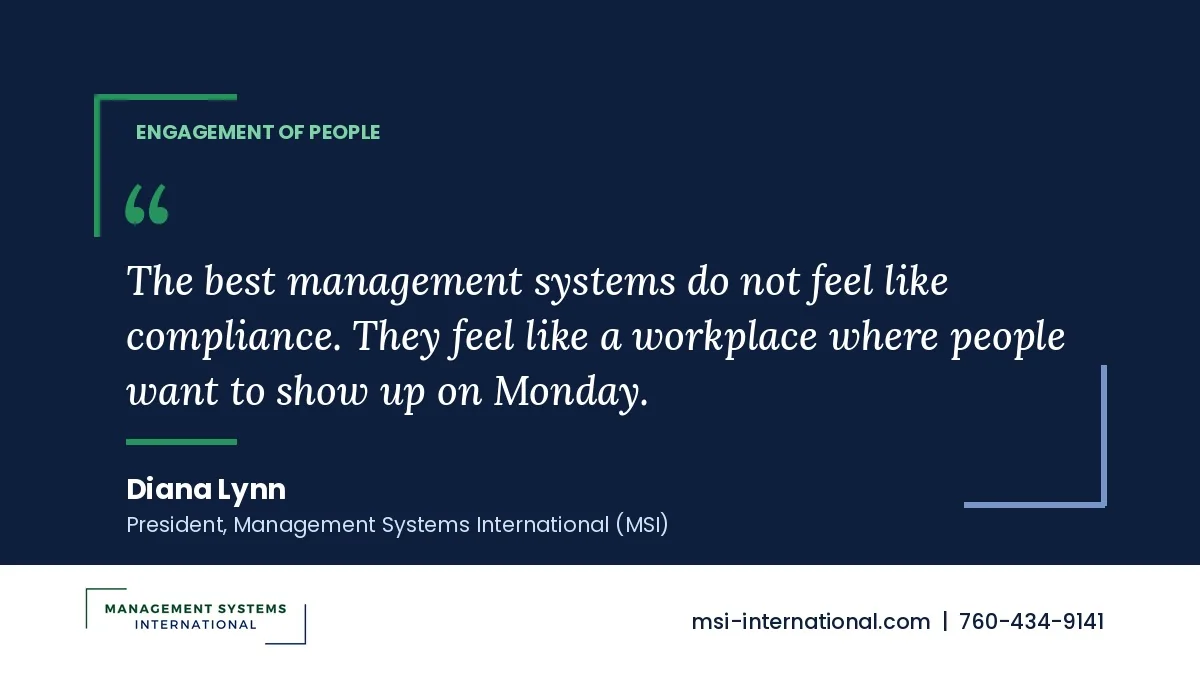
The best management systems do not feel like compliance. They feel like a workplace where people want to show up on Monday, because what they notice matters and what they suggest gets done. That is engagement of people, and it is worth building on purpose.
Diana Lynn, President, Management Systems International (MSI)
Next Steps
Ready to Build Engagement of People on Purpose?
Choose. Build. Thrive.
Most popular
Give Your People a System Worth Believing In
Procedures written the way work actually happens, so your team improves them instead of working around them. Thirteen procedure families and 100+ editable templates across ISO 9001, 13485, 14001:2026, 45001, and 7101, built to one architecture so every piece interlocks.
For leadership teams
Put Engagement on the Agenda Where Decisions Get Made
Clause-by-clause management review agendas and minutes that turn scorecard data, awareness findings, and worker input into owned, dated leadership decisions. Nothing required can be missed by not knowing it exists.
For safety teams
Build Worker Participation Into Every Safety Procedure
The full ISO 45001 procedure library, including psychosocial hazards under Clause 6.1.2.1 and a participation mechanism that satisfies Clause 5.4 from the way each document is produced.
For Clause 5 leaders
Lead the Culture ISO 9001:2026 Now Requires
A focused workshop that equips ISO 9001 and ISO 13485 leaders to own their role in the management system, from visible commitment to the quality culture the 2026 edition asks top management to promote.
Prefer to Talk It Through First?
Book a planning session with MSI. We will look at the engagement evidence you already have and map the shortest path forward. Call 760-434-9141 or explore our ISO consulting services.
FAQ
Frequently Asked Questions About Engagement of People
Clear. Direct. Useful.
What is engagement of people in ISO 9001?
Engagement of people is one of the seven quality management principles that ISO 9001 is built on, listed in Clause 0.2. It describes competent, empowered, and engaged people at all levels contributing to the organization’s ability to create and deliver value. ISO 10018:2020 provides detailed guidance on applying it.
Is engagement of people a requirement in ISO 9001:2026?
The principle itself is foundational rather than a numbered clause, but ISO 9001:2026 turns much of it into requirements. Clause 5.1.1 i) requires top management to promote quality culture and ethical behavior, Clause 7.3 e) requires awareness of that culture, and Annex A.7.3 points to ISO 10018 for people engagement guidance.
How does engagement of people relate to ISO 45001?
ISO 45001 Clause 5.4 requires consultation and participation of non-managerial workers in hazard identification, risk assessment, and controls, and asks organizations to remove barriers to participation. That is engagement of people applied to safety. ISO 45003 adds guidance on managing psychosocial risks such as workload and workplace culture.
How can we measure engagement of people without a new survey tool?
Use behavioral evidence your system already produces: near-miss reporting rates, employee improvement ideas, corrective action participation and close time, internal auditor volunteers, awareness interview quality, early-tenure retention, and worker consultation records. Track trends over time and bring them to management review.
Does engagement of people really improve performance?
MSI client experience suggests it does, because engaged people surface problems earlier and participate in fixing them, which shortens corrective action cycles and reduces repeat nonconformities. Gallup estimates that low engagement costs the global economy about $10 trillion in lost productivity.
Where should engagement of people appear in management review?
Add quality culture and engagement of people as a standing agenda item with a named owner. Present scorecard trends, internal audit findings on awareness, and worker consultation themes, then record decisions with owners and dates so the review produces action rather than a report.
Keep Reading
References and Sources
- ISO — ISO 9001 Quality management systems
- ISO — Quality management principles
- ISO 10018:2020 — Quality management: Guidance for people engagement
- ISO — New ISO standard rolls out practical tips for employee engagement
- ISO 10010:2022 — Guidance to understand, evaluate and improve organizational quality culture
- ISO 45001:2018 — Occupational health and safety management systems
- ISO 45003:2021 — Psychological health and safety at work
- ISO 19011:2026 — Guidelines for auditing management systems
- Gallup — State of the Global Workplace 2026
- World Health Organization — WHO and ILO call for new measures to tackle mental health issues at work
- U.S. Surgeon General — Framework for Workplace Mental Health and Well-Being
- NIOSH — Total Worker Health
- OSHA — Recommended Practices for Safety and Health Programs
- Global Accreditation Cooperation (Global ACI)
ISO 9001:2026 clause references are drawn from MSI’s licensed copy of the published standard. Accreditation of certification bodies through the transition is coordinated by Global ACI, which replaced IAF and ILAC on January 1, 2026.
About MSI
Diana Lynn, President and Principal ISO Consultant at Management Systems International (MSI), a consulting firm she founded in 1998. With 28 years of experience, MSI’s track record includes 80+ certifications supported, 200+ audits attended, and 600+ professionals trained across manufacturing, technology, medical device, government, healthcare, and other regulated industries. Today MSI implements ISO 9001, ISO 13485, ISO 14001, and ISO 45001, with an expanding focus on ISO 7101 healthcare quality. MSI is veteran-owned and female-owned. Call 760-434-9141 or visit msi-international.com.
