
ISO Transition Planning · The 2026 Revisions
Anchor. Reverse. Decide.
Direct Answer: ISO transition planning is the practice of building next year’s operating calendar backward from the two audit dates you do not control — your next surveillance visit and your recertification audit — rather than forward from the transition deadline. ISO 9001:2026 published on September 16, 2026, and ISO 14001:2026 published on April 15, 2026, each carrying a three-year window. For almost every certified organization, that means the real work lands inside the next twelve months, and the decision that matters most is which surveillance visit you fold the transition into.
Sound ISO transition planning produces four things before the calendar year turns: a named owner, a booked registrar slot, a documentation target date, and a run-in period long enough for revised procedures to generate real records.
There are roughly 1.4 million organizations holding a valid ISO 9001 certificate right now, and every single one of them is certified to an edition of the standard that no longer exists. That sentence sounds alarming. It is not. It is simply arithmetic, and arithmetic is the most reassuring thing in this entire subject — because arithmetic can be planned, and panic cannot.
Here is the part nobody says out loud at the conference sessions: you are not behind. Nothing has expired. Your certificate is valid on its printed date, your customers still recognize it, and your registrar is not going to appear unannounced. What has changed is that the window to move has opened, and windows close in the order people enter them. That is the entire reason ISO transition planning matters more than transition work right now. The work is modest. The scheduling is not.
Across 28 years and 200+ audits attended alongside clients, MSI has watched three revision cycles play out the same way. The organizations that finished early were not the ones with the best documentation. They were the ones whose leadership made a calendar decision twelve to eighteen months ahead of the audit and then let the quality or environmental function execute against it. The organizations that scrambled had excellent documentation and no date. This article gives you that calendar decision, and the ISO transition planning method behind it.
Definition
What Is ISO Transition Planning — and Why Does Next Year Decide It?
Define. Sequence. Commit.
Most people hear “transition” and picture a documentation project: read the new edition, mark up the procedures, reissue the manual, done. That picture is accurate about the effort and completely wrong about the duration. Documentation is the shortest leg of an ISO transition planning schedule and the only one you fully control. Everything else on the critical path belongs to someone else’s calendar.
Direct Answer: ISO transition planning differs from transition work in one respect: planning allocates the scarce resource, which is audit-day capacity, not staff hours. The revised procedures can be drafted in weeks. The registrar slot, the internal audit cycle, the management review, and the run-in period during which revised processes generate genuine records cannot be compressed at all. ISO transition planning is the discipline of protecting those four immovable items on a twelve-month calendar.
Consider what a transition audit actually examines. Your registrar’s auditor is not reading your revised procedure to see whether the words match the new clause numbering. That check takes ten minutes. The auditor is looking for evidence that the revised process has operated — that records exist, dated across a meaningful period, generated by people following the changed requirement in the normal course of business. You cannot manufacture that in the fortnight before the visit, and no template purchase shortens it.
That single fact reorganizes the whole exercise of ISO transition planning. Working backward from a transition audit, you need a completed internal audit against the revised requirements, a management review that evaluated the revised system, and a stretch of ordinary operation before both. Add those up honestly and the documentation start date lands roughly nine to twelve months before the audit — which is precisely why next year’s calendar is the one that decides the outcome, and why ISO transition planning is a leadership activity rather than a quality-department chore.
“The clause that moves the least in print moves the most in practice. After 200+ audits attended, the pattern has never varied: what costs organizations time is never the editing. It is the operating period nobody put on the calendar.”
The Reassurance
Why 1.4 Million Certified Companies Can Breathe
Valid. Recognized. Unhurried.
The most recent global count of accredited management system certificates, compiled through the IAF CertSearch database that feeds the annual ISO Survey, records 1,474,118 valid ISO 9001 certificates and 676,232 valid ISO 14001 certificates worldwide. ISO itself describes ISO 9001 as trusted by more than one million organizations. Every one of those certificates was issued against a 2015 edition. Every one of them has to move.
Now here is why that is good news rather than bad. A population that large does not get audited in a stampede, because the global registrar community physically cannot deliver 1.4 million transition audits in a compressed period. The system is built to absorb this. Certificates stay valid on their own terms throughout the window — publication of a new edition does not shorten, cancel, or invalidate the certificate hanging in your lobby. Your obligations between now and your transition audit are exactly what they were last month: keep the system running, keep meeting your surveillance commitments.
The second piece of reassurance is the size of the change itself. ISO describes the 2026 edition of ISO 9001 as focused on clarity and usability rather than reinvention — the process approach, customer focus, risk-based thinking, and continual improvement all survive intact. On the environmental side, ANSI’s summary of ISO 14001:2026 notes that the edition introduces editorial improvements and sharper guidance rather than a wholesale rewrite. If your management system is genuinely operating, you are closer to compliant than you feel, and ISO transition planning becomes an exercise in scheduling rather than rebuilding.
Direct Answer: No, your certificate did not expire when the new editions published. ISO 9001:2015 is withdrawn as a standard, but certificates issued against it remain valid through the transition window on their original expiry dates. The only thing ISO transition planning has to protect is the date by which your registrar issues a certificate against the 2026 edition — and that date is set by your audit cycle, not by the publication date.
The third piece is the one leaders underweight: this revision cycle is genuinely useful. ISO 9001:2026 sharpens leadership expectations around quality culture and ethical behavior, and separates risks from opportunities so the two get treated as the different disciplines they are. Organizations that already run a real management review and a real internal audit function will find the 2026 edition describes something they are close to doing, which makes ISO transition planning a far shorter conversation than most leaders expect. MSI’s analysis of what the revision means for boardrooms and governance works through that alignment in detail.
The Method
ISO Transition Planning Starts From Dates You Do Not Control
Anchor. Subtract. Schedule.
Every transition plan MSI has seen fail started at the same place: the deadline. Someone writes “September 2029” on a slide, counts the months, concludes there is plenty of room, and schedules the kickoff for a quarter that feels comfortable. Three years later the room has vanished, because the deadline was never the constraint.
Correct ISO transition planning inverts that. You begin with the two dates your registrar already owns — your next surveillance audit and your recertification audit — and derive every other date from them. Those two are facts. The deadline is a boundary. Planning against a boundary produces a plan that finishes exactly at the boundary, with no margin for the one process that always takes longer than expected.
Below is the ISO transition planning worksheet MSI now builds into client management reviews. It is deliberately austere: nine milestones, two anchor dates you already know, and seven dates you calculate from them. Leaders who fill this in during a single review meeting leave with a transition plan. Leaders who leave it for “the quality team” get a document update and no schedule.
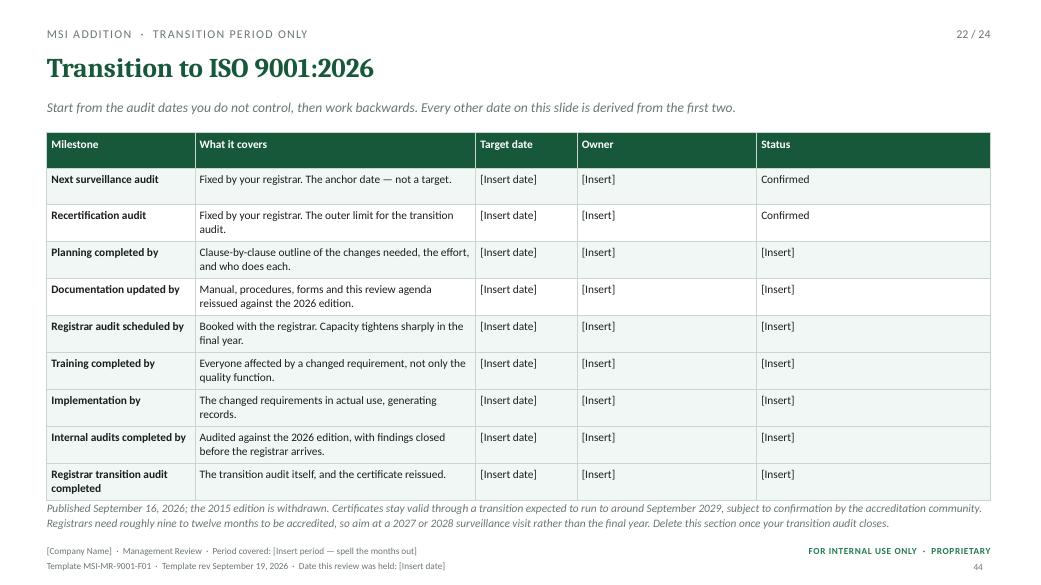
The transition planner MSI adds to management review agendas during a revision cycle. Start from the audit dates you do not control, then work backwards.
The Calendar
The Nine-Milestone ISO Transition Planning Calendar
Nine Rows. One Truth.
Each ISO transition planning milestone below carries an owner and a date. The first two are given to you. The remaining seven are yours to set, and setting them is the whole of ISO transition planning.
The anchor date, not a target. Everything else is derived from it. Confirm it in writing rather than from memory; surveillance dates drift by a month or two more often than people expect.
The outer limit for your transition audit. If your recertification falls inside the transition window, folding the transition into it is usually the cheapest route available.
A clause-by-clause outline of the changes needed, the effort each requires, and who does each one. This is the deliverable that turns a revision into a project. Most organizations can finish it in two working sessions.
Manual, procedures, forms, and the management review agenda itself reissued against the 2026 edition. Budget roughly an afternoon per procedure for renumbering and cross-reference repair, plus real drafting time for anything genuinely new.
Booked, confirmed, in writing. This is the row that punishes delay, because capacity tightens sharply as the window narrows and the organizations that booked first get the dates that suit them.
Everyone affected by a changed requirement, not only the quality or environmental function. MSI has trained 600+ professionals through revision cycles, and the consistent finding is that awareness training for process owners saves more audit time than auditor training does.
The changed requirements in actual use, generating records. This is the run-in period, and it is the row most ISO transition planning efforts omit entirely. Treat three to six months as a floor.
Audited against the 2026 edition, with findings closed before the registrar arrives. An internal audit that finds nothing is not a clean system; it is an audit that was scheduled too early.
The audit itself, and the reissued certificate. Once this row closes, delete the transition block from your review agenda and return to the normal cycle.
Direct Answer: The correct order for ISO transition planning is backward, not forward. Start at the registrar audit date, subtract the internal audit cycle, subtract the management review that must evaluate the revised system, subtract a three-to-six-month run-in during which revised procedures generate records, then subtract documentation time. What remains is your start date — and for most organizations transitioning in 2027 or 2028, that start date falls inside the next twelve months.
Skip the Blank Page
Your Transition Documents, Already Written — So Milestone 4 Takes a Week, Not a Quarter
The documentation row of your ISO transition planning calendar is the one you fully control, which makes it the one worth buying back. MSI’s ISO Procedure Templates and Guides library hands you editable procedures, worksheets, and worked examples written to the current clause numbering — with the interpretation already done, drawn from 28 years of practice and 200+ audits attended. Integrated versions cover ISO 9001, ISO 14001, and ISO 45001 in a single document set, so one determination feeds three registers kept properly distinct. Your team adapts a defensible set instead of drafting from nothing.
Quality Side
ISO Transition Planning for ISO 9001:2026: What Next Year Must Carry
Culture. Evidence. Time.
ISO 9001:2026 published on September 16, 2026, and ISO 9001:2015 is now withdrawn and replaced. The sixth edition is available from ISO as the current requirements standard. A three-year transition window is the long-established pattern for a revision of this kind, which puts the practical outer limit somewhere around September 2029 — subject to confirmation by the accreditation community.
That caveat is not pedantry, and it changes how a careful leader plans. Transition periods are set by the accreditation bodies, not by ISO. Since January 1, 2026, that role belongs to Global Accreditation Cooperation Incorporated (Global ACI), which replaced the former International Accreditation Forum and the International Laboratory Accreditation Cooperation. Its published resolutions are the authoritative source for transition arrangements. Until a global mandatory document lands, individual accreditation bodies have been setting their own dates — which is exactly why ISO transition planning should anchor on your registrar’s written answer rather than on a date read off a vendor’s infographic.
There is a second timing reality worth building into next year’s ISO transition planning, and it cuts in your favor. Certification bodies cannot issue accredited certificates to a new edition until they have themselves been assessed and accredited against it, and that process typically runs nine to twelve months after publication. Practically, the first accredited ISO 9001:2026 certificates arrive in the second half of 2027. Your ISO transition planning therefore has a natural landing zone: a 2027 or 2028 surveillance visit, not a 2026 scramble and not a 2029 cliff.
The Four Changes That Actually Consume Calendar Time
Most of the 2026 edition’s additions sit in the introduction and Annex A, which are guidance rather than requirements — one reason ISO transition planning on the quality side is narrower than it first looks. The requirement changes that touch your schedule are few, and they share a characteristic: each one needs evidence that accumulates over time rather than a document that can be written in an afternoon.
- Quality culture and ethical behavior become auditable. Leadership is asked to demonstrate them; the wider organization is asked to understand them. Auditors will look for communications, decision records, and people who can explain expectations in their own words. That evidence trail is the longest-maturing item in the entire revision, which is why it belongs at the front of your calendar rather than the back. MSI works through the acceptable evidence in its guide to auditing quality culture.
- Risks and opportunities are separated. The two have always been different disciplines treated as one register. Splitting them is a half-day of design work and a full cycle of operation before it looks natural.
- Climate change is formally embedded. The 2024 amendment is now part of the standard text, so climate must be considered when determining context. Most organizations addressed this in 2024; if yours did not, it is a context-review item, not a sustainability project, and it belongs early in ISO transition planning rather than late.
- Clarity edits ripple through cross-references. Renumbering and rewording break links across a 2015-era document set. Cheap per document, expensive across forty of them.
ISO publishes a short myths-versus-facts briefing that is worth circulating to anyone in your organization convinced the revision demands a rebuild. It does not. MSI’s own read on when to bring in outside help, and when not to, is set out in its timing test for ISO 9001:2026 support.
Direct Answer: For ISO 9001:2026, the single highest-value act of ISO transition planning costs nothing and takes twenty minutes: add quality culture and ethical behavior as a standing item on your next management review agenda and record the discussion in the minutes. That entry starts the evidence trail the revised standard expects, it dates from today rather than from the month before your audit, and it is the one artifact that cannot be created retroactively.
Environmental Side
ISO 14001:2026 Transition Planning Runs on a Shorter Clock
Earlier. Tighter. Firmer.
If you hold an environmental certificate, your clock started five months before the quality one did. ISO 14001:2026 published on April 15, 2026, and accreditation bodies have been setting transition milestones against it since. The UKAS technical bulletin on the environmental transition is a useful window into how accreditation bodies are sequencing their own readiness, and ANAB’s guidance covers what certified organizations should expect from their certification bodies. A widely applied outer date for environmental transition decisions is April 30, 2029, with new 2015-edition certificates typically unavailable after roughly eighteen months post-publication.
That offset matters for one practical reason. An EHS manager reading “three years” on both standards will assume a shared runway. There is no shared runway. Environmental ISO transition planning has to land roughly two surveillance visits earlier than the quality equivalent, and in an integrated system that asymmetry is the thing that decides whether you run one project or two.
For EHS Managers on the Shorter Clock
Move Your ISO 14001:2015 System to the 2026 Edition in About a Week
The ISO 14001:2026 Procedure Templates and Guides bundle was built for exactly one reader: an experienced environmental manager who already runs a working system and needs it moved to the new edition without a rebuild. Revised procedures, context and aspects worksheets, the audit-objectives field, and the restructured review agenda — mapped change by change to the 2026 clauses, in editable Word, with the interpretation done. Experienced managers using the bundle typically complete the documentation milestone in a week rather than a quarter.
Where the Environmental Work Actually Sits
ISO has said the 2026 edition added no new requirements. That statement is easy to misread as “nothing to do.” Put the clauses side by side and four areas consume real calendar time:
- Context widened. External and internal issues now explicitly include environmental conditions affecting or affected by the organization — pollution levels, natural resource availability, climate change, biodiversity, ecosystem health. A context review that names climate alone no longer describes what the clause asks for. MSI’s deep read on Clause 4.1 in the 2026 edition details what auditors examine here.
- Aspects cascade from context. A widened context feeds a widened aspects register, which feeds objectives and operational controls. This is the longest chain in the environmental transition and the one a mapping table cannot surface, because the clause numbers look identical on both sides. MSI’s analysis of what changed in the aspects clause covers it.
- Internal audits must state objectives. Each internal audit now defines objectives in addition to scope and criteria — a normative requirement that lands directly on your audit plan template and procedure.
- Management review restructured. The review clause was reorganized, and because changes in context are a named review input, the review is where a shallow context update becomes visible.
There is a companion change with no transition period at all. ISO 19011:2026 published on May 27, 2026, and the 2018 edition was withdrawn immediately. If your internal audit procedure cites the 2018 guidance, that reference is already out of date. MSI has set out the six edits an internal audit procedure needs, and the broader picture of how audit planning changes across standards.
Milestone 6 · Training Completed By
Walk Your Whole Team Through Every 2026 Change — Clause by Clause, Before the Run-In Starts
Revised procedures only generate usable records if the people following them understand what changed and why. That is the training milestone in your ISO transition planning calendar, and it is the one that quietly decides how the run-in period goes. MSI’s ISO 14001:2026 Transition course takes your environmental management system through every change in the new edition — the widened context, the aspects cascade, the audit-objectives requirement, and the restructured review — so your next surveillance audit is a non-event rather than a discovery exercise.
Take the ISO 14001:2026 Transition course →
Auditing to the 2026 edition takes more than the old checklist. ISO 14001:2026 Internal Auditing trains your auditors on the revised clauses, including the new per-audit objectives requirement, so milestone 8 lands clean.
Both Certificates
One Program, Two Clocks: ISO Transition Planning for Dual-Certified Sites
Once. Not Twice.
If you hold both certificates, you are running two clocks through one organization, one document set, and one pool of auditor time. The instinct is to treat that as double trouble. It is closer to the opposite — provided the decision gets made deliberately and early, which is the whole point of doing ISO transition planning at leadership level rather than inside two separate functions.
Both 2026 editions sit on the same Harmonized Structure, which is what makes combined ISO transition planning possible at all. Context, leadership, planning, support, operation, performance evaluation, and improvement carry the same clause architecture in each. An organization with integrated procedures can run one context review, one documentation pass, one training cycle, and one internal audit program covering both scopes — then transition both certificates through a single well-sequenced project. Organizations that run two separate efforts duplicate the documentation, double the audit load, and pay twice for the same determination.
Direct Answer: For a dual-certified organization, correct ISO transition planning sequences to the earlier clock. Build the combined program around the environmental deadline, carry the quality changes through the same documentation and audit passes, and transition both certificates at one registrar visit where your cycle allows it. Planning to the later date and hoping to catch the environmental system up separately is the single most expensive sequencing error available in this revision cycle.
One caution keeps the integration honest: the standards diverge in places, and a merged procedure must mark which obligation comes from which standard so single-standard requirements survive the merge. Where they conflict, the stricter requirement wins. MSI works through the full sequencing argument in its guide to running a single ISO 9001 and 14001 transition, and the arithmetic behind the two windows in its analysis of the 2026 transition deadlines.
Hold Three or Four Certificates? This Is the Consolidation Window
Almost every organization running multiple management systems has, at some point, put consolidation on a wish list and taken it back off. The reasoning is always the same and always sound: merging separate quality, environmental, and safety document sets is real work, it produces no new capability on the day it finishes, and nobody wants to fund a rewrite whose only benefit is tidiness. So the parallel systems survive another year, each with its own manual, its own audit schedule, its own review meeting, and its own version of the same context determination.
A revision cycle removes that objection entirely. You are reopening the documents anyway. The renumbering, the cross-reference repair, the context rework, the audit procedure edits — all of it is happening to every affected system in the same window, funded by a budget that has already been approved for the transition. Restructuring while the documents are open costs a fraction of restructuring as a standalone initiative, and it is the only moment in a decade when the business case writes itself. Leaders who build consolidation into their ISO transition planning get an integrated system for close to the price of a transition.
Direct Answer: If you hold three or more certificates, the strongest argument for consolidating them into one integrated management system is timing, not theory. ISO transition planning already requires reopening the documents, reworking context, revising the internal audit procedure, and retraining process owners. Doing that once across all scopes costs marginally more than doing it for one standard and substantially less than a separate integration project later.
What consolidation folded into ISO transition planning actually buys, in the order the savings arrive:
- One context determination feeding several registers. The widened environmental context work is the heaviest single item in this revision cycle. Done once, it feeds the environmental aspects register, the quality risk register, and the safety hazard register — each kept properly distinct, but derived from a single exercise rather than three overlapping ones.
- One internal audit program instead of three. Combined audits are the normal case in an integrated system, and a single pass across quality, environmental, and safety scopes replaces three separate schedules, three sets of auditor assignments, and three rounds of auditee disruption. It has staffing implications — auditing three disciplines in one pass requires broader competence — and those belong in the plan explicitly.
- One management review with standard-specific sections. Every standard here requires management review at planned intervals. One meeting with clearly labelled sections satisfies all of them and puts leadership in front of the whole operating picture rather than three partial ones.
- Combined registrar audits. A combined audit prices very differently from separate certifications, and registrars vary in how they treat integrated systems. Ask the question during the registrar conversation below — it is one of the few places where consolidation shows up as a line-item saving rather than an efficiency.
- One document control system. Quieter than the rest and compounding. Every future change lands once instead of three times.
Two boundaries keep consolidation honest. First, ISO 13485 does not share the harmonized ten-clause structure — it predates it, its management review inputs are more numerous and differently organized, and its corrective action structure differs from the quality standard’s. Device manufacturers can integrate at the process level and should not force a clause-for-clause merge. Second, wherever two standards state the same obligation differently, the merged procedure takes the stricter requirement and records which standard each obligation came from, so single-standard requirements survive the merge intact. MSI’s integrated internal audit procedure template documents all ten divergences across the three standards, in three directions, with the rejected alternatives recorded — which is the part organizations usually re-derive from scratch.
If consolidation is on the table, decide it in the same management review where your ISO transition planning dates get set. Bolting an integration decision onto a transition already in flight is the one sequence that genuinely does cost more than running the two efforts separately.
Budget Season
What Belongs in Next Year’s Budget Line
Four Buckets. No Surprises.
ISO transition planning budgets fail in a predictable way: they fund the documentation and the audit, and silently omit the two lines in between. Here are the four buckets, in the order they hit the ledger.
- Documentation revision. Procedures, forms, manual, agendas. Smallest and most predictable line. Templates compress it dramatically.
- Internal effort during the run-in. Process owners operating changed requirements while everything else continues. Rarely costed, always consumed. This is the line that decides whether the plan is real.
- Internal audit and management review cycles. An extra internal audit pass and, during a transition, a tighter review cadence. MSI’s general recommendation is a six-month review interval; during a transition, quarterly is better, and the standard supports it — reviews happen at planned intervals, and an organization undergoing significant change has an obvious reason to plan them closer together.
- External effort. The transition audit itself, plus whatever training, templates, or ISO consulting support you buy to avoid re-deriving decisions other organizations have already made. MSI’s breakdown of what ISO certification actually costs and its environmental transition cost analysis give realistic shapes for both.
“A transition budget that funds only the first and fourth buckets is a plan that discovers the second and third in the final year — which is the worst possible time to find them.”
This Quarter
The Registrar Conversation Worth Having Before the Year Turns
Ask. Record. Book.
One email, five questions, and your ISO transition planning stops being an estimate. Send it to your registrar’s scheme manager rather than the scheduler, and ask for the answers in writing.
- When did you gain — or when do you expect to gain — accreditation to issue certificates against each 2026 edition we hold?
- What is the last date you will accept a transition audit for each of our certificates?
- How many additional audit days does a transition add to a surveillance or recertification visit for our scope?
- Can both of our certificates transition at one combined visit, and what does that do to audit days?
- What is your current lead time for booking, and how far ahead do we need to commit?
Those five answers convert nine speculative ISO transition planning milestones into a schedule with real dates. They also surface something leaders rarely check: whether their registrar is actually positioned to serve them on the timetable they assumed. MSI’s guide to choosing and comparing registrars covers how to read the answer you get back, and its overview of how the audit relationship works explains why the registrar sits outside your control by design.
Presenting the backward arithmetic once, in a management review, does more to protect a transition timeline than a year of status emails — because the people who control the resources are in the room when the math is shown.
Where the Plan Gets Approved
Turn Management Review Into the Meeting Where the Transition Date Actually Gets Decided
A transition plan approved in a hallway is a wish. A transition plan approved in a management review is a record — with an owner, a date, and resources committed by the people who control them. MSI’s ISO Management Review Toolkits give you the agenda, the input pack, the minutes template, and the decision log, structured clause by clause so every required input is covered and every output is a real decision. Built for ISO 9001, ISO 13485, ISO 14001, ISO 45001, and ISO 7101 — including the transition block you drop in for the duration and delete once your certificate reissues.
See the ISO Management Review Toolkits →
Related reading: what a management review procedure has to prove and why the environmental review agenda changes in 2026.
Patterns From 200+ Audits
Five Patterns That Quietly Cost Leaders a Year
Spot. Name. Avoid.
MSI has supported 80+ certifications and sat alongside clients in 200+ audits across manufacturing, technology, medical device, government, healthcare, and other regulated industries. Across three revision cycles, the same five patterns appear. None of them is a documentation failure.
1. Planning forward from the deadline
Covered above, and worth repeating because it is the most common by a wide margin. A plan that starts at the deadline finishes at the deadline. ISO transition planning that starts at the audit date finishes a cycle early, with room to absorb the one thing that always slips.
2. Treating a mapping table as the whole method
Old clause on the left, new clause on the right, edit until the columns agree. It is fast, cheap, and genuinely correct for a large share of both revisions. But a mapping table can only carry forward requirements that had a predecessor. Anything genuinely new has nothing in the left column to map from, so it drops silently out of the plan and out of the budget. Read the 2026 editions forward, clause by clause, as if implementing fresh, and use the mapping table only to work out what you can reuse.
3. Delegating the calendar to the quality function
A quality or environmental manager can execute a transition. They cannot commit the organization’s capital, book a registrar against a budget they do not own, or free a process owner’s time in a quarter that belongs to operations. ISO transition planning is delegated well and decided badly more often than any other failure on this list.
4. Assuming the two standards share a runway
They do not. Five months separate the publication dates, and accreditation bodies have moved faster on the environmental side. Dual-certified organizations that plan to the quality clock discover the environmental one late.
5. Booking the transition into the final available visit
Registrar capacity tightens sharply in the last twelve months of any transition window, and a nonconformity raised at a final-year transition audit leaves no cycle in which to close it before the certificate lapses. Aim for a 2027 or 2028 visit. The organizations that do this are not more diligent than everyone else; they simply made the ISO transition planning decision while folding was still possible.
Direct Answer: The most expensive mistake in ISO transition planning is not a technical one. It is scheduling the transition audit into the last available surveillance visit, which removes every remaining cycle in which a finding could be closed. Booking one visit earlier costs nothing extra and converts a hard edge into a soft one.
Next Twelve Months
Your Twelve-Month ISO Transition Planning Calendar
Quarter. By. Quarter.
Here is what a calm year of ISO transition planning looks like for an organization aiming at a 2027 or 2028 transition audit. Nothing in it requires heroics, and every item fits inside a normal operating cycle.
Send the five-question registrar email. Fill in the nine-milestone planner at a management review. Name one accountable owner. Add quality culture and ethical behavior to the standing review agenda. Buy the standards themselves so your team is reading the text rather than a summary of it.
Run a current-state assessment clause by clause against each 2026 edition you hold, reading forward rather than mapping backward. Produce the change list with effort estimates and owners. Book the registrar slot. Approve the budget across all four buckets.
Reissue documentation against the 2026 clause numbering. Update the internal audit procedure for audit objectives and the ISO 19011:2026 references. Train everyone touched by a changed requirement, not only the quality function. Move the review cadence to quarterly for the duration.
Run the revised processes in normal business and let them generate records. Do not audit yet. This quarter looks like the least productive one on the calendar and is the one that decides the audit outcome.
The year after that carries the internal audit against the 2026 requirements, the management review that evaluates the revised system, finding closure, and the registrar visit. Spread across two ordinary years, ISO transition planning stops being a project and becomes a cadence — which is exactly how organizations that never seem rushed manage to never seem rushed.
Keep Reading
- ISO 2026 Transition Deadline: Why the Math Wins
- ISO 9001 and 14001 Transition: Why One Plan Wins
- ISO 14001:2026 Updates: Complete Guide to New Requirements
- Internal Audit Risk Matrix: Why Essential Proof Wins
- ISO 14001 Continual Improvement: Why Proof Wins
- ISO Consulting: Confident Certification Audits Win
- The Future of ISO: What the 2026 Revisions Mean for Your Certification Strategy
Thirty Minutes, No Pitch
Have MSI Map Your Transition Against Your Own Surveillance Calendar
Bring your next two audit dates and the standards you hold. MSI will work the backward arithmetic with you on the call and tell you which surveillance visit your transition should fold into — and what has to be true by when for that to work. It is a working conversation, not a sales script, drawn from 28 years, 80+ certifications supported, and 200+ audits attended.
Call MSI at 760-434-9141 to book a planning session.
Deciding whether to pursue or keep certification at all? Watch MSI’s ISO Executive Decision Briefs for the leadership view. Pursuing a first certificate? See SurePath. Already certified and want the year-round work handled? See SureResults.
Answers
Frequently Asked Questions About ISO Transition Planning
Ask. Answer. Apply.
Is my ISO 9001:2015 certificate still valid?
When should we actually start ISO transition planning?
Can we transition ISO 9001 and ISO 14001 at the same audit?
Why can’t we just update the documents a few months before the audit?
Who sets the transition deadline now that the IAF no longer exists?
How much of next year does ISO transition planning really consume?
We hold three certificates. Is this a good time to combine them into one system?
Do we need outside help, or can we run this internally?
References & Primary Sources
- International Organization for Standardization — ISO launches update to the world’s most widely used quality management standard (September 16, 2026)
- ISO — ISO 9001:2026, Quality management systems — Requirements
- ISO — ISO 9001:2015 (withdrawn and replaced)
- ISO — ISO 9001:2026: what businesses need to know
- ISO — ISO 9001 made simple: separating myths from facts (PDF)
- ISO — ISO 14001:2026, Environmental management systems — Requirements with guidance for use
- ISO — ISO 14001 standard overview
- ISO — ISO 19011:2026, Guidelines for auditing management systems
- Global Accreditation Cooperation Incorporated — General Assembly resolutions
- UKAS — Technical bulletin: EMS ISO 14001:2026 transition
- ANAB / ANSI — ISO 14001:2026 transition: key changes and how to prepare
- ANSI — ISO 14001:2026 environmental management systems requirements
- IAF CertSearch — global database of accredited management system certifications (source data for the annual ISO Survey)
About Management Systems International (MSI)
Diana Lynn, President and Principal ISO Consultant at Management Systems International (MSI), a consulting firm she founded in 1998. With 28 years of experience, MSI’s track record includes 80+ certifications supported, 200+ audits attended, and 600+ professionals trained across manufacturing, technology, medical device, government, healthcare, and other regulated industries. Today MSI implements ISO 9001, ISO 13485, ISO 14001, and ISO 45001, with an expanding focus on ISO 7101 healthcare quality.
Veteran-owned and female-owned. msi-international.com · 760-434-9141
