
Hiring & Competence | ISO 7101:2023
A healthcare quality manager job description written from an ISO 9001 template will miss most of the job.
ISO 7101:2023 is the first international standard written specifically for healthcare quality, and it does not behave like the industrial standards. Competence requirements include credentialing and privileging. Clause 8 runs from medical gas pipelines to blood transfusion protocols. Nonconformity handling requires informing the service user. None of that appears in a quality template, and none of it is optional.
Safety. Experience. Evidence.
A healthcare quality manager job description has a harder job than its industrial cousins, because the standard behind it distributes requirements that a quality reader expects to find in one place. Workforce numbers sit in the leadership clause. Named training topics sit in competence. Consent sits in service provision. Statutory duties appear throughout rather than in a single compliance clause. Write the healthcare quality manager job description from an ISO 9001 template and you will miss them precisely because you will be looking in the wrong place.
Direct Answer
A complete healthcare quality manager job description runs seventeen numbered sections, plus a vision, mission and values block at the top. In healthcare that block is not a courtesy: ISO 7101:2023 Clause 5.1 a) requires top management to define the organization’s mission, vision and values, so the block at the top of the document is evidence against a named requirement. The sections carrying the ISO 7101 weight are the reporting line, the basic function and scope, principal responsibilities with percentage of time, competence, authority, and working conditions.
The Seventeen Sections
What Must a Healthcare Quality Manager Job Description Contain?
Complete. Current. Defensible.
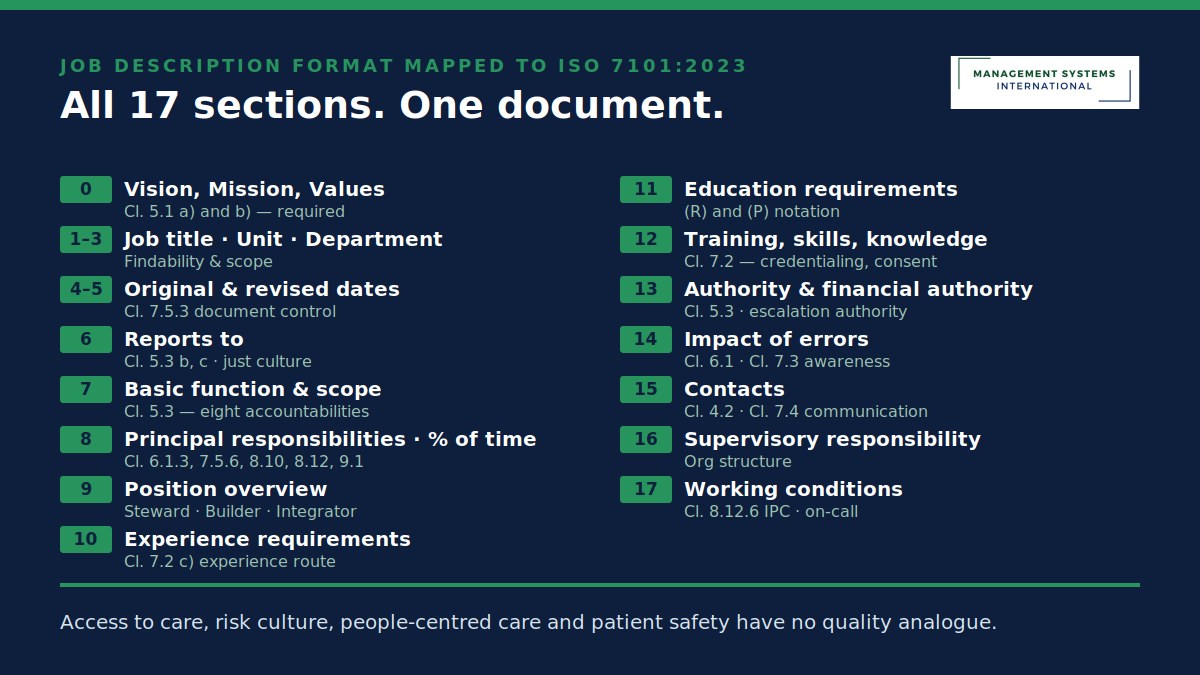
The seventeen-section format most organizations already run through HR has a home for every ISO 7101 requirement. MSI maps that format section by section in its companion articles on the quality systems manager job description and the environmental manager job description, and the mapping holds here — Section 6 carries the reporting line, Section 7 the assignment of responsibilities, Section 8 the clause-mapped duties, Section 12 competence, Section 13 authority. Rather than repeat that, this article concentrates on what a healthcare quality manager job description has to say that no industrial quality document ever says.
Four things make a healthcare quality manager job description structurally different from a quality one. The first is that ISO 7101 uses Plan-Do-Study-Act rather than Plan-Do-Check-Act — a small wording change that signals the standard’s origin in healthcare improvement science rather than manufacturing control. The second is vocabulary: the standard says service user, not customer, and stakeholder, not interested party. The third is Clause 5.3, which assigns eight named accountabilities rather than the two ISO 9001 assigns. The fourth is Clause 8, which is not a process-control clause at all but a sprawling operational chapter reaching from facilities maintenance to blood transfusion safety.
Direct Answer
The fastest test of a healthcare quality manager job description is whether it names five things: who owns the risk management program and the patient safety incident process, who owns the audit of clinical and non-clinical records, who reports quality objectives and health indicators to top management, who assesses service user experience, and where the boundary sits between this role and clinical governance. A document that leaves any of the five implied has not described the job.
Across 28 years and 200+ audits attended, the pattern MSI sees in every sector is the same: not a missing job description, but one written at first certification, never revised, and describing a job nobody is doing. In healthcare the consequence is sharper, because the document has to survive both a certification body and — separately — an accreditation surveyor who is looking at overlapping ground with different expectations.
Title Architecture
The Job Title in a Healthcare Quality Manager Job Description Decides Who Applies
Findable. Accurate. Weighted.
A healthcare quality manager job description competes with more titles than any other sector’s, and they are not interchangeable. Several of them carry regulatory or accreditation meaning that a hiring team may not intend to invoke.
“An accreditation coordinator keeps you ready for the survey. A healthcare quality management systems manager keeps the system that makes you ready. Those are not the same hire, and only one of them scales.”
— MSI, from 200+ audits attended
Direct Answer
Head a healthcare quality manager job description with Healthcare Quality Management Systems Manager when the role owns the ISO 7101 system itself. Use Director of Quality when the role carries departmental budget and reports. Use Patient Safety Officer only when patient safety is the whole job, because ISO 7101 Clause 8.12 alone contains nine named sub-requirements. Use QAPI Coordinator only for a CMS-driven scope — it signals a regulatory compliance role, not a management system role.
What each title tells a healthcare quality manager job description reader:
- Healthcare Quality Management Systems Manager — the certified system is the product of the role. The most precise title, and the right one when the ISO 7101 certificate is the deliverable. Pairs cleanly with Quality Systems Manager in health systems that also run ISO 9001.
- Director of Quality — the common senior title. Carries budget, headcount and a seat at the leadership table. Correct when the scope includes the quality department rather than only the system.
- Quality and Patient Safety Manager — signals that Clause 8.12 patient safety and the Clause 6.1.3 incident process are the centre of gravity. Honest and searched.
- Accreditation Manager — survey readiness for an accrediting body. A narrower job than ISO 7101, and hiring one into a 7101 build is a predictable mismatch.
- QAPI Coordinator — a CMS Conditions of Participation term. Precise in that context, invisible outside it, and it reads as junior.
- Chief Quality Officer — executive scope with clinical governance authority. Only use it if the role genuinely sits at that level; ISO 7101 Clause 5.1 assigns twenty duties to top management, and a Chief Quality Officer is normally part of top management rather than reporting to it.
A practical note on titling a healthcare quality manager job description for search. Clinicians and quality professionals browse job boards using the short common forms, so put Healthcare Quality Manager or Director of Quality in the requisition header and state the precise internal title in line one of the body. A posting headed “Healthcare Quality Manager” that clarifies the internal title is “Manager, Healthcare Quality Management Systems” collects the traffic and keeps the accuracy.
One more thing to settle in the healthcare quality manager job description: exempt classification. A role with independent judgment over quality and safety decisions normally qualifies for an administrative or executive exemption, and the job description is the document a wage-and-hour reviewer reads. The Department of Labor exemption fact sheets set out the duties test.
Why 7101 Reads Differently
What ISO 7101:2023 Requires in a Healthcare Quality Manager Job Description
Scattered. Specific. Named.
Start a healthcare quality manager job description with what the standard does not require, because it saves an argument. ISO 7101 has no management representative clause. Clause 5.3 requires top management to assign responsibilities, authorities and accountabilities — a third word ISO 9001 does not use — and then names eight of them. The title is yours to choose; the eight assignments are not optional.
Direct Answer
A healthcare quality manager job description written to ISO 7101:2023 must assign, by clause: context including climate change relevance (4.1), stakeholders (4.2), scope with documented exclusion reasoning (4.3), the healthcare quality policy (5.2), service user focus (5.4), access to care (5.5), risk culture and risk management processes (6.1.2, 6.1.3), healthcare quality objectives (6.2), planning of changes (6.3), competence including credentialing and privileging (7.2), clinical communication (7.4.3), information management and electronic information (7.5.4, 7.5.5), audit of records (7.5.6), the whole of Clause 8, healthcare quality indicators (9.1.2), internal audit at least every twelve months (9.2.2), management review (9.3), and nonconformity including informing the service user (10.2.2).
The duties that belong in Section 8 of a healthcare quality manager job description, clause by clause:
- Clause 4.1 — Context. Determine external and internal issues, and determine whether climate change is a relevant issue. The standard also requires the organization to be an entity that can be held legally responsible for its activities.
- Clause 4.2 — Stakeholders. Not “interested parties.” Determine relevant stakeholders and their requirements, monitor stakeholder information, maintain documented information, and demonstrate accountability towards agreed expectations — including agreements with global financing partners and governmental or non-governmental organizations.
- Clause 4.3 — Scope. Where items are excluded, the organization must state the reason and hold that reasoning as documented information. Exclusions are permitted but must be justified in writing.
- Clause 5.2 — Healthcare quality policy. Must express a commitment to people-centred care, consider stakeholder input, and — where services are delivered at a distance — be communicated, understood and applied to mobile clinics, health outposts and telehealth providers.
- Clause 5.4 — Service user focus. Ensure service user rights are clearly known, methods exist to listen and respond to the service user’s voice, experience is assessed, and lessons learned facilitate change.
- Clause 5.5 — Access to care. Address affordability and accessibility while minimizing financial risk to service users, including economically challenged and vulnerable populations. There is no analogue for this in any industrial standard.
- Clause 6.1.2 — Risk culture. Define a risk management program consistent with vision, mission and values; continually educate the workforce about it; and measure risk awareness culture at defined intervals.
- Clause 6.1.3 — Risk management processes. Maintain a register of risks and opportunities, define a risk criterion stating how much risk the organization can accept, rate risks, and define processes to capture and analyse patient safety incidents including near misses, adverse and sentinel events.
- Clause 6.2 — Healthcare quality objectives. Must include assessment of service user experience, consider socio-economic status, culture and diversity, and use evidence-informed practice data and established indicators of health outcomes.
- Clause 6.3 — Planning of changes. Including the replication of best practices beyond project mode and the infrastructure to support full-scale implementation.
- Clause 7.2 — Competence. Ten named obligations, covered in its own section below.
- Clause 7.4.2 / 7.4.3 / 7.4.4 — Communication. Service user communication, clinical communication, and external communications are three separate sub-clauses with different requirements.
- Clause 7.5.4 / 7.5.5 — Information management. The information management system must be validated before use, protected from unauthorized access, backed up, and must address cybersecurity risk protections. Amendments to records must be identified, dated and attributed.
- Clause 7.5.6 — Audit of records. A second, distinct audit obligation: periodic audits of clinical and non-clinical records, with documented evidence of the audit and its results.
- Clause 8 — Operation. Facilities and maintenance, contingency planning, equipment, waste management, materials, service user belongings, emerging technologies, service design, external providers, provision of services, people-centred care, ethics, and patient safety.
- Clause 9.1.2 — Healthcare quality indicators. A named list including wait times, service user experience, waste reduction, and — where applicable — morbidity, mortality and quality of life.
- Clause 9.2.2 — Internal audit. Define objectives, criteria and scope for each audit; ensure audits are conducted by trained and qualified individuals; take corrective action without undue delay; and perform internal audits at a minimum once every twelve months.
- Clause 9.3 — Management review. Inputs include internal finances and funding from external partners, and accessibility of health services for all people.
- Clause 10.2 — Nonconformity and corrective action. Sources named in the standard include undesired clinical outcomes, patient safety incidents and near misses, and workforce complaints and grievances.
That list is why a healthcare quality manager job description adapted from a manufacturing template fails at audit. It is not that the words are wrong. It is that half the obligations have no counterpart to adapt from. MSI’s overview of the ISO 7101 healthcare quality management system covers how the framework fits together.
Written to 7101’s Own Clause Structure
A Procedure Set Adapted From ISO 9001 Misses the Healthcare Requirements Entirely
Credentialing and privileging, consent, named training topics, workforce numbers and statutory duties do not sit where an ISO 9001 reader looks for them — which is exactly why a renumbered quality template misses them. MSI’s ISO 7101:2023 Procedure Templates and Guides are written to 7101’s own clause structure, as working documents rather than outlines, so the healthcare-specific obligations land where the standard actually puts them and your new manager inherits a record rather than an intention.
Explore the ISO 7101:2023 Procedure Templates & Guides →
Building the system rather than buying documents? MSI is taking ISO 7101 founding partner engagements with healthcare organizations pioneering the standard.
Clause 5.3
The Eight Accountabilities That Belong in a Healthcare Quality Manager Job Description
Assigned. Communicated. Understood.
ISO 9001 Clause 5.3 names two things top management must assign. ISO 7101 Clause 5.3 names eight, and adds a requirement that they be not merely assigned and communicated but understood within the organization. This single clause is the strongest spine available for the document.
What the Standard Requires
ISO 7101:2023, Clause 5.3. Top management assigns responsibility, authority and accountability for: system conformity; reporting system performance to top management; reporting quality objectives and health indicators at all levels of the organization and healthcare system; the effective functioning of the risk management program; transparency of reporting based on a just culture; promoting and improving service user experience; proposing and implementing modifications to improve the system; and allocating resources and empowering the workforce.
Eight assignments. Most healthcare quality job descriptions carry two of them.
Three of the eight deserve particular attention when drafting a healthcare quality manager job description, because they are the ones most often left unassigned:
- Health indicators, not just quality objectives. Clause 5.3 c) requires reporting on the performance and status of quality objectives and health indicators at all levels — primary, secondary, tertiary, quaternary care and private providers as appropriate. Most job descriptions assign the first half and skip the second.
- Transparency of reporting based on a just culture. Clause 5.3 e) names just culture explicitly, and the standard defines it: an atmosphere of trust in which healthcare workers are supported and treated fairly when something goes wrong. Assigning accountability for that atmosphere to a named role is a different act from writing a policy about it.
- Allocating resources and empowering the workforce. Clause 5.3 h) puts resource allocation into the assignment. A healthcare quality manager job description that assigns this responsibility and grants no budget authority in Section 13 contradicts itself.
Direct Answer
Write all eight Clause 5.3 assignments into Section 7 of the healthcare quality manager job description, then check each one against Section 13. Every assignment that carries no matching authority is a responsibility the organization has created and not funded. Clause 5.3 requires the assignments to be assigned, communicated and understood — and a document that contradicts itself cannot be understood.
The Boundary
The Clinical Boundary a Healthcare Quality Manager Job Description Must State
Bounded. Stated. Respected.
This is the section that separates a healthcare quality manager job description written by someone who has actually worked in a hospital from one written by someone who has not. Get the boundary wrong and you will either hire a non-clinician into a role the medical staff will not accept, or write a document that quietly implies a quality manager approves clinical protocols.
Direct Answer
A healthcare quality manager job description should state explicitly that the role owns the system around clinical care and never the clinical content of care. The manager maintains the process by which protocols are written, reviewed, approved, controlled and audited. Clinicians write the protocols and clinical governance approves them. Say this in Section 7 in one sentence, and the medical staff will read the rest of the document differently.
The boundary is workable in a healthcare quality manager job description because ISO 7101 is written on the same side of it. Clause 8.9 requires documented protocols and procedures for recording clinical findings, for ordering diagnostic investigations, for obtaining informed consent, and for referral and transfer — but it requires the organization to maintain them, not to write their clinical content. Clause 8.12.4 requires a list and guidelines for high-risk drugs and an alert system; the pharmacological judgment belongs to pharmacy and the medical staff. The standard specifies the mechanism, and the clinicians supply the medicine.
That distinction has a direct hiring consequence. It means a healthcare quality manager job description does not have to require a clinical licence — and in many organizations should not, because doing so shrinks the pool to a fraction of the qualified management-system practitioners available. Where the role does require clinical credibility, say why: chairing a clinical audit committee, leading incident review, or interfacing with the medical executive committee are legitimate reasons. “Because it’s a hospital” is not.
Write the interfaces into Section 15 of the healthcare quality manager job description rather than leaving them to the org chart: clinical governance or the medical executive committee, the infection prevention and control committee named at Clause 8.12.6 e), the pharmacy and therapeutics function, and the ethics process required at Clause 8.11.
Clause 8.12
Patient Safety in a Healthcare Quality Manager Job Description: Nine Sub-Requirements
Named. Specific. Auditable.
Most healthcare quality manager job description drafts contain the phrase “supports patient safety initiatives.” ISO 7101 Clause 8.12 contains nine sub-clauses, each with its own named obligations. The gap between those two facts is the gap between a document and a job.
Direct Answer
ISO 7101 Clause 8.12 covers patient safety in nine parts: general (8.12.1), knowledge and learning in safety (8.12.2), patient identification (8.12.3), medication safety (8.12.4), surgical safety (8.12.5), infection prevention and control (8.12.6), prevention of falls, pressure ulcers and thromboembolism (8.12.7), diagnostic safety (8.12.8), and blood transfusions (8.12.9). A healthcare quality manager job description should name which of the nine are in the role’s scope, because a clinic and a surgical hospital have very different answers.
Details worth writing into the healthcare quality manager job description because they are unambiguous and testable:
- Patient identification (8.12.3). At least two unique identifiers, required at all points of care and before any diagnostic or therapeutic procedure — and the standard expressly forbids using room number, bed number or location. It also requires a defined process for patients who cannot confirm their identity.
- Workforce ratios (8.12.1 a). The standard asks the organization to consider workforce ratios and the balance of qualified workforce according to workload. Staffing appears inside the patient safety clause, not in a human resources clause. A healthcare quality manager job description that never mentions staffing analysis has missed where the standard put it.
- Infection prevention and control (8.12.6). Nine named elements including a monitoring or audit system with a dashboard, a surveillance program, an immunization policy, annual workforce training, and an organizational culture for IPC.
- Diagnostic safety (8.12.8). Reporting of critical results and timely communication of results to providers and service users.
- Blood transfusions (8.12.9). Screening for transfusion transmissible infections to include at a minimum HIV I/II, hepatitis B, hepatitis C and syphilis. Where this is in scope, name it.
The manager does not perform any of this clinical work. The manager owns the documented process, the indicator, the audit and the evidence. Stating that distinction in the healthcare quality manager job description is what makes the scope both honest and hireable. MSI’s coverage of ISO 7101 in action for patient safety walks the practical side.
Required vs. Preferred
Competence Under Clause 7.2 — Including Credentialing and Privileging
Defined. Verified. Retained.
A healthcare quality manager job description has more competence ground to cover than a quality one. ISO 9001 Clause 7.2 has four obligations; ISO 7101 Clause 7.2 has ten, and several of them are things a manufacturing quality manager has never had to own.
Direct Answer
ISO 7101 Clause 7.2 requires a documented recruitment process defining competence, education, qualification, training, technical knowledge, skills and experience; orientation for all workforce at joining; documented procedures for credentialing and privileging of healthcare professionals and support workforce; ongoing education; documented performance evaluation at defined intervals; training on service user preferences, co-production, compassionate care and obtaining informed consent; and retained evidence of competence for all workforce members. A healthcare quality manager job description must say whether this role owns that process or interfaces with the function that does.
Credentialing and privileging are the item to settle in the healthcare quality manager job description before the requisition posts. In most hospitals the medical staff office owns them. ISO 7101 nonetheless places them inside the competence clause of the management system, which means the healthcare quality manager job description has to name the interface explicitly: who maintains the documented procedure, who verifies it operates, and who produces the evidence at audit. Leaving it undefined produces the most common finding pattern in any system — a requirement everyone assumes someone else owns.
Required
- Bachelor’s degree in nursing, health administration, public health, a clinical discipline, or a related field — or an equivalent combination of education and demonstrated healthcare quality experience.
- Five or more years in healthcare quality, patient safety, accreditation or clinical risk, including at least two years with direct responsibility for a quality management or accreditation program.
- Demonstrated working knowledge of ISO 7101:2023 at clause level, or of a comparable management system standard plus demonstrated ability to work to a new one.
- Direct experience with accreditation survey or regulatory inspection preparation and hosting.
- Patient safety incident management including near miss, adverse and sentinel event review.
- Root cause analysis using a named methodology, and experience of corrective action to verified closure.
- Service user experience assessment using a validated, reliable methodology.
- Documented internal auditor training, or a commitment to complete it within a stated period.
Preferred
- Certified Professional in Healthcare Quality (CPHQ) through the National Association for Healthcare Quality.
- Certified Professional in Patient Safety (CPPS) through the Institute for Healthcare Improvement.
- ASQ Certified Quality Auditor, or lead auditor qualification against a management system standard.
- Active clinical licence — required only where the scope genuinely includes clinical audit leadership or medical staff interface.
- Master’s degree in health administration, public health, nursing or quality.
- Lean or Six Sigma credentials, where the organization actually runs those programs.
- Experience with ISO 9001 or another harmonized-structure standard, where the organization intends to integrate.
- Health equity, health literacy or community engagement experience — Clause 8.10 makes these system requirements rather than initiatives.
A note on the competence record. Clause 7.2 j) requires retained documented information as evidence of competence for all workforce members — and that includes the person hired against this healthcare quality manager job description. Transcripts, certificates, prior audit records and training completions become management system evidence. Organizations that file them purely as HR documents are frequently unable to produce them at audit. MSI’s guidance on the ISO onboarding process and the human resource management procedure both cover the handoff.
Describe the physical and work-environment requirements honestly, using the essential-functions framing in the EEOC guidance for employers. Clinical area access, immunization and fit-testing requirements under Clause 8.12.6, personal protective equipment, and on-call expectations for serious incident response all belong in Section 17 as accurate statements of the job.
Independence
The Reporting Line in a Healthcare Quality Manager Job Description
Direct. Unrestricted. Documented.
In a manufacturing job description the reporting-line argument is about throughput. In healthcare it is about incident reporting, and the stakes are different.
Direct Answer
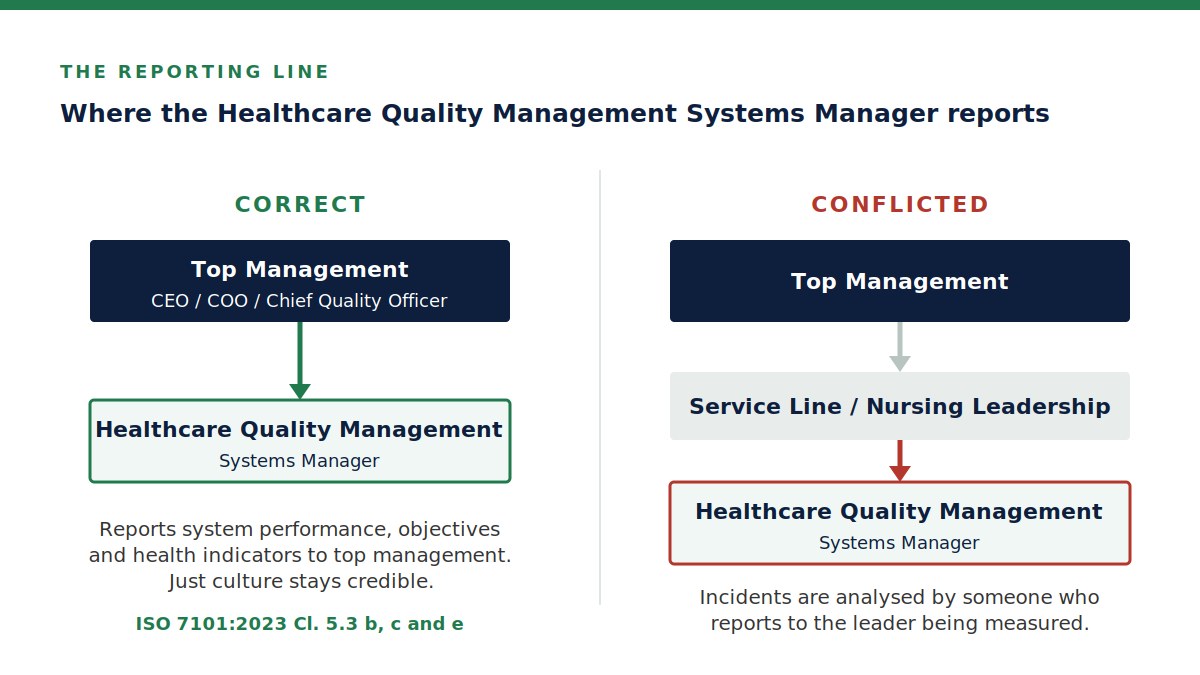
The reporting line in a healthcare quality manager job description should run to top management — the chief executive, chief operating officer, or an executive quality lead — not to the service line being measured. ISO 7101 Clause 5.3 b) requires reporting on system performance to top management, and Clause 5.3 e) assigns accountability for transparency of reporting based on a just culture. A person who reports to the nursing or service leadership whose incidents they analyse cannot underwrite that transparency, however good their intentions.
A healthcare quality manager job description has to reckon with the standard’s definition of just culture at 3.40, which describes as an atmosphere of trust in which healthcare workers are supported and treated fairly when something goes wrong in the delivery of care. That definition has a structural implication most organizations miss: an incident system depends entirely on people choosing to report, and people report to functions they believe will treat them fairly. If the person who receives the report also writes the performance review of the person reporting, the volume of reported near misses will fall — and a falling near-miss count reads as improvement when it is the opposite.
“A falling near-miss count is the easiest number in healthcare to celebrate and the hardest one to trust.”
— Diana Lynn, President and Principal ISO Consultant, MSI
Where a solid-line report to top management is not organizationally possible, the healthcare quality manager job description must supply the compensating controls in writing: unrestricted access to top management on quality and safety matters, a defined escalation path that bypasses the intermediate leader, standing attendance at management review, and documented authority to escalate a patient safety concern directly. A verbal understanding of unrestricted access is not evidence of unrestricted access.
Three authorities belong in Section 13 of the healthcare quality manager job description explicitly:
- Authority to escalate and to halt. To escalate a patient safety concern directly to top management, and to suspend or delay a service where Clause 10.2.2 c) 1) contemplates correction, containment, delay or suspension of services.
- Authority to convene. To call management review, require participation from service and clinical leaders, and convene incident review.
- Authority to access. Unrestricted access to records, clinical and non-clinical, to areas, to workforce and to top management across the scope — which Clause 7.5.6 requires anyway, because someone has to audit the records.
MSI client experience suggests that where a quality role carries recurring findings across cycles, a meaningful share trace back to responsibility that was written down and authority that was left implied. The healthcare quality manager job description is where that silence either ends or hardens.
Accreditation Interface
ISO 7101 Sits on Top of the Accreditation You Already Hold
Layered. Distinct. Complementary.
Unlike a manufacturer taking on ISO 9001, a healthcare organization adopting ISO 7101 is never starting from bare ground — and the healthcare quality manager job description has to account for what is already there. There is already an accreditation program, already a regulatory compliance function, already a quality committee structure. The healthcare quality manager job description has to say where ISO 7101 fits among them, or the new hire will spend six months negotiating it.
Direct Answer
Accreditation asks whether an organization meets a set of standards at a point in time. ISO 7101 asks whether it operates a management system that keeps it meeting them, and produces evidence continuously. A healthcare quality manager job description should state which accreditation the organization holds, that ISO 7101 is a management system layer rather than a replacement, and that the role owns the interface between them rather than running two parallel programs.
Practical overlap worth naming in the healthcare quality manager job description so the hire knows what they are inheriting: the quality governance structures and committees required at Clause 5.1 e) usually already exist; the infection prevention and control program at Clause 8.12.6 is almost certainly running; incident reporting exists in some form. What is typically missing is the system layer — the documented process set, the internal audit program at Clause 9.2, the management review at Clause 9.3 with its named inputs, and the audit of records at Clause 7.5.6.
For U.S. organizations, the regulatory floor is worth citing by name in the requisition where it applies. The Medicare Conditions of Participation require a Quality Assessment and Performance Improvement program at 42 CFR 482.21, and the Agency for Healthcare Research and Quality supplies much of the measurement vocabulary a healthcare quality manager will be expected to use. Naming these tells a candidate exactly which world they are entering.
A useful framing for the job description, drawn from the standard’s own aims at 0.2: ISO 7101 exists to create a culture of quality starting with top management, to embrace people-centred care, to identify and address risks, to ensure patient and workforce safety and wellbeing, to control service delivery through documented processes, to monitor clinical and non-clinical performance, and to continually improve. Those seven aims make a better Section 7 opening than any duty list.
Three Different Jobs
Steward, Builder or Integrator: Three Healthcare Quality Manager Job Descriptions
Maintain. Build. Integrate.
Because ISO 7101 is new and very few organizations hold it, almost every healthcare quality manager job description written this year is for a builder or an integrator rather than a steward, and a healthcare quality manager job description that does not say which will attract the wrong shortlist. Naming which one changes the candidate profile completely.
Direct Answer
Write one healthcare quality manager job description for one of three situations. The steward runs an existing certified system. The builder creates an ISO 7101 system where only an accreditation program exists. The integrator brings ISO 7101 alongside an ISO 9001 system already in place, using the shared harmonized structure so context, leadership, planning, support, performance evaluation and improvement are planned once rather than twice. MSI’s guidance on integrated management system implementation covers what that scope involves.
| Steward | Builder | Integrator | |
|---|---|---|---|
| The work | Run and improve an existing ISO 7101 system | Build the system layer over an accreditation program | Add ISO 7101 to an existing ISO 9001 system |
| Objectives | Performance — indicators, incident closure, audit completion | Milestones — scope, risk register, procedure set, first audit cycle | Deltas — the 7101-only clauses layered onto shared ground |
| Weight in hiring | Indicator discipline, incident review depth | Implementation from zero, change management, clinical credibility | Harmonized-structure fluency across two standards |
| Biggest risk | Indicators reported but never acted on | Hiring an accreditation coordinator for a system build | Two parallel document sets audited twice |
The builder’s first fourteen months
Put these stages in the healthcare quality manager job description. A candidate who has read ISO 7101 will recognize immediately whether the schedule is real.
Months 1–2
Scope, context and stakeholders
Clause 4.3 boundaries across sites and service lines, with documented reasoning for anything excluded. Stakeholder determination under 4.2, including funding and governmental partners.
Months 2–4
Risk culture and risk register
Clause 6.1.2 and 6.1.3: the risk management program, the register, the risk criterion, the incident capture process, and a first measurement of risk awareness culture.
Months 4–7
Procedure set and Clause 8
Policy, objectives and the documented processes the standard requires — including the Clause 8 operational obligations most organizations discover late because they are not where a quality reader looks.
Months 7–9
Indicators and workforce awareness
Clause 9.1.2 indicators defined and baselined. Clause 7.3 awareness across the workforce, and the Clause 7.2 training topics the standard names by hand.
Months 9–11
First audit cycle and record audit
A full internal audit cycle with objectives, criteria and scope defined per audit, plus the separate Clause 7.5.6 audit of clinical and non-clinical records.
Months 11–14
Management review and assessment
Management review with all Clause 9.3.2 inputs including finances and accessibility of services, then external assessment as the ISO 7101 certification ecosystem matures.
One honest note for the requisition: ISO 7101 is new, and very few U.S. organizations have implemented it. MSI is candid that it is early to this standard, as is every consulting firm — what MSI brings is 28 years and 80+ certifications built on the same harmonized structure ISO 7101 uses. A healthcare quality manager job description that pretends a deep 7101 talent pool exists will not find one. Hire for management system capability and healthcare judgment, and treat 7101 clause fluency as something the organization will build. MSI’s key steps for immediate action on ISO 7101 covers where to start.
Accountability
Measurable Objectives in a Healthcare Quality Manager Job Description
Specific. Measured. Reviewed.
A job description without measurable objectives describes activity, not performance. ISO 7101 removes the excuse entirely, because Clause 9.1.2 names what the monitoring system must include — so the objectives in the healthcare quality manager job description and the objectives in the system can be the same objectives.
Direct Answer
Objectives in a healthcare quality manager job description should be drawn from the Clause 9.1.2 list rather than invented for the performance review. The standard requires the monitoring system to include outcomes from clinical and non-clinical services, patient safety issues and results of safety interventions, risk identification and mitigation results, continuum-of-care capacity including transfers, wait times, service user experience, and waste reduction. Where applicable, health indicators must include morbidity, mortality and quality of life and wellbeing.
Objectives worth naming in the healthcare quality manager job description, and why each earns its place:
- Patient safety incident reporting rate and closure time. Both numbers, always together. Reporting rate alone can rise for good reasons or fall for bad ones; closure time says whether anything happened afterwards.
- Serious incident review completion within defined timeframe. The measure that tells you whether Clause 6.1.3 f) is real.
- Service user experience. Clause 8.10.2 requires a validated, reliable methodology with a representative sample ensuring all groups are equitably included — so the objective is not just the score but the representativeness of the sample.
- Wait times. Named at Clause 9.1.2 e). Time to initial appointment, time for specialist referral, and waiting time once arrived are all in the standard’s own note.
- Internal audit program completion. Clause 9.2.2 sets a floor of once every twelve months. The earliest indicator a system is decaying.
- Record audit completion. The separate Clause 7.5.6 obligation, with results documented.
- Risk awareness culture measurement. Clause 6.1.2 e) requires it at defined intervals. Almost nobody does it, and it is trivially auditable.
- Healthcare associated infection rates. Under the Clause 8.12.6 surveillance program.
- Waste reduction. Clause 8.3.2 requires a waste reduction plan, and Clause 9.1.2 g) makes the effort a monitored item.
- Workforce wellbeing. Clause 8.10.7 requires processes addressing stress, burnout and violence from service users or co-workers. Measure it or the clause is decorative.
Organizations typically report that moving from activity measures to outcome measures changes what the role does more than any other single edit to the healthcare quality manager job description. Counting policies written is activity. Reducing avoidable harm is performance. Review them at management review rather than only at appraisal — MSI’s work on management review benefits and the management review procedure covers how those measures reach the leadership forum intact. For the candidate’s view of where this role leads, MSI’s piece on the quality manager career path is worth sending to your shortlist.
Management Review Is in the Job Description
ISO 7101 Management Review Asks for Finances, Access and Health Indicators
Clause 9.3.2 inputs go well beyond the industrial list — internal finances and funding from external partners, accessibility of health services for all people, service user experience, patient safety, waste management, and the extent to which established health indicators have been met. That changes the agenda, the attendees and the minutes. MSI’s ISO Management Review Toolkits supply the agenda, input templates, decision worksheet and a minutes format that records decisions rather than attendance.
Paste-Ready Template
The Complete Healthcare Quality Manager Job Description Template
Adapt. Approve. Publish.
This healthcare quality manager job description is written to the standard seventeen-section format, with the vision, mission and values block at the top — which in healthcare is evidence against Clause 5.1 a) rather than a courtesy. Replace the bracketed content, delete the Clause 8.12 items your setting does not perform, and choose one variant in Section 9.
Job Description
Healthcare Quality Management Systems Manager
0. Our Vision, Mission and Values
Vision: [Where the organization intends to be.]
Mission: [What the organization does, for whom, and why.]
Values: [Three to five values, stated plainly.] Code of conduct: [reference].
The Healthcare Quality Management Systems Manager is expected to reinforce these values through the management system and to help evidence the organization’s culture of quality. ISO 7101:2023 Clause 5.1 a) and b) require top management to define the mission, vision and values and a code of conduct.
1. General Job Title: Healthcare Quality Management Systems Manager (post externally as “Healthcare Quality Manager” or “Director of Quality”) 4. Original Date: [date]
2. Unit: [hospital / clinic / health system] 3. Department: Quality and Patient Safety 5. Revised Date: [date] Rev: [__]
Standards and programs in scope: [ISO 7101:2023 / ISO 9001:2015 / accreditation body / CMS Conditions of Participation] Certification or accreditation body: [name] FLSA: Exempt
6. Reports To
[Chief Executive Officer / Chief Operating Officer / Chief Quality Officer]. Reports on the performance of the management system for quality, and on quality objectives and health indicators, directly to top management (ISO 7101:2023 Cl. 5.3 b and c). Holds unrestricted access to top management on quality and patient safety matters.
7. Basic Function and Scope of Responsibilities
Owns the design, implementation, maintenance and continual improvement of the management system for quality in the healthcare organization, in conformity with ISO 7101:2023, across the scope defined in the management system documentation. Serves as primary interface to the certification body and to the organization’s accrediting body.
Clinical governance boundary: This position owns the system around clinical care — the processes by which clinical protocols are written, reviewed, approved, controlled, audited and improved. It does not author or approve clinical content. Clinical protocols are written by clinicians and approved through clinical governance.
Clause 5.3 assignments. Accountable for: system conformity; reporting system performance to top management; reporting quality objectives and health indicators at all levels; the effective functioning of the risk management program; transparency of reporting based on a just culture; promoting and improving service user experience; proposing and implementing modifications to improve the system; and allocating assigned resources and empowering the workforce within delegated authority.
8. Principal Responsibilities (percentages illustrative)
- Own the risk management program: risk culture, register of risks and opportunities, risk criterion, and the process to capture and analyse patient safety incidents including near misses, adverse and sentinel events. [Cl. 6.1.2, 6.1.3] — 18%
- Own the healthcare quality monitoring system and indicators, including clinical and non-clinical outcomes, patient safety results, wait times, service user experience and waste reduction. [Cl. 9.1.1, 9.1.2, 9.1.3, 9.1.4] — 15%
- Plan and execute the internal audit program with objectives, criteria and scope defined per audit, conducted by trained and qualified auditors, at minimum once every twelve months. [Cl. 9.2] — 12%
- Own the periodic audit of clinical and non-clinical records, with documented evidence of the audit and results. [Cl. 7.5.6] — 6%
- Own nonconformity and corrective action, including informing the service user where the nonconformity affects them, and communicating lessons learned to the workforce. [Cl. 10.2] — 10%
- Maintain the patient safety processes in scope: patient identification, medication safety, surgical safety, infection prevention and control, prevention of falls, pressure ulcers and thromboembolism, diagnostic safety, and blood transfusions. [Cl. 8.12] — 12%
- Own the people-centred care processes: service user experience assessment, compassionate care, inclusivity and diversity, health literacy, co-production and workforce wellbeing. [Cl. 8.10] — 8%
- Maintain context, stakeholders, scope, healthcare quality policy, objectives, planning of changes, competence and awareness, communication, documented information, information management and management review. [Cl. 4.1–4.4, 5.2, 6.2, 6.3, 7.2–7.5, 9.3] — 14%
- Perform other job-related duties as assigned. — 5%
Reasonable accommodations may be made to enable individuals with disabilities to perform the essential functions of this position.
9. Position Overview — choose one variant
Steward: The organization operates an ISO 7101:2023 management system. First-year deliverables: complete the internal audit program and the Clause 7.5.6 record audit; reduce median serious incident review closure to [target] days; baseline and improve [named indicator]; deliver [number] management reviews with recorded decisions.
Builder: The organization holds [accreditation] and intends to implement ISO 7101:2023. First-year deliverables: scope, context and stakeholder determination by month [2]; risk register and incident process by month [4]; procedure set including Clause 8 by month [7]; indicators baselined and workforce awareness complete by month [9]; first internal audit cycle and record audit by month [11]; management review by month [12].
Integrator: The organization holds ISO 9001 and intends to add ISO 7101:2023. Both use the harmonized structure, so context, leadership, planning, support, performance evaluation and improvement are planned once. First-year deliverables: shared-clause mapping by month [2]; the 7101-only obligations — access to care, risk culture, people-centred care, patient safety, audit of records — layered by month [8]; combined internal audit cycle by month [11].
10. Experience Requirements
Five or more years in healthcare quality, patient safety, accreditation or clinical risk (R), including two or more years with direct responsibility for a quality or accreditation program (R). Experience with accreditation survey or regulatory inspection preparation and hosting (R). Patient safety incident management including serious incident review (R). Service user experience assessment using a validated methodology (R). Prior management system implementation from scoping through certification (P — required for builder roles). Experience with ISO 9001 or another harmonized-structure standard (P — required for integrator roles). [Setting] experience in [acute / ambulatory / long-term care / behavioural health] (P).
11. Education Requirements
Minimum level required: ☐ High School / GED ☐ Vocational or some college ☐ Associate’s, Trade or Technical ☑ Bachelor’s Degree ☐ Master’s ☐ Doctoral
Specific degrees and licensures: Bachelor’s degree in nursing, health administration, public health, a clinical discipline or a related field (R) — or an equivalent combination of education and demonstrated healthcare quality experience (R). Master’s in health administration, public health, nursing or quality (P). Active clinical licence (P — state as required only where the scope genuinely includes clinical audit leadership or medical staff interface). Note: ISO 7101 specifies no credential for this role; competence is established under Section 12 per Clause 7.2.
12. Training, Skills, Knowledge and/or Experience
Specific skills: Risk register construction and risk criterion definition (R). Root cause analysis using a named methodology (R). Indicator design and data analysis (R). Procedure authoring in plain language (R). Facilitation of multidisciplinary and clinical groups (R). Health equity and health literacy practice (P). Electronic quality and incident management system administration (P).
Specific training courses: Internal auditor training against ISO 7101 or a harmonized-structure standard (R). Patient safety and serious incident investigation training (R). CPHQ (P). CPPS (P). ASQ Certified Quality Auditor or lead auditor qualification (P). Lean or Six Sigma credential (P).
General experience: Working knowledge of ISO 7101:2023 at clause level, or of a comparable management system standard with demonstrated ability to work to a new one (R). Working knowledge of the accreditation program and regulatory requirements applicable to the organization, including [CMS Conditions of Participation / state licensure] (R).
Experience specific to this position: Prior ownership of an internal audit program (R). Prior ownership of management review (R). Prior accreditation or certification body interface (R). Interface with credentialing and privileging processes (R). Documented evidence of competence is retained per Clause 7.2 j).
13. Authority
Decision making: Works under general direction from top management with wide latitude for independent judgment. Holds documented authority to escalate a patient safety concern directly to top management; to recommend correction, containment, delay or suspension of a service under Clause 10.2.2 c) 1); to convene management review and incident review and require participation from service and clinical leaders; and to access clinical and non-clinical records, areas, workforce and top management across the scope without restriction.
Financial authority: Manages the quality and patient safety budget of approximately $[amount], including audit and certification fees, incident and quality management software, training, and service user experience measurement. Signing authority up to $[amount].
14. Impact of Errors or Non-Performance
Failure to perform the principal responsibilities of this position can result in avoidable harm to service users; unrecognized patterns in patient safety incidents; loss or suspension of accreditation or ISO 7101 certification and the payer or contractual arrangements contingent on them; regulatory enforcement, including findings against the Conditions of Participation where applicable; erosion of just culture and consequent under-reporting of incidents; loss of service user and community confidence; and workforce harm through unaddressed wellbeing, burnout or violence.
15. Contacts
Internal: Top management — system performance, quality objectives and health indicators, escalation — monthly and at management review. Clinical governance or medical executive committee — protocol approval interface, clinical audit — monthly. Infection prevention and control committee (Cl. 8.12.6 e) — ongoing. Nursing, service line and department leaders — incidents, audits, corrective action — weekly. Medical staff office — credentialing and privileging interface — ongoing. Pharmacy and therapeutics — medication safety — monthly.
External: Certification body — audit scheduling, findings, certificate maintenance — annually. Accrediting body — survey readiness and follow-up — as required. Regulatory authorities — reportable events and inspections — as required. Service users, families and community groups — experience, co-production, complaints — ongoing. External providers of clinical and non-clinical services (Cl. 8.8) — performance and corrective action — monthly.
16. Supervisory Responsibility
☐ None ☐ Provides guidance or training (no direct supervision) ☐ Supervises non-exempt personnel ☑ Supervises exempt, professional or technical employees ☐ Supervises supervisory/managerial employees
Organizational structure: Reports to: [CEO / COO / Chief Quality Officer]. Direct reports: [Quality Specialist, Patient Safety Specialist, Accreditation Coordinator, Data Analyst]. Indirect reports: [unit-based quality champions; trained internal auditors from other functions on audit assignment].
17. Working Conditions
Physical surroundings: Combination of office and clinical environments including [inpatient units, operating theatres, ambulatory clinics, laboratory, pharmacy]. Standard office equipment; electronic health record and quality management software.
Adverse working environment: Access to clinical areas with potential exposure to infectious agents, chemicals and medical gases. Immunization and respirator fit-testing requirements per the infection prevention and control program (Cl. 8.12.6). Personal protective equipment as posted.
Physical effort: Extended standing and walking during audits, tracers and observation; occasional lifting up to [__] lbs.
Domestic/international travel: Approximately [__]% for multi-site audits, external provider audits, and training.
Extended hours: Availability for serious incident response outside normal hours. Extended hours during accreditation surveys, certification audits and regulatory inspections.
Approvals
Approved by (Supervisor): ______________________ Approved by (HR): ______________________
Salary grade (HR): ____________ Cost center (HR): ____________ Employee acknowledgement: ______________________ Date: __________
Two details are worth defending. The revision field makes the healthcare quality manager job description the healthcare quality manager job description a controlled document under Clause 7.5.3, revised when the scope, the accreditation, the reporting line or the standard changes. And the percentage-of-time column in Section 8 is the earliest warning an organization gets that the program it has scheduled is larger than the role it has funded — if patient safety gets 5% against nine sub-clauses, the problem is visible before the hire starts.
Worked Audit
Nine Defects in a Legacy Healthcare Quality Job Description
Common. Costly. Fixable.
The following is drawn from a composite of healthcare quality manager job description drafts MSI has reviewed. No organization is identified and the details are generalized. The pattern is typical, which is the point.
- The role is defined by accreditation, not by a system. Duties are written as survey readiness tasks, so the document describes a cycle of preparation rather than a management system that runs continuously.
- “Supports patient safety initiatives.” One line for a clause with nine named sub-requirements. The candidate cannot tell whether surgical safety and blood transfusion are in scope.
- Reports to a service line. The person analysing incidents reports to the leader whose incidents they analyse, with no compensating controls documented and no reference to just culture.
- No risk management ownership. Clause 6.1.2 risk culture and Clause 6.1.3 risk management processes are the engine of ISO 7101 and appear nowhere in the duty list.
- Clinical boundary undefined. The document neither claims nor disclaims authority over clinical protocols, so the medical staff assume the worst and the manager arrives negotiating.
- Credentialing and privileging unmentioned. Clause 7.2 f) puts them inside competence. Nobody owns the interface, so nobody produces the evidence.
- No audit of records. Clause 7.5.6 is a separate obligation from internal audit and is almost universally missing from job descriptions.
- Indicators without a system. A list of metrics with no owner for the monitoring system itself, no methods defined, and no route from result to improvement plan.
- No variant. Silent on whether the organization is certified, building, or integrating with an existing ISO 9001 system — so the candidate cannot tell which of three jobs is on offer.
Fixing all nine takes an afternoon with the template above. Leaving them costs a hiring cycle, and often a second, because the person hired against a document like this arrives expecting survey readiness and discovers a system build. A healthcare quality manager job description is cheap to fix and expensive to ignore.
Before You Post the Requisition
Have Someone Who Has Sat Through 200+ Audits Read It First
A thirty-minute planning session will tell you whether you are hiring a steward, a builder or an integrator, whether the reporting line will survive a just-culture question, and where the clinical governance boundary should sit. Call MSI at 760-434-9141 and bring the draft.
Support the Role
How to Set a New Healthcare Quality Manager Up to Succeed
Resourced. Trained. Backed.
A correct healthcare quality manager job description is necessary and not sufficient on its own. Three decisions made before the hire starts do more than anything in the document.
Direct Answer
A new hire against a healthcare quality manager job description succeeds faster when three things are in place before day one: a procedure baseline written to ISO 7101’s own clause structure so the role adapts documents rather than authoring them, budgeted internal auditor training so the audit program has qualified auditors other than the manager, and an explicit statement from top management — to clinical leadership, not just to HR — of the clinical governance boundary and the authority that goes with the role.
Give the healthcare quality manager a procedure baseline written to 7101. The predictable month-one failure is a capable manager disappearing into document authoring for a quarter — and in healthcare the risk is worse, because a set adapted from ISO 9001 will silently omit the obligations 7101 scatters through Clauses 7 and 8. A clause-mapped 7101 set turns that quarter into adaptation work.
Budget auditor training before it is urgent. Clause 9.2.2 d) requires audits to be conducted by trained and qualified individuals, and 9.2.2 b) requires objectivity and impartiality. A program run entirely by the person who owns the system satisfies neither. Training two or three auditors from other functions solves both at once. MSI’s internal audit services, ISO internal auditor training and internal audit skills guidance all address it, and the ISO training license covers a whole workforce without per-seat surprises.
State the healthcare quality manager job description boundary and the sponsorship to clinicians. This role depends on cooperation from functions that do not report to it, several of them clinical. Top management announcing the appointment, the authority and the clinical governance boundary — before the manager needs to invoke any of it — is worth more than any paragraph in the document.
Where the system does not yet exist, ISO consulting support in the first year is usually cheaper than the alternative. MSI’s SurePath methodology has built 80+ management systems from scratch and is being applied to ISO 7101 as a founding partner engagement with healthcare organizations pioneering the standard; MSI’s ISO consulting practice covers the rest.
FAQ
Healthcare Quality Manager Job Description: Frequently Asked Questions
Asked. Answered. Sourced.
Does ISO 7101 require a management representative?
No. ISO 7101:2023 Clause 5.3 requires top management to assign responsibilities, authorities and accountabilities for eight named items and to ensure they are communicated and understood — but it does not require an appointed management representative. A healthcare quality manager job description should assign all eight by name and function. ISO 13485 is the standard that still requires a named management representative; ISO 7101 does not.
Does the healthcare quality manager need a clinical licence?
Usually not, and requiring one without reason shrinks the pool sharply. The role owns the system around clinical care, not the clinical content — clinicians write protocols and clinical governance approves them. Require a licence in a healthcare quality manager job description only where the scope genuinely includes clinical audit leadership or medical staff committee interface, and say which.
Does ISO 7101 replace our accreditation?
No. Accreditation assesses whether an organization meets a set of standards at a point in time. ISO 7101 assesses whether it runs a management system that keeps it meeting them and produces evidence continuously. A healthcare quality manager job description should name the accreditation held, state that ISO 7101 is a system layer rather than a replacement, and give the role ownership of the interface so the organization does not end up running two parallel programs.
How often must internal audits be performed?
At a minimum once every twelve months. ISO 7101 Clause 9.2.2 states the frequency explicitly, which most management system standards do not — they leave it to planned intervals. The clause also requires objectives, criteria and scope defined for each audit, auditors who are trained and qualified, results reported to relevant managers in a timely manner, and corrective action without undue delay. All of that belongs in the healthcare quality manager job description.
What is the audit of records, and is it the same as internal audit?
It is a separate obligation. Clause 7.5.6 requires the organization to define what counts as a clinical and non-clinical record and then periodically audit those records for completeness and accuracy, with documented evidence of the audit and its results. It sits in the documented information clause, not the performance evaluation clause, and it is one of the most commonly missed requirements. Assign it explicitly in the healthcare quality manager job description.
Can one person own ISO 7101 and ISO 9001 together?
Yes. Both use the harmonized structure, so context, leadership, planning, support, performance evaluation and improvement align and one audit program, one management review and one corrective action system can serve both. What does not merge is the 7101-only content — access to care, risk culture, people-centred care, patient safety, audit of records — so a combined healthcare quality manager job description must write those duties explicitly rather than assuming the quality clauses cover them.
Why does ISO 7101 say Plan-Do-Study-Act instead of Plan-Do-Check-Act?
Because it comes from healthcare improvement science rather than manufacturing control. The standard describes PDSA at 0.4: study means monitoring, measuring and assessing processes against the organization’s policies, commitments, objectives and operating criteria, and reporting the results. The practical difference for a healthcare quality manager job description is emphasis — the job is to learn from cycles of measurement, not to check conformity and stop.
Must we tell a patient when a nonconformity affects them?
Under ISO 7101, yes. Clause 10.2.2 c) 2) lists informing the service user among the actions to implement, and marks it as required if the nonconformity affects the service user. A healthcare quality manager job description should assign ownership of that process, because it is the point where a management system requirement meets an organization’s duty of candour and its legal advice — and those conversations go badly when nobody agreed in advance who leads them.
How often should the job description be reviewed?
Annually at minimum, and immediately whenever the scope changes, a service line is added, the accreditation changes, or the reporting line changes. Treat the healthcare quality manager job description as a controlled document under Clause 7.5 with a revision number, an approval and a next-review date — the same discipline applied to every other document in the system.
Related Reading
Keep Building the Healthcare Quality Manager Role
Equip. Train. Support.
ISO 7101:2023 Procedure Templates & Guides →
Every procedure a healthcare organization needs, written to ISO 7101’s own clause structure as working documents — so the healthcare-specific obligations land where the standard actually puts them.
ISO 7101 Healthcare Quality Consulting →
Founding partner engagements for healthcare organizations building the first U.S. ISO 7101 systems, using the SurePath methodology behind 80+ management systems.
ISO 7101 Leadership and Governance Procedure →
Leadership, healthcare quality policy, service user focus and management review in one document — the Clause 5 obligations this job description assigns.
The Quality Systems Manager Job Description →
The sibling article, with the full seventeen-section format mapped section by section to ISO clauses.
ISO 7101 and People-Centred Care →
What service user focus means when it is a top management requirement rather than a value statement.
28 years, 80+ certifications supported, 200+ audits attended, 600+ professionals trained. Call 760-434-9141 to talk through the role before you post it.
References and Authoritative Sources
- ISO 7101:2023 — Healthcare organization management: iso.org/standard/81647
- ISO/TC 304 — Healthcare organization management: iso.org/committee/4266308
- ISO — Quality management, ISO 9001: iso.org
- ISO 15189 — Medical laboratories, requirements for quality and competence: iso.org/standard/76677
- eCFR — 42 CFR 482.21, Condition of Participation: Quality Assessment and Performance Improvement: ecfr.gov
- CMS — Conditions of Participation and Conditions for Coverage: cms.gov
- Agency for Healthcare Research and Quality: ahrq.gov
- AHRQ Patient Safety Network: psnet.ahrq.gov
- WHO — Global Patient Safety Action Plan 2021–2030: who.int
- WHO Quality Health Services Toolkit: qualityhealthservices.who.int
- WHO — Health literacy: who.int
- WHO — Universal health coverage: who.int
- United Nations Sustainable Development Goals: sdgs.un.org
- Institute for Healthcare Improvement: ihi.org
- National Association for Healthcare Quality — CPHQ: nahq.org
- ASQ — Certified Quality Auditor: asq.org
- ANAB — ANSI National Accreditation Board: anab.ansi.org
- Global ACI — Global Accreditation Cooperation Incorporated: global-aci.org
- U.S. Bureau of Labor Statistics — Medical and Health Services Managers: bls.gov
- U.S. Department of Labor — Overtime exemption for executive employees: dol.gov
- EEOC — The ADA: Your Responsibilities as an Employer: eeoc.gov
About Management Systems International (MSI)
Management Systems International (MSI) is a veteran-owned, female-owned ISO consulting firm founded in 1998. With 28 years of experience, MSI’s track record includes 80+ certifications supported, 200+ audits attended, and 600+ professionals trained across manufacturing, technology, medical device, government, healthcare, and other regulated industries.
Today MSI implements ISO 9001, ISO 13485, ISO 14001, and ISO 45001, with an expanding focus on ISO 7101 healthcare quality.
msi-international.com · 760-434-9141
