
Hiring & Competence | ISO 9001 & ISO 13485
Your quality systems manager job description is the first thing your new hire will find wrong.
Most quality systems manager job descriptions in circulation were written to a standard that was superseded in 2015. They name a role ISO 9001 no longer requires, report it to a function that creates a conflict, and ask for a credential neither standard specifies — while omitting the audit program, the management review, and the corrective action system the job actually runs.
Title. Authority. Competence.
A quality systems manager job description is the single most leveraged document in a certification program, and almost every one in circulation was written for a standard that no longer exists. The role now sits at the intersection of ISO 9001, ISO 13485, and — for organizations running integrated systems — ISO 14001, ISO 45001, and ISO 7101. Write the job description to the standards you actually hold, and you hire someone who can carry the system. Write it from a template inherited in 2009, and you hire an administrator with a clipboard.
Direct Answer
A complete quality systems manager job description runs seventeen numbered sections, plus a vision, mission, and values block at the top: job title, unit, and department; original and revised dates; reporting line; basic function and scope of responsibilities; principal responsibilities with percentage of time; position overview; experience requirements; education requirements; training, skills, knowledge and experience; authority, including financial authority; impact of errors; contacts; supervisory responsibility and organizational structure; and working conditions. Every ISO requirement for this role has a home in one of those seventeen — none of it needs a separate quality document.
The Seventeen Sections
What Must a Quality Systems Manager Job Description Contain?
Complete. Current. Defensible.
Most job descriptions for this role are assembled from three sources: an HR template, a copy of the last person’s description, and a paragraph lifted from the standard. The result reads like a compliance artifact rather than a hiring document, and it fails at both jobs. It does not attract the candidate the organization needs, and it does not satisfy an auditor asking how responsibilities and authorities were assigned and communicated.
The quality systems manager job description has three audiences and must serve all three. The quality systems manager candidate reads it to decide whether to apply. The hiring manager reads it to decide who to interview. The registrar auditor reads it — and this is the part organizations forget — as objective evidence that top management assigned the responsibility and authority the standard requires. A quality systems manager job description that only serves the first audience will be produced in an audit and will not hold up.
Across 28 years and 200+ audits attended, the pattern MSI sees most often is not a missing job description. It is a job description that exists, was approved, was signed, and describes a job nobody is doing. The document and the reality diverged the moment the organization recertified to a newer edition of the standard and never revisited the paperwork underneath.
Direct Answer
The fastest test of a quality systems manager job description is to hand it to your registrar auditor’s likely question list. If the document does not name who owns the internal audit program, who compiles management review inputs, who has authority to stop nonconforming product, and who reports quality system performance to top management, the document is not evidence of anything.
The rest of this article builds the document section by section, then supplies a paste-ready template in the standard seventeen-section format, then audits a real legacy job description so the failure modes are concrete rather than theoretical. If you are on the other side of this — a practitioner deciding where the role leads rather than an employer writing the req — MSI’s companion piece on the quality manager career path covers the same role from the candidate’s seat.
Title Architecture
Why the Job Title Decides Who Applies to Your Quality Systems Manager Opening
Findable. Accurate. Weighted.
The title is not cosmetic. It determines the quality systems manager applicant pool before a single word of the body is read, and it signals the weight of the quality systems manager role to everyone inside the company who will later be asked to cooperate with the person holding it.
“The title is the only part of the job description that most candidates will ever read. Everything else is downstream of whether they clicked.”
— Diana Lynn, President and Principal ISO Consultant, MSI
Three failure modes recur. The first is the ambiguous title — “Systems Manager,” “Compliance Coordinator,” “Documentation Manager.” These are invisible in job-board search, they attract IT and records-management applicants, and internally they read as support functions. The second is the inflated title — “Director of Quality” attached to an individual-contributor scope with no reports and no budget. Experienced candidates read the mismatch immediately and self-select out; the ones who do not read it accept and leave inside a year. The third is the narrow title — “Quality Engineer” or “QA Specialist” — used for a role that actually owns the entire management system.
Direct Answer
Use Quality Systems Manager when the quality systems manager owns the management system itself — documentation, internal audits, management review, corrective action, and the registrar relationship. Use Quality Manager when the role also owns inspection, metrology, and quality engineering headcount. Use Quality Assurance Manager in regulated device and pharmaceutical settings where the title carries specific regulatory meaning. The word “Systems” is the signal that this is a management-system role rather than a product-inspection role.
Titles worth considering for a quality systems manager opening, and what each one tells the market:
- Quality Systems Manager — the management system is the product of the role. Best fit for a single-standard or dual-standard organization hiring one quality systems manager where inspection sits elsewhere.
- Quality Management Systems Manager — the fully explicit version. Longer, less searched, but unambiguous internally and useful when the organization has multiple “systems” managers.
- Integrated Management Systems Manager — signals ownership across quality, environment, and occupational health and safety. Correct when the scope genuinely covers ISO 14001 or ISO 45001.
- Quality Assurance Manager — in medical device organizations, this title carries regulatory expectation. Reserve it for scopes that include regulatory reporting.
- Quality Systems Manager and Management Representative — an ISO 13485 organization may append the second half, because ISO 13485 still names that role explicitly.
A practical note on titling a quality systems manager req for search: candidates searching job boards use the short, common forms. Put the searched title in the requisition header and the precise internal title in the body. A req headed “Quality Systems Manager” that clarifies in line one that the internal title is “Manager, Integrated Management Systems” gets both the traffic and the accuracy.
One more consideration organizations skip: exempt classification. A quality systems manager role with genuine discretion, independent judgment, and system-level authority normally qualifies for an executive or administrative exemption, but the job description is the document a wage-and-hour reviewer will read. The U.S. Department of Labor’s exemption fact sheets set out what the duties test actually requires, and the same document that satisfies your auditor should satisfy that test too.
Section One
Why Vision, Mission, and Values Belong at the Top
Purpose. Direction. Alignment.
Almost no job description opens with the company’s vision, mission, and values. It should — and for this role in particular, it is not a nicety. It is the clause-level context the rest of the document depends on.
Direct Answer
Vision, mission, and values belong at the top of a quality systems manager job description because the quality systems manager role’s core deliverable — a quality policy appropriate to the purpose and strategic direction of the organization — is impossible to write without them. ISO 9001 Clause 5.2 requires the quality policy to be appropriate to the organization’s purpose and context and to support its strategic direction. If the quality systems manager who maintains that policy has never been told the organization’s purpose in writing, the requirement is being met by accident.
The mechanism is straightforward. ISO 9001 Clause 4.1 asks the organization to determine external and internal issues relevant to its purpose. Clause 5.2 requires the quality policy to be appropriate to that purpose and to support strategic direction. Clause 6.2 requires quality objectives consistent with that policy. Every one of those requirements terminates in a document the quality systems manager drafts, maintains, and defends in front of an auditor. Handing a new quality systems manager a job description that never states the purpose is asking them to reverse-engineer it from hallway conversation. MSI’s detailed treatment of ISO 9001 context of the organization traces the full chain from Clause 4.1 through to management review.
The values statement earns its place for a second reason, and it is about to become a requirement rather than a nicety. ISO 9001:2026, publishing 16 September 2026, adds an explicit top-management duty to promote quality culture and ethical behavior at Clause 5.1. Culture is evidenced through shared values, stated attitudes, and observed behaviors. A job description that names the organization’s values and then makes the quality systems manager accountable for reinforcing them is already producing the evidence the new clause will look for.
There is also a straightforward hiring benefit. Candidates for this role — good ones, the ones with options — are choosing between organizations that all describe the same duties. The duties do not differentiate you. The purpose does. Job descriptions that open with a real vision, mission, and values statement convert better than those that open with a duty list, because the first thing a serious candidate wants to know is whether the quality function here is a genuine leadership seat or a compliance backstop.
Two cautions. First, use the real statements, not aspirational filler written for the job posting. A candidate will ask about them in the interview, and a values list nobody in the room can explain does more damage than no values list. Second, keep the section short — three to five lines total. It is framing, not a brochure.
If the organization does not have written vision, mission, and values, that is worth knowing before you hire. It is one of the first things a competent new quality systems manager will need, and one of the first things a registrar will probe when evaluating whether the quality policy is genuinely appropriate to the organization’s purpose.
Before the Documents, the Plan
The Transition Deadline Isn’t Your Constraint. Your Audit Date Is.
ISO 9001:2026 publishes 16 September 2026 and a three-year transition is anticipated. Three years sounds generous. It is not the constraint. Documents have to change early enough that an internal audit and a management review can run against them and produce evidence before your auditor arrives — which means the real question is your own audit date, and the last safe start date it implies for every document.
MSI’s ISO Documentation Program opens with a strategic planning engagement built from a working session with the people who own your system. It produces a document index with a disposition against every item, condition triage against the edition you already hold, a suggested records list mapped to the clause requiring it, a functions and responsibilities matrix, a maturity baseline, and a dated schedule with named owners — set against your audit, not against a published deadline. Document work and ongoing support are separate stages you can take or leave. The plan is written to be handed to your own team, and that is a legitimate outcome.
Explore the ISO Documentation Program →
The program covers ISO 9001, ISO 14001 and ISO 45001, singly or together. For ISO 13485 documentation, start with the ISO 13485 Procedure Templates Package or the ISO Procedure Templates & Guides hub.
ISO 9001 Requirements
What ISO 9001 Requires of the Quality Systems Manager
Assigned. Communicated. Evidenced.
Start with what ISO 9001 stopped requiring of the quality systems manager, because this is where most inherited job descriptions go wrong on line one.
Direct Answer
ISO 9001:2015 removed the mandatory “management representative” that ISO 9001:2008 required. Clause 5.3 instead requires top management to assign and communicate responsibilities and authorities, including for ensuring the system conforms to the standard and for reporting on its performance to top management. A quality systems manager job description written to ISO 9001 should therefore assign those responsibilities by name and function — not by reciting a role title the standard no longer contains.
Organizations may still give the quality systems manager the management representative title if they find it useful, and many do. What changed is that the title no longer discharges the requirement. Clause 5.3 is satisfied by assignment and communication of specific responsibilities, and the job description is the primary evidence of both.
The quality systems manager responsibilities that belong in the document, mapped to clause:
- Clause 4.1 / 4.2 — Context and interested parties. Facilitate and maintain the determination of external and internal issues and the needs and expectations of interested parties. Refresh at defined intervals, not once at certification.
- Clause 4.3 / 4.4 — Scope and processes. Maintain the documented scope statement and the process map, including sequence, interaction, criteria, and assigned process owners.
- Clause 5.2 — Quality policy. Draft, maintain, communicate, and make the policy available to interested parties.
- Clause 6.1 — Risks and opportunities. Maintain the process by which risks and opportunities are determined and addressed, and evidence that the actions taken were evaluated for effectiveness.
- Clause 6.2 — Quality objectives. Facilitate objective setting at relevant functions and levels, and maintain the plans that say what will be done, with what resources, by whom, by when, and how results are evaluated.
- Clause 6.3 — Planning of changes. Ensure changes to the system are carried out in a planned manner.
- Clause 7.1.5 — Monitoring and measuring resources. Own the calibration system and the records that make measurement results traceable and defensible.
- Clause 7.2 / 7.3 — Competence and awareness. Determine necessary competence, verify it, retain evidence of it, and evidence that people are aware of the policy, objectives, and their contribution. MSI’s guide to the ISO onboarding process covers how this is operationalized for new arrivals, and its work on the human resource management procedure covers the departure side that almost nobody builds.
- Clause 7.5 — Documented information. Own document control and records: creation, review, approval, version control, distribution, retention, and disposition.
- Clause 8.3 — Design and development. Where applicable, maintain the design control process — planning, inputs, controls, outputs, reviews, verification, validation, and change control. MSI’s operational walkthrough of the ISO 9001 design and development process covers Clause 8.3 in practice.
- Clause 8.4 — Externally provided processes, products, and services. Maintain supplier evaluation, selection, monitoring, and re-evaluation criteria — and apply them to the suppliers actually in use.
- Clause 8.7 — Nonconforming output. Hold documented authority to identify, segregate, and control nonconforming output, including authority to stop shipment.
- Clause 9.1 — Monitoring, measurement, analysis, evaluation. Own the data set that says whether the system is working, including customer satisfaction. MSI’s analysis of the customer satisfaction procedure covers why a score alone answers half the requirement.
- Clause 9.2 — Internal audit. Own the audit program: frequency, methods, responsibilities, planning, reporting, auditor selection, and impartiality.
- Clause 9.3 — Management review. Compile inputs, convene the review, and record decisions and actions as outputs.
- Clause 10.2 / 10.3 — Nonconformity, corrective action, continual improvement. Own the corrective action system and the improvement loop that closes it. MSI’s treatment of continual improvement under ISO 9001 shows why this is the clause that separates a certificate from a better-run business.
A quality systems manager job description that maps to that list is doing something the generic version cannot: it tells the candidate exactly what the job is, and it tells the auditor exactly where the assignment lives. Both audiences are satisfied by the same paragraph. For organizations that want the sequencing checked before a registrar checks it, MSI’s ISO 9001 Gap Analysis page walks the clause-by-clause exposure.
ISO 13485 Requirements
What ISO 13485 Requires That ISO 9001 Does Not
Regulated. Traceable. Named.
This is where copy-and-paste quality systems manager job descriptions fail hardest, because ISO 13485 does not share ISO 9001’s clause architecture. ISO 13485 predates the harmonized structure and deliberately kept its own. None of the ISO 9001 clause numbers transfer. An organization that writes a device job description by renumbering a quality one produces a document with no correct citations in it.
Direct Answer
ISO 13485 Clause 5.5.2 still requires top management to appoint a member of management as the management representative, with responsibility and authority for ensuring quality management system processes are documented and maintained, for reporting on system performance and improvement needs to top management, and for promoting awareness of applicable regulatory requirements. A quality systems manager job description in a device organization must name that appointment explicitly — it is a requirement ISO 9001 no longer has and ISO 13485 never dropped.
The additional responsibilities that must appear in a device-sector quality systems manager job description:
- Clause 4.1.6 — Validation of software applications. Software used in the quality system must be validated before initial use and after changes. This is an explicit, auditable obligation and it is routinely missing from job descriptions.
- Clause 4.2.3 — Medical device file. Establish and maintain a file for each device type or family containing or referencing the general description, intended use, labeling, specifications, and manufacturing, measuring, installation, and servicing procedures. This is the standard’s documented knowledge base and it is a named deliverable.
- Clause 5.5.2 — Management representative. Appointed, documented, and communicated.
- Clause 6.2 — Competence. Competence determined per defined role, with a documented process for establishing competence, providing training, and ensuring awareness.
- Clause 6.4 — Work environment and contamination control. Requirements for work environment conditions affecting product conformity, and where relevant, contamination control arrangements. This is a product-conformity clause, not a workplace-culture clause.
- Clause 7.1 — Risk management in product realization. ISO 13485 applies risk management across product realization, with ISO 14971 as the governing method. Note that ISO 13485 contains no “risks and opportunities” construct — that language belongs to ISO 9001 Clause 6.1 and importing it into a device job description is a citation error auditors notice.
- Clause 7.3 — Design and development. Design controls are not optional in the same way ISO 9001 Clause 8.3 can be scoped out. Design files, design transfer, and design history are named obligations.
- Clause 7.5.9 — Traceability. Including the heightened requirements for implantable devices.
- Clause 8.2.1 / 8.2.2 — Feedback and complaint handling. Feedback from production and post-production is a required input; complaint handling is a distinct, named process.
- Clause 8.2.3 — Reporting to regulatory authorities. Where regulation requires notification of adverse events or issuance of advisory notices, documented procedures must exist and someone must own them.
- Clause 8.2.4 — Internal audit. Same discipline as ISO 9001 Clause 9.2, different clause number.
- Clause 5.6 — Management review. Twelve named inputs, including regulatory reporting and new or revised regulatory requirements as explicit, separate items. MSI’s ISO 13485 management review playbook walks the full agenda.
- Clause 8.5.2 / 8.5.3 — Corrective and preventive action. ISO 13485 retains preventive action as a distinct requirement. ISO 9001 folded it into risk-based thinking; ISO 13485 did not.
There is a regulatory layer above the standard that a device-sector quality systems manager job description must acknowledge. The FDA’s Quality Management System Regulation amended 21 CFR Part 820 to incorporate ISO 13485:2016 by reference, with a compliance date of 2 February 2026. That means the standard is now the operative regulatory text for finished devices marketed in the United States, and the quality systems manager is holding a regulatory-facing role whether or not the job description says so. MSI’s breakdown of the FDA QMSR and 21 CFR Part 820 alignment covers what changed, and its analysis of medical device cybersecurity as a QMS obligation covers one of the fastest-moving downstream effects.
For organizations placing devices on the European market, EU MDR Article 15 requires a person responsible for regulatory compliance with defined qualifications. That is frequently a separate appointment from the quality systems manager, and the job description should say which it is at your organization rather than leaving the interface undefined. MSI’s ISO 13485 Gap Analysis page maps the device-side exposure clause by clause, and its overview of quality management systems for medical device companies covers the wider build.
Match the Procedure Set to the Standards You Actually Hold
Hire the Manager. Hand Them the Procedure Set That Already Cites the Right Clauses.
The renumbering problem described above is exactly what a mismatched procedure library creates. MSI’s procedure packages are written to each standard’s own architecture — ISO 9001 to the Harmonized Structure, ISO 13485 to its pre-Annex SL clause set — so a new quality systems manager inherits documents that already cite correctly instead of a template that has to be reverse-engineered.
ISO 9001 Procedure Template & Guide →ISO 13485 Procedure Templates Package & Guides →Combined ISO 9001 & 13485 Package →
Running both standards under one system? The combined package is the one built for that scope. Browse everything across all five standards at the ISO Procedure Templates & Guides hub.
Independence
The Reporting Line Is a Requirement, Not a Preference
Direct. Unrestricted. Documented.
One line in the quality systems manager job description does more damage than any other when it is wrong: the reporting relationship for the quality systems manager. It is also the line most often filled in by org-chart convenience rather than by requirement.
Direct Answer
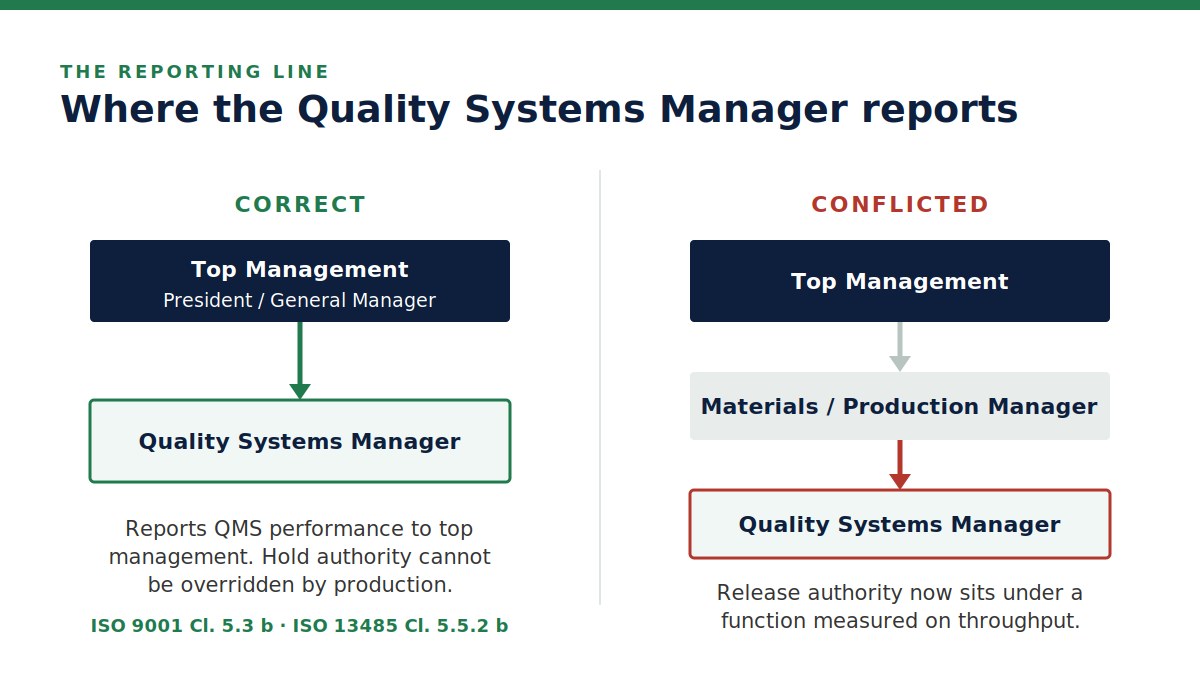
The quality systems manager should report to top management — the president, general manager, or site leader — not to production, operations, materials, or engineering. ISO 9001 Clause 5.3 b) requires that reporting on quality management system performance goes to top management, and ISO 13485 Clause 5.5.2 b) requires the same. A reporting line into a function whose objectives are throughput or cost creates a structural conflict with the authority to stop nonconforming output.
What the Standards Require
ISO 9001, Clause 5.3. Top management assigns the responsibility and authority for reporting on the performance of the quality management system to top management. The requirement names the destination of the report, not the title of the reporter.
ISO 13485, Clause 5.5.2. Top management appoints a member of management who — irrespective of other responsibilities — reports to top management on the performance of the quality management system and on any need for improvement. The appointment is explicit and the destination is the same.
The conflict is not hypothetical. Consider the ordinary Friday afternoon: a shipment is on hold pending a disposition decision, the customer is escalating, and the person who must approve the release reports to the person whose bonus depends on the ship date. Nothing improper has to happen for the outcome to be predictable. The structure decided it.
Where a solid-line report to top management genuinely is not possible — a small site inside a larger group, for example — the job description must supply the compensating control in writing: unrestricted access to top management on quality matters, a defined escalation path, standing attendance at management review, and documented authority to withhold release that cannot be overridden by the intermediate manager. Write it down. A verbal understanding that the quality systems manager has unrestricted access is not evidence of unrestricted access.
“Responsibility without authority is not a job. It is a place to put the blame.”
— MSI, from 200+ audits attended
Three quality systems manager authorities belong in the document explicitly, because their absence is what turns the role into an administrator:
- Authority to stop. To place product, process, or shipment on hold pending disposition, without prior approval from the function being stopped.
- Authority to convene. To call management review, to require attendance by process owners, and to escalate unresolved corrective actions to top management.
- Authority to access. Unrestricted access to records, areas, personnel, and top management, across every function inside the certified scope.
MSI client experience suggests that of the recurring findings organizations carry into surveillance audits, a meaningful share trace back to a role that had the responsibility written down and the authority left implied. The quality systems manager job description is where that gap either closes or opens.
Two Different Jobs
Certified Already or Building From Zero? Two Different Quality Systems Manager Roles
Maintain. Or. Build.
This is the distinction the request that prompted this article got exactly right, and the one almost every published job description gets wrong. Hiring into a certified organization and hiring to roll out a management system for the first time are not the same job. They need different candidates, different first-year objectives, and different quality systems manager job descriptions.
Direct Answer
A quality systems manager hired into a certified organization is a steward: the system exists, the job is to run it, improve it, and defend it at surveillance. A quality systems manager hired to launch a first system is a builder: the job is scoping, process mapping, writing procedures nobody has written, training a workforce that has never been trained, and getting through a two-stage certification audit. Write one job description for one of those, not a blended document that describes neither.
| Steward — already certified | Builder — first rollout | |
|---|---|---|
| What the job is | Run, defend, and improve an existing system | Create a system that does not exist yet |
| Primary skill | Discipline and consistency over cycles | Project management and change management |
| First-year objectives | Performance measures — cycle time, repeat findings, audit completion | Milestone dates — scope, procedures, training, Stage 1, certification |
| Prior implementation | Preferred | Required |
| Biggest hiring risk | A maintainer when the system is quietly failing | A maintainer who has never built anything from zero |
| Registrar relationship | Inherited — surveillance and recertification | Selected — quotation, booking, Stage 1 and Stage 2 |
The steward profile — hiring into a certified system
What the quality systems manager actually does: sustaining a system through surveillance cycles, closing corrective actions on time, keeping the audit program from decaying into a checklist exercise, driving measurable improvement, and — right now — running the transition to the 2026 revisions. What to weight in the candidate: audit history on the receiving end, corrective-action discipline, the ability to work with process owners who did not choose to be process owners, and evidence of improvement rather than maintenance. First-year objectives are performance objectives: reduce corrective-action cycle time, close a specific finding category, lift on-time internal audit completion.
The trap: hiring a quality systems manager who maintains when the system is quietly failing. If the last two surveillance audits produced repeat findings, the role is closer to a rebuild than a stewardship, and the job description should say so.
The builder profile — first-time implementation
What the quality systems manager actually does: determining scope, mapping processes that have never been mapped, writing a procedure set from nothing, standing up document control, training the workforce, running a first internal audit cycle against a system with no history, holding a first management review, selecting a registrar, and surviving Stage 1 and Stage 2. It is a project management job wearing the quality systems manager title, and the failure mode is hiring someone who has only ever maintained.
What to weight: prior implementation experience from zero, change management ability, comfort with ambiguity, and the political skill to get process owners to describe how work actually happens rather than how the org chart says it happens. A candidate who has been through one full implementation is worth substantially more here than a candidate with ten years maintaining a mature system.
First-year objectives are milestone objectives: scope and process map approved by month two, procedure set released by month five, workforce trained by month seven, first full internal audit cycle complete by month nine, first management review held by month ten, Stage 1 by month eleven. Those dates belong in the job description, because they are the honest description of the job.
The builder’s first fourteen months
Put these dates in the job description. They are the honest description of a first-time implementation, and a candidate who has done one before will recognize whether the schedule is real.
Months 1–2
Scope and process map
Determine the certified scope, map the processes as they actually run, assign process owners, and get both approved by top management. Nothing downstream works if this is guessed.
Months 3–5
Procedure set released
Policy, objectives, and the documented procedures the standard requires — written to how the organization works, not to how the template assumed it works.
Months 6–7
Workforce trained
Awareness of the policy, the objectives, and each person’s contribution. Competence determined, verified, and evidenced against the matrix.
Months 8–9
First full internal audit cycle
Every clause and every process audited at least once, by auditors trained and impartial to the area they audit. Findings raised, not softened.
Month 10
First management review
All required inputs compiled, the review held, and decisions and actions recorded as outputs. Attendance is not the output.
Months 11–14
Stage 1, Stage 2, certification
Registrar selected and booked well ahead. Stage 1 documentation review, corrective actions closed, Stage 2 on site, certificate issued.
One hard truth worth stating in the req: a first-time implementation run by a single new hire with no external support and no procedure library typically takes far longer than leadership expects. Organizations that pair the hire with implementation support and a ready procedure set compress that timeline substantially — which is the model behind MSI’s SurePath turnkey certification program and the reason the templates hub exists. Setting the expectation in the job description is more honest than discovering it in month eight.
A third variant is increasingly common and deserves its own document: hiring a quality systems manager to add a second or third standard to an existing certified system. That is neither pure stewardship nor pure build. MSI’s guidance on integrated management system implementation covers what that scope actually involves.
Required vs. Preferred
Education, Experience, and Competence: What to Require and What to Prefer
Defined. Verified. Retained.
Separating required from preferred in a quality systems manager job description is not an HR formality. It is the mechanism that keeps the applicant pool open while keeping the competence bar honest, and it is the section where legacy job descriptions most visibly contradict themselves — assigning system-level scope in one paragraph and requiring a high school diploma in the next.
Direct Answer
Neither ISO 9001 nor ISO 13485 specifies a degree for the quality systems manager role. Both require that competence be determined for the role and demonstrated on the basis of appropriate education, training, or experience — and that documented evidence be retained. Write the requirement as competence with named acceptable routes, not as a credential, and the job description satisfies Clause 7.2 (ISO 9001) or Clause 6.2 (ISO 13485) directly.
Required
- Bachelor’s degree in engineering, science, quality, or a related discipline — or an equivalent combination of education and demonstrated management-system experience. The “or” clause is what keeps excellent non-degreed practitioners in the pool.
- Five or more years in a quality or management-system role, including at least two years with direct responsibility for a certified system.
- Demonstrated working knowledge of the specific standard the organization holds, at the current edition, cited by name and year in the req.
- Documented internal auditor training against the applicable standard.
- Direct experience preparing for and hosting third-party certification or surveillance audits.
- Demonstrated corrective action and root cause analysis capability, with a named methodology.
- Ability to write procedures and work instructions in plain language that the people doing the work can follow.
Preferred
- Lead auditor qualification against the applicable standard.
- Professional certification — ASQ Certified Manager of Quality/Organizational Excellence, Certified Quality Auditor, or Certified Quality Engineer.
- Experience with more than one standard, particularly where the organization intends to integrate. Multi-standard fluency is genuinely scarce; MSI’s article on the quality manager career covers why.
- Statistical methods, process capability, and sampling.
- Lean or Six Sigma credentials, where the organization actually runs those programs.
- Electronic quality management system administration experience.
- For device organizations: FDA inspection experience, MDSAP audit experience, EU MDR familiarity, and ISO 14971 risk management practice.
- Prior first-time implementation experience — required rather than preferred if the role is a build.
A note on the competence record. Whatever the quality systems manager job description requires, the organization must retain evidence that the person hired meets it. That means the hiring file — transcripts, certificates, prior audit records, training completions — becomes quality system evidence. Organizations that treat the quality systems manager competence file as an HR document rather than a quality record are frequently unable to produce it during audit. Build the handoff into the process.
Finally, describe the physical and environmental requirements honestly, using the essential-functions framing that the EEOC’s guidance for employers describes. Production floor access, personal protective equipment, controlled-environment gowning where applicable, and travel expectations all belong in the document — not as boilerplate, but as an accurate statement of the job.
Management Review Is in the Job Description — Give Them the Tools
Your New Hire’s First Management Review Shouldn’t Be Built From Scratch
Compiling management review inputs is one of the responsibilities this job description assigns — and it is the one that most often gets built from habit rather than from the clause. MSI’s ISO Management Review Toolkits supply the agenda, the input templates, the decision worksheet, and a minutes format that records decisions rather than attendance — for ISO 9001 Clause 9.3, ISO 13485 Clause 5.6, ISO 14001, ISO 45001, and ISO 7101.
Accountability
Measurable Objectives for the Quality Systems Manager
Specific. Measured. Reviewed.
A quality systems manager job description without measurable objectives describes activity, not performance. It also leaves the organization with nothing to evaluate at review time except impressions — which is how a role that is quietly failing survives three years.
Direct Answer
Measurable objectives for a quality systems manager should be drawn from the organization’s quality objectives under ISO 9001 Clause 6.2, not invented separately for the performance review. Typical measures include internal audit schedule completion, corrective action cycle time, on-time closure rate, repeat-finding count, external audit finding count, customer complaint rate, supplier performance, and training completion against the competence matrix.
Quality systems manager objectives worth naming in the document, with the reason each earns its place:
- Internal audit program completion. Percentage of scheduled audits completed on schedule. The most reliable early indicator that the system is decaying — audits slip before anything else does.
- Corrective action cycle time. Median days from finding to verified-effective closure. Cycle time exposes a system that opens actions and never closes them.
- Repeat findings. Count of findings recurring within twelve months. A repeat finding is a root cause analysis that failed, and it is what registrars escalate on.
- External audit results. Major and minor nonconformity count per surveillance cycle, trended rather than reported once.
- Customer complaint rate and response time. A named ISO 9001 Clause 9.1.2 input and, for device organizations, a distinct ISO 13485 Clause 8.2.2 process.
- Supplier performance. On-time and in-full, nonconforming receipt rate, re-evaluation completion against the Clause 8.4 criteria.
- Cost of poor quality. Scrap, rework, warranty, and returns as a percentage of revenue — the measure that gives leadership a reason to fund the function.
- Competence and training completion. Percentage of required training completed on schedule against the competence matrix.
- Management review cadence and output. Reviews held on schedule with recorded decisions and assigned actions — not attendance.
Set quality systems manager targets that are achievable in the first year and revisit them at management review rather than only at performance review. That alignment is the point: the objectives the quality systems manager is measured against should be the same objectives the system is measured against, reviewed in the same forum, with the same data.
Organizations typically report that the shift from activity measures to outcome measures changes what the role does more than any other single edit to the job description. Counting procedures written is activity. Reducing repeat findings is performance. MSI’s work on management review benefits and its analysis of the management review procedure cover how those measures make it into the leadership forum intact.
Scope Expansion
When the Quality Systems Manager Also Owns ISO 14001, ISO 45001, or ISO 7101
Integrated. Scoped. Resourced.
Scope creep in the quality systems manager role is normal and usually unmanaged. A quality role acquires the environmental system because nobody else has bandwidth, then acquires occupational health and safety, and eighteen months later the job description describes a third of the actual job.
Direct Answer
If the quality systems manager will own ISO 14001 or ISO 45001, retitle the role Integrated Management Systems Manager and write the environmental and occupational health and safety responsibilities in explicitly — aspects and impacts, compliance obligations, hazard identification, emergency preparedness, and legal compliance evaluation. ISO 9001, ISO 14001, ISO 45001, and ISO 7101 share the Harmonized Structure, so context, leadership, planning, support, operation, performance evaluation, and improvement align cleanly across all four. ISO 13485 does not share that structure and must be mapped separately.
The shared structure is the reason an integrated quality systems manager scope works. One context analysis, one interested-party analysis, one internal audit program, one management review, one corrective action system, one document control system. What does not merge is the technical content: environmental aspects and impacts, compliance obligations, and emergency preparedness under ISO 14001 have no quality-system analogue, and hazard identification and worker consultation under ISO 45001 have none either.
There is a timing issue that belongs in any environmental-scoped req written this year. ISO 14001:2026 published 15 April 2026 with a three-year transition window closing around April 2029, and the revision is not cosmetic.
Clause 4.1 now explicitly names environmental conditions — pollution levels, natural resource availability, climate change, biodiversity, ecosystem health — as issues that must be determined. Clause 6.3 adds planning of changes. Internal audits must now state defined objectives. If the quality systems manager you hire inherits an ISO 14001:2015 system, the transition is their project, and the job description should say so. MSI’s coverage of the ISO 14001 2026 transition and the ISO 2026 transition deadline capacity math both matter for scoping that expectation realistically. Procedure sets for the environmental and occupational health and safety scopes sit alongside the quality ones at the ISO Procedure Templates & Guides hub.
ISO 7101 for healthcare quality management adds a further dimension for hospitals, clinics, and health systems, and it is the fastest-growing scope MSI sees added to this role. Where the organization holds both quality and environmental certificates, the sequencing of the two 2026 revisions should be treated as one program rather than two, as MSI sets out in its guide to the combined ISO 9001 and 14001 transition.
Future-Proofing
What ISO 9001:2026 Adds to the Quality Systems Manager Job Description
Confirmed. Dated. Actionable.
Writing a quality systems manager job description this year and citing ISO 9001:2015 alone means rewriting it within months. The date is now fixed rather than anticipated.
Direct Answer
ISO 9001:2026 publishes 16 September 2026, with a three-year transition period anticipated to close around September 2029. A quality systems manager job description written now should cite ISO 9001:2015 as the current certified edition, name the 2026 revision, and make the transition an explicit first-year deliverable rather than a surprise handed to the hire in month four.
For the quality systems manager, the revision is evolutionary. The process approach, the Plan-Do-Check-Act cycle, and risk-based thinking all remain central, and the clause structure holds. What changes carries direct implications for this role:
- Quality culture and ethical behavior at Clause 5.1. Top management gains an explicit duty to promote both. The quality systems manager becomes the person who has to evidence something that has never been evidenced before — which is exactly why the values statement at the top of the job description stops being decorative.
- Clearer separation of risks and opportunities. Organizations that treated the two as one register will need to separate them.
- Climate change considerations. Formalized in the context requirements, following the 2024 amendments.
- A guidance annex. The first in the standard’s history, which changes how implementation questions get answered internally.
Two related revisions belong on the same radar. ISO 19011:2026, the auditing guidance, published 27 May 2026 and withdrew the 2018 edition outright — which matters because the audit program in this job description is built on it. And the accreditation framework itself changed: Global Accreditation Cooperation Incorporated replaced the former International Accreditation Forum and International Laboratory Accreditation Cooperation on 1 January 2026, so any job description referencing the old bodies is citing organizations that no longer exist.
Practical wording for the quality systems manager req: state the current certified edition, state the revision and its publication date, and list “lead the ISO 9001:2026 transition, including impact assessment, documentation updates, workforce training, and registrar coordination” as a named first-year deliverable. MSI’s analysis of ISO 9001:2026 for boardrooms and its coverage of the ethics and culture changes both set out what leadership will be asked to demonstrate, and its overview of the 2026 revisions and certification strategy frames the whole cycle.
Format Mapping
Mapping the Standard 17-Section Job Description Format to ISO Clauses
Mapped. Numbered. Auditable.
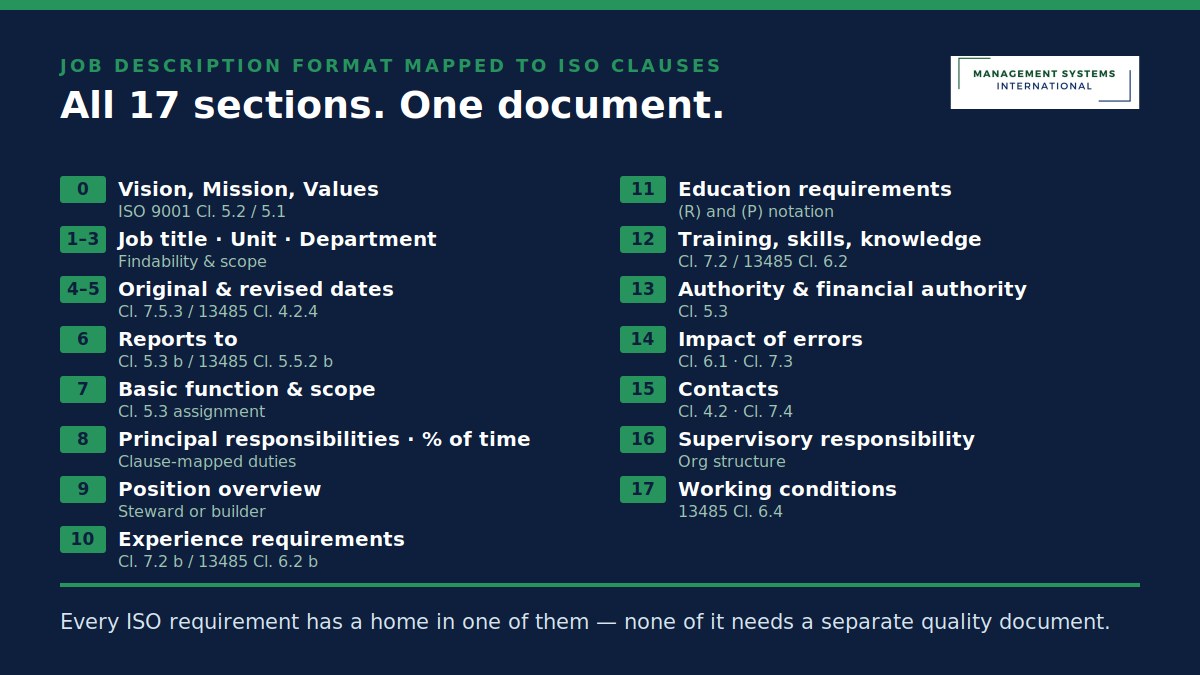
Most established organizations already run a controlled, numbered quality systems manager job description format through HR — typically a seventeen-section structure covering title and department, dates, reporting line, basic function, principal responsibilities with percentage of time, position overview, experience, education, training and skills, authority, error impact, contacts, supervisory responsibility, and working conditions. The instinct when ISO enters the picture is to bolt a separate quality systems manager document onto the side of it. That is the wrong move.
Direct Answer
Do not create a separate ISO version of the quality systems manager job description. The standard seventeen-section HR format already contains a home for every ISO requirement — Section 7 carries Clause 5.3 assignment, Section 8 carries the clause-mapped duties, Section 12 carries Clause 7.2 or Clause 6.2 competence, Section 13 carries authority, Section 14 carries risk-based impact, Section 15 carries interested-party interfaces, and Section 16 carries the reporting-line requirement. Two parallel documents is a document control finding waiting to happen.
Section by section, here is where each ISO requirement for the quality systems manager lands in the standard format:
- Sections 1–3 (Job Title, Unit, Department). The quality systems manager title decision covered earlier in this article. “Systems Manager” belongs to no standard and no search result.
- Sections 4–5 (Original Date, Revised Date). These are the document control fields. ISO 9001 Clause 7.5.3 and ISO 13485 Clause 4.2.4 both require control of changes and identification of documented information. A revised date that has not moved since 2009 is objective evidence the document is uncontrolled.
- Section 6 (Reports to). ISO 9001 Clause 5.3 b) and ISO 13485 Clause 5.5.2 b). This is the single line where the reporting-line conflict discussed earlier either exists or does not.
- Section 7 (Basic Function and Scope of Responsibilities). The Clause 5.3 assignment statement. For device organizations, this is where the ISO 13485 Clause 5.5.2 management representative appointment is made explicit.
- Section 8 (Principal Responsibilities, with Percentage of Time). The clause-mapped quality systems manager duty list. The percentage column is genuinely useful here and most organizations waste it — it is the only place in the document where the organization states how much of the role is actually resourced for audits, corrective action, and management review. If internal audit is 5% and the schedule assumes twenty audits a year, the resourcing problem is visible before the hire starts rather than after the program slips.
- Section 9 (Position Overview). The place for the build-versus-maintain distinction and the first-year quality systems manager deliverables.
- Section 10 (Experience Requirements). Contributes to Clause 7.2 b) / Clause 6.2 b) competence on the basis of experience.
- Section 11 (Education Requirements). The minimum-level checkbox plus specific degrees and licensures denoted required or preferred. Neither standard mandates a credential, so the (R) and (P) notation is doing the real work — see the required-versus-preferred discussion above.
- Section 12 (Training, Skills, Knowledge and/or Experience). This is the ISO competence section. Clause 7.2 (ISO 9001) and Clause 6.2 (ISO 13485) both require competence to be determined, established, and evidenced. The four prompts — specific skills, specific training courses, general field experience, experience specific to this position — map cleanly onto “appropriate education, training, or experience.”
- Section 13 (Authority — Decision Making and Financial Authority). Clause 5.3. This is where authority to stop, authority to convene, and unrestricted access get written down rather than assumed. Financial authority matters too: a quality systems manager with no signing authority cannot commission calibration, external audits, or training without a negotiation each time.
- Section 14 (Impact of errors or of not carrying out the responsibilities). An underused section, and for the quality systems manager a direct ISO 9001 Clause 6.1 risk hook. It is also Clause 7.3 awareness — the implications of not conforming with management system requirements.
- Section 15 (Contacts — internal and external, with purpose and frequency). Maps to Clause 4.2 interested parties and Clause 7.4 communication. For device organizations it should name the registrar, regulatory authorities, notified body, and the EU MDR Article 15 person responsible for regulatory compliance.
- Section 16 (Supervisory Responsibility and Organizational Structure). The reporting line restated as an org chart. If Section 6 and Section 16 disagree, an auditor will find it.
- Section 17 (Working Conditions). Physical surroundings, adverse environment, physical effort, travel, and extended hours. For device organizations this is also where ISO 13485 Clause 6.4 work environment and contamination control conditions get stated.
Two additions are worth making to the standard quality systems manager format rather than working around it. The first is the vision, mission, and values block at the very top, for the reasons set out earlier — the quality policy has to be appropriate to the organization’s purpose, and ISO 9001:2026 adds an explicit culture duty at Clause 5.1. The second is a revision number alongside the Original Date and Revised Date fields, so the document carries a version identifier and not just a timestamp.
One caution from experience: when a job description template is reused across a company, the sample text in the interpersonal skills, travel, and residency blocks tends to survive from whatever role the template was last used for. Read those sections before the quality systems manager requisition posts. A quality systems manager description carrying leftover language about worldwide regulatory trend guidance from a regulatory affairs posting is a small error that reads as carelessness to exactly the candidate you want.
Paste-Ready Template
The Complete Quality Systems Manager Job Description Template
Adapt. Approve. Publish.
This quality systems manager job description is written to the standard seventeen-section format, with the vision, mission, and values block added at the top. Replace the bracketed content, delete the standards you do not hold, and choose the steward or builder variant in Section 9. Everything else is structural.
Job Description
Quality Systems Manager
0. Our Vision, Mission, and Values
Vision: [Where the organization intends to be.]
Mission: [What the organization does, for whom, and why.]
Values: [Three to five values, stated plainly.] The Quality Systems Manager is expected to reinforce these values through the management system and to help evidence the organization’s quality culture.
1. General Job Title: Quality Systems Manager 4. Original Date: [date]
2. Unit: [site or business unit] 3. Department: Quality 5. Revised Date: [date] Rev: [__]
Standards in scope: [ISO 9001:2015 / ISO 13485:2016 / ISO 14001:2026 / ISO 45001:2018 / ISO 7101:2023] Registrar: [name] FLSA: Exempt
6. Reports To
[President / General Manager / Site Leader]. The Quality Systems Manager reports on management system performance and improvement opportunities directly to top management and holds unrestricted access to top management on quality matters.
7. Basic Function and Scope of Responsibilities
Owns the design, implementation, maintenance, and continual improvement of the organization’s management system in conformity with [standards], across the certified scope defined in the management system documentation. Serves as the primary interface to the registrar and, where applicable, to regulatory authorities. [Device organizations: Appointed as Management Representative in accordance with ISO 13485 Clause 5.5.2, with responsibility and authority for ensuring management system processes are documented and maintained, reporting on system performance and improvement needs to top management, and promoting awareness of applicable regulatory requirements throughout the organization.]
8. Principal Responsibilities (percentages illustrative — adjust to scope)
- Own document and records control, including creation, review, approval, version control, distribution, retention, and disposition. [ISO 9001 7.5 / ISO 13485 4.2] — 15%
- Plan, schedule, and execute the internal audit program, including auditor selection, impartiality, and reporting of results to relevant management. [ISO 9001 9.2 / ISO 13485 8.2.4] — 15%
- Own corrective action: intake, root cause analysis, action, effectiveness verification, and closure. [Device: including preventive action.] [ISO 9001 10.2 / ISO 13485 8.5.2 and 8.5.3] — 15%
- Compile management review inputs, convene the review at planned intervals, and record decisions and actions as outputs. [ISO 9001 9.3 / ISO 13485 5.6] — 10%
- Maintain context and interested-party determination, the documented scope, the process map, and assigned process owners. [ISO 9001 4.1–4.4] — 10%
- Draft and maintain the quality policy and facilitate quality objectives and achievement plans at relevant functions and levels. [ISO 9001 5.2, 6.2] — 5%
- Maintain the process for determining and addressing risks and opportunities. [Device: maintain risk management across product realization per ISO 14971.] [ISO 9001 6.1 / ISO 13485 7.1] — 10%
- Determine competence requirements, verify competence, deliver or coordinate training, and retain evidence. [ISO 9001 7.2–7.3 / ISO 13485 6.2] — 5%
- Own supplier evaluation, selection, monitoring, and re-evaluation, and control of externally provided processes, products, and services. [ISO 9001 8.4 / ISO 13485 7.4] — 5%
- Own control of nonconforming output, including authority to place product, process, or shipment on hold. [ISO 9001 8.7 / ISO 13485 8.3] — 5%
- Own monitoring, measurement, analysis, and evaluation, including customer satisfaction and the calibration system. [ISO 9001 9.1, 7.1.5 / ISO 13485 8.2.1, 7.6] — 5%
- [Device only] Maintain the medical device file; validate quality system software; maintain design and development controls, traceability, complaint handling, and reporting to regulatory authorities and advisory notices. [ISO 13485 4.2.3, 4.1.6, 7.3, 7.5.9, 8.2.2, 8.2.3] — %
- Perform other job-related duties as assigned. — %
Reasonable accommodations may be made to enable individuals with disabilities to perform the essential functions of this position.
9. Position Overview
Steward variant (existing certified system): The organization holds [standard] certification with [registrar]. First-year deliverables: complete 100% of the scheduled internal audit program; reduce median corrective action closure time to [target] days; eliminate repeat findings in [category]; deliver [number] management reviews with recorded decisions; complete the ISO 9001:2026 impact assessment and transition plan.
Builder variant (first-time implementation): The organization is not yet certified and intends to achieve [standard] certification. First-year deliverables: scope and process map approved by month [2]; procedure set released by month [5]; workforce trained by month [7]; first full internal audit cycle complete by month [9]; first management review held by month [10]; Stage 1 audit by month [11]; certification achieved by month [14].
10. Experience Requirements
Five or more years in a quality or management systems role (R), including two or more years with direct responsibility for a certified management system (R). Direct experience preparing for and hosting third-party certification and surveillance audits (R). Experience implementing a management system from initial scoping through certification (P — required for builder roles). Regulated-industry experience in [sector] (P).
11. Education Requirements
Minimum level of formal education required: ☐ High School Diploma or GED ☐ Vocational School or some college ☐ Associate’s, Trade or Technical ☑ Bachelor’s Degree ☐ Master’s ☐ Doctoral
Specific degrees, areas of study, and licensures: Bachelor’s degree in engineering, science, quality management, or a related technical discipline (R) — or an equivalent combination of education and demonstrated management system experience (R). Master’s degree in engineering, quality, or business (P). Note: neither ISO 9001 nor ISO 13485 specifies a credential; competence is established under Section 12 on the basis of education, training, or experience.
12. Training, Skills, Knowledge and/or Experience
Specific skills in this field: Procedure and work-instruction authoring in plain language (R). Root cause analysis using a named methodology (R). Process mapping and process-owner facilitation (R). Data analysis and trend reporting to leadership (R). Statistical methods, process capability, and sampling (P). Electronic quality management system administration (P).
Specific training courses in this field: Internal auditor training against [standard] (R). Lead auditor qualification against [standard] (P). ASQ CMQ/OE, CQA, or CQE (P). Lean or Six Sigma credential (P). [Device: ISO 14971 risk management training (R); MDSAP and EU MDR familiarity (P).]
General experience in this field: Working knowledge of [standard and edition] at clause level (R). Awareness of the ISO 9001:2026 revision, published 16 September 2026, and its transition requirements (R). [Device: working knowledge of 21 CFR Part 820 as amended by the Quality Management System Regulation (R).]
Experience specific to this position: Prior ownership of an internal audit program (R). Prior ownership of management review (R). Prior registrar interface (R). Multi-standard or integrated management system experience (P). Evidence of competence is retained in the personnel file as a quality system record.
13. Authority
Decision Making: Works under general direction with wide latitude for independent judgment. Holds documented authority to place product, process, or shipment on hold pending disposition without prior approval from the function being stopped; to convene management review and require process-owner participation; to escalate unresolved corrective actions directly to top management; and to access records, areas, and personnel across the certified scope without restriction.
Financial Authority: Manages the quality department budget of approximately $[amount], including calibration services, registrar and certification fees, training, and external audit support. Signing authority up to $[amount].
14. Impact of Errors or Non-Performance
Failure to perform the principal responsibilities of this position can result in loss or suspension of [standard] certification and the customer contracts contingent on it; shipment of nonconforming product to customers; failed surveillance or recertification audits; unaddressed systemic quality issues and rising cost of poor quality; and, for device organizations, failure to meet applicable regulatory requirements including adverse event reporting and advisory notice obligations, with associated regulatory enforcement exposure.
15. Contacts
Internal: Top management — management system performance reporting and escalation — monthly and at management review. Process owners across operations, engineering, purchasing, and human resources — process maintenance, audits, corrective action — weekly. Production supervision — nonconformity, hold, and disposition — daily.
External: Registrar / certification body — audit scheduling, findings, certificate maintenance — quarterly to annually. Customers — quality agreements, complaints, corrective action responses — as required. Suppliers — evaluation, performance, supplier corrective action — monthly. [Device: regulatory authorities and notified body — reporting and advisory notices — as required; EU MDR Article 15 person responsible for regulatory compliance — ongoing.]
16. Supervisory Responsibility
☐ No supervisory responsibility ☐ Provides guidance, leadership, or training to other employees (no direct supervision) ☐ Supervises non-exempt, clerical, or office administrative personnel ☑ Supervises exempt, professional, or technical employees ☐ Supervises supervisory/managerial employees
Organizational Structure: Reports to: [President / General Manager]. Direct reports: [Quality Engineer, Quality Technician, Document Control Specialist]. Indirect reports: [inspectors, trained internal auditors from other functions on audit assignment].
17. Working Conditions
Physical surroundings: Combination of office and [production / warehouse / laboratory / clinical] environments. Standard office equipment; measurement and inspection equipment as required.
Adverse working environment: Regular exposure to [manufacturing noise, temperature variation, moving machinery]. Personal protective equipment as posted, including safety glasses and closed-toe footwear. [Device: controlled-environment gowning and contamination control practices per ISO 13485 Clause 6.4.]
Physical effort: Extended periods standing and walking during audits and floor observation; occasional lifting up to [__] lbs; bending and reaching to access records and materials.
Domestic/international travel: Approximately [__]% for supplier audits, registrar activities, and training.
Extended hours: Occasional extended hours during certification and surveillance audits, customer audits, and regulatory inspections.
Interpersonal Skills · Job Type · Residency · Travel
Interpersonal skills: Collaborates with top management and process owners across functions and sites. Communicates effectively with production floor personnel and with the boardroom. Influences without direct authority. Facilitates training and coaching. Externally, represents the organization to registrars, customers, and [where applicable] regulatory authorities. Job type: Full time, [shift]. Residency: [specify or “no specific residency requirements”]. Travel: [specify].
Approvals
Approved by (Supervisor): ______________________ Approved by (HR): ______________________
Salary grade (HR): ____________ Cost center (HR): ____________ Employee acknowledgement: ______________________ Date: __________
The above statements are intended to describe the general nature and level of work being performed by persons assigned to this position. They are not intended to be an exhaustive list of all associated responsibilities, skills, efforts, or working conditions. [Company name] reserves the right to change, amend, add, delete, and otherwise assign any and all duties, responsibilities, and position titles as it deems necessary to meet the needs of the business.
Two details in that template are easy to miss and worth defending.
The first is the revision field beside the Original Date and Revised Date. A quality systems manager job description is a controlled document; it should carry a version identifier, an approval, and a review trigger, and it should be revised when the standard edition, the certified scope, or the reporting line changes. The most common reason an organization is presenting a 2008-era job description in 2026 is that nobody ever put it under document control. The second is the percentage-of-time column in Section 8 — filled in honestly, it is the earliest warning an organization gets that the program it has scheduled is larger than the role it has funded.
Worked Audit
Eleven Defects in a Real Legacy Job Description
Common. Costly. Fixable.
The following is drawn from a composite of manufacturing job descriptions MSI has reviewed — no client is identified, and the details have been generalized. The pattern is entirely typical, which is the point. A document like this is still in circulation at a large number of certified organizations.
The document titles the role “Systems Manager,” reports it to the Materials Manager, cites ISO 9001:2008 throughout, assigns the “Management Representative” role under that edition, requires a high school diploma, and asks for five years of experience “preferable in administrative work.” It runs to roughly one page.
Fatal defects
- The title is invisible. “Systems Manager” returns IT applicants on job boards and reads internally as a support function. It is the single highest-leverage fix in the document.
- The reporting line conflicts. Reporting to the Materials Manager subordinates release authority to throughput objectives and does not satisfy the requirement that management system performance be reported to top management.
- The standard is two editions stale. ISO 9001:2008 was superseded in 2015; ISO 9001:2026 publishes 16 September 2026. Every clause reference in the document is wrong.
- Management Representative is cited under the wrong standard. ISO 9001:2015 removed the requirement. ISO 13485 Clause 5.5.2 retains it. The document invokes it under ISO 9001, which no longer asks for it, and says nothing about ISO 13485, which does.
Structural gaps
- Nothing on context, planning, or objectives. Clauses 4.1, 4.2, 6.1, and 6.2 are absent entirely — the entire planning half of the standard.
- Nothing on documented information, design, or suppliers. Clauses 7.5, 8.3, and 8.4 do not appear, though the role owns all three in practice.
- The audit program is unowned. Clause 9.2 is not mentioned. Neither is management review under Clause 9.3, beyond a passing reference to reporting.
- Corrective action appears only as registrar coordination. Clause 10.2 ownership — root cause, effectiveness verification, systemic fix — is nowhere.
- No device content at all. If the organization holds or intends ISO 13485, the medical device file, regulatory reporting, complaint handling, software validation, preventive action, and risk management under ISO 14971 are all missing, and so is any acknowledgement of the FDA’s Quality Management System Regulation.
Hiring defects
- Education and experience contradict the scope. A high school diploma and five years of administrative work do not support system-level ownership. The document creates its own competence finding: the role as described requires competence the qualifications as described do not establish.
- No measurable objectives and no build-versus-maintain branch. Nothing the hire can be held to, and no signal whether the organization needs a steward or a builder.
Fixing all eleven takes an afternoon with the quality systems manager template above. Leaving them costs a hiring cycle, and frequently a second one — because the person hired against a document like this arrives expecting an administrative role and discovers a leadership one, or arrives expecting leadership and discovers no authority to exercise it. Either way the organization repeats the search. A quality systems manager job description is cheap to fix and expensive to ignore.
Before You Post the Requisition
Have Someone Who Has Sat Through 200+ Audits Read It First
A thirty-minute planning session will tell you whether the role you are describing is a steward or a builder, whether the reporting line will survive a registrar’s questions, and what the first-year objectives should realistically be. Call MSI at 760-434-9141 and bring the draft.
Support the Role
How to Set a New Quality Systems Manager Up to Succeed
Resourced. Trained. Backed.
A correct quality systems manager job description is necessary and not sufficient. The three things that most reliably separate a successful first quality systems manager year from a failed one are all decisions the organization makes before the hire starts.
Direct Answer
A new quality systems manager succeeds faster when three things are in place before day one: a documented procedure baseline so the role is not authoring from a blank page, budgeted internal auditor training so the audit program has qualified auditors other than the manager, and visible top-management sponsorship communicated to process owners before the hire arrives rather than after the first refusal.
Give the quality systems manager a procedure baseline. The most predictable month-one failure is a competent manager disappearing into document authoring for a quarter. A clause-mapped procedure set converts that quarter into adaptation work — reading how your organization actually operates and adjusting the procedures to match, which is the work you hired them for.
Budget auditor training for the quality systems manager before it is urgent. An audit program run entirely by the person who owns the system has an impartiality problem the standard names directly. Training two or three internal auditors from other functions solves the impartiality problem and the bandwidth problem at once. MSI’s internal audit services and its ISO internal auditor training both address it, and for organizations building capability broadly, the ISO training license covers the whole workforce without per-seat surprises. MSI’s article on internal audit skills covers what competence actually looks like here.
Communicate the quality systems manager’s sponsorship before the first refusal. The quality systems manager depends on cross-functional cooperation that no job description can compel. Top management announcing the appointment, the authority, and the expectation of cooperation — before the new manager needs to invoke it — is worth more than any paragraph in the document. Every quality manager who has had to establish authority after being ignored will confirm it.
Where the organization does not yet have the system to hand over, ISO consulting support during the first year is usually cheaper than the alternative, which is a capable hire spending twelve months rebuilding knowledge that already exists in documented form. MSI’s ISO 9001 certification consulting and ISO consulting practice exist to make that first year productive rather than foundational.
FAQ
Quality Systems Manager Job Description: Frequently Asked Questions
Asked. Answered. Sourced.
Is a management representative still required?
It depends on the standard. ISO 9001:2015 removed the requirement; Clause 5.3 now requires top management to assign and communicate responsibilities and authorities instead. ISO 13485 Clause 5.5.2 still requires an appointed management representative. A quality systems manager job description in a device organization must name the appointment; an ISO 9001-only organization may use the title if it finds it useful but must assign the underlying responsibilities either way.
Quality Systems Manager or Quality Manager — which title should we use?
Use Quality Systems Manager when the role owns the management system — documentation, audits, management review, corrective action, and the registrar relationship — and inspection or quality engineering sits elsewhere. Use Quality Manager when the role also owns inspection headcount and metrology. Use Integrated Management Systems Manager when the scope genuinely covers ISO 14001 or ISO 45001 as well.
Does ISO require a degree for this role?
No. Neither standard specifies a credential. ISO 9001 Clause 7.2 and ISO 13485 Clause 6.2 both require that competence be determined for the role and established on the basis of appropriate education, training, or experience, with documented evidence retained. A quality systems manager job description should therefore state competence requirements with named acceptable routes — degree or equivalent demonstrated experience — rather than a hard credential gate.
Who should the role report to?
Top management. Both ISO 9001 Clause 5.3 b) and ISO 13485 Clause 5.5.2 b) require reporting on management system performance to top management. Where a solid-line report is not organizationally possible, the quality systems manager job description must document compensating controls: unrestricted access to top management, a defined escalation path, standing management review attendance, and release authority that the intermediate manager cannot override.
How should the job description differ for a first-time implementation?
Substantially. A build role needs scoping, process mapping, procedure authoring, workforce training, first-cycle auditing, registrar selection, and Stage 1 and Stage 2 delivery — with milestone-based first-year objectives rather than performance-based ones. Prior first-time implementation experience moves from preferred to required. A quality systems manager whose entire background is maintaining a mature system is a genuine risk on a build.
Should we cite ISO 9001:2015 or ISO 9001:2026?
Both. Cite ISO 9001:2015 as the edition currently certified, name ISO 9001:2026 with its 16 September 2026 publication date, and list the transition as a named first-year deliverable. A quality systems manager job description that ignores the revision will be inaccurate within weeks of posting, and the transition is squarely this role’s project.
Can one person own ISO 9001 and ISO 13485 together?
Yes — one quality systems manager commonly owns both, and in smaller device organizations it is the norm. The caution is structural rather than practical: ISO 13485 does not share ISO 9001’s clause architecture, so the job description must carry both sets of citations separately. A document that renumbers ISO 9001 clauses and calls the result ISO 13485 coverage will not survive contact with a device auditor. Organizations running both under one system are usually best served by a combined ISO 9001 and 13485 procedure package rather than two separate libraries maintained in parallel.
Do we need a separate ISO version of the job description?
No, and you should not create one. The standard seventeen-section HR job description format already has a home for every ISO requirement: Section 6 for the reporting line, Section 7 for the Clause 5.3 assignment and any ISO 13485 Clause 5.5.2 appointment, Section 8 for clause-mapped duties, Section 12 for competence, Section 13 for authority, Section 14 for error impact, Section 15 for interested-party contacts, and Section 17 for work environment. Maintaining a second parallel quality systems manager job description is a document control problem, not a solution.
How often should the job description be reviewed?
Annually at minimum, and immediately whenever the standard edition changes, the certified scope changes, the reporting line changes, or a standard is added. Treat the quality systems manager job description as a controlled document under Clause 7.5 with a revision number, an approval, and a next-review date — the same discipline applied to every other procedure in the system.
Related Reading
Keep Building the Quality Systems Manager Role
Equip. Train. Support.
A strategic planning engagement that works backwards from your own audit date: document index and dispositions, condition triage, records list, responsibilities matrix, and a dated schedule with owners. Document work and ongoing support are optional stages. ISO 9001, ISO 14001 and ISO 45001.
ISO Procedure Templates & Guides →
The complete clause-mapped procedure library across ISO 9001, 13485, 14001, 45001, and 7101 — so your new hire adapts documents instead of authoring them.
Combined ISO 9001 & 13485 Procedure Package →
Built for organizations running both standards under one system, with each standard written to its own clause architecture rather than renumbered.
ISO Management Review Toolkits →
Agenda, input templates, decision worksheet, and a minutes format that records decisions rather than attendance — for Clause 9.3 and Clause 5.6.
The Quality Manager Career Path →
The same role viewed from the candidate’s seat — useful reading before you interview, and worth sending to the person you hire.
ISO Internal Auditor Training →
Solve the impartiality problem before it becomes a finding by qualifying auditors outside the quality function.
28 years, 80+ certifications supported, 200+ audits attended, 600+ professionals trained. Call 760-434-9141 to talk through the role before you post it.
References and Authoritative Sources
- ISO — Quality management, ISO 9001: iso.org
- ISO/FDIS 9001, sixth edition catalogue entry: iso.org/standard/88464
- ISO/TC 176/SC 2 — ISO 9001 revision update and publication date: committee.iso.org
- ISO — Medical devices, ISO 13485: iso.org
- ISO 14971:2019 — Application of risk management to medical devices: iso.org/standard/72704
- ISO — Environmental management, ISO 14001: iso.org
- ISO — Occupational health and safety, ISO 45001: iso.org
- eCFR — 21 CFR Part 820, Quality Management System Regulation: ecfr.gov
- Federal Register — Medical Devices; Quality System Regulation Amendments final rule: federalregister.gov
- FDA — Quality Management System Regulation final rule FAQ: fda.gov
- FDA — Medical Device Single Audit Program (MDSAP): fda.gov
- EUR-Lex — Regulation (EU) 2017/745 on medical devices: eur-lex.europa.eu
- ANAB — ANSI National Accreditation Board: anab.ansi.org
- Global ACI — Global Accreditation Cooperation Incorporated: global-aci.org
- ASQ — Certified Manager of Quality/Organizational Excellence: asq.org
- ASQ — Certified Quality Auditor: asq.org
- U.S. Bureau of Labor Statistics — Industrial Production Managers: bls.gov
- U.S. Department of Labor — Overtime exemption for executive employees: dol.gov
- EEOC — The ADA: Your Responsibilities as an Employer: eeoc.gov
About Management Systems International (MSI)
Management Systems International (MSI) is a veteran-owned, female-owned ISO consulting firm founded in 1998. With 28 years of experience, MSI’s track record includes 80+ certifications supported, 200+ audits attended, and 600+ professionals trained across manufacturing, technology, medical device, government, healthcare, and other regulated industries.
Today MSI implements ISO 9001, ISO 13485, ISO 14001, and ISO 45001, with an expanding focus on ISO 7101 healthcare quality.
msi-international.com · 760-434-9141
