
Hiring & Competence | ISO 14001:2026
Your environmental manager job description is hiring for a standard that changed in April.
The Environmental Management Systems Manager role changed in April. ISO 14001:2026 published on 15 April 2026 and the transition deadline is 30 April 2029. Context is now bidirectional, Clause 6.3 is new, indicators are required, internal audits need stated objectives, and management review results reach the strategic direction of the organization. Every one of those lands on the desk of the person you are about to hire — and almost no requisition in circulation says so.
Aspects. Obligations. Evidence.
An environmental manager job description carries something a quality job description does not: legal exposure. Permits have deadlines. Reports have statutory due dates. A missed discharge monitoring submission is not a nonconformity to be closed at the next management review — it is a violation with a docket number. Write the environmental manager job description to that reality and you hire someone who can hold it. Write it from a 2015 template and you hire a documentation coordinator for a job that carries enforcement risk.
Direct Answer
A complete environmental manager job description runs seventeen numbered sections, plus a vision, mission and values block at the top. The sections that carry the ISO 14001:2026 weight are the reporting line, the basic function and scope, the principal responsibilities with percentage of time, the competence section, the authority section, and working conditions. What separates this role from a quality role is Clause 6.1.3: the Environmental Management Systems Manager owns compliance obligations, which means statutory permits, reporting deadlines, and the organization’s knowledge of its own compliance status.
The Seventeen Sections
What Must an Environmental Manager Job Description Contain?
Complete. Current. Defensible.
The seventeen-section format most organizations already run through HR has a home for every ISO 14001 requirement, and the environmental manager job description does not need to escape it. MSI has mapped that format section by section in its companion article on the quality systems manager job description, and the mapping is identical here — Section 6 carries the reporting line, Section 7 the assignment of responsibility and authority, Section 8 the clause-mapped duties, Section 12 competence, Section 13 authority, Section 15 interested-party contacts. Rather than repeat that, this article concentrates on what the environmental manager job description has to say that no quality document ever says.
Three things make the environmental manager job description structurally different from a quality one. The first is compliance obligations — a statutory register with dates on it. The second is the life cycle perspective, which pushes the role’s reach into design, procurement, transport, use, and end-of-life treatment. The third is emergency preparedness and response, which means the environmental manager job description describes someone who may be called at two in the morning.
Direct Answer
The fastest test of an environmental manager job description is whether it names four things: who holds the compliance obligations register, who has authority to stop an activity that threatens a permit condition, who signs the statutory reports, and who is on call for an environmental emergency. A document that leaves any of the four implied has not described the job.
Across 28 years and 200+ audits attended, the pattern MSI sees is not an absent environmental manager job description. It is one written when the organization first certified, never revised, and now describing a system two editions behind the standard it claims to conform to — which is itself a Clause 7.5.3 problem before it is a hiring problem.
Before the Documents, the Plan
April 2029 Isn’t Your Deadline. Your Next Audit Is.
Three years sounds generous. It is not the constraint. Documents have to change early enough that an internal audit and a management review can run against them and produce evidence before your auditor arrives — so the date that governs your transition is your own audit date, and the last safe start date it implies for every document. An organization nine months from recertification that plans as though it has two years will be writing documents the week before the audit.
MSI’s ISO Documentation Program opens with a strategic planning engagement built from a working session with the people who own your system. It produces a document index with a disposition against every item, condition triage against the edition you already hold, a suggested records list mapped to the clause requiring it, a functions and responsibilities matrix, a maturity baseline, and a dated schedule with named owners. Where you also hold ISO 9001 or ISO 45001, shared clauses are planned once rather than twice — and the plan establishes whether your certificates can be brought onto a single cycle when they are re-issued.
Explore the ISO Documentation Program →
Document work and ongoing support are separate stages — take the plan and run it with your own team if you prefer. If you would rather start from documents than from a plan, see the ISO 14001:2026 Procedure Templates & Guides or the templates hub.
Title Architecture
Environmental Manager, EHS Manager, or Sustainability Manager?
Findable. Accurate. Weighted.
This is the decision in an environmental manager job description that determines your applicant pool, and in the environmental field the titles are not interchangeable. They describe three different professions that happen to overlap.
“Hire a sustainability manager to run a certified environmental management system and you will get beautiful reporting on a system that fails its transition audit.”
— MSI, from 200+ audits attended
Direct Answer
Head an environmental manager job description with Environmental Management Systems Manager when the role owns the ISO 14001 certificate — aspects, compliance obligations, audits, management review. Use EHS Manager only when occupational health and safety is genuinely in scope, because that title commits you to ISO 45001 or OSHA-program ownership too. Use Sustainability Manager for a disclosure and reporting role, which is a different job with different candidates.
What each title on an environmental manager job description tells the market:
- Environmental Management Systems Manager — the certified system is the product of the role. The most precise title, and the right one when the ISO 14001 certificate is the deliverable. Pairs cleanly with Quality Systems Manager in organizations running both.
- Environmental Manager — the common, high-volume title. Broader: usually includes permits, waste contracts, and regulatory reporting alongside the management system. This is the title most candidates search, which is why the requisition header and the internal title can differ.
- EHS Manager — environment plus occupational health and safety. Only use it if safety is really in the scope; hiring an EHS Manager and giving them no safety authority produces a title nobody can act on.
- Environmental Compliance Manager — signals the permit and reporting side is the centre of gravity. Correct in heavily regulated operations where the ISO 14001 system sits on top of a large statutory load.
- Sustainability Manager — external disclosure, greenhouse gas accounting, supply chain engagement, ESG frameworks. Overlaps the environmental manager job description but is not a substitute for it.
- Integrated Management Systems Manager — correct when one person will own ISO 14001 alongside ISO 9001 or ISO 45001.
A practical note on search. Candidates browse job boards using the short common forms, so put Environmental Manager in the requisition header and the precise internal title in line one of the body. A posting headed “Environmental Manager” that clarifies the internal title is “Manager, Environmental Management Systems” collects the traffic and keeps the accuracy.
One more thing worth settling in the environmental manager job description: exempt classification. A role with independent judgment over compliance decisions normally qualifies for an administrative or executive exemption, and the job description is the document a wage-and-hour reviewer reads. The Department of Labor exemption fact sheets set out what the duties test requires.
ISO 14001:2026 Requirements
What ISO 14001:2026 Requires in an Environmental Manager Job Description
Assigned. Communicated. Evidenced.
Start with what the standard does not require of an environmental manager job description, because it saves an argument. ISO 14001:2026 has no management representative clause. Clause 5.3 requires top management to assign and communicate responsibilities and authorities, specifically for ensuring the system conforms to the standard and for reporting on environmental performance to top management. The title is yours to choose; the assignment in the environmental manager job description is not optional.
Direct Answer
An environmental manager job description written to ISO 14001:2026 must assign, by clause: context including environmental conditions (4.1), interested parties (4.2), scope with a life cycle view (4.3), the environmental policy (5.2), aspects and impacts (6.1.2), compliance obligations (6.1.3), risks and opportunities (6.1.4), objectives and indicators (6.2), planning of changes (6.3), competence and awareness (7.2, 7.3), internal and external communication (7.4), documented information (7.5), operational control (8.1), emergency preparedness and response (8.2), monitoring with criteria and indicators (9.1.1), evaluation of compliance (9.1.2), internal audit (9.2), management review (9.3), and nonconformity and corrective action (10.2).
The duties that belong in Section 8 of the environmental manager job description, clause by clause:
- Clause 4.1 — Context, including environmental conditions. The 2026 edition requires the issues determined to include environmental conditions being affected by the organization or capable of affecting it — pollution levels, availability of natural resources, climate change, biodiversity, ecosystem health. MSI’s analysis of ISO 14001 environmental conditions covers why the direction of that question changed.
- Clause 4.2 — Interested parties. Determine relevant parties, their needs and expectations, and which of those become compliance obligations.
- Clause 4.3 — Scope. Maintain the documented scope, considering organizational units, activities, products and services, and the authority and ability to exercise control and influence over the life cycle. The scope must be available to interested parties.
- Clause 5.2 — Environmental policy. Draft and maintain the policy, including commitments to protect the environment, meet compliance obligations, and continually improve. MSI’s guide to the ISO 14001 environmental policy rewrite covers what the 2026 context change does to it.
- Clause 6.1.2 — Environmental aspects. Determine aspects and impacts across a life cycle perspective, taking into account normal and abnormal conditions, change, and potential emergency situations; set and apply significance criteria; communicate significant aspects across levels and functions. See MSI on ISO 14001 environmental aspects in the 2026 edition.
- Clause 6.1.3 — Compliance obligations. Determine and have access to them, determine how they apply, and take them into account throughout the system. Documented.
- Clause 6.1.4 — Risks and opportunities. Determine those that need to be addressed, drawing on context, interested parties, aspects and compliance obligations. Documented.
- Clause 6.2 — Objectives and indicators. Establish objectives at relevant functions and levels; determine what will be done, with what resources, by whom, by when, and how results will be evaluated — including indicators for monitoring progress.
- Clause 6.3 — Planning of changes. New in 2026. Changes affecting the system are carried out in a planned manner and managed so intended outcomes are still achieved.
- Clause 7.2 / 7.3 — Competence and awareness. Determine competence for those whose work affects environmental performance and the ability to meet compliance obligations; determine training needs associated with the aspects and the system; evidence competence.
- Clause 7.4 — Communication. Internal and external. Respond to relevant communications. Ensure environmental information communicated is consistent and reliable.
- Clause 7.5 — Documented information. Creation, update, control, distribution, retention, disposition, and control of documents of external origin.
- Clause 8.1 — Operational planning and control. Establish operating criteria and control the processes to them; control or influence externally provided processes, products and services; address environmental requirements in design and development, in procurement, in communication to external providers, and consider providing information about significant impacts in transport, use, and end-of-life treatment. MSI covers the provider side in ISO 14001 externally provided processes.
- Clause 8.2 — Emergency preparedness and response. Prepare, respond, mitigate, periodically test the planned response where practicable, review and revise after incidents and tests, and provide information and training to relevant interested parties including persons working under the organization’s control.
- Clause 9.1.1 — Monitoring and measurement. Determine what to monitor, the methods, the criteria against which environmental performance will be evaluated, and appropriate indicators, and when. Ensure calibrated or verified equipment.
- Clause 9.1.2 — Evaluation of compliance. Determine frequency, evaluate, act where needed, and maintain knowledge and understanding of compliance status.
- Clause 9.2 — Internal audit. Own the audit program — frequency, methods, responsibilities, planning, reporting — and define the audit objectives, criteria and scope for each audit.
- Clause 9.3 — Management review. Compile the inputs, convene the review, record the results. MSI’s management review procedure guidance covers the mechanics.
- Clause 10.2 — Nonconformity and corrective action. React, mitigate adverse environmental impacts, find and eliminate causes, review effectiveness. MSI on ISO 14001 continual improvement covers the loop that closes it.
An environmental manager job description that maps to that list does two jobs at once. It tells the candidate what the work actually is, and it gives an auditor the objective evidence that responsibilities and authorities were assigned and communicated. For organizations that want the clause-level exposure checked first, MSI’s ISO 14001 Gap Analysis page walks it.
Don’t Hand Them a Blank Page and a 2029 Deadline
Your New Environmental Management Systems Manager Inherits the 2026 Transition
Whoever you hire will spend their first quarter either writing procedures or running your transition — not both. MSI’s ISO 14001:2026 Procedure Templates & Guides were built for the experienced environmental manager who does not need the standard explained and does need the documents updated: aspect identification, compliance obligations, operational control, purchasing, document control, leadership, and the new Clause 6.3 change process, all written to the April 2026 edition rather than adapted from 2015.
Legal Exposure
Compliance Obligations: The Part of the Job No Quality Role Carries
Statutory. Dated. Owned.
Compliance obligations are the section most environmental manager job descriptions understate, and the one that should be hardest to negotiate. A quality manager who misses an internal deadline creates a finding. An environmental manager who misses a statutory reporting deadline creates a violation.
What the Standard Requires
Clause 6.1.3. The organization determines and has access to its compliance obligations, determines how they apply, and takes them into account when establishing, implementing, maintaining and continually improving the environmental management system. Those obligations are available as documented information.
Clause 9.1.2. The organization determines how often compliance will be evaluated, evaluates it, takes action where needed, and — the phrase worth reading twice — maintains knowledge and understanding of its compliance status. That is a standing state, not an annual exercise.
Direct Answer
Every environmental manager job description should name the specific compliance obligations in scope rather than saying “applicable environmental regulations.” List the permit types the site holds, the reporting cycles it owes, and the authorities it reports to. A candidate reading “Title V air permit, NPDES discharge permit, RCRA generator status, and annual TRI reporting” knows in one line whether they can do the job.
Compliance obligations in an environmental manager job description are broader than statute under ISO 14001:2026. They include legal requirements the organization has to comply with and other requirements it has to or chooses to comply with — customer environmental requirements, agreements with community groups, voluntary commitments, industry codes, and contractual terms. Once the organization adopts a voluntary commitment, it becomes an obligation the system must meet. Publicly announcing a reduction target and then failing to build the evidence for it is a Clause 9.1.2 problem, not just a communications one.
Practical content for the environmental manager job description: name the register, name the review cycle, name who has authority to escalate a compliance concern outside the reporting line, and name what happens when an evaluation finds a shortfall. ISO 14001:2026 notes that where an organization agrees a course of action with a regulator, that agreement itself becomes a compliance obligation — a detail worth knowing before you hire the person who will negotiate it.
Authoritative reference points to cite in the requisition where they apply: the EPA laws and regulations index, the relevant parts of 40 CFR, and EPA ECHO for the site’s own enforcement and compliance history — which a serious candidate will look up before the interview whether you mention it or not.
What Changed in 2026
What the 2026 Revision Adds to the Environmental Manager Job Description
Published. Dated. Deadlined.
ISO said the fourth edition added no new requirements, which is why so many an environmental manager job description was left alone. That is true of the obligations and misleading about the evidence. Requirements moved, lost qualifying words, and gained cross-references to clauses that did not previously exist — and the evidence an auditor now expects has changed accordingly.
Direct Answer
ISO 14001:2026 published 15 April 2026, with a transition deadline of 30 April 2029. An environmental manager job description written now should cite ISO 14001:2015 as the currently certified edition, name the 2026 revision and its deadline, and list the transition as an explicit first-year deliverable rather than a surprise handed to the hire in month four.
The six changes that most affect what an environmental manager job description has to require:
- Context became bidirectional. Clause 4.1 now requires the issues to include environmental conditions capable of affecting the organization, not only those the organization affects. Five named conditions have to reach a documented conclusion — including a reasoned conclusion of low relevance.
- Clause 6.3, planning of changes, is new. A change process the previous edition did not have, and the single most common omission in transition projects.
- Indicators are now required. Clause 6.2.2 e) asks for indicators for monitoring progress toward measurable objectives, and Clause 9.1.1 c) asks for the criteria against which environmental performance is evaluated plus appropriate indicators. “We track it” is no longer an answer.
- Internal audits need stated objectives. Clause 9.2.2 a) requires the audit objective, criteria and scope to be defined for each audit — not just an annual schedule.
- Management review reaches the strategy. Clause 9.3.3 results now include opportunities to improve integration of the environmental management system with other business processes, and any implications for the strategic direction of the organization. This changes who needs to be in the room.
- Terminology shifted. “Meet compliance obligations” replaces “fulfil”; “externally provided processes, products or services” replaces “outsourced”; the standalone definition of risk was removed in favour of the defined term “risks and opportunities.” Any environmental manager job description quoting the old wording is quoting a withdrawn edition.
Two adjacent changes belong on the same radar. ISO 19011:2026, the auditing guidance the audit program is built on, published 27 May 2026 and withdrew the 2018 edition outright. And the accreditation framework changed: Global Accreditation Cooperation Incorporated replaced the former International Accreditation Forum and International Laboratory Accreditation Cooperation on 1 January 2026, so a job description citing the old bodies names organizations that no longer exist.
If the organization also holds ISO 9001, the two 2026 revisions should be sequenced as one program rather than two — ISO 9001:2026 publishes 16 September 2026. MSI covers the combined path in its guide to the ISO 9001 and 14001 transition, the capacity problem in the 2026 transition deadline, and the wider cycle in what the 2026 revisions mean for certification strategy.
Independence
The Reporting Line in an Environmental Manager Job Description
Direct. Unrestricted. Documented.
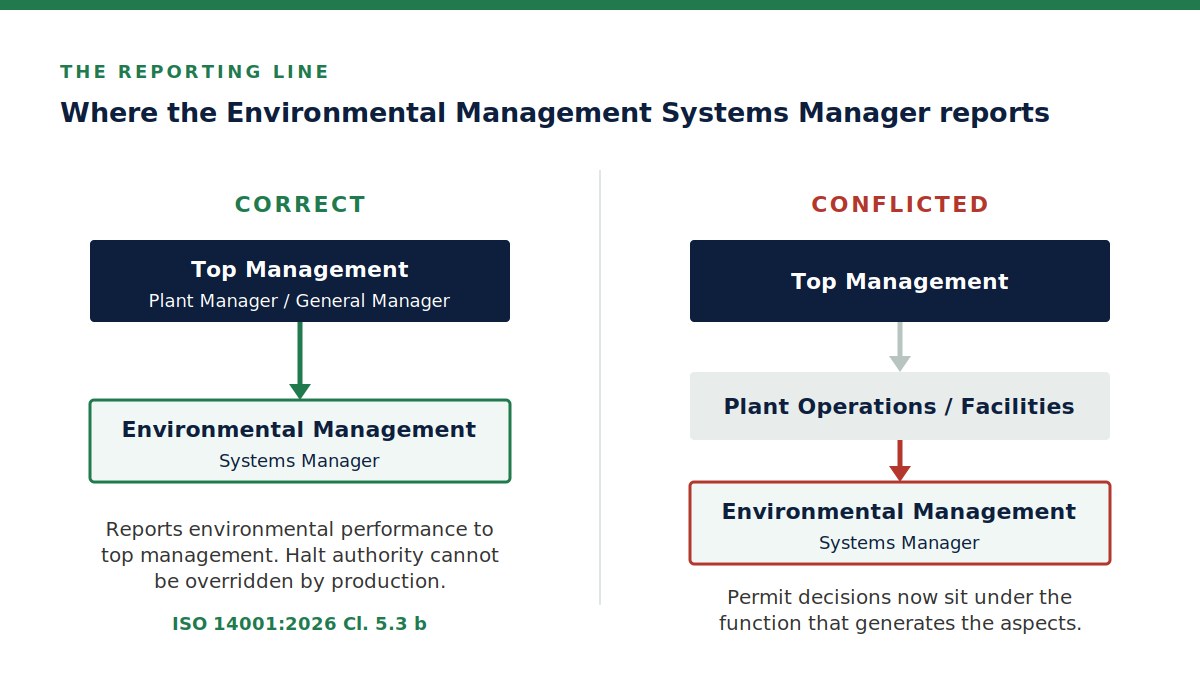
One line in an environmental manager job description does more damage than any other when it is wrong, and in this role it is usually wrong in the same way: the environmental manager job description reports the position into Plant Operations, Facilities, or Maintenance — the functions whose activities generate the aspects and hold the permits.
Direct Answer
The reporting line in an environmental manager job description should run to top management — the plant manager, general manager, or site leader — not into operations, facilities, or maintenance. ISO 14001:2026 Clause 5.3 b) requires reporting on environmental performance to top management. A line into the function that generates the significant aspects and holds the permits puts compliance decisions below production decisions.
The conflict an environmental manager job description has to resolve is concrete. A wastewater treatment unit is underperforming and the discharge is trending toward a permit limit. Correcting it means slowing production for two shifts. The person who must decide reports to the person whose numbers are the production numbers. Nothing improper has to happen for the outcome to be predictable — the structure decided before anyone spoke.
“An environmental manager with responsibility for a permit and no authority to stop the activity that threatens it has been given a liability, not a job.”
— Diana Lynn, President and Principal ISO Consultant, MSI
Where a solid-line report to top management is not organizationally possible, the environmental manager job description must supply the compensating controls in writing: unrestricted access to top management on environmental matters, a defined escalation path that bypasses the intermediate manager, standing attendance at management review, and authority to halt an activity that threatens a compliance obligation which the intermediate manager cannot override. A verbal understanding of unrestricted access is not evidence of unrestricted access.
Three authorities belong in the environmental manager job description explicitly:
- Authority to halt. To suspend an activity, discharge, or shipment that threatens a permit condition or compliance obligation, without prior approval from the function being stopped.
- Authority to convene and escalate. To call management review, require process-owner participation, and escalate an unresolved compliance concern directly to top management.
- Authority to sign and to access. To sign or to formally endorse statutory submissions, and unrestricted access to records, areas, personnel, monitoring data, and contractors across the certified scope.
MSI client experience suggests that where an environmental role carries recurring findings across surveillance cycles, a meaningful share trace back to responsibility that was written down and authority that was left implied. The environmental manager job description is where that silence either ends or hardens.
Three Different Jobs
Steward, Builder, or Transitioner? Three Environmental Manager Job Descriptions
Maintain. Build. Transition.
Quality hiring splits two ways: run the system or build it. An environmental manager job description in 2026 has a third option. Environmental hiring in 2026 splits three ways, because the transition is live and it is a distinct piece of work with a fixed deadline.
Direct Answer
Write one environmental manager job description for one of three situations, not a blend. The steward runs a system already certified to ISO 14001:2026. The builder creates a system that does not exist and takes it to first certification. The transitioner moves a live ISO 14001:2015 system to the 2026 edition before 30 April 2029 — the most common vacancy this year, and the one most requisitions fail to name.
| Steward | Builder | Transitioner | |
|---|---|---|---|
| The work | Run, improve and defend a 2026-conformant system | Create the system and reach first certification | Move a working 2015 system to the 2026 edition |
| Objectives | Performance — permit exceedances, audit completion, closure time | Milestones — scope, aspects register, procedures, Stage 1 and 2 | Deltas — context, Clause 6.3, indicators, audit objectives, review outputs |
| Weight in hiring | Regulatory reporting discipline, audit history | Prior implementation from zero, project management | Clause-level fluency in both editions |
| Timeline | Ongoing surveillance cycle | 12–18 months to certificate | Fixed — 30 April 2029, minus registrar lead time |
| Biggest risk | A maintainer when the system is quietly decaying | Someone who has only ever maintained | Treating the revision as a documentation refresh |
The transitioner’s roadmap
One planning point worth writing into the requisition, because it is the thing most transition schedules get wrong: the 2029 deadline is not what governs the work. An internal audit and a management review have to run after the documents change and before the registrar arrives, or there is no evidence to audit. Working backwards from your own audit date is what produces a last safe start date for each document — and it is why an organization nine months from recertification and one two years out need genuinely different plans, not the same plan at different speeds.
Put these stages in the environmental manager job description. A candidate who has read the 2026 text will recognize immediately whether an environmental manager job description schedule is real.
Stage 1
Clause-by-clause impact assessment
Read the 2026 text against the live system, not against the 2015 text. Produce a delta list with an owner and a date against each item.
Stage 2
Rebuild the context analysis
Five environmental conditions, each with a documented conclusion — including reasoned conclusions of low relevance. Feed the results into risks and opportunities.
Stage 3
Restructure the aspects register
Life cycle stages, normal and abnormal conditions, emergency situations reconciled with the response plan, significance criteria rebuilt to include beneficial impacts.
Stage 4
Build the Clause 6.3 change process
The new clause. Wire the trigger into aspect rescoring, operational control, and document control rather than writing a standalone procedure nobody uses.
Stage 5
Define criteria and indicators
Clause 9.1.1 c) criteria plus indicators, and Clause 6.2.2 e) indicators against each measurable objective. This is where most 2015 systems have nothing to show.
Stage 6
Audit, review, transition audit
A full internal audit cycle with defined objectives per audit, a management review producing strategic-direction outputs, then the registrar. Book early — the 2029 window is shared with every other certificate holder.
For a first-time build rather than a transition, the sequence is longer and starts elsewhere — MSI’s step-by-step ISO 14001 implementation guide, its one-year certification roadmap, and its essential guide to ISO 14001 certification cover that path. Organizations already certified to ISO 9001 have a genuine head start, mapped in MSI’s ISO 9001 to ISO 14001 integration guide.
Required vs. Preferred
Education, Certifications, and Competence in an Environmental Manager Job Description
Defined. Verified. Retained.
The required-versus-preferred split in an environmental manager job description keeps the pool open while keeping the competence bar honest. In environmental roles it does something extra: it separates the technical credentials that regulators recognize from the management-system credentials the certificate depends on. Both belong in the environmental manager job description, and they are not the same list.
Direct Answer
ISO 14001:2026 specifies no degree for this role. Clause 7.2 requires the organization to determine the necessary competence of persons whose work affects environmental performance and the ability to meet compliance obligations, ensure competence on the basis of appropriate education, training or experience, determine training needs associated with the aspects and the system, and retain documented evidence. An environmental manager job description should therefore state competence with named acceptable routes, not a credential gate.
Required
- Bachelor’s degree in environmental science, environmental engineering, chemistry, biology, or a related discipline — or an equivalent combination of education and demonstrated environmental management experience.
- Five or more years in an environmental or EHS role, including at least two years with direct responsibility for a certified ISO 14001 system.
- Demonstrated working knowledge of ISO 14001 at clause level, at the edition the organization holds, cited by name and year in the requisition.
- Direct experience owning a compliance obligations register and meeting statutory reporting deadlines in the applicable programs.
- Documented internal auditor training against ISO 14001.
- Experience preparing for and hosting third-party certification and surveillance audits.
- Aspects and impacts assessment experience, including setting and applying significance criteria.
- Emergency preparedness and response planning, including testing the planned response.
Preferred
- Lead auditor qualification against ISO 14001 — for example an Exemplar Global environmental management systems auditor certification.
- Professional certification: Certified Hazardous Materials Manager, Registered Environmental Manager, Qualified Environmental Professional, or ASQ Certified Quality Auditor.
- Multi-standard experience, particularly ISO 45001 or ISO 9001 where integration is intended.
- Greenhouse gas accounting and reporting to a recognized framework such as ISO 14064 or the GHG Protocol.
- Environmental performance evaluation using indicators per ISO 14031 — directly relevant to the new Clause 9.1.1 criteria requirement.
- Master’s degree in environmental engineering, environmental management, or business.
- Experience with life cycle assessment, covered in MSI’s work on ISO 14001 life cycle assessment and circular economy under ISO 14001.
- Prior 2015-to-2026 transition experience — required rather than preferred for a transitioner role.
A note on the competence record. Whatever the environmental manager job description requires, the organization has to retain evidence that the person hired meets it. Transcripts, certificates, prior audit records and training completions become quality system evidence. Organizations that file them as HR documents are frequently unable to produce them during audit. Build the handoff into the process — MSI’s human resource management procedure and ISO onboarding process guidance both cover it.
Describe the physical and environmental requirements in the environmental manager job description honestly, using the essential-functions framing set out in the EEOC guidance for employers. Confined-space awareness, respirator fit testing, hazardous waste site access, sampling in weather, and after-hours emergency callout all belong in the environmental manager job description as accurate statements of the job rather than boilerplate.
Management Review Is in the Job Description
In 2026, Management Review Outputs Reach the Strategic Direction
Clause 9.3.3 now requires the results to include opportunities to improve integration with other business processes and any implications for the strategic direction of the organization. That changes the agenda, the attendees, and the minutes. MSI’s ISO Management Review Toolkits supply the agenda, the input templates, the decision worksheet, and a minutes format that records decisions rather than attendance — for ISO 14001, ISO 9001, ISO 13485, ISO 45001, and ISO 7101.
Accountability
Measurable Objectives in an Environmental Manager Job Description
Specific. Measured. Reviewed.
An environmental manager job description without measurable objectives describes activity, not performance. In an environmental role the 2026 edition removes the excuse: indicators are now required by the standard, so the objectives in the environmental manager job description and the objectives in the system can be the same objectives.
Direct Answer
Objectives for the Environmental Management Systems Manager, set in an environmental manager job description, should be drawn from the organization’s environmental objectives under Clause 6.2 and paired with the indicators Clause 6.2.2 e) now requires — not invented separately for the performance review. Typical measures: permit exceedances, notices of violation, on-time statutory reporting, compliance evaluation completion, internal audit schedule completion, corrective action closure time, repeat findings, waste diversion rate, energy and water intensity, and emissions intensity per unit of production.
Objectives worth naming in an environmental manager job description, and why each earns its place:
- Permit exceedances and notices of violation. The environmental manager job description measure with the shortest line to consequence. Trended, not reported once.
- On-time statutory reporting. Percentage of required submissions filed by the due date. A single number that tells you whether the compliance calendar is real.
- Compliance evaluation completion. Percentage of the register evaluated within its defined frequency — the direct Clause 9.1.2 measure.
- Internal audit program completion. The earliest indicator that a system is decaying; audits slip before anything else does.
- Corrective action closure time and repeat findings. Median days to verified-effective closure, and count of findings recurring within twelve months.
- Aspects register currency. Time since last review, and whether the Clause 6.3 change trigger has actually fired when the site changed.
- Resource intensity. Energy, water, and material use normalized to production — intensity rather than absolute, so growth does not read as failure.
- Waste diversion and disposal cost. Diversion rate plus disposal spend, which is the measure that funds the function.
- Emissions intensity. Per unit of production, against a defined boundary and a stated method.
- Emergency response test completion. Clause 8.2 d) requires periodic testing where practicable. Tests held, findings raised, plan revised.
Organizations typically report that moving from activity measures to outcome measures changes what the role does more than any other single edit to the environmental manager job description. Counting procedures written is activity. Reducing exceedances is performance. Review them at management review, not only at appraisal — MSI’s work on management review benefits covers why that alignment matters.
Scope Expansion
When the Environmental Management Systems Manager Also Owns ISO 45001 or ISO 9001
Integrated. Scoped. Resourced.
Scope creep in an environmental manager job description is normal and usually unmanaged. An environmental role acquires safety because nobody else has bandwidth, then acquires ESG disclosure because the customer questionnaire arrived, and eighteen months later the environmental manager job description describes a third of the actual job.
Direct Answer
If the role will own ISO 45001 as well, retitle it EHS Manager or Integrated Management Systems Manager and write the safety responsibilities in explicitly — hazard identification, worker consultation and participation, incident investigation. ISO 9001, ISO 14001, ISO 45001 and ISO 7101 share the Harmonized Structure, so context, leadership, planning, support, operation, performance evaluation and improvement align cleanly and one environmental manager job description can genuinely carry more than one standard.
The shared structure is what makes integration work: one context analysis, one interested-party analysis, one internal audit program, one management review, one corrective action system, one document control system. What does not merge is the technical content. Environmental aspects and compliance obligations have no safety analogue; hazard identification and worker participation have no environmental analogue. Write both into the environmental manager job description, or write neither and hire two people. MSI’s guidance on integrated management system implementation covers what the combined scope actually involves.
ESG and sustainability disclosure is the expansion that most often arrives unbudgeted. ESG is adjacent to the environmental manager job description, not the same work: the environmental management system produces evidence a disclosure can rely on, but the disclosure has its own frameworks, boundaries, assurance expectations, and audiences. If the environmental manager job description is going to carry it, say so and resource it. MSI covers the relationship in sustainability program and ISO 14001.
Where an environmental manager job description covers multiple standards, the procedure library matters more, not less. MSI’s ISO Procedure Templates & Guides hub covers the same procedure families across all five standards, so an integrated scope inherits one consistent set rather than three libraries that disagree with each other.
Paste-Ready Template
The Complete Environmental Manager Job Description Template
Adapt. Approve. Publish.
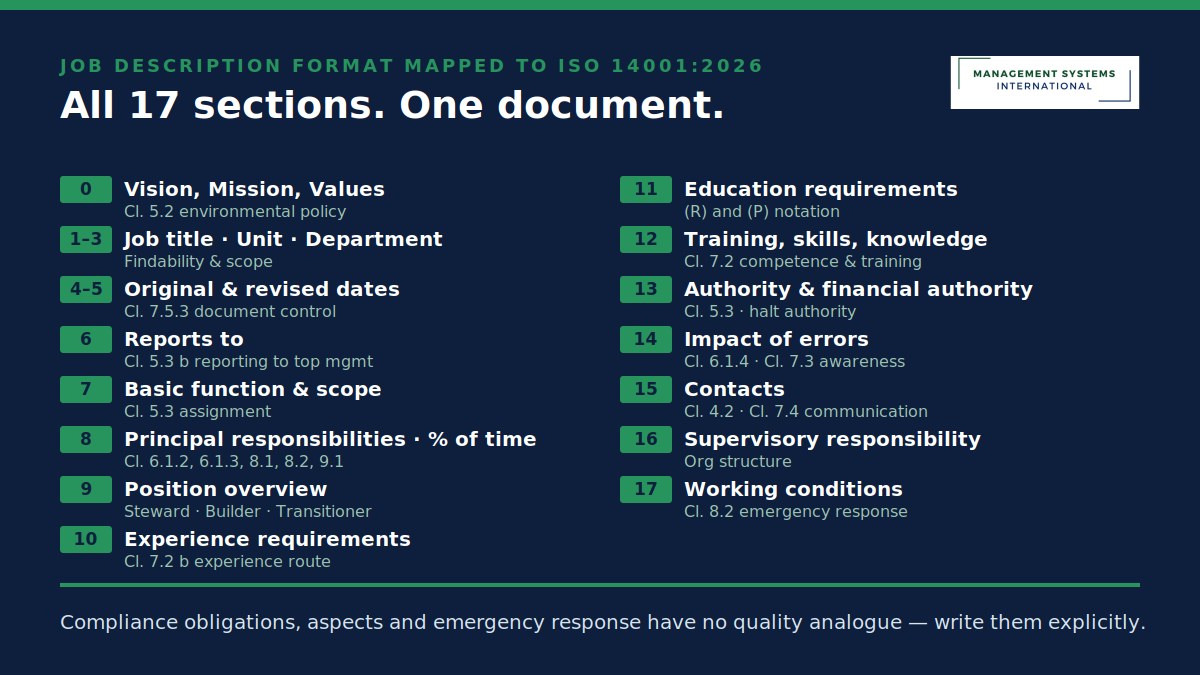
This environmental manager job description is written to the standard seventeen-section format, with the vision, mission and values block added at the top. Replace the bracketed content, delete the programs the site does not hold, and choose one variant in Section 9. Everything else is structural.
Job Description
Environmental Management Systems Manager
0. Our Vision, Mission, and Values
Vision: [Where the organization intends to be.]
Mission: [What the organization does, for whom, and why.]
Values: [Three to five values, stated plainly.] The Environmental Management Systems Manager is expected to reinforce these values through the environmental management system and to help evidence the organization’s commitment to protecting the environment.
1. General Job Title: Environmental Management Systems Manager (post as “Environmental Manager”) 4. Original Date: [date]
2. Unit: [site] 3. Department: Environmental / EHS 5. Revised Date: [date] Rev: [__]
Standards in scope: [ISO 14001:2015 transitioning to ISO 14001:2026 / ISO 14001:2026 / plus ISO 9001, ISO 45001] Registrar: [name] FLSA: Exempt
6. Reports To
[Plant Manager / General Manager / Site Leader]. Reports on environmental performance and improvement opportunities directly to top management (ISO 14001:2026 Cl. 5.3 b) and holds unrestricted access to top management on environmental and compliance matters.
7. Basic Function and Scope of Responsibilities
Owns the design, implementation, maintenance and continual improvement of the environmental management system in conformity with ISO 14001:[edition], across the certified scope. Owns the compliance obligations register and the organization’s knowledge of its compliance status. Serves as primary interface to the registrar and to environmental regulatory authorities.
8. Principal Responsibilities (percentages illustrative)
- Own the compliance obligations register, statutory reporting calendar, permit conditions, and evaluation of compliance. [Cl. 6.1.3, 9.1.2] — 20%
- Maintain the environmental aspects and impacts register across a life cycle perspective, including normal and abnormal conditions, change, and potential emergency situations; apply significance criteria; communicate significant aspects. [Cl. 6.1.2] — 15%
- Own monitoring, measurement, analysis and evaluation, including performance criteria, indicators, and calibrated or verified equipment. [Cl. 9.1.1] — 10%
- Plan and execute the internal audit program, defining objectives, criteria and scope for each audit. [Cl. 9.2] — 10%
- Own corrective action: intake, root cause, action, effectiveness verification, closure. [Cl. 10.2] — 10%
- Maintain emergency preparedness and response, including periodic testing, post-incident review, and training of relevant interested parties. [Cl. 8.2] — 8%
- Maintain operational controls and operating criteria, including control or influence over externally provided processes, products and services and environmental requirements in design and procurement. [Cl. 8.1] — 8%
- Compile management review inputs, convene the review, and record results including integration opportunities and strategic-direction implications. [Cl. 9.3] — 5%
- Maintain context including environmental conditions, interested parties, scope, policy, risks and opportunities, objectives and indicators, and the Clause 6.3 change process. [Cl. 4.1–4.3, 5.2, 6.1.4, 6.2, 6.3] — 7%
- Determine competence and training needs associated with the aspects and the system, deliver or coordinate training, and retain evidence. [Cl. 7.2, 7.3] — 4%
- Own internal and external environmental communication and documented information. [Cl. 7.4, 7.5] — 3%
- Perform other job-related duties as assigned. — %
Reasonable accommodations may be made to enable individuals with disabilities to perform the essential functions of this position.
9. Position Overview — choose one variant
Steward: The organization holds ISO 14001:2026 certification with [registrar]. First-year deliverables: zero permit exceedances; 100% on-time statutory reporting; complete the internal audit program; reduce median corrective action closure to [target] days.
Builder: The organization is not certified and intends to achieve ISO 14001:2026 certification. First-year deliverables: scope and aspects register approved by month [3]; procedure set released by month [6]; workforce trained by month [8]; internal audit cycle complete by month [10]; management review month [11]; Stage 1 month [12].
Transitioner: The organization holds ISO 14001:2015 certification and must transition by 30 April 2029. First-year deliverables: clause-by-clause impact assessment by month [2]; context analysis rebuilt across the five environmental conditions by month [4]; aspects register restructured by month [6]; Clause 6.3 change process operating by month [7]; criteria and indicators defined by month [9]; full internal audit cycle and management review by month [12]; transition audit booked.
10. Experience Requirements
Five or more years in an environmental or EHS role (R), including two or more years with direct responsibility for a certified ISO 14001 system (R). Direct experience owning a compliance obligations register and meeting statutory reporting deadlines (R). Experience preparing for and hosting third-party audits (R). Prior ISO 14001 implementation from initial scoping through certification (P — required for builder roles). Prior 2015-to-2026 transition experience (P — required for transitioner roles). Sector experience in [industry] (P).
11. Education Requirements
Minimum level required: ☐ High School / GED ☐ Vocational or some college ☐ Associate’s, Trade or Technical ☑ Bachelor’s Degree ☐ Master’s ☐ Doctoral
Specific degrees and licensures: Bachelor’s degree in environmental science, environmental engineering, chemistry, biology or a related technical discipline (R) — or an equivalent combination of education and demonstrated environmental management experience (R). Master’s in environmental engineering, environmental management or business (P). State-specific operator licences for [wastewater treatment / air pollution control] (R where applicable). Note: ISO 14001 specifies no credential; competence is established under Section 12.
12. Training, Skills, Knowledge and/or Experience
Specific skills: Aspects and impacts assessment with defensible significance criteria (R). Compliance register construction and maintenance (R). Procedure authoring in plain language (R). Root cause analysis using a named methodology (R). Data analysis and indicator design (R). Life cycle assessment (P). Greenhouse gas inventory preparation (P).
Specific training courses: ISO 14001 internal auditor training (R). ISO 14001 lead auditor qualification (P). RCRA and DOT hazardous materials training as applicable to the site (R). Emergency response and spill control training (R). ISO 14031 environmental performance evaluation (P). CHMM, REM or QEP certification (P).
General experience: Working knowledge of ISO 14001:[edition] at clause level (R). Awareness of the ISO 14001:2026 revision published 15 April 2026 and the 30 April 2029 transition deadline (R). Working knowledge of the federal and state programs applicable to the site (R).
Experience specific to this position: Prior ownership of an internal audit program (R). Prior ownership of management review (R). Prior regulatory agency interface and inspection experience (R). Multi-standard or integrated management system experience (P). Evidence of competence is retained in the personnel file as an environmental management system record.
13. Authority
Decision making: Works under general direction from top management with wide latitude for independent judgment. Holds documented authority to suspend an activity, discharge or shipment that threatens a permit condition or compliance obligation, without prior approval from the function being stopped; to convene management review; to escalate an unresolved compliance concern directly to top management; and to access records, areas, personnel, monitoring data and contractors across the certified scope without restriction.
Financial authority: Manages the environmental budget of approximately $[amount], including waste disposal and treatment contracts, laboratory analysis, monitoring equipment and calibration, permit and registrar fees, and training. Signing authority up to $[amount].
14. Impact of Errors or Non-Performance
Failure to perform the principal responsibilities of this position can result in permit exceedances, notices of violation, civil penalties and enforcement action; missed statutory reporting deadlines; loss or suspension of ISO 14001 certification and the customer contracts contingent on it; failed transition, surveillance or recertification audits; uncontrolled environmental releases with remediation liability; and reputational damage with customers, regulators and the surrounding community.
15. Contacts
Internal: Top management — environmental performance reporting and escalation — monthly and at management review. Operations, maintenance and engineering process owners — aspects, controls, audits, corrective action — weekly. Purchasing — environmental requirements for external providers — monthly.
External: Registrar / certification body — audit scheduling, findings, certificate maintenance — annually. Environmental regulatory authorities — permits, reporting, inspections — as required. Waste and treatment contractors — manifests, performance, audits — monthly. Analytical laboratories — sampling and results — monthly. Community and other interested parties — external communication — as required.
16. Supervisory Responsibility
☐ None ☐ Provides guidance or training (no direct supervision) ☐ Supervises non-exempt personnel ☑ Supervises exempt, professional or technical employees ☐ Supervises supervisory/managerial employees
Organizational structure: Reports to: [Plant Manager / General Manager]. Direct reports: [Environmental Engineer, Environmental Technician, EHS Coordinator]. Indirect reports: [trained internal auditors from other functions on audit assignment; contracted environmental support].
17. Working Conditions
Physical surroundings: Combination of office and [production / warehouse / laboratory / outdoor] environments, including treatment plant, waste accumulation and storage areas.
Adverse working environment: Exposure to [manufacturing noise, chemicals, temperature extremes, outdoor weather, moving machinery]. Personal protective equipment as posted; respirator fit testing and medical clearance where required; confined-space and hazardous-waste site awareness as applicable.
Physical effort: Extended standing and walking during audits, inspections and sampling; climbing ladders and stairs to access monitoring points; occasional lifting up to [__] lbs.
Domestic/international travel: Approximately [__]% for multi-site audits, contractor audits, regulatory meetings and training.
Extended hours: On-call participation in the environmental emergency response rota. Extended hours during regulatory inspections, certification and transition audits, and reporting deadlines.
Approvals
Approved by (Supervisor): ______________________ Approved by (HR): ______________________
Salary grade (HR): ____________ Cost center (HR): ____________ Employee acknowledgement: ______________________ Date: __________
Two details in this environmental manager job description are worth defending. The revision field beside the dates makes the environmental manager job description a controlled document under Clause 7.5.3, revised when the edition, the scope, the permit portfolio, or the reporting line changes. And the percentage-of-time column in Section 8 is the earliest warning an organization gets that the compliance load it carries is larger than the role it has funded — if compliance obligations get 5% against a Title V permit and quarterly reporting, the problem is visible before the hire starts rather than after the first missed deadline.
Worked Audit
Nine Defects in a Legacy Environmental Manager Job Description
Common. Costly. Fixable.
The following is drawn from a composite of manufacturing environmental manager job descriptions MSI has reviewed. No client is identified and the details are generalized. The pattern is typical, which is the point.
- The standard is cited without an edition. “Maintains ISO 14001 compliance” tells a candidate nothing and tells an auditor less. Name the edition and the transition deadline.
- Compliance obligations appear as “applicable regulations.” No permits named, no reporting cycles, no authorities. The candidate cannot self-assess and the organization cannot evidence Clause 6.1.3 ownership.
- Reports to the Plant Operations Manager. The function that generates the significant aspects and holds the permits. No compensating controls documented.
- No authority to halt. Responsibility for permit conditions with no stated power to stop the activity that threatens them.
- Aspects and impacts are missing entirely. Clause 6.1.2 is the engine of the standard and does not appear in the duty list.
- No life cycle perspective. Nothing on design, procurement, external providers, transport, use, or end-of-life treatment — so Clause 8.1 has no owner.
- Emergency response is assumed, not assigned. No mention of preparedness, periodic testing, post-incident review, or on-call expectations, though the person will carry the phone.
- No indicators and no measurable objectives. Under the 2026 edition this is now a clause problem as well as a management one.
- No variant. Silent on whether the organization is certified, building, or transitioning — so the candidate cannot tell which of three jobs is being offered.
Fixing all nine takes an afternoon with the template above. Leaving them costs a hiring cycle and frequently a second one, because the person hired against a document like this arrives expecting a reporting-and-permits role and discovers a management-system rebuild with a 2029 deadline. An environmental manager job description is cheap to fix and expensive to ignore.
Before You Post the Requisition
Have Someone Who Has Sat Through 200+ Audits Read It First
A thirty-minute planning session will tell you whether you are hiring a steward, a builder, or a transitioner, whether the reporting line will survive a registrar’s questions, and what the first-year deliverables should realistically be against a 30 April 2029 deadline. Call MSI at 760-434-9141 and bring the draft.
Support the Role
How to Set a New Environmental Management Systems Manager Up to Succeed
Resourced. Trained. Backed.
A correct environmental manager job description is necessary and not sufficient. Three decisions made before the hire starts do more than anything in the environmental manager job description.
Direct Answer
A new hire against an environmental manager job description succeeds faster when three things are in place before day one: a 2026-edition procedure baseline so the role adapts documents rather than authoring them under deadline, budgeted internal auditor training so the audit program has qualified auditors other than the manager, and visible top-management sponsorship communicated to process owners before the first refusal rather than after it.
Back the environmental manager job description with a 2026 procedure baseline. The predictable month-one failure is a capable environmental manager disappearing into document authoring for a quarter while the transition clock runs. A clause-mapped 2026 procedure set turns that quarter into adaptation work — reading how the site actually operates and adjusting the documents to match, which is the work you hired them for.
Budget auditor training before it is urgent. An environmental manager job description that assigns the audit program without funding auditors has assigned a bottleneck. An audit program run entirely by the person who owns the system has an impartiality problem the standard names directly. Training two or three auditors from other functions solves impartiality and bandwidth at once. MSI’s internal audit services, ISO internal auditor training, and internal audit skills guidance all address it, and the ISO training license covers a whole workforce without per-seat surprises.
Communicate sponsorship before the first refusal. This role depends on cooperation from functions that do not report to it, and no environmental manager job description can compel that. Top management announcing the appointment, the authority, and the expectation of cooperation — before the new manager needs to invoke it — is worth more than any paragraph in the document.
Where the system behind the environmental manager job description does not yet exist, or where the transition is already behind schedule, ISO consulting support in the first year is usually cheaper than the alternative. MSI’s SurePath turnkey certification program and its ISO consulting practice exist to make that first year productive rather than foundational.
FAQ
Environmental Manager Job Description: Frequently Asked Questions
Asked. Answered. Sourced.
Does ISO 14001 require a management representative?
No. ISO 14001:2026 Clause 5.3 requires top management to assign and communicate responsibilities and authorities — specifically for ensuring the system conforms to the standard and for reporting on environmental performance to top management — but it does not require an appointed management representative. An environmental manager job description should assign those two responsibilities by name and function. ISO 13485 is the standard that still requires a named management representative; ISO 14001 does not.
Environmental Manager or EHS Manager — which title should we use?
Use Environmental Manager, or Environmental Management Systems Manager internally, when the scope is ISO 14001 and environmental compliance. Use EHS Manager only when occupational health and safety is genuinely in scope, because that title commits you to safety ownership as well. A common and defensible approach is to post the environmental manager job description under the searched title and state the precise internal title in line one of the body.
Who should the environmental manager report to?
Top management — the plant manager, general manager, or site leader. ISO 14001:2026 Clause 5.3 b) requires reporting on environmental performance to top management, and a line into operations, facilities, or maintenance places compliance decisions below production decisions. Where a solid-line report is not possible, the environmental manager job description must document compensating controls: unrestricted access to top management, a defined escalation path, standing management review attendance, and halt authority the intermediate manager cannot override.
Does ISO 14001 require a degree for this role?
No. Clause 7.2 requires competence to be determined for persons whose work affects environmental performance and the ability to meet compliance obligations, established on the basis of appropriate education, training or experience, with documented evidence retained. An environmental manager job description should therefore state competence with named acceptable routes — degree or equivalent demonstrated experience — rather than a hard credential gate. Site-specific operator licences are a separate matter and may genuinely be required.
How should the job description change for the ISO 14001:2026 transition?
Substantially. A transitioner needs clause-level fluency in both editions and first-year deliverables expressed as deltas rather than milestones: rebuild the context analysis across the five environmental conditions, restructure the aspects register, build the new Clause 6.3 change process, define Clause 9.1.1 criteria and indicators, and add audit objectives per audit. Prior transition experience moves from preferred to required. An environmental manager job description silent on the 30 April 2029 deadline is describing a job the candidate will discover in month four.
Should the job description name specific permits and regulations?
Yes. “Applicable environmental regulations” is the weakest sentence in most environmental manager job descriptions, and naming the specifics is the highest-value edit you can make to an environmental manager job description. Name the permit types the site holds, the reporting cycles it owes, and the authorities it reports to. It lets candidates self-assess accurately, it shortens the interview, and it evidences that the organization has determined its own compliance obligations under Clause 6.1.3 rather than gesturing at them.
Can one person own ISO 14001 and ISO 9001 together?
Yes, and it is common. Both standards use the Harmonized Structure, so context, leadership, planning, support, operation, performance evaluation and improvement align and one audit program, one management review and one corrective action system can serve both. The technical content does not merge — aspects, compliance obligations and emergency preparedness have no quality analogue — so an environmental manager job description covering both must write both sets of duties explicitly. Retitle to Integrated Management Systems Manager if the scope is genuinely dual.
Is an environmental manager the same as a sustainability manager?
No. A sustainability manager works on external disclosure, greenhouse gas accounting, supply chain engagement and reporting frameworks. The environmental management system produces evidence that a disclosure can rely on, but it is a different discipline with different candidates. If one person will do both, the environmental manager job description should say so explicitly and the percentage-of-time column should show how the week actually splits.
How often should the job description be reviewed?
Annually at minimum, and immediately whenever the standard edition changes, the certified scope changes, the permit portfolio changes, or the reporting line changes. Treat the environmental manager job description as a controlled document under Clause 7.5 with a revision number, an approval, and a next-review date — the same discipline applied to every other document in the environmental management system.
Related Reading
Keep Building the Environmental Management Systems Manager Role
Equip. Train. Support.
A strategic planning engagement that works backwards from your own audit date to a last safe start date per document: index and dispositions, condition triage, records list, responsibilities matrix, and a dated schedule with owners. Document work and ongoing support are optional stages.
ISO 14001:2026 Procedure Templates & Guides →
Seven 2026-edition procedures plus the transition course — built for the experienced environmental manager who needs documents, not a tutorial, and has a 2029 deadline.
ISO Procedure Templates & Guides Hub →
The same procedure families across ISO 9001, 13485, 14001, 45001 and 7101 — for scopes that carry more than one standard.
ISO Management Review Toolkits →
Agenda, inputs, decision worksheet and minutes format — updated for the Clause 9.3.3 results that now reach the strategic direction of the organization.
The Quality Systems Manager Job Description →
The sibling article, with the full seventeen-section format mapped to ISO 9001 and ISO 13485 clause by clause.
ISO 14001 Environmental Conditions →
The bidirectional context change your new hire has to evidence — five conditions, each needing a documented conclusion.
28 years, 80+ certifications supported, 200+ audits attended, 600+ professionals trained. Call 760-434-9141 to talk through the role before you post it.
References and Authoritative Sources
- ISO — Environmental management, ISO 14001: iso.org
- ISO — Quality management, ISO 9001: iso.org
- ISO — Occupational health and safety, ISO 45001: iso.org
- ISO/TC 176/SC 2 — ISO 9001 revision publication date: committee.iso.org
- ISO 14031 — Environmental performance evaluation guidelines: iso.org/standard/74263
- ISO/TC 207/SC 1 — Environmental management systems subcommittee: isotc207.org
- US EPA — Laws and regulations: epa.gov
- US EPA — Environmental management systems: epa.gov/ems
- US EPA ECHO — Enforcement and compliance history online: echo.epa.gov
- eCFR — Title 40, Protection of Environment: ecfr.gov
- Federal Register — Environmental Protection Agency documents: federalregister.gov
- Global ACI — Global Accreditation Cooperation Incorporated: global-aci.org
- ANAB — ANSI National Accreditation Board: anab.ansi.org
- Exemplar Global — auditor certification: exemplarglobal.org
- ASQ — Certified Quality Auditor: asq.org
- Greenhouse Gas Protocol — corporate accounting standards: ghgprotocol.org
- US Bureau of Labor Statistics — Environmental scientists and specialists: bls.gov
- US Department of Labor — Overtime exemption for executive employees: dol.gov
- EEOC — The ADA: Your Responsibilities as an Employer: eeoc.gov
About Management Systems International (MSI)
Management Systems International (MSI) is a veteran-owned, female-owned ISO consulting firm founded in 1998. With 28 years of experience, MSI’s track record includes 80+ certifications supported, 200+ audits attended, and 600+ professionals trained across manufacturing, technology, medical device, government, healthcare, and other regulated industries.
Today MSI implements ISO 9001, ISO 13485, ISO 14001, and ISO 45001, with an expanding focus on ISO 7101 healthcare quality.
msi-international.com · 760-434-9141
