Culture change for industrial transformation is the work of making a plant behave differently after the equipment, the software, or the process has already changed — and it is the line item almost every capital project forgets to fund. The cell goes in on schedule. Integration passes acceptance testing. Six months later the second shift is running a workaround the first shift invented, the deviation log is longer than it was before the upgrade, and the one operator who understood the old machine has retired without anyone writing down what she knew.
Direct Answer
Culture change for industrial transformation is the deliberate, evidenced change in how people on a plant floor make decisions after a technical change — planned under the change-planning clause, carried by organizational knowledge and competence requirements, and judged at management review. A quality culture is no longer something an organization may choose to pursue. The current ISO management system standards name culture directly, expect it to be determined and addressed, and produce records an assessor can ask to see.
Most guidance on this subject was written for offices. It assumes people share a floor, a shift, and a language, that a workshop can be scheduled without stopping production, and that the knowledge holding the operation together lives in documents. On a plant floor none of those assumptions hold, which is why culture change for industrial transformation fails in ways that office culture programs never encounter.
Across 28 years, 200+ audits attended, and 600+ professionals trained, the pattern Management Systems International (MSI) observes most often in culture change for industrial transformation is not resistance. Operators are usually the first to want a machine that works. The failure is structural: the technical change was planned in detail and the behavioral change was left to happen on its own, in a building where nobody has time for it to happen on its own.
This article does three things. It sets out why a quality culture is now an expectation rather than an aspiration. It gives you three tests you can run today, before committing budget, that predict whether your culture change for industrial transformation will hold. And it maps the work to the specific clauses that carry it, so the effort enters your management system through the front door instead of running alongside it.
The Expectation
Why Is a Quality Culture Now Expected Rather Than Optional?
Named. Required. Assessed.
Direct Answer
A quality culture is expected because the standards now name it. ISO 14001:2026 lists culture as an internal issue to determine, requires top management to promote a culture that engages people, and defines management review suitability partly in terms of organizational culture. ISO 45001 requires consultation and participation with barriers removed. ISO 7101 requires workforce well-being. For anyone planning culture change for industrial transformation, the practical consequence is that the work is no longer voluntary and no longer unmeasured.
There was a time when a quality manager could reasonably treat culture — and culture change for industrial transformation with it — as somebody else's department. That time ended in 2026. The fourth edition of ISO 14001, published April 15, 2026, wrote culture into three of the places a management system actually decides things — context, leadership, and review — and ISO 9001:2026, scheduled for publication on September 16, 2026, carries the same expectation into the quality system that most industrial sites run as their primary certificate.
The wording matters more than the volume, and for anyone planning culture change for industrial transformation the wording is the whole story. ISO 14001:2026 does not contain a clause headed “culture,” and no standard tells you to run a program. What the guidance does is name culture among the internal characteristics an organization determines under the context clause, alongside its activities, its environmental performance, its strategic direction, and its capabilities — where capabilities are defined as people, knowledge, processes, and systems. Once culture is a determined internal issue, it feeds risks and opportunities, which feeds planning of action, which feeds objectives and operational control. The route is already built.
Leadership Is Now a Distributed Requirement
The leadership and commitment clause in the 2026 edition of ISO 14001 closes with an obligation that did not exist before: top management must support other relevant roles in demonstrating leadership within their own areas of responsibility. Annex A explains what that support looks like — promoting a culture that engages the people working for the organization or on its behalf in activities that contribute to the system's intended outcomes.
Read that from a plant floor and it is a statement about shift supervisors and cell leads. It says the system does not run on an executive's commitment; it runs on the layer that translates intent into instruction being backed when it exercises judgment. Anyone who has watched a culture change for industrial transformation evaporate three weeks after the kickoff meeting will recognise the layer this requirement is aimed at.
Management Review Must Now Judge Organizational Fit
Management review has always required conclusions on continuing suitability, adequacy, and effectiveness. A plant that has just completed culture change for industrial transformation carries a specific obligation here. The 2026 Annex A now defines suitability as how the system fits the organization, its operations, its culture, and its business systems. A review minute that asserts the system remains suitable, with no reasoning about whether it fits how the plant actually runs after a major changeover, is thinner than it used to be — because the standard has told you what suitability is made of. MSI's management review procedure guide covers what the restructured review requires in practice.
The Standards Give You a Plant-Floor Example
The risks and opportunities guidance in ISO 14001:2026 offers an example unusually close to the shop floor: environmental spills arising because literacy or language barriers prevented workers from understanding local work procedures. That is a culture and communication failure written up as an environmental risk. It is also the cleanest available argument that culture change for industrial transformation belongs inside the planning clauses rather than beside them, and it names a condition present in a very large share of manufacturing operations.
The Three Tests
Three Tests to Ask Before Any Culture Change for Industrial Transformation
Ask. Answer. Act.
Direct Answer
Three tests predict whether culture change for industrial transformation will hold. The Placement Test asks which clause the work enters through. The Supervisor Test asks what the middle layer was told to stop doing to make room. The Evidence Test asks which record will look different in six months if the effort succeeds. An initiative that cannot answer all three is a communication campaign, and it will behave like one.
These three tests are worth running before the budget for culture change for industrial transformation is approved, not after the launch. Each takes about ten minutes and each has a structural fix if the answer comes back wrong. In 200+ audits attended, MSI's consistent observation is that the programs which survive contact with a production schedule are the ones that could answer these three questions on day one.
Test 1 — The Placement Test: Which Clause Does This Enter Through?
Ask: Name one documented process that will change because of this work, and name the clause that will make it change.
If the answer is a steering committee, a communications plan, and a set of posters, the work is sitting beside the management system rather than inside it. Anything beside the system depends on somebody remembering it. Anything inside the system gets surfaced by internal audit and management review whether or not anyone remembers.
Fix: Write the current state into the context clause as a determined internal issue, in the language of the standard so it survives the next document review. Carry it into risks and opportunities. Set at least one objective against it with a named owner and an evaluation method. After that the culture change for industrial transformation cannot go unreviewed, because the system will keep asking about it.
Test 2 — The Supervisor Test: What Did You Tell Them to Stop Doing?
Ask: Go to three shift supervisors and ask what they were told to stop doing in order to make room for the new expectations.
If the answer is nothing, the initiative has been added to a workload that was already full, and behavior will revert inside a quarter. This is the single most common failure MSI encounters in culture change for industrial transformation, and it is not a motivation problem. A supervisor asked to hit the old output numbers, absorb a new control system, and coach different behavior — with no additional time, authority, or training — will do the first of those three, because that is the one that gets measured on Friday.
Fix: Treat supervisor capability as a competence requirement under the competence clause, with defined actions and a real effectiveness evaluation rather than an attendance record. Then give the layer a documented decision right it did not previously hold — authority to stop a line, to hold a changeover, or to reject a work instruction that does not match the new equipment. The new distributed-leadership requirement in ISO 14001:2026 is written for exactly this. MSI's work on sustained success through leadership performance addresses the same layer from the leadership side.
Test 3 — The Evidence Test: Which Record Looks Different in Six Months?
Ask: If this succeeds completely, which document will read differently in six months? Then ask the same question assuming it fails completely.
If both answers describe the same set of documents, the effort is decorative. This is the test that separates culture change for industrial transformation from a rebranding exercise, and it is deliberately uncomfortable, because most programs have never been asked to name their own evidence in advance.
Fix: Name two records before you start. Good industrial candidates are the corrective action file, where you are looking for cause statements that name process design rather than operator error, and the consultation record, where you are looking for a decision that changed because someone on the floor said so. Both are records the standards already require, which means a well-planned effort creates no new documentation burden — it changes what the existing documents contain.
Documents That Carry the Behavior
Twenty-Eight Years of Judgment Calls, Already Written Down
Every one of the three tests above resolves into a procedure — change planning, competence, communication, consultation, corrective action, management review. MSI's ISO Procedure Templates and Guides cover 15 procedure topics across five standards and their combinations, in editable Word, with the decisions an experienced practitioner would make already recorded and every point where two standards diverge documented rather than averaged away. You are not buying blank forms; you are buying the reasoning behind them.
The Industrial Difference
What Makes Culture Change for Industrial Transformation Different?
Shifts. Skills. Silence.
Direct Answer
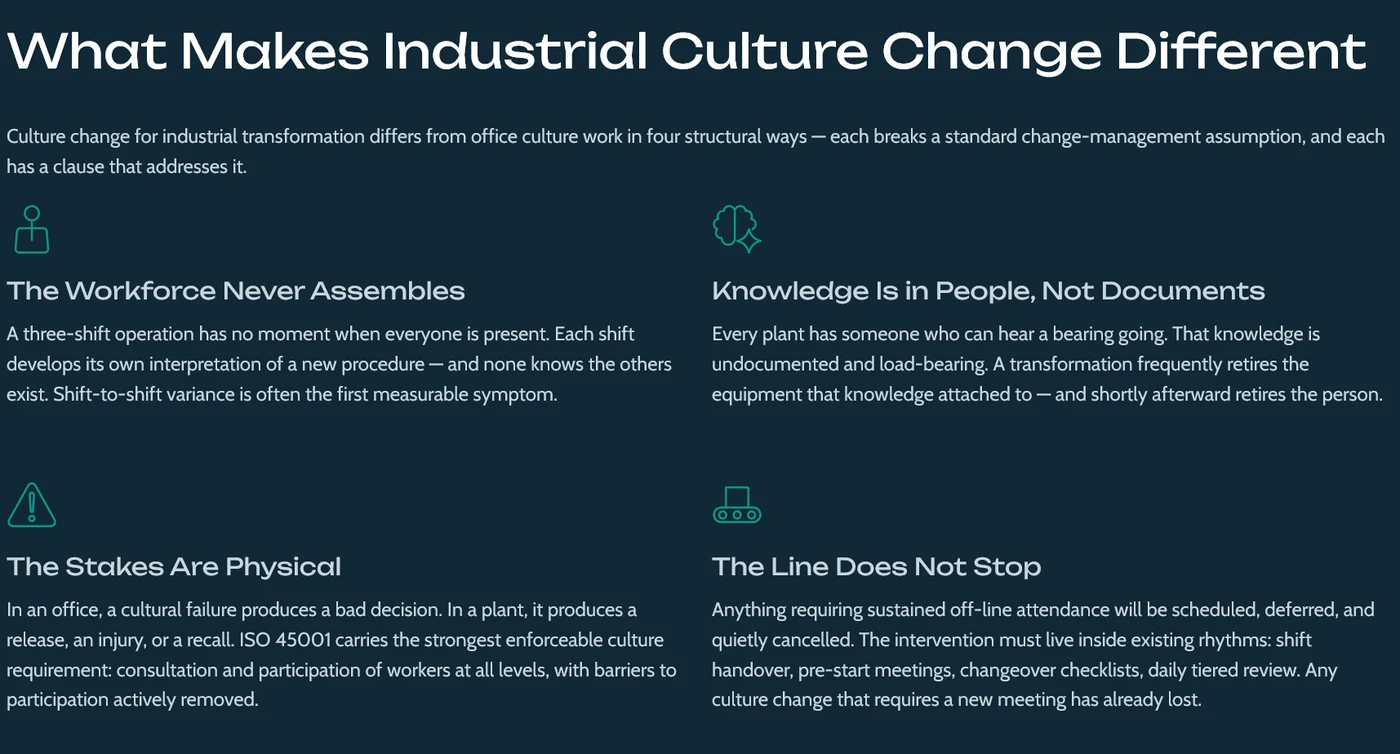
Culture change for industrial transformation differs from office culture work in four structural ways: shift patterns mean the workforce never assembles in one room, critical knowledge is undocumented and held by long-tenured individuals, physical and environmental risk raises the cost of a behavioral failure, and production cannot pause for the intervention. Each of these breaks a standard change-management assumption, and each has a clause that addresses it.
The Workforce Never Assembles
A three-shift operation has no moment when everyone is present. Communication designed around a town hall reaches the day shift and arrives at the night shift as rumor. Worse, each shift develops its own interpretation of a new procedure and none of them knows the others exist, which is why shift-to-shift variance is often the first measurable symptom that a culture change for industrial transformation has not landed. The communication clause requires the organization to determine what it communicates, when, to whom, and how — and on a multi-shift site the “how” is the hard part, not an administrative detail.
The Knowledge Is in People, Not Documents
Every plant has someone who can hear a bearing going. That knowledge is real, it is load-bearing, and it is undocumented. A technical transformation frequently retires the equipment that knowledge attached to, and shortly afterward retires the person. The organizational knowledge clause in ISO 9001 requires the organization to determine the knowledge it needs, maintain it, and consider how to acquire additional knowledge when needs change — which is a direct instruction to capture what a departing expert knows before the departure, not after.
Most sites treat that clause as a filing requirement. Treated properly it is one of the highest-return elements of any culture change for industrial transformation, because it converts a retirement risk into a documented asset and it gives long-tenured people a visible role in the new operation rather than a redundancy notice. MSI's guidance on reducing employee turnover through quality systems develops the retention side of this.
The Stakes Are Physical
In an office, a cultural failure produces a bad decision. In a plant, it produces a release, an injury, or a recall. That difference is why ISO 45001 carries the strongest enforceable culture requirement in the ISO landscape: consultation and participation of workers at all applicable levels, with non-managerial workers named specifically, and an obligation to remove obstacles and barriers to participation. That last phrase requires you to go looking for the reasons people do not speak up — shift timing, language, literacy, or the absence of any route that does not run through a direct supervisor. The ISO 45001 safety standard page covers scope, and MSI's coverage of the ISO 45001 revision and psychosocial risk explains where the requirement is heading.
The Line Does Not Stop
Office culture work assumes you can take people out of production for a day. Industrial work cannot. Anything requiring sustained off-line attendance will be scheduled, deferred, and quietly cancelled. This is a design constraint, not an excuse — it means the intervention has to live inside existing rhythms: shift handover, the pre-start meeting, the changeover checklist, the daily tiered review. Any culture change for industrial transformation that requires a new meeting has already lost.
The Clause Spine
Which ISO Clauses Carry Culture Change for Industrial Transformation?
Change. Knowledge. Competence.
Direct Answer
Culture change for industrial transformation runs through five clause areas: planning of changes, which requires change to be carried out in a planned manner; organizational knowledge, which requires you to capture what the operation depends on; competence, which requires effectiveness evaluation rather than attendance; operational control, which requires controls to survive the change; and consultation, which requires workers to be involved before decisions rather than told after. ISO 13485 is the exception and does not carry these constructs.
Planning of Changes — The Clause Built for This
ISO 14001:2026 gives planning of changes its own clause, requiring changes that affect the management system to be carried out in a planned manner and managed so the intended outcomes are still achieved. Annex A lists the triggers, and they read like a transformation project charter: new or changed products, services, processes, operations, equipment, or facilities; developments in knowledge and technology; changes to technical specifications of materials or process inputs; changes in staff or external providers including contractors.
The clause also requires you to review the consequences of unintended changes and act to mitigate adverse effects. That is the sentence that makes the workaround your problem rather than the operator's. MSI's article on ISO 9001 change management covers how to sequence changes without destabilizing the system while you make them.
Environmental Aspects Move When the Process Moves
Culture change for industrial transformation carries an environmental dimension that is easy to miss: a new process changes what the site emits, consumes, and disposes of. ISO 14001:2026 requires environmental aspects to be determined taking into account normal and abnormal conditions, planned or new developments, new or modified activities, and potential emergency situations — and requires them to be considered across a life cycle perspective. A transformation that updates the equipment register but not the aspects register has left a compliance obligation floating. The ISO 14001 environmental standard page covers the certification path, and certified organizations have until April 30, 2029 to complete the transition to the fourth edition.
Transition Resource
Move Your ISO 14001:2015 System to the 2026 Edition in a Week
Built for experienced EHS managers who need to bring a working 2015 system up to the fourth edition without rebuilding it from scratch. Editable Word procedures, worked examples, and the judgment calls already made — including the planning-of-changes, context, leadership, and management review language the 2026 edition changed. If your plant is mid-transformation, this is the document set that keeps the environmental system current while the process underneath it moves. Most teams complete the set inside a week.
Competence Means Evaluated, Not Attended
Competence is where culture change for industrial transformation stops being a slogan. The competence clauses require four things: determine necessary competence, ensure people have it, take action where they do not, and evaluate whether the action worked. The fourth step is the one most often missing, and it is the one that matters during a transformation, because vendor training on new equipment is almost universally recorded as attendance. A signature on a sign-in sheet tells you about scheduling. A record showing an operator's first-pass yield or fault-diagnosis accuracy before and after tells you whether the culture change for industrial transformation reached the person doing the work. MSI's ISO Internal Auditor Workshop and ISO Overview training are built around demonstrated capability rather than seat time, and the ISO training license covers sites that need to deliver this repeatedly across shifts.
Operational Control Has to Survive the Change
Operational control decides whether culture change for industrial transformation survives the integrator's departure. It requires establishing operating criteria and implementing control in accordance with them, and it extends to externally provided processes, products, and services. During a transformation the external provider often holds more knowledge about the new system than anyone on your payroll, which makes the control and influence question urgent rather than theoretical. The standard is explicit that the type and extent of control to be applied must be defined within the management system — not left to the integrator's project plan. MSI's guidance on multi-site ISO certification covers how this scales when the transformation runs across several plants, and integrated management systems covers the architecture decision when quality, environmental, and safety certificates all touch the same change.
The ISO 13485 Exception
This needs stating clearly, because it is the most common cross-standard error MSI encounters. ISO 13485:2016 uses the pre-Annex SL structure. It does not share the harmonized ten-clause architecture of ISO 9001, ISO 14001, ISO 45001, and ISO 7101, and it carries no culture language, no awareness clause of the harmonized type, and no consultation requirement. What it has is competence per role at Clause 6.2 and the medical device file at Clause 4.2.3. If you run a device line inside a mixed-certificate site and write one culture procedure claiming coverage of every standard on the wall, the device system is where the claim breaks. Run the culture change for industrial transformation through the harmonized standards and cross-reference into ISO 13485 through competence and training records only. The ISO 13485 medical device standard page sets out the structural differences.
Observed Patterns
Where Culture Change for Industrial Transformation Breaks on the Floor
Recognize. Diagnose. Correct.
Direct Answer
Culture change for industrial transformation typically breaks in four places: the pilot cell that never scales because its conditions were never reproducible, the night shift that was trained by rumor, the retiring expert whose knowledge left undocumented, and the vendor handover that transferred equipment without transferring understanding. Each is a placement failure rather than a motivation failure, and each is visible in records before it is visible in performance.
These are field observations on culture change for industrial transformation from 28 years of implementation and audit attendance across manufacturing, technology, medical device, government, healthcare, and other regulated industries — offered as patterns MSI sees repeatedly, not as validated industry statistics.
A fifth pattern deserves separate mention because it is the quietest. Where corrective action cause statements after a transformation consistently read “operator error” or “training,” the system is assigning blame downward and the culture change for industrial transformation has not reached the people writing the records. MSI's article on dysfunctional company symptoms and their proven fixes develops that diagnostic, and MSI's internal audit services cover how to surface it during the audit itself rather than a year later.
The Sequence
How Do You Sequence This Around the 2026 Revisions?
Determine. Deploy. Demonstrate.
Direct Answer
Sequence culture change for industrial transformation into the document reviews the 2026 revisions already force. Two published editions inside eighteen months mean context, leadership, change planning, and management review documents are being opened anyway. Doing the culture work during that review is one project instead of two, and it lands the new requirements and the new behaviors in the same version of the same document.
The practical sequence inside that window runs in four moves. Run a current-state assessment of your existing records first — corrective action causes, consultation outcomes, competence evaluations, shift variance — because the records will tell you what a survey will not. Write the finding into the context determination as an internal issue. Convert it into risks, opportunities, and two or three objectives with owners, completion dates, and evaluation methods, keeping at least one binary. Then deploy through change planning, knowledge capture, competence, and consultation, and audit the result before it reaches management review.
If the transformation itself needs structure, SurePath covers turnkey certification, SureFinish covers six-week advising for teams that already have a system and need it finished, and SureResults covers year-round maintenance once the change has settled. MSI's management system maturity guide is a useful companion for setting realistic expectations about how fast any of this moves.
Make the Review the Turning Point
Management Review Toolkits — Agendas, Inputs, and the Record That Decides
Transformation programs die in reviews that note progress and decide nothing. MSI's ISO Management Review Toolkits give top management a structured agenda, the full input set for each standard, and a results format that forces a conclusion and an owner onto every line — including the suitability judgment the 2026 edition now expects you to reason through rather than assert. If your last review recorded a transformation status update with no decision attached, this is the fix.
Measurement
How Do You Measure Culture Change for Industrial Transformation?
Count. Compare. Conclude.
Direct Answer
Measure culture change for industrial transformation with six indicators drawn from records the plant already keeps: shift-to-shift variance, cause-statement quality, near-miss and stop-work reporting rate, knowledge capture completion, competence effectiveness rate, and decision-change rate from consultation. All six are quantitative or binary, none require a new system, and together they show whether behavior changed rather than whether sentiment improved.
ISO 14001:2026 defines an indicator as a quantitative, qualitative, or binary variable representing the status of operations, management, conditions, or impacts — which explicitly authorizes binary indicators. That matters here, because the most honest measures on a plant floor are often yes-or-no questions.
- Shift-to-shift variance — spread in output, scrap, or deviation rate across shifts running identical work. Narrowing means the change reached everyone, not just days.
- Cause-statement quality — proportion of corrective actions whose recorded cause names a system factor rather than an individual. The single most diagnostic number in the file.
- Stop-work and near-miss reporting rate — a rise usually signals rising trust, not rising risk. Falling reporting after a change is a warning, not a win.
- Knowledge capture completion — binary, per critical role. Is the knowledge documented, yes or no.
- Competence effectiveness rate — proportion of competence actions with a completed effectiveness evaluation rather than a completion date.
- Decision-change rate — proportion of consulted decisions modified by worker input. If nothing has ever been modified, you have a briefing process.
Every one of these six exists in a plant already, which is what makes them usable. Track all six for four quarters before drawing conclusions about culture change for industrial transformation. Two quarters of movement is noise; four is a trend, and a trend is what management review needs in order to reach the suitability conclusion the 2026 edition now expects. MSI client experience suggests the behavioral indicators begin moving in the second or third quarter, while repeat-nonconformity rate — the hardest and most persuasive measure — usually lags a further two to four quarters. Organizations expecting movement in one quarter typically abandon the effort just before the evidence would have appeared.
Run the Three Tests With Someone Who Has Seen 200+ Audits
A Planning Session on Where Your Culture Work Should Enter the System
Thirty minutes on your actual records — change planning, competence evaluations, consultation, corrective action causes, and your last management review — and a straight answer on which clause your culture change for industrial transformation should enter through, what evidence you already hold, and what the 2026 editions will expect that your current documents do not yet carry. No obligation, and you keep the map either way.
Or call 760-434-9141 and ask for Diana.
Related Reading
More on Culture, Change, and ISO Consulting
Read. Reference. Renew.
- Work Culture Transformation: The Proven ISO Method
- AI Flat Organizations Are Breaking Traditional QMS
- Scale Operations Confidently: Proven Strategies and Techniques
- Business Reinvention: The Systems That Make Renewal Repeatable
- The Quality Management Mindset
- ISO 9001 Quality Management: The Certification Path
- ISO Manual Templates and Guides
- ISO Internal Auditor Training
- Industries We Serve
- MSI Case Studies
- The Portrait: How MSI Works
- Contact MSI
Frequently Asked
Culture Change for Industrial Transformation: Questions Plant Leaders Ask
Asked. Answered.
Is a quality culture actually required, or just recommended?
No clause says “have a quality culture,” but the expectation is now built into requirements you cannot skip. Culture is named as an internal issue to determine under the context clause, top management is required to support other roles in demonstrating leadership by promoting a culture that engages people, and management review suitability is defined partly in terms of organizational culture. The obligation is to determine and address, not to run a branded program.
What are the three tests before starting?
The Placement Test — which clause does this enter through, and which documented process will change. The Supervisor Test — what were the shift supervisors told to stop doing to make room. The Evidence Test — which record will read differently in six months if it works, and which if it fails. A culture change for industrial transformation that cannot answer all three will behave like a communications campaign, because that is what it is.
How is this different from office culture work?
Culture change for industrial transformation differs from office culture work in four structural ways. Shift patterns mean the workforce never assembles. Critical knowledge is undocumented and held by long-tenured individuals whose equipment the transformation may be removing. Physical and environmental risk raises the cost of a behavioral failure from a bad decision to a release or an injury. And production cannot pause, so any intervention requiring off-line time will be deferred and cancelled.
Which clause should we use as the anchor?
Planning of changes is the natural anchor for culture change for industrial transformation, because it requires change affecting the management system to be carried out in a planned manner and requires review of the consequences of unintended changes. Organizational knowledge and competence carry the capability side, consultation carries the participation side, and management review closes the loop.
Does ISO 13485 carry any of this?
No. ISO 13485:2016 uses the pre-Annex SL structure and does not share the harmonized ten-clause architecture, so it has no culture language, no awareness clause of the harmonized type, and no consultation requirement. It addresses people through competence at Clause 6.2 and documents knowledge through the medical device file at Clause 4.2.3. On mixed-certificate sites, run the culture change for industrial transformation through the harmonized standards and connect to the device system through competence and training records only.
How long does it take?
Twelve months produces a defensible evidence base; twenty-four to thirty-six months produces durable change. MSI client experience suggests behavioral indicators on a plant floor begin moving in the second or third quarter, with shift-to-shift variance usually the first to respond and repeat-nonconformity rate the last. A culture change for industrial transformation judged at six months will almost always be judged as a failure that was actually on schedule.
Should we wait for the 2026 transitions or start now?
Start now and sequence into them. ISO 14001:2026 published April 15, 2026 with a transition deadline of April 30, 2029, and ISO 9001:2026 is scheduled for publication on September 16, 2026. Both force a review of context, leadership, change planning, and management review documents — the same documents a culture program touches. Doing the two together is one project; doing them separately is two, and the second one never gets funded.
References and Further Reading
- ISO 14001:2026, Environmental management systems — Requirements with guidance for use, fourth edition. Clauses 4.1, 5.1, 6.1.2, 6.1.4, 6.3, 7.2, 8.1, 9.3 and Annex A. ISO
- ISO 9001, Quality management systems — Requirements. Clauses 5.1.1, 6.3, 7.1.6, 7.2, 7.3, 7.4, 8.1, 9.3. ISO
- ISO 45001:2018, Occupational health and safety management systems. Clauses 5.1, 5.4, 7.2, 7.4, 8.1. ISO
- ISO 7101:2023, Healthcare organization management — Management systems for quality in healthcare organizations. ISO
- ISO 19011:2026, Guidelines for auditing management systems. ISO
- ISO 30401, Knowledge management systems — Requirements. ISO
- ISO 10015, Quality management — Guidelines for competence management and people development. ISO
- ISO/IEC Directives, Part 1, Annex SL — the harmonized structure for management system standards. ISO Directives and Policies
- Global Accreditation Cooperation (Global ACI), the international accreditation authority that succeeded IAF and ILAC effective January 1, 2026. Global ACI
- NIST Manufacturing Extension Partnership — workforce and technology adoption support for small and mid-sized manufacturers. NIST MEP
- Manufacturing USA — the national network of advanced manufacturing institutes. Manufacturing USA
- OSHA, Recommended Practices for Safety and Health Programs — worker participation as a core program element. U.S. Department of Labor
- OSHA, Process Safety Management — management of change requirements for covered processes. OSHA
- NIOSH, Total Worker Health — integrating hazard protection with worker well-being. CDC / NIOSH
- U.S. EPA, Sustainable Manufacturing — environmental performance in industrial operations. EPA
- U.S. Bureau of Labor Statistics — manufacturing employment and tenure data. BLS
- U.S. Department of Energy, Better Plants — industrial energy and process improvement. DOE
- ASQ, PDCA Cycle — the improvement loop underlying every management system standard cited here. American Society for Quality
- The W. Edwards Deming Institute, PDSA Cycle — drive out fear as a precondition for improvement. Deming Institute
Where to Start
Culture Change for Industrial Transformation Starts in a Clause
Enter. Evidence. Endure.
The plants that sustain culture change for industrial transformation are not the ones with the best launch. They are the ones that found the clause where the behavior belonged and put it there, so the system itself keeps asking the question long after the vendor has gone and the enthusiasm has moved on. Run the three tests before the budget is approved. If any of them comes back empty, fix the placement first — the money will go further afterward.
MSI has supported 80+ certifications, attended 200+ audits, and trained 600+ professionals across manufacturing, technology, medical device, government, healthcare, and other regulated industries over 28 years. The ISO consulting work that holds up over time is rarely the work that added the most documents. It is the work that put the right requirement in the right place and then left behind a system capable of noticing when it slipped. Call 760-434-9141 or contact MSI to talk through where yours should sit.
About Management Systems International (MSI)
Management Systems International (MSI) is a veteran-owned, female-owned ISO consulting firm founded in 1998. With 28 years of experience including extensive AS9100 work in MSI's early years, MSI's track record includes 80+ certifications supported, 200+ audits attended, and 600+ professionals trained across manufacturing, technology, medical device, government, healthcare, and other regulated industries.
Today MSI implements ISO 9001, ISO 13485, ISO 14001, and ISO 45001, with an expanding focus on ISO 7101 healthcare quality.
msi-international.com · 760-434-9141
