
Most businesses hit the same wall when they try to grow. Sales increase, orders multiply, new hires come on board — and suddenly no one is doing things the same way anymore. Quality slips. Mistakes multiply. Customers notice.
The ability to scale operations with ISO 9001 is precisely why certified companies grow through that wall instead of into it. ISO 9001 does not just give you a certificate to hang in the lobby. It gives you something far more valuable: a complete set of fully written, integrated procedures that become the operating system of your entire company.
This article explains exactly how that works, why documented procedures are the real engine of scalable growth, and what your company can do to put that system in place.
What Most Companies Get Wrong About Scaling
When business leaders think about scaling, they typically think about hiring more people, buying more equipment, or expanding into new markets. Those are outputs of successful scaling — not the cause of it.
The real cause is consistency. A company that can deliver the same result at 100 units as it did at 10 units is a company that can scale. A company that relies on tribal knowledge, individual heroics, and informal habits cannot.
This is where most unstructured businesses quietly fail. Their best employee leaves and takes the process with them. A new hire does the job a different way and no one catches it until a customer complains. Uncertified companies typically don’t have a corrective action program, a disciplined document and records control system, or formal hiring and development programs — the very systems that prevent these problems from compounding as you grow.
ISO 9001 solves all of this at the source. It requires that your processes be formally documented, approved, controlled, and continuously improved — not kept in someone’s head. That is the foundation of business resilience and sustainable growth.
The Real Benefit of ISO 9001: Fully Written, Integrated Procedures
This is the most underappreciated benefit of ISO 9001 certification, and the most practical one.
When a company pursues ISO 9001 certification, they do not simply take an exam and receive approval. They go through a structured process of documenting every significant procedure in their operation — from how customer orders are received, to how design changes are approved, to how a defective product is handled. Every procedure is written out, reviewed, and approved. Every document is controlled so no one is working from an outdated version.
The result is that your company runs on written procedures, not on people’s memories. That distinction changes everything when you scale. ISO certification significantly enhances a company’s value by improving operational efficiency, credibility, and compliance — making certified companies attractive acquisition targets for larger firms looking to expand their capabilities and market presence.
Why Written Procedures Are the Foundation of Scalable Growth
When a new employee joins your company, training is no longer dependent on who happens to be available to show them the ropes. The procedure exists. It is written. It is approved. It is current. The new hire learns the same process as every other employee before them — the same standard, every time.
When your production volume doubles, the quality control steps do not get skipped because someone is busy. The procedure is documented. The checklist exists. The record must be filled out. Consistent and predictable results are achieved when activities are understood and managed as interrelated processes that function as a coherent system.
When a problem occurs — and problems always occur — your corrective action program kicks in. The issue is documented, root cause is identified, and a fix is implemented and recorded. That knowledge does not live in one person’s email inbox. It lives in your system, available to everyone, building a knowledge base that compounds in value over time.
This is how ISO 9001 transforms scaling from a chaotic, risky endeavor into a structured, repeatable process. It is also why expanding your business capabilities without this foundation is far riskier than most leaders realize.
How Integrated Procedures Connect Every Department
One of the most powerful aspects of ISO 9001 is that its procedures do not exist in isolation — they are integrated across departments. Your sales process connects to your design and development process. Your purchasing process connects to your supplier evaluation process. Your production process connects to your quality control and inspection process. Your customer complaint process connects to your corrective action program.
Each procedure feeds the next. Each output becomes an input. When you scale one part of the operation, the connected parts scale with it — because the handoffs are already defined in writing.
This integration is what separates ISO-certified companies from companies that have a folder full of SOPs nobody reads. ISO 9001 requires that the procedures form a coherent system, not just a collection of documents. Management and risk strategies work best when built on this kind of integrated foundation.
How ISO 9001 Enables You to Scale Operations: The Core Components
Understanding which parts of ISO 9001 do the heavy lifting for scaling helps you prioritize where to focus your energy.
Document and Records Control
Before any procedure can be written, you need a system for controlling documents and records. ISO 9001 requires this as a foundation. Every document has an approved version. Every record proves the process was followed.
This matters enormously for scaling because as you grow, the number of documents multiplies. Without a control system, you end up with employees working from outdated procedures while a newer, approved version already exists. ISO certification prevents that from happening — and as standards continue to evolve, a well-controlled document system keeps your organization ahead of every revision.
The Corrective Action Program
The corrective action program (CAP) is arguably the most powerful scaling tool ISO 9001 provides. When something goes wrong, the CAP requires you to document the problem, investigate root cause, implement a fix, and verify that the fix worked.
Over time, your CAP becomes an institutional knowledge base. It records every significant problem your company has ever faced and exactly how it was resolved. When you hire a new quality manager, they do not start from zero — they inherit the entire history of how your organization learns from its mistakes.
For companies pursuing ISO 13485 for medical devices, the CAP expands to include preventive actions as well, capturing potential problems before they occur. The foundation for continual improvement is built directly into this cycle.
Management Review
ISO 9001 requires regular management reviews in which leadership examines data on quality performance, customer satisfaction, process effectiveness, and improvement opportunities. The standard specifies exactly what data must be reviewed.
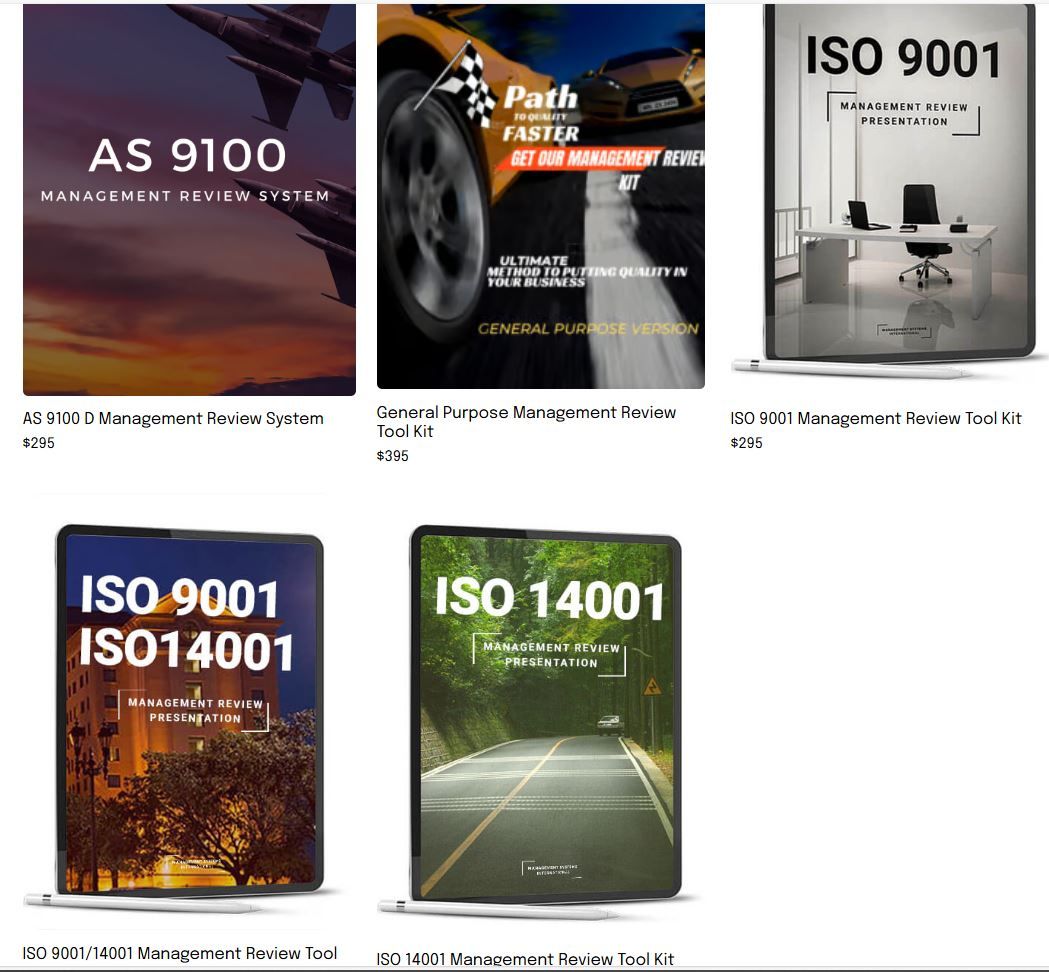
This structure forces leadership to establish unity of purpose and direction based on evidence rather than intuition. When you follow the protocols of an ISO program, it tells you exactly what data is to be tracked and trended — removing guesswork from your most important decisions. See our Management Review Toolkits to support this process.
Employee Competency and Training Records
ISO 9001 requires that the organization determine the necessary competencies for roles that affect quality, provide appropriate training or development, and retain records of that training.
This is a critical scaling enabler. When you open a new location or bring on a new team, you are not guessing what skills people need. The competency requirements are documented. Investing in employee training ensures consistent quality standards across the organization. Onboarding becomes systematic rather than improvised. See our Design and Development Training as one example of how formal training integrates with your ISO system.

The 7 Key Principles of ISO 9001 That Drive Scalable Growth
ISO 9001 is built on seven principles that directly address the most common reasons small and growing businesses struggle to scale. Understanding these principles helps you see why the standard works — not just as a compliance exercise, but as a practical operating framework.
- Customer Focus: The primary focus of quality management is to meet customer requirements and strive to exceed customer expectations. For small businesses, this is everything — one unhappy customer at 20 clients has far more impact than at 2,000. ISO 9001 builds customer feedback loops directly into your processes so problems surface and get fixed before they cost you relationships.
- Leadership: Effective leadership establishes unity of purpose and direction for the organization. In a small business, the owner is often also the quality manager, operations lead, and sales team. ISO 9001 gives leadership a structured framework to step out of the day-to-day and work on the business — not just in it.
- Engagement of People: Competent, empowered, and engaged people at all levels are essential for delivering consistent value. Small businesses cannot afford disengaged employees. When your team understands the procedures and has a voice in improving them, retention improves and quality stays consistent even as headcount grows.
- Process Approach: Consistent and predictable results are achieved when activities are understood and managed as interrelated processes. This is the principle that directly prevents the chaos most small businesses experience during a growth surge — because every process is already defined, connected, and documented before the surge arrives.
- Improvement: Successful organizations maintain an ongoing focus on improvement. Setting improvement objectives, monitoring performance, and implementing necessary changes keeps your operation competitive without requiring expensive outside help every time something needs to change.
- Evidence-Based Decision Making: Decisions based on the analysis and evaluation of data produce more reliable results. For small business owners who often rely on instinct, ISO 9001 introduces the discipline of tracking what is actually happening — and making decisions based on that data rather than assumptions.
- Relationship Management: For sustained success, organizations manage their relationships with suppliers and key partners to optimize performance. A small business with one or two critical suppliers is especially vulnerable to supply chain disruptions — ISO 9001’s supplier management requirements reduce that vulnerability significantly.
ISO certification continues to evolve, but these seven principles have remained the foundation of every revision because they reflect how well-run organizations actually operate at any size.
Real Companies That Used ISO 9001 to Scale Operations
Genstar Technologies
Genstar Technologies achieved both ISO 13485:2016 and ISO 9001:2015 certification. With dual certification in place, the company’s documented systems, quality controls, and compliance procedures made it a highly attractive acquisition target for larger firms seeking an established, verifiable operation in the medical device space (see our Launch Mastery Course). The procedures they built became a core part of the company’s demonstrable value.
Mindflow Design
Mindflow Design, a medical device design firm, achieved ISO 13485:2016 and ISO 9001:2015 certifications(later only kept ISO 13485). For a design house, this is no small undertaking — it requires that the entire design and development process be documented, controlled, and subject to formal review at each stage. That level of procedural rigor became a competitive differentiator that set Mindflow apart from uncertified competitors in a highly regulated field. Was later purchased by Midwest Products Engineering.
A Laboratory Development and Monitoring Company
One of our clients in the lab space achieved ISO 9001:2015 certification with design scope included. The certification process required them to formalize procedures that had previously existed only in their team’s collective experience. Within months of certification, onboarding new technicians became significantly faster and more consistent — directly because the procedures were written down and controlled. They have sites in Europe as well.
Common Scaling Challenges That ISO 9001 Solves Directly
| Scaling Challenge | How ISO 9001 Addresses It |
|---|---|
| New hires don’t know the correct process | Written, approved procedures become the training standard for every employee |
| Quality drops as volume increases | Documented quality controls and inspection records apply at every production volume |
| Institutional knowledge leaves with employees | Procedures and corrective action records are stored in the system, not in people |
| Different locations do things differently | Controlled documents ensure everyone uses the same approved procedure |
| Customer problems repeat without permanent fixes | Customer satisfaction is protected by a CAP that requires root cause analysis and verified resolution |
| Leadership makes decisions based on gut feel | Management review requires data-driven decisions on a defined schedule |
| Supplier quality is inconsistent | ISO 9001 requires formal supplier evaluation and ongoing monitoring processes |
| Processes become inefficient as complexity grows | Process optimization is built into the ISO framework, eliminating waste and improving turnaround times |
How to Start Scaling Operations with ISO 9001
If your company is not yet certified, the path begins with these foundational steps.
Step 1: Assess your current state. Identify which processes are documented and which exist only in people’s heads. The gaps in your documentation are the gaps in your scalability. Strategic quality thinking is a useful starting point for mapping where your organization stands today.
Step 2: Build your document control system first. Before you write any procedures, establish how documents will be created, reviewed, approved, versioned, and stored. This is the container that holds everything else. Efficient processes, a skilled workforce, and the right systems all depend on this foundation being solid.
Step 3: Document your core processes. Start with the processes most directly tied to customer outcomes — order processing, product or service delivery, and quality control. Eliminating unnecessary steps, reducing waste, and optimizing workflows begins here. Write procedures that describe what actually happens, not what you wish happened.
Step 4: Implement your corrective action program. Begin recording problems and their resolutions immediately. Establishing a quality management system based on ISO 9001 standardizes this process and reduces variability from day one, long before certification is complete.
Step 5: Establish internal audit and management review cycles. These are the feedback mechanisms that tell you whether your system is working and where improvement is needed. Internal audits are among the most powerful risk mitigation strategies available to a scaling company.
Step 6: Pursue formal certification. Working with an experienced ISO consultant accelerates this process significantly. Fostering a culture of learning and innovation throughout implementation ensures the system is embraced, not just installed. Learn about our SurePath turnkey ISO implementation program.
Technology and Tools That Support ISO 9001 Scaling
For small businesses especially, the concern is not just whether ISO 9001 works — it is whether the technology needed to support it is affordable and practical. The good news is that the tools available today make implementation more accessible than ever.
Automation for Consistency at Scale
One of the biggest fears small business owners have about scaling is that quality will slip when they are no longer personally overseeing every task. Automation directly addresses that fear. By automating repetitive tasks — data entry, inspection checklists, customer notifications, document routing for approval — businesses can reduce errors, save time, and free up resources for higher-value work. Your ISO procedures define what needs to happen; automation ensures it actually does, every time, without depending on a specific person being available.
Cloud-Based Solutions for Growing Teams
Small businesses scaling into new locations or remote teams face a common problem: how does everyone access the same approved, current version of every procedure? Cloud-based solutions solve this directly. Your document control system lives in the cloud, so every employee — whether in the same building or across the country — is always working from the current approved version. As your team grows, access scales with it. No more emailed attachments, no more version confusion, no more outdated printed procedures on the shop floor.
Data Analytics for Smarter Decisions
ISO 9001’s management review requirement means you need data — on quality performance, customer satisfaction, process efficiency, and improvement trends. Digital tools that track and visualize this data turn what could be a burdensome reporting exercise into genuine business intelligence. For a small business owner making decisions with limited resources, knowing exactly where your operation is underperforming — and having the data to prove it — is a significant competitive advantage.
Financial Management for Small Businesses Scaling with ISO 9001
One of the most common concerns small business owners raise about ISO 9001 is cost. The honest answer is that ISO 9001 is an investment — but it is one that pays back through reduced waste, fewer errors, lower rework costs, and stronger customer retention. Understanding how to manage that investment smartly is critical.
Budgeting for ISO Implementation
The cost of ISO 9001 implementation falls into three categories: consultant fees, certification body fees, and internal time. For most small businesses, the internal time — the hours spent documenting procedures and training employees — is the largest cost and the one most frequently underestimated. Building a realistic budget that accounts for this time, and using digital tools to streamline document management and training tracking, significantly reduces that burden.
The return on that investment is measurable. Companies that complete ISO 9001 implementation typically report faster onboarding, fewer customer complaints, reduced rework, and — critically for small businesses — the ability to bid on contracts that require certification. Many government and enterprise procurement processes require ISO 9001 as a baseline qualification. The certification pays for itself the first time it opens a door that was previously closed.
Risk Management on a Small Business Budget
Small businesses are disproportionately vulnerable to operational risk. A single key employee leaving, one supplier failing, or one quality escape reaching a major customer can be existential at small scale in a way it simply is not for a large corporation. Internal audits are among the most powerful and cost-effective risk mitigation strategies available to a small business — because they surface problems before they become crises.
ISO 9001’s built-in risk management framework requires you to identify potential failure points, develop contingency plans, and review them regularly. As standards continue to update, keeping your risk management current ensures your business remains protected against emerging threats — supply chain instability, regulatory changes, and market shifts included. For a small business, this is not overhead. It is insurance that actively reduces the probability of the events it covers.
Proven Strategies & Techniques for Scaling Operations with ISO 9001
Understanding the principles is one thing — putting them into practice is another. Here are the seven core strategies that ISO-certified companies use to scale operations confidently.
- Implement a Robust QMS: Establishing a quality management system based on ISO 9001 helps organizations standardize processes, reduce variability, and ensure consistent quality. This foundation is crucial for scaling operations confidently. One of the first actions we develop is the corrective action program — and if pursuing ISO 13485 for medical devices, you also include preventive actions. Through these programs, your company can identify where problems usually occur and systematically resolve them. This builds a substantial institutional knowledge base over time.
- Focus on Customer Satisfaction: Continuously gather and analyze customer feedback to improve products and services. Satisfied customers are more likely to return and recommend your business, driving growth through relationships that compound in value over time.
- Empower Employees: Engage and empower employees by providing training, resources, and opportunities for involvement in decision-making processes. An engaged workforce is more productive and innovative. Having formal, controlled, and approved procedures gives employees the clarity they need — and those procedures become the foundation for continual improvement across the organization.
- Optimize Processes: Use the process approach to identify and eliminate inefficiencies. Streamlining operations reduces waste, improves turnaround times, and enhances overall productivity — all of which become more critical as volume increases.
- Data-Driven Decisions: Collect and analyze data to make informed decisions. Use key performance indicators (KPIs) to monitor progress and identify areas for improvement. When you follow the protocols of an ISO program for management reviews, it tells you exactly what data is to be tracked and trended — removing guesswork from leadership decisions.
- Continuous Improvement: Foster a culture of continuous improvement by regularly reviewing processes, setting improvement objectives, and implementing corrective actions. This ensures the organization remains competitive and adaptable as the market evolves.
- Strengthen Supplier Relationships: Develop strong relationships with suppliers to ensure a reliable supply chain. Collaborate with suppliers to improve quality and reduce costs — because your scalability is only as strong as your supply chain’s consistency.
See our Management Review Toolkits to support your implementation of these strategies.
Frequently Asked Questions About Scaling Operations with ISO 9001
What is ISO 9001 and how does it help companies scale?
ISO 9001 is an internationally recognized standard for quality management systems. It helps companies scale by requiring them to document all significant procedures in writing, creating an integrated system of processes that employees follow consistently regardless of team size, location, or production volume. The quality management systems market continues to grow as more companies recognize this competitive advantage.
What is the first step to scale operations with ISO 9001?
The first step is to establish a document and records control system. This system defines how procedures are written, approved, versioned, and stored, forming the foundation for all other ISO 9001 activities. Without document control, procedures cannot be managed consistently across a growing organization. A risk-based approach to implementation ensures you prioritize the most critical processes first.
Why do ISO-certified companies scale faster than non-certified companies?
ISO-certified companies have fully written and approved procedures for every core process. When they hire new employees, open new locations, or increase production volume, they apply the same documented system to a larger operation — rather than rebuilding processes from scratch or relying on informal habits that vary between people. Formal processes built around ISO 9001 make scaling efficient in ways that informal operations simply cannot replicate.
What is a corrective action program and why does it matter for scaling?
A corrective action program (CAP) is a formal system for documenting problems, identifying root causes, implementing solutions, and verifying that the solutions worked. For scaling companies, the CAP serves as an institutional knowledge base that records every significant issue and resolution. Regularly updating your risk management strategies in response to CAP findings ensures the organization remains resilient as it grows.
Can a small company benefit from ISO 9001 before they start scaling?
Yes — implementing ISO 9001 before scaling is the ideal approach. Building documented procedures and quality systems while the organization is small is far easier than retrofitting a system onto a large, fast-moving operation. Companies that certify early scale with their systems already in place. Meeting and exceeding customer requirements from the start builds the reputation that makes scaling sustainable.
Does ISO 9001 certification make a company more attractive to buyers or investors?
Yes. ISO 9001 certification signals to potential acquirers and investors that the company’s operations are documented, controlled, and capable of being transferred or replicated. Setting clear quality objectives and achieving them consistently is exactly what sophisticated buyers look for when evaluating an acquisition target. Several of our certified clients have had this happen firsthand.
How long does it take to get ISO 9001 certified?
Most small to mid-sized companies achieve ISO 9001 certification within 6 to 18 months of beginning implementation. Working with an experienced consultant typically reduces that timeline by helping companies avoid common documentation gaps and audit preparation mistakes. Companies that certify also find it easier to grow into new markets, since their documented systems transfer to new regions without rebuilding from scratch. Contact us to discuss your timeline.
Conclusion: Procedures Are the Product
The companies that scale successfully are not necessarily the smartest or the best-funded. They are the ones that figured out how to make their best work repeatable.
ISO 9001 is the framework that makes that possible. By requiring fully written, integrated procedures — controlled, approved, and continuously improved — it gives growing companies something that no amount of hiring or equipment can provide on its own: a system that works the same way every time, for every employee, at any scale. Management systems are the true foundation of business resilience and growth — and ISO 9001 is the most proven way to build them.
If your business is serious about growth, the question is not whether you can afford to pursue ISO 9001. The question is whether you can afford to scale without it.
Source: ISO 9001:2015 Quality Management Systems — ISO.org
