ENVIRONMENTAL MANAGEMENT · 2026 EDITION
Circular. Auditable. Enforceable.
A circular economy ISO 14001 strategy stopped being a sustainability aspiration on 19 July 2026. On that date the first hard circularity obligation under European product law entered into application, and for a defined class of organizations the question changed from should we design waste out of our operations to can we evidence that we did. That is a different question, it lands in a different clause of the standard, and most environmental management systems are not built to answer it.
This circular economy ISO 14001 guide is written for the EHS manager, EMS coordinator, or management representative who already holds a certified environmental management system and is working the transition to the 2026 edition. It assumes you are past deciding whether to certify. What follows maps circularity to the clauses that now carry it, separates the parts that are voluntary from the parts that are not, and shows what the evidence has to look like when an auditor asks.
DIRECT ANSWER
Circular economy ISO 14001 alignment means running circular strategies — designing out waste, keeping materials in use, and regenerating natural systems — inside the governance machinery of a certified environmental management system, so that circular claims become documented, measured, and third-party verified rather than asserted. Under ISO 14001:2026, published 15 April 2026 with a transition deadline of 30 April 2029, circularity touches Clause 4.1 (natural resource availability as an environmental condition), Clause 4.3 (scope determined with a life cycle perspective), Clause 5.2 (sustainable resource use named as an example commitment), Clause 6.1.2 (aspects across the life cycle), Clause 6.1.3 (compliance obligations), Clause 6.3 (planning of changes), and Clause 9.1.2 (evaluation of compliance).
THE DEFINITION
What Does Circular Economy ISO 14001 Alignment Actually Mean in 2026?
System. Evidence. Consequence.
The circular economy is a systemic model that keeps materials and products in use at their highest value for as long as possible, then recovers and regenerates what remains. It replaces the linear take–make–dispose sequence with loops. That much has been settled language for a decade, and circular economy ISO 14001 discussions rarely stall on the definition. What has not been settled — and what a circular economy ISO 14001 approach exists to solve — is the gap between saying it and proving it.
In a circular economy ISO 14001 pairing, the standard supplies the proving apparatus. It is the framework that turns intent into a register, a register into objectives, objectives into operational controls, controls into monitored data, and data into management review decisions with names attached. The circular economy supplies the direction of travel. Neither is sufficient alone. A circular strategy without a management system produces claims nobody can verify, which is the deficit circular economy ISO 14001 practice exists to close. A management system without a circular strategy produces compliance with nothing behind it. Run together as circular economy ISO 14001 practice, they produce something an auditor, a customer, and a regulator will each accept for different reasons.
“The circular economy was never short of ambition. It was short of evidence. That is precisely the deficit a management system is built to close.”
Two developments in 2026 changed the stakes. The first is the publication of the revised standard itself. The second is that circularity acquired legal teeth in a major market. Taken together, they move a circular economy ISO 14001 programme from the objectives clause, where participation is discretionary, toward the compliance obligations clause, where it is not. MSI’s guide to ISO 14001 environmental conditions covers the context half of that shift in detail; this article covers the material-flow half.
WHAT CHANGED
Why Did Circularity Move Out of the Sustainability Team This Year?
Standards. Statutes. Deadlines.
For most of the past decade, circularity sat with whoever wrote the sustainability report rather than with the people running circular economy ISO 14001 processes. It was measured in narrative, not in records. Three separate developments have relocated it into the environmental management system, and the sequence matters because each one raises the evidentiary bar set by the last.
MAY 2024
ISO publishes the first three standards of the ISO 59000 family — ISO 59004, ISO 59010, and ISO 59020. Circularity acquires an international vocabulary, a set of principles, and a measurement method.
18 JULY 2024
The EU Ecodesign for Sustainable Products Regulation, Regulation (EU) 2024/1781, enters into force as a framework regulation. Obligations phase in through delegated acts over the following years.
9 FEBRUARY 2026
The European Commission adopts the delegated and implementing acts that put detail behind the unsold-goods rules, including Delegated Regulation (EU) 2026/296 and its list of permitted derogations.
15 APRIL 2026
ISO 14001:2026 is published. Clause 4.1 names natural resource availability among the environmental conditions requiring evaluation. Clause 4.3 requires the EMS scope to be determined considering a life cycle perspective.
19 JULY 2026
The destruction of unsold apparel, clothing accessories, and footwear becomes prohibited for large enterprises across the EU. Medium-sized enterprises follow in 2030. Micro and small enterprises are exempt.
30 APRIL 2029
The transition deadline for ISO 14001:2015 certificates. Systems that have not moved to the 2026 edition by this date lose accredited status.
For circular economy ISO 14001 planning, the July date is the one worth pausing on. According to the European Commission’s own announcement, large companies across the EU are now prohibited from destroying unsold clothes, clothing accessories, and footwear, and the European Environment Agency estimates that between four and nine percent of textile products placed on the European market were being destroyed before use. What makes this consequential for a circular economy ISO 14001 programme is a definitional detail: under EU law, “destruction” encompasses recycling and other recovery routes, not merely landfill and incineration. An organization that quietly shredded deadstock and booked it as recycling has not complied. It has committed the prohibited act under a friendlier name.
That is the kind of distinction a compliance obligations register is designed to capture and a sustainability narrative is not. It is also why circular economy ISO 14001 work has stopped being optional for organizations placing products on the European market, regardless of where those products are manufactured.
DIRECT ANSWER
Circularity moved into the environmental management system in 2026 because it acquired both a standards vocabulary and a legal deadline in the same period. A circular economy ISO 14001 programme now has to distinguish between circular activity the organization chose to undertake, which belongs in Clause 6.2 environmental objectives, and circular activity the organization is legally required to undertake, which belongs in the Clause 6.1.3 compliance obligations register and must be evaluated under Clause 9.1.2. Registers built before 2026 rarely make that distinction.
THE CLAUSE MAP
Where Does Circularity Live Inside ISO 14001:2026?
Clause. Requirement. Record.
A common mistake in circular economy ISO 14001 work is to treat circularity as a single initiative attached to one clause. It is not. It threads the system, and each thread carries its own documented output. The table below maps where circular material flows show up in the 2026 edition and what evidence the clause expects.
| Clause | What Circularity Looks Like Here | Expected Record |
|---|---|---|
| 4.1 Context | Natural resource availability is now a named environmental condition. Input scarcity and secondary-material supply are context issues, not procurement problems. | Context analysis showing what was evaluated, what was material, and why |
| 4.3 Scope | Scope must be determined considering a life cycle perspective — which drags upstream and downstream material flows inside the boundary. | Documented scope statement with life cycle reasoning |
| 5.2 Policy | The expanded NOTE names sustainable resource use and preservation or conservation of natural resources as example commitments. | Policy appropriate to a context that now includes resource availability |
| 6.1.2 Aspects | Aspects determined considering a life cycle perspective. Material inputs, packaging, returns, and end-of-life routes each generate aspects. | Aspects and impacts register, significance criteria, significant aspects |
| 6.1.3 Compliance obligations | Product and waste law that mandates circular handling — the ESPR destruction ban being the current example. | Register entry with applicability, method, and evaluation frequency |
| 6.2 Objectives | Voluntary circular targets: recycled content, diversion rate, remanufactured volume, product life extension. | Objective with metric, owner, resources, timeframe, evaluation method |
| 6.3 Planning of changes | New in 2026. Switching to a take-back model or a new secondary feedstock is a planned change requiring controlled handling. | Change record with purpose, consequences, resources, responsibilities |
| 8.1 Operational control | Operating criteria for segregation, disposition decisions, and supplier take-back terms. | Documented operating criteria and evidence the process runs to them |
| 9.1.2 Evaluation of compliance | Planned, periodic confirmation that circular legal obligations are actually being met. | Evaluation results, knowledge of compliance status, retained evidence |
| 9.3 Management review | Circular performance and compliance status arrive as review inputs, not as an annual slide. | Review minutes with decisions, actions, and resource commitments |
Read the circular economy ISO 14001 clause map as a cascade rather than a checklist. A resource-availability issue named in Clause 4.1 has to reappear in the risks and opportunities determined under Clause 6.1, which has to be reflected in objectives under Clause 6.2, which drives controls under Clause 8, evaluation under Clause 9, and improvement under Clause 10. Circularity does not sit in one place. Once it enters the context analysis, it threads the entire system — and a circular economy ISO 14001 programme that stops at the register has stopped one clause too early. MSI’s detailed treatment of ISO 14001 environmental aspects under Clause 6.1.2 and its walkthrough of the ISO 14001 environmental policy rewrite cover two of these links in depth.
BUILT FOR THE TRANSITION
Seven Procedures, Written to the 2026 Edition — Not Adapted From 2015
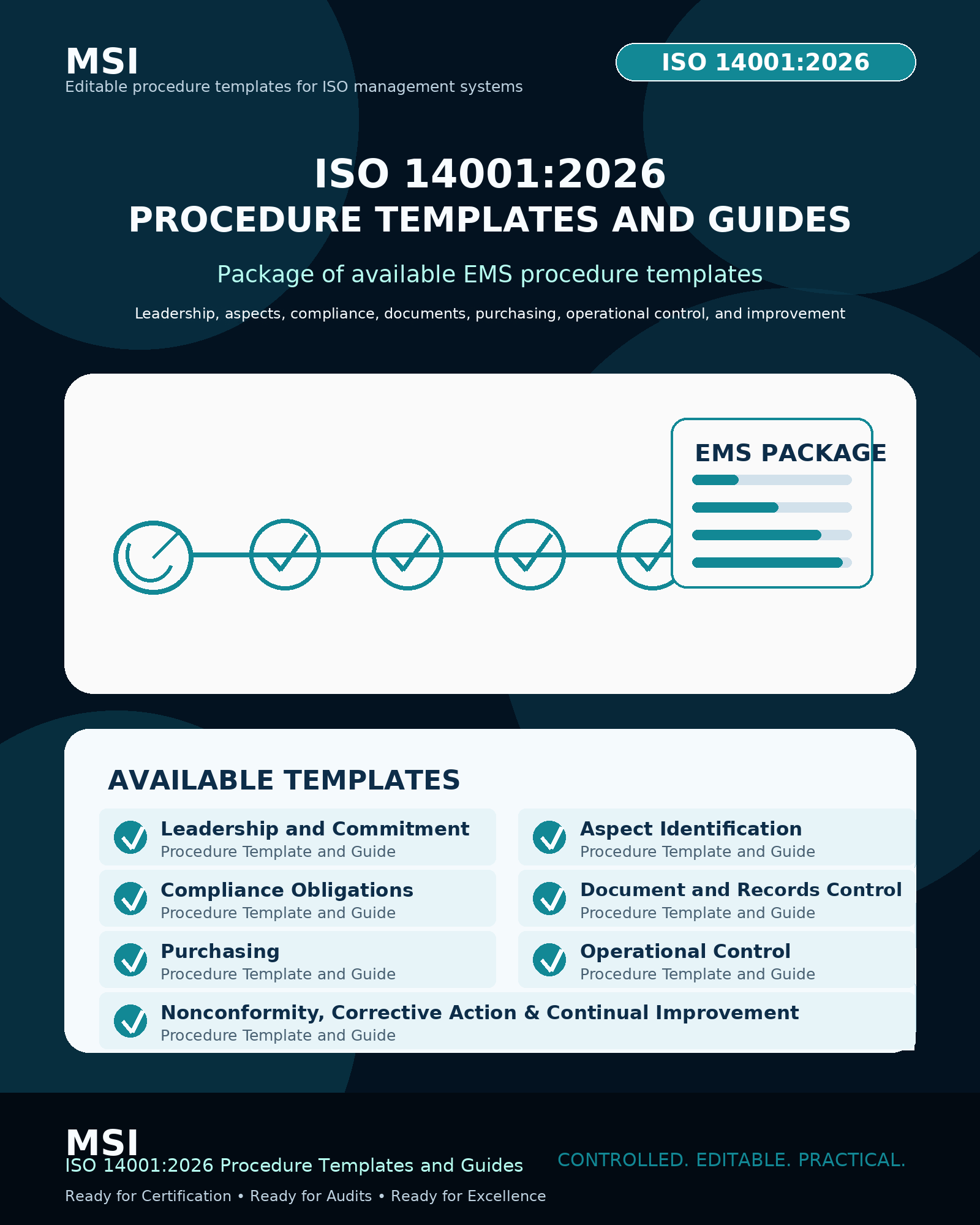
Every clause in the table above needs a procedure behind it, and the aspects register, compliance obligations process, and Clause 6.3 change process are the three that circular work touches hardest. MSI’s Transition ISO 14001:2026 Procedure Templates and Guides package supplies all seven as complete, editable Word documents written to the edition published in April 2026 — with the judgment calls already made and explained, and bracketed placeholders only where a value is genuinely yours to set.
It is built for an experienced EHS manager who has a transition to complete and no spare month to write seven procedures from a blank page. Most work through the whole set in about a week rather than a quarter. The ISO 14001:2026 Transition course is included in the package.
THE DECIDING DISTINCTION
Objective or Obligation? The Question That Decides Your Audit Outcome
Chosen. Required. Different.
This is the single most consequential judgment in circular economy ISO 14001 work right now, and it is the one most systems get wrong by omission rather than by error. Get it right and the rest of a circular economy ISO 14001 transition is mechanical. Get it wrong and the register looks complete while carrying a hole in it.
An environmental objective under Clause 6.2 is something the organization chose. It has a metric, an owner, a timeframe, and a method of evaluation. If it is missed, the system asks why, adjusts, and continues. Missing an objective is not a nonconformity in itself; failing to manage the objective process is.
A compliance obligation under Clause 6.1.3 is something external and binding. It must be determined, it must be accessible, it must be taken into account when establishing the environmental management system, and under Clause 9.1.2 the organization must evaluate fulfilment at a determined frequency and maintain knowledge and understanding of its compliance status. Missing one is a different order of finding, and the auditor’s question is not did you hit the target but did you know, and can you show me when you last checked.
Before 19 July 2026, an apparel manufacturer’s decision not to destroy unsold stock was a laudable objective. After that date, for a large enterprise placing goods on the EU market, it is a legal obligation whose fulfilment must be periodically evaluated and evidenced.
SAME ACTIVITY. DIFFERENT CLAUSE. DIFFERENT AUDIT.
The circular economy ISO 14001 failure mode here is predictable. A circular initiative was launched years ago as a voluntary programme and logged as an objective. Legislation caught up with it. Nobody moved the entry. The register still shows a target, the compliance obligations register shows nothing, and the evaluation-of-compliance record has no line item for it. At the transition audit the auditor reads the ESPR into scope, asks for the compliance evaluation, and there is none — not because the organization is non-compliant with the law, but because it never wrote down that the law applied to it.
MSI client experience suggests this pattern is most common in organizations with mature voluntary sustainability programmes, precisely because the good behaviour predates the requirement. Organizations that started later, after the obligation existed, tend to file it correctly the first time. Running a structured ISO 14001 gap analysis against the 2026 edition surfaces misfiled entries like these before an external auditor does.
DIRECT ANSWER
In a circular economy ISO 14001 system, circular activity the organization chose belongs in Clause 6.2 as an environmental objective with a metric and an owner. Circular activity the organization is legally required to perform belongs in the Clause 6.1.3 compliance obligations register, with an applicability determination, an evaluation method, and a determined frequency, and must be evaluated under Clause 9.1.2. The same activity can move from one to the other when legislation changes — and if the register is not updated when it does, the finding writes itself at the next audit.
THE STANDARDS FAMILY
How Does the ISO 59000 Family Fit With Circular Economy ISO 14001 Work?
Vocabulary. Model. Measurement.
Circularity now has its own standards family, and a surprising number of teams doing circular economy ISO 14001 work have not registered that it exists. ISO published ISO 59004:2024 on vocabulary, principles, and implementation guidance; ISO 59010:2024 on transitioning business models and value networks; and ISO 59020:2024 on measuring and assessing circularity performance. The family has since grown, with ISO 59014 covering the sustainability and traceability of recovered secondary materials and ISO 59040 supplying a product circularity data sheet. ISO maintains the full set on its circular economy sector page.
None of these are management system standards, and none are certifiable in the way ISO 14001 is. That is the point, and it is why they complement rather than compete with a circular economy ISO 14001 approach. ISO 59004 gives you a defensible definition and six principles — systems thinking, value creation, value sharing, resource management, resource tracking, and ecosystem resilience. ISO 59020 gives you a standardized data-collection and calculation process, which converts “we improved circularity” into a number an auditor can trace. ISO 14001 supplies the governance that makes those numbers recur reliably rather than appearing once in a report.
“ISO 59020 tells you how to calculate circularity. ISO 14001 is what makes sure someone actually does it again next year, and that the answer changes when the process changes.”
The practical move for a certified organization is to adopt ISO 59020 as the measurement method behind a Clause 6.2 objective and to cite it in the objective’s evaluation-method field. This is a small documentation change with disproportionate effect: it replaces an internally invented metric, which an auditor may reasonably challenge, with an international method, which is far harder to argue with. Organizations building circular economy ISO 14001 evidence for customer questionnaires find the same substitution pays off there too.
One caution for circular economy ISO 14001 programmes. Adopting an external measurement method mid-cycle is itself a change to the environmental management system, and under the 2026 edition that triggers Clause 6.3. The requirement has no 2015 predecessor, which is exactly why transitions run from a mapping table quietly lose it — a new requirement has nothing in the left-hand column to map from, so it drops out silently. MSI’s coverage of the compliance obligations procedure and the operational control procedure both address how change records connect to the clauses circular work touches.
THE REGISTER
What Does a Circular Aspect Look Like When It Is Written Correctly?
Activity. Interaction. Consequence.
Circular economy ISO 14001 registers fail for a consistent reason: the aspect column gets filled with impacts. “Waste” is not an aspect. “Landfill disposal of unsold finished goods” is the aspect; depletion of the resources embodied in those goods, plus the emissions from their disposal, are the impacts. When the aspect column holds a consequence rather than an operational interaction, nobody can assign a control to it, and the register becomes a document that describes concern rather than one that drives action.
Circular economy ISO 14001 entries follow the same discipline. Three worked examples show the pattern.
| Aspect (the interaction) | Impact (the consequence) | Where It Files |
|---|---|---|
| Disposition of unsold finished goods at end of season | Loss of embodied energy, water, and material; avoidable disposal emissions | Aspect at 6.1.2; obligation at 6.1.3 where the destruction ban applies |
| Specification of virgin polymer in primary packaging | Extraction pressure on fossil feedstock; downstream recyclability constraint | Aspect at 6.1.2; recycled-content target as objective at 6.2 |
| Acceptance of returned equipment for refurbishment | Avoided virgin extraction; new handling and storage aspects created on site | Aspect at 6.1.2; operating criteria at 8.1; change record at 6.3 |
Note the third row carefully, because it contains the trap that catches well-intentioned circular economy ISO 14001 programmes. Bringing returned product back onto your site is environmentally beneficial in aggregate and simultaneously creates new aspects you did not previously have: storage of used goods, handling of residual substances, segregation of non-recoverable fractions, and possibly a waste classification you were not permitted for. The 2026 edition’s NOTE at Clause 6.1.2 is explicit that beneficial impacts are themselves a source of risks and opportunities. A register that only records the benefit has recorded half the change.
There is a second subtlety in the 2026 text worth knowing. The word “operating” was dropped from the phrase describing normal and abnormal conditions, which widens the scope beyond running operations. A take-back scheme sitting idle in the off-season is still a condition the register has to consider. MSI’s ISO 14001 lifecycle assessment guide covers how to bound life cycle stages without turning every register entry into a full study.
DIRECT ANSWER
A correctly written circular economy ISO 14001 aspect names an operational interaction the organization controls or influences — disposition of unsold goods, specification of virgin material, acceptance of returned product — not the consequence that follows from it. Circular initiatives create aspects in both directions: they remove environmental burden upstream while creating new handling, storage, and segregation aspects on site. The 2026 edition treats beneficial impacts as a source of risks and opportunities in their own right, so a register that captures only the benefit is structurally incomplete.
THE EVIDENCE
How Do You Build Circular Evidence an Auditor Will Actually Accept?
Map. Measure. Defend.
Six steps, in order, for building circular economy ISO 14001 evidence. Each one produces a record, and the record is the point — consideration that was never documented is invisible to an external auditor no matter how carefully it was done.
1. Map material flows before you set any target
Inventory what enters, what leaves, and where value is lost in between. This is the foundation every other circular economy ISO 14001 record is built on. This is the evidence base for everything downstream, and setting objectives before you have it produces targets that cannot be defended when an auditor asks how the number was chosen. A material flow map also tells you which life cycle stages genuinely matter for your operation, which keeps Clause 4.3 scope reasoning proportionate rather than performative.
2. Sort every circular activity into objective or obligation
Take the circular economy ISO 14001 activity list you just built and file each item against Clause 6.2 or Clause 6.1.3, using the test from earlier in this article. Where an item is an obligation, record the applicability determination and the evaluation frequency at the same moment — because frequency is a property of the individual obligation, and if it is not chosen when the entry is created, it is usually never chosen at all.
3. Adopt a published measurement method
Use ISO 59020 for circularity performance in your circular economy ISO 14001 objectives, or a comparable published method appropriate to your sector, and name it in the evaluation-method field of each objective. Invented metrics are the most common reason a circular claim fails to survive a customer audit. A method with a standard number attached transfers the burden of argument.
4. Write operating criteria, not intentions
Clause 8.1 asks whether the process is controlled so that environmental performance is what the organization intended. For circular economy ISO 14001 work that means naming who makes the disposition decision on returned or unsold stock, what the decision threshold is, what documentation accompanies it, and what happens when the normal route is unavailable. Decisions made once and centrally beat decisions improvised under pressure by whoever picked up the work.
5. Run the change through Clause 6.3
Any material shift in a circular economy ISO 14001 programme — new feedstock, new take-back route, new refurbishment line — is a planned change to the environmental management system. Record the purpose, the potential consequences, the resources required, and who holds responsibility. This is the requirement most transitions lose, and losing it is what turns a well-run circular initiative into an undocumented one.
6. Put circular performance into management review as an input
Clause 9.3 expects performance data and compliance status to arrive as inputs and decisions to leave as outputs. A circular economy ISO 14001 programme reported to leadership once a year as a slide is not a management review input. Reported alongside internal audit results, compliance evaluation, and objective progress, it becomes one — and it earns the resource commitments that keep it running. MSI’s work on internal audit programmes and the ISO audit cycle explains how these inputs assemble across a certification period.
RUNNING MORE THAN ONE STANDARD?
Ten Procedure Topics. Five Standards and Combinations. Editable Word.
Circular material flows rarely stay inside the environmental management system. They touch purchasing, design, and nonconformity handling on the quality side too. MSI’s ISO Procedure Templates and Guides hub carries the full library across ISO 9001, ISO 13485, ISO 14001, and ISO 45001, including integrated versions for organizations running one system against several standards — twenty-eight years of practice, written down, with the judgment calls already made.
THE OPERATING CASE
What Is the Operational Case for Circular Economy ISO 14001 Beyond Compliance?
Resilience. Access. Durability.
The scale of the opportunity is not in dispute. The Circularity Gap Report, produced by Circle Economy with Deloitte Netherlands, has tracked a global circularity metric that fell to 6.9 percent, meaning the overwhelming majority of materials entering the global economy still come from virgin sources. The 2026 edition reframed the problem in economic terms, estimating the avoidable annual value lost to linear material use at roughly €25.4 trillion, close to a third of global output. The European Circular Economy Stakeholder Platform hosts the report alongside the EU policy context.
Those are macro figures, and for circular economy ISO 14001 purposes they are useful as context rather than as a forecast for any individual organization. The operational case for circular economy ISO 14001 work is narrower and more defensible, and it rests on three things a management system actually delivers.
Input resilience. A circular economy ISO 14001 material flow map plus a resource-availability entry in the context analysis gives you early warning when a feedstock tightens. Organizations typically report that the first tangible benefit of circular work is not cost reduction but the discovery of single-source dependencies nobody had documented. MSI’s analysis of climate risk in supply chain strategy and its case studies on climate-resilient supplier networks follow this thread further upstream.
Market access. Increasingly, circularity data is a condition of supply rather than a differentiator. Customer questionnaires ask for recycled content, end-of-life routes, and take-back provisions, and the organizations that answer fastest are the ones whose answers already exist as EMS records. A circular economy ISO 14001 system turns a two-week questionnaire scramble into a lookup.
Defensibility. As enforcement of environmental claims tightens, an unaudited claim is exposure and an audited one is a defense — which is the strongest single argument for running circular work as circular economy ISO 14001 practice rather than as a reporting exercise. That distinction is the entire practical difference between a sustainability report and a certified system, and it is why MSI’s guide to converting a sustainability programme into ISO 14001 certification treats defensibility as the primary argument rather than a secondary one.
Circular economy ISO 14001 certification itself is granted by an accredited certification body, not by a consultant and not by ISO. Accreditation recognition now runs through Global ACI, which unified the former IAF and ILAC arrangements effective 1 January 2026, with national bodies such as ANAB accrediting in the United States. Auditing against the 2026 edition should also follow ISO 19011:2026, published 27 May 2026, which replaced the 2018 edition without a transition period.
GLOBAL ALIGNMENT
How Does Circular Economy ISO 14001 Work Support the UN SDGs?
Shared. Verified. Comparable.
The United Nations Sustainable Development Goals give circular work an internationally understood reference frame, which matters because it lets an investor, a customer, and a regulator read the same evidence against the same benchmark. Circular economy ISO 14001 practice maps most directly to the following.
- SDG 12 — Responsible Consumption and Production. The core alignment. Decoupling output from virgin material throughput is the definition of the goal and the definition of circularity simultaneously.
- SDG 13 — Climate Action. Material demand and emissions are coupled. Cutting the first reduces the second in ways an energy transition alone does not reach, a point the Ellen MacArthur Foundation has documented in detail.
- SDG 9 — Industry, Innovation and Infrastructure. Remanufacturing and product-as-a-service models are industrial innovation with a measurable environmental output.
- SDG 8 — Decent Work and Economic Growth. Repair and remanufacturing are labour-intensive relative to disposal, which changes the employment profile of a material stream.
- SDG 15 — Life on Land. Reduced virgin extraction lowers land conversion and habitat pressure, connecting circular work to the biodiversity and ecosystem-health considerations the 2026 edition brought into Clause 4.1.
- SDG 17 — Partnerships for the Goals. A certified system gives cross-sector partners a shared, verified vocabulary rather than competing internal definitions.
MSI’s broader treatment of how ISO standards align with the UN SDGs covers the reporting mechanics, and reporting frameworks such as the Global Reporting Initiative supply the disclosure structure. On the material-recovery side, the US EPA’s Sustainable Materials Management programme and the Cradle to Cradle certification scheme both give practical design tooling that a circular economy ISO 14001 programme can reference in its operational controls.
DIRECT ANSWER
A circular economy ISO 14001 programme advances SDG 12 as its core alignment, with meaningful secondary contributions to SDG 13, SDG 9, SDG 8, SDG 15, and SDG 17. The value of citing SDGs is not the alignment itself but the comparability: an investor, a customer, and a regulator can read the same certified evidence against a shared benchmark rather than against six different internal definitions.
FREQUENTLY ASKED
Circular Economy ISO 14001: Questions EHS Managers Ask
Short. Direct. Useful.
Does ISO 14001:2026 require a circular economy approach?
No. The standard does not mandate circular practices by name. It does require a life cycle perspective when determining scope and aspects, names natural resource availability as an environmental condition, and offers sustainable resource use as an example policy commitment. Those requirements make circular thinking the natural way to satisfy the clauses, without making it compulsory. Where circularity does become compulsory is through compliance obligations under Clause 6.1.3 — law, not the standard.
We are a US company with no EU sales. Does the destruction ban affect us?
Not directly. The obligation attaches to products placed on the EU market, including goods manufactured elsewhere. If nothing you make reaches that market, it is not one of your compliance obligations — but you should still record the determination that it does not apply, because Clause 6.1.3 asks you to determine obligations, and a documented “evaluated, not applicable, here is why” is a stronger position than silence. Indirect exposure through customers who do sell into the EU is worth checking separately.
Can a small business run circular economy ISO 14001 work meaningfully?
Yes, and the standard is explicitly scalable. Circular economy ISO 14001 depth of analysis is proportional to relevance, not to headcount. Many of the highest-leverage circular interventions — extending equipment life, redesigning segregation at source, tightening packaging specification — are low-cost and well within reach of a small operation. What does not scale down is the documentation discipline: a small organization still has to show what it evaluated and why it concluded what it concluded.
Should we certify to ISO 59004 as well as ISO 14001?
The ISO 59000 family is guidance rather than a set of certifiable management system requirements, so there is no equivalent certification to pursue. The productive use is to adopt ISO 59004’s vocabulary and principles internally and ISO 59020’s measurement process as the evaluation method behind your Clause 6.2 objectives. That gives circular economy ISO 14001 evidence an international method behind it while keeping certification effort focused on the standard that actually carries a certificate.
What is the first step for an already-certified organization?
Audit your own registers rather than launching an initiative. Pull the compliance obligations register and the objectives register side by side, and check whether any circular activity currently filed as a voluntary objective has since become a legal requirement. That single reconciliation catches the most common transition finding in circular economy ISO 14001 work and takes a fraction of the time a new programme would.
How does circularity relate to our carbon reduction targets?
Closely, and mostly through Scope 3. A large share of emissions sits in raw-material extraction, processing, and disposal rather than in your own operations, so circular economy ISO 14001 work cuts emissions that no amount of on-site energy efficiency will reach. MSI’s carbon neutrality guide covers the Scope 1, 2, and 3 mechanics, and its guide to reducing carbon footprint covers the operational levers.
When does our ISO 14001:2015 certificate stop being valid?
30 April 2029. ISO 14001:2026 was published on 15 April 2026 with a three-year transition. Waiting until the final year concentrates every certified organization into the same audit-scheduling window, which is the practical reason to move earlier rather than the compliance reason. The ISO 14001 certification guide and the one-year ISO 14001 roadmap cover sequencing for organizations at different starting points.
Do we need a consultant for this, or can we run it internally?
Either works. An experienced EHS lead running circular economy ISO 14001 work with procedure templates written to the 2026 edition can complete most of a transition internally. ISO consulting support tends to earn its place where the organization runs several standards as one system, where scope or applicability determinations are contested, or where the team simply does not have the weeks available. MSI’s ISO consulting practice and its approach to certification audits describe both routes.
WHERE TO GO NEXT
Three Ways to Move Your Circular Economy ISO 14001 Work Forward
Documents. Training. Judgment.
1. You have a transition to complete and no spare month
The Transition ISO 14001:2026 Procedure Templates and Guides package gives you all seven environmental procedures written to the 2026 edition, including the aspects register, the compliance obligations process, and the Clause 6.3 change process that mapping-table transitions lose. The transition course is included.
2. You want the clause-by-clause walkthrough first
The ISO 14001:2026 Transition course walks every change and what it means for documents you already hold. If you are building an environmental management system from scratch rather than transitioning one, EMS 14001 Launch Mastery is the right starting point instead.
3. You want a second opinion on a contested determination
Applicability calls and scope boundaries are where circular economy ISO 14001 transitions stall most often. Call MSI at 760-434-9141 for a planning session, or look at SurePath for turnkey certification and SureResults for year-round system maintenance. Organizations running quality, environmental, and safety together should start with integrated management systems.
RELATED READING
References and Primary Sources
- ISO — ISO 14001 Environmental Management Systems
- ISO — ISO 14001 Explained
- ISO — Circular Economy Standards Portfolio
- ISO 59004:2024 — Vocabulary, Principles and Guidance for Implementation
- ISO 59010:2024 — Transition of Business Models and Value Networks
- ISO 59020:2024 — Measuring and Assessing Circularity Performance
- European Commission — Ban on Destruction of Unsold Clothes and Shoes Enters Application
- European Circular Economy Stakeholder Platform — Circularity Gap Report 2026
- Circle Economy — Circularity Gap Report
- Circularity Gap Report 2026 — Overview and the Value Gap
- Ellen MacArthur Foundation — Circular Economy
- Ellen MacArthur Foundation — Completing the Picture: Climate Change
- US EPA — Sustainable Materials Management
- United Nations — Sustainable Development Goals
- Global Reporting Initiative
- Cradle to Cradle Products Innovation Institute
- Global ACI — International Accreditation and Conformity Assessment
- ANAB — ANSI National Accreditation Board
- ASQ — ISO 14001 Environmental Management Resources
About Management Systems International (MSI)
Diana Lynn is President and Principal ISO Consultant at Management Systems International (MSI), a veteran-owned, female-owned consulting firm she founded in 1998. With 28 years of experience, MSI’s track record includes 80+ certifications supported, 200+ audits attended, and 600+ professionals trained across manufacturing, technology, medical device, government, healthcare, and other regulated industries.
Today MSI implements ISO 9001, ISO 13485, ISO 14001, and ISO 45001, with an expanding focus on ISO 7101 healthcare quality.
msi-international.com · 760-434-9141
This article is written for environmental managers, EHS leads, and management representatives aligning circular material strategy with a certified environmental management system. Certification decisions rest with an accredited certification body. Regulatory applicability determinations should be confirmed against the current text of the applicable law for your markets.
