
Environmental Management
Score. Sequence. Transition.
An ISO 14001 gap analysis run in 2026 is a different exercise than one run in 2024, and organizations that do not understand why are about to lose time they cannot get back. ISO 14001:2026 published on April 15, 2026. Every ISO 14001:2015 certificate stops being recognized after April 30, 2029. For anyone already certified, the question is no longer whether your environmental management system meets the standard — it is which standard it meets, and how far the 2026 edition has moved the target.
Direct Answer: An ISO 14001 gap analysis is a clause-by-clause comparison of your environmental management system against the requirements of ISO 14001, scoring each requirement twice — once for whether it is documented, once for whether it is actually implemented. In 2026 it serves two distinct purposes: readiness for first-time certification, and transition readiness for organizations moving from the 2015 edition to the 2026 edition before the April 30, 2029 window closes.
Those two purposes produce very different work lists. A company certifying for the first time is building an EMS from a partial base — some environmental compliance work exists, most of the management system does not. A company already holding ISO 14001:2015 has a functioning system and needs to find the specific places where the 2026 revision raised the bar. Running the wrong version of the exercise wastes months.
This guide covers both. It walks through what an ISO 14001 gap analysis must score, which clause catches nearly everyone in the 2026 transition, how to score honestly, how to read the results, how a topic-level maturity check deepens the result, and — the step most guides skip — what the findings actually oblige you to write. MSI publishes a free ISO 14001 gap analysis tool you can use to run one yourself, a set of free maturity checks that score one process at a time, and a complete set of 2026-edition procedure templates for closing what they find.
The Clock
Why an ISO 14001 Gap Analysis Is Urgent in 2026
Published. Ticking. Closing.
Three years sounds generous. It is not, and the arithmetic explains why.
ISO 14001:2026 published on April 15, 2026, cancelling and replacing the 2015 edition on the same day, and the transition window closes on April 30, 2029. But the deadline is not the constraint. The constraint is the internal audit cycle. To demonstrate conformity with the revised clauses, your EMS has to actually run under them — generating records, closing findings, feeding a management review — before a registrar will transition your certificate. That operating period sets a floor no amount of documentation speed can lower.
There is a second, quieter deadline. New certificates to the 2015 edition stop being issued around October 30, 2027 — eighteen months before the window closes. And every certified organization in the world is transitioning on the same schedule, which means registrar capacity in the final year will be exactly as available as you would expect.
Strip the front and back off that window and the realistic clearing period is closer to two years than three. MSI works the arithmetic in full in its analysis of the ISO 2026 transition deadline: more than 675,000 ISO 14001 certificates worldwide, a finite and non-scalable pool of qualified auditors, and a second revision arriving five months behind the first. That second date is now fixed — ISO 9001:2026 publishes on September 16, 2026, its technical content frozen since the Final Draft ballot closed on July 9 — which means dual-certified organizations face two confirmed clocks drawing on one team.
Direct Answer: An ISO 14001 gap analysis is urgent in 2026 because the transition to the 2026 edition requires your revised EMS to operate long enough to generate audit evidence before a registrar will transition the certificate. The real constraint is the internal audit and management review cycle, not the April 30, 2029 deadline — which is why starting the scoring exercise in 2026 rather than 2028 is the difference between a structured update and a scramble.
Transition timelines are governed by Global Accreditation Cooperation Incorporated (Global ACI), the body that unified the former IAF and ILAC on 1 January 2026 and now oversees the accreditation framework worldwide. Your registrar answers to an accreditation body such as ANAB, which answers to that peer-evaluation system. Nobody in that chain has discretion to extend your window. The ISO guidance on certification and conformity is explicit that the certificate, not the standard, is what expires.
MSI’s complete guide to the ISO 14001:2026 updates covers every change in detail, and its analysis of the combined ISO 9001 and 14001 transition is the right read for anyone holding both certificates — running the two as one project is meaningfully cheaper than running them as two. Organizations running several standards at once should also read MSI’s guide to integrated management systems.
The Clause That Catches Everyone
Clause 4.1: Where Every ISO 14001 Gap Analysis Now Fails First
Context. Ecosystems. Evidence.
Measured by word count, the change to Clause 4.1 is small. Measured by what it asks you to prove, it is the most consequential environmental management update in a decade — and it is where a transition-focused ISO 14001 gap analysis should start.
The 2015 standard asked what environmental conditions surrounded your organization. The 2026 standard asks how you depend on, impact, and adapt to the living systems you operate within. Clause 4.1 now explicitly names biodiversity, ecosystem health, pollution levels, and natural resource availability as environmental conditions you must evaluate. That is not a paperwork edit. It is a different question, and MSI’s guide to ISO 14001 environmental conditions covers the dependency direction most context documents miss entirely.
Direct Answer: The clause most likely to fail an ISO 14001 gap analysis in 2026 is Clause 4.1, context of the organization. The 2026 edition explicitly names biodiversity, ecosystem health, pollution, and natural resource availability as environmental conditions requiring evaluation. Copying your 2015 context document and bolting on a biodiversity paragraph will draw a finding — the structure of the analysis itself has to change.
Score this clause with unusual honesty, because three patterns reliably create findings. The first is the bolted-on paragraph described above. The second is assuming ecosystem considerations do not apply to a non-land-based business — an office-based firm still inherits supply-chain exposure through what it buys. The third is asserting rather than evidencing: an auditor will ask which ecosystems were identified near your sites, what data supports that identification, and how the conclusion flowed into your aspects register. General statements draw findings; named primary sources do not. Screening tools such as the Integrated Biodiversity Assessment Tool and WRI Aqueduct produce exactly the kind of site-specific evidence that survives a question.
Proportionality matters and is frequently misunderstood. ISO 14001:2026 does not expect a small manufacturer to build a biodiversity accounting program. It expects consideration proportionate to your size, sector, and impact profile. A documented finding that a factor is immaterial, with the reasoning shown, satisfies the requirement. What does not satisfy it is silence.
MSI treats this clause at length in its guides to ISO 14001:2026 Clause 4.1, ecosystem health, and biodiversity under the 2026 revision. Read all three before you score Clause 4.1 — it is the single highest-leverage hour in the whole exercise.
The Rest of the Standard
What Else Your ISO 14001 Gap Analysis Must Score
Aspects. Obligations. Performance.
Clause 6.1.2 — Environmental Aspects and Impacts
This is the engine of the whole system, and it is where the most quietly serious gaps live. When MSI asks certified organizations to name their environmental aspects, the answers are reliably the same four: energy, emissions, waste, wastewater. All correct, all incomplete. The 2026 revision sharpens the lifecycle perspective, which means aspects arising upstream in your supply chain and downstream in product use and disposal belong in the register — not just what happens inside your fence. Score the register for completeness across the lifecycle, not just for existence — this single row moves more ISO 14001 gap analysis scores than any other. MSI’s detailed treatment of ISO 14001 environmental aspects under the 2026 edition sets out the four wording changes that quietly widen what belongs in the register, and the free Risk, Aspect and Job Hazard Maturity Check scores your identification process in about six minutes.
Clause 6.1.3 — Compliance Obligations
Your obligations register should be a living document that updates when a regulation does — not a snapshot taken during your last certification audit. Score two things separately: whether the register is complete, and whether there is a defined process that keeps it current. Most organizations pass the first and fail the second, and the free Compliance Obligations Maturity Check separates those two answers in under five minutes. Regulatory sources such as the Environmental Protection Agency and the Electronic Code of Federal Regulations change on their own schedule, not yours. Score Clause 9.1.2 alongside it — the 2026 edition asks you to hold a compliance status continuously and to have determined the evaluation frequency deliberately, which are two separate scoreable requirements. MSI’s compliance obligations procedure template covers both clauses in one document.
Clause 6.3 — Planning of Changes (New)
The 2026 edition adds an explicit planning-of-changes clause. If your EMS handles change informally — a new process line goes in, someone eventually updates the aspects register — that is now a scoreable gap with a clause number attached to it. Score whether changes to your operations trigger a defined environmental review before they happen rather than after, and flag it explicitly on your ISO 14001 gap analysis worksheet. This clause is also the one a mapping table loses: a transition run by matching old clause numbers to new ones has nothing in the left-hand column for Clause 6.3, so it silently drops out of the work list.
Clause 8.1 and 8.2 — Operational Control and Emergency Preparedness
Operating criteria are where an EMS either bites or does not. Score whether your controls name a role, state a threshold, and define what happens when the normal case fails — not merely whether a procedure exists. The 2026 edition also carries the lifecycle perspective into operational control and into the waste obligations that attach to the person running the process, which is where externally provided processes stop being a procurement matter and become an environmental one. Two free checks score these clauses at process level: the Production and Operational Control Maturity Check and the Emergency Preparedness and Response Maturity Check. MSI’s operational control procedure template maps all of the obligations in these two clauses so you can score against a complete list rather than your memory of one.
Clause 9.2 — Internal Audit With Defined Objectives
The 2026 revision now requires that every internal audit state defined objectives. This is a small edit with real teeth — a great many internal audit programs run on a schedule and a checklist with no stated objective beyond “audit clause 8.” Score your audit program against the requirement using the free Internal Audit Maturity Check, and note that the governing guidance, ISO 19011:2026, published on 27 May 2026 and withdrew the 2018 edition outright with no transition period at all.
Clause 9.3 and Clause 10 — Management Review and Improvement
Management review was restructured so that inputs and results are more explicit, and Clause 10 was consolidated. The substantive shift across both is from documented process toward demonstrated environmental performance — improvement is no longer something you claim, it is a number that moved. The audit-objectives requirement at 9.2.2 feeds this directly, and MSI traces that whole chain in its guide to the ISO 14001:2026 management review. Management review is required by ISO 14001, ISO 9001, ISO 13485, and ISO 45001 alike; the free Management Review and Leadership Maturity Check scores the governance layer across all five standards, and MSI’s guide to ISO 14001 continual improvement covers what auditors now expect to see. The ISO/TC 207 committee responsible for the standard has been consistent on this direction across two revision cycles.
Tools for Clause 9.3
Stop Building the Review Deck the Week Before
Every required management review input is produced somewhere else in the standard — audit results, compliance status, environmental performance, corrective action trends, interested party communications. That is precisely why the meeting is hard to prepare and why the record usually falls short of what Clause 9.3.2 lists. MSI’s ISO Management Review Toolkits give each required input a producing role, a frequency, and a place the record lives before the review opens, with the agenda, the input table, and the minutes format already built. If your ISO 14001 gap analysis scored Clause 9.3 amber, this is the fastest row on the list to close.
Direct Answer: Beyond Clause 4.1, an ISO 14001 gap analysis must score environmental aspects across the full lifecycle (6.1.2), a compliance obligations register with a process that keeps it current (6.1.3 and 9.1.2), the new planning-of-changes clause (6.3), operational control and emergency preparedness (8.1 and 8.2), internal audits with defined objectives (9.2), and the restructured management review and improvement clauses (9.3 and 10). The through-line in the 2026 edition is demonstrated environmental performance rather than documented intention.
What the Findings Oblige You to Write
From ISO 14001 Gap Analysis to Documented Procedures
Scored. Written. Defensible.
Here is the part of the exercise nobody warns you about. An ISO 14001 gap analysis is fast — days, not weeks. Then it hands you a list, and every red row on that list resolves into the same thing: a document somebody has to sit down and write. That is where transitions stall, and it is not because the team lacks knowledge. It is because a blank page and an accurate list of requirements are not the same as a finished procedure.
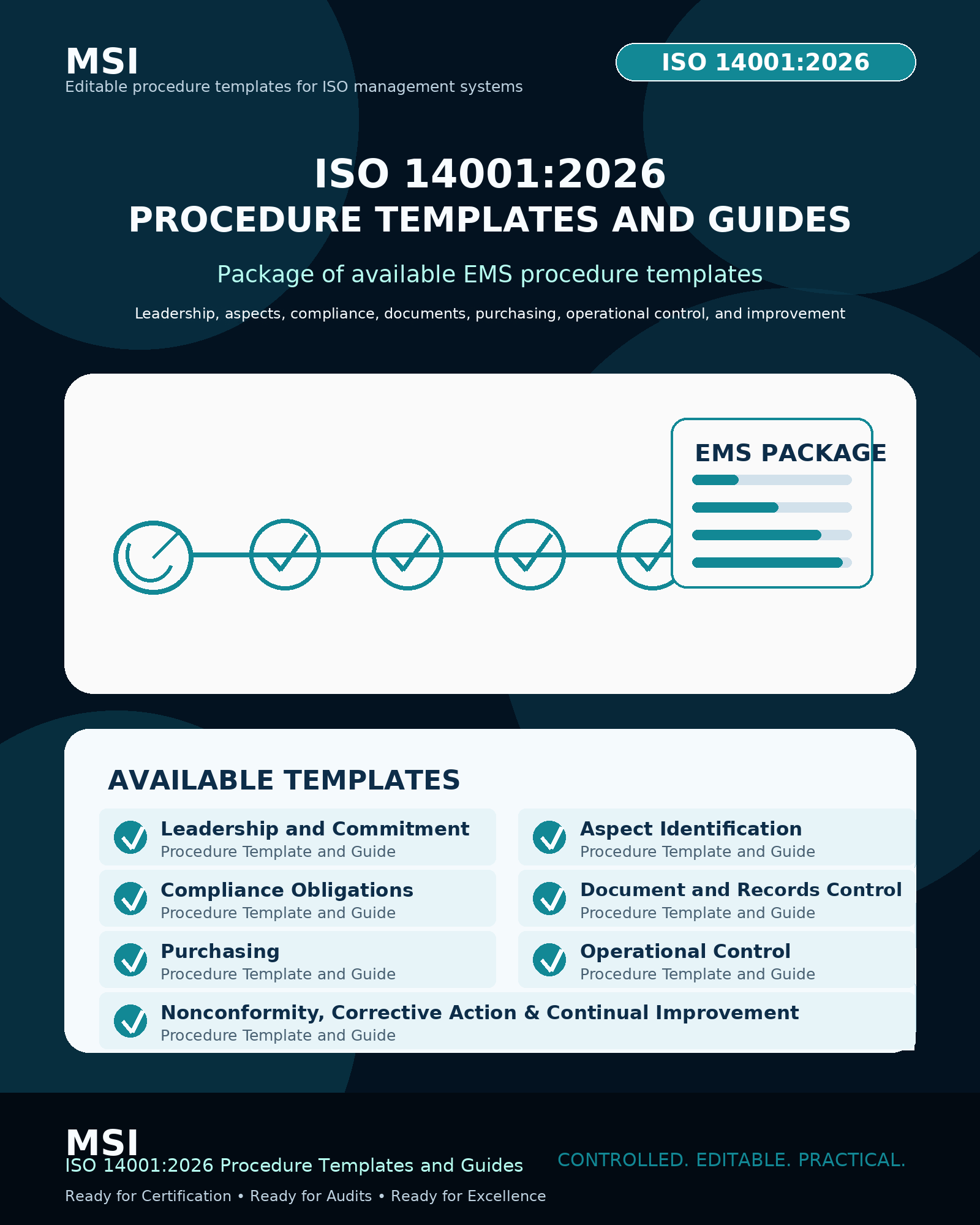
A transition-mode ISO 14001 gap analysis against the 2026 edition reliably produces work in seven places: leadership and commitment, aspect identification, compliance obligations, operational control, emergency preparedness, planning of changes, and the internal audit programme. Each of those is a procedure with judgment calls embedded in it — who owns the threshold, what value it is set at, what happens when the normal case fails, and how you would defend that decision to an auditor who asks who decided.
Direct Answer: A transition-mode ISO 14001 gap analysis typically generates documentation work in seven areas: leadership and commitment, aspect identification, compliance obligations, operational control, emergency preparedness, planning of changes, and internal auditing. The scoring itself takes days. Writing seven defensible procedures from a blank page is what turns a transition into a quarter-long project — which is precisely the step a complete 2026-edition template set removes.
There is an important distinction between a briefing and a document. A briefing tells you Clause 6.3 is new, that context is now bidirectional, and that risks and opportunities moved. Then it ends, and you are still holding an accurate list of things to write. A generic template restates the clause and stops, which leaves you making every hard decision yourself — the reason you reached for a template in the first place. What closes a gap is a worked procedure with the decisions already made and explained, and bracketed placeholders only where the value is genuinely yours to set.
Method
How to Run an ISO 14001 Gap Analysis in Four Passes
Documented. Implemented. Prioritized. Owned.
Two-axis scoring is the whole method. Separate what is written from what is done, because the space between those two answers is where every serious finding lives — and in environmental management, that space is unusually wide. Environmental procedures are among the most likely in any management system to be beautifully written and quietly ignored.
Pass 1 — Score what is documented. Clause by clause, does a controlled procedure exist? Be strict. An environmental policy on the wall is not an aspects methodology. A spreadsheet someone maintains privately is not a compliance obligations register.
Pass 2 — Score what is implemented. Do people follow it, and could you show an auditor the evidence? This is where an ISO 14001 gap analysis earns its cost. Ask the maintenance supervisor, not the EHS manager, whether the spill procedure is what actually happens.
Pass 3 — Prioritize by consequence. Sort by regulatory exposure and environmental risk first, certification risk second, housekeeping last. A missing training signature and an uncontrolled discharge are not the same finding.
Pass 4 — Assign owners and dates. Every gap gets a name and a deadline, folded into your normal improvement cycle rather than run as a separate transition project. Separate projects end when the enthusiasm does.
Direct Answer: Run an ISO 14001 gap analysis in four passes: score what is documented, score what is actually implemented, prioritize by regulatory and environmental consequence rather than by ease of fixing, then assign every gap an owner and a date. Two-axis scoring is essential — a documented-but-unimplemented environmental control is the finding auditors reach first.
Run it with the people who own each process rather than about them. An ISO 14001 gap analysis conducted by the EHS manager alone, from memory, will be optimistic by exactly the margin you would predict. Conducted with the plant engineer, the maintenance lead, and the purchasing manager in the room, it will be accurate — and the corrective actions will land faster. MSI’s free ISO 14001 gap analysis tool is a self-scoring spreadsheet built exactly this way, with a readiness dashboard by clause and a recommended next step attached to every row. The same two-axis method drives MSI’s ISO 9001 gap analysis guide and its ISO 13485 equivalent, so multi-standard organizations can run one consistent exercise across every certificate they hold.
A Gap Analysis Per Topic
Maturity Checks: A Mini ISO 14001 Gap Analysis for Each Topic
Score. Deepen. Prioritize.
A clause-level scoring pass is a wide, shallow instrument by design. It asks one question of every requirement in the standard, gets a yes or a no twice over, and returns a map of where to look. That is exactly what it should do, and it is also its limit. An ISO 14001 gap analysis tells you a requirement is met. It does not tell you how well, how reliably, or whether it will still be met next quarter.
A maturity check is the same exercise run the other way round — narrow and deep, on one topic at a time. Eight elements, four levels each: Documented, Controlled, Measured, Anticipatory, every level written as observable behavior rather than as intention. It is, in effect, a mini ISO 14001 gap analysis for a single process, and it answers the question the clause pass cannot: not whether the thing exists, but which rung it is standing on.
Direct Answer: A maturity check is a mini ISO 14001 gap analysis scoped to one topic instead of the whole standard. Where a clause-level pass returns present or absent, a maturity check returns a rung on a four-level ladder — Documented, Controlled, Measured, Anticipatory — across eight elements of that single process, scored on how it behaves on a busy week rather than on what the procedure says. Run the standard-wide pass first to find where to look, then the topic checks to find out how deep the problem goes.
Clause 6.1.2 makes the difference concrete. An ISO 14001 gap analysis scores it green: an aspects register exists, it is controlled, people use it. True, and not enough. The topic check asks four further questions. Does the register get rebuilt when a process line changes, or only when someone remembers? Have the significance criteria been reviewed since the day they were written? Does anyone measure whether the identification catches things before they surface as findings? And could the process anticipate an aspect arising from a change that has not happened yet? Those are four different answers, three of them invisible to a green row on a worksheet, and the last of them is the one a 2026 transition audit is most likely to test.
The ladder also names a legitimate stopping place, which matters more than it sounds. Controlled is a defensible rung for a well-implemented certified system, and the checks say so rather than pushing every organization toward the top. An assessment that fails everyone is not an assessment — it is a sales instrument with a score attached. Your result and band appear immediately without entering anything, and if the result is useful on its own, take it and act on it.
Where they fit in the four-pass method. Run the topic checks between Pass 2 and Pass 3. Pass 2 of the ISO 14001 gap analysis hands you a set of red and amber rows; the checks tell you which of those are shallow — a missing record, a form nobody fills in — and which are structural, where the process itself has never risen above Documented. That distinction is exactly the input Pass 3 needs, and prioritizing without it is how teams spend a quarter closing the easy rows and arrive at the audit with the hard ones untouched.
MSI publishes fourteen checks across the fifteen procedure families. Twelve of them apply to ISO 14001, and five of those map directly onto the clauses this article has already asked you to score:
Mapped to the clauses you just scored
→ Risk, Aspect and Job Hazard Maturity Check — Clause 6.1.2, about six minutes
→ Compliance Obligations Maturity Check — Clauses 6.1.3 and 9.1.2, under five minutes
→ Production and Operational Control Maturity Check — Clause 8.1, about six minutes
→ Emergency Preparedness and Response Maturity Check — Clause 8.2, about four minutes
→ Internal Audit Maturity Check — Clause 9.2, about six minutes
→ Management Review and Leadership Maturity Check — Clauses 5 and 9.3, under five minutes
The supporting processes an EMS runs on
→ Nonconformity and Corrective Action Maturity Check — Clause 10.2
→ Document and Records Control Maturity Check — Clause 7.5
→ Human Resource Management Maturity Check — Clauses 7.2 and 7.3
→ Purchasing and Supplier Control Maturity Check — Clause 8.1, external providers
→ Measuring Equipment Control Maturity Check — Clause 9.1.1 monitoring equipment
→ Design and Development Maturity Check — lifecycle design controls
The bottom six are the ones organizations most often leave out of an ISO 14001 gap analysis altogether, on the reasoning that document control and competence are quality processes rather than environmental ones. They are not. Clause 7.2 c) makes the aspect register the input to your environmental competence determination; Clause 8.1 makes external providers your problem when what they do is within your control or influence; Clause 9.1.1 requires that monitoring equipment be calibrated or verified, which is a live requirement in any operation reporting emissions data. Each of those is a scoreable requirement of ISO 14001:2026, each belongs on your ISO 14001 gap analysis worksheet, and each has a check behind it.
Direct Answer: Twelve of MSI’s fourteen free maturity checks apply to ISO 14001, and six of them map straight onto clauses an ISO 14001 gap analysis already scores: aspects (6.1.2), compliance obligations (6.1.3 and 9.1.2), operational control (8.1), emergency preparedness (8.2), internal audit (9.2), and management review and leadership (5 and 9.3). The remaining six cover the supporting processes an environmental management system depends on and that clause-level scoring most often omits.
Each check is built from the procedure that closes what it finds — the same eight elements and the same four levels appear in Section 13 of every MSI procedure template, so the check tells you which rung you are on and the procedure contains the rung above it, already written out. That is the whole loop: run the ISO 14001 gap analysis across the standard, score the topic, then close the topic. Nothing about it obliges you to buy anything, and the score is yours either way.
Two Different Exercises
First-Time vs Transition: Two Modes of ISO 14001 Gap Analysis
Build. Or Update.
Score the same standard, but read the results differently depending on which situation you are in.
Mode 1 — First-time certification
You will find more than you expect already in place. Environmental permits, spill procedures, waste manifests, monitoring data — most organizations that touch the environment have been doing this work for years without calling it a management system. The gap is rarely environmental competence; it is the management system architecture around it: documented aspects methodology, objectives with measures, defined authority, internal audit, management review. Certify directly to the 2026 edition rather than the 2015 — building to the current standard now avoids transitioning later. MSI’s all-industries ISO 14001 certification guide maps the full path.
Mode 2 — Transition from ISO 14001:2015
Your system works. You are hunting for the specific places the 2026 edition moved. Score Clause 4.1 first and hardest — it is where the revision concentrated. Then the lifecycle extension to your aspects register, the new planning-of-changes clause, the internal audit objectives requirement, and the commitments the revision expects your ISO 14001 environmental policy to carry. Most of your system carries forward intact; the transition is a focused documentation-and-audit refresh, not a rebuild. The mistake is assuming it is therefore trivial.
Direct Answer: An ISO 14001 gap analysis runs in two modes. For first-time certification, most gaps sit in management system architecture rather than environmental competence — and you should certify directly to the 2026 edition. For a transition from ISO 14001:2015, the exercise is narrower and sharper: find where the revision moved, starting with Clause 4.1, the lifecycle extension of the aspects register, the new planning-of-changes clause, and the internal audit objectives requirement.
Organizations running an existing quality system have a third advantage worth naming. If you already hold ISO 9001, the shared harmonized structure means document control, competence, internal audit, and management review are live processes you extend rather than build. MSI’s guide to converting a sustainability program into ISO 14001 certification covers how much existing environmental work already maps to clause requirements — usually far more than teams assume — and the QMS-to-EMS integration guide shows how to extend the system you already run.
Reading the Results
What Your ISO 14001 Gap Analysis Results Actually Mean
Read. Rank. Respond.
A readiness percentage is a starting point, not a verdict. Three score patterns are worth learning to recognize.
High documented, low implemented. Endemic in environmental management, because environmental procedures are written by specialists and executed by everyone else. It feels like readiness and audits like negligence. If your EMS manual is excellent and your production supervisors have never opened it, this is your profile.
Low documented, high implemented. Common in operations with strong environmental practice and no management system — a well-run plant that has been doing the right things for twenty years without writing them down. Easier to close than it looks, because you are capturing reality rather than changing it.
Strong everywhere except Clause 4.1. The signature profile of a 2026 transition. Your 2015 system is sound; the context requirement moved underneath you. This is the good outcome — a narrow, well-defined gap with a clear path.
Direct Answer: The most common result of an ISO 14001 gap analysis in a currently certified organization is strong scores across the system with a concentrated failure at Clause 4.1. That is the expected shape of the 2026 transition, and it is good news — a narrow, well-defined gap. The dangerous result is high documentation paired with low implementation, which reads as readiness and audits as failure.
Once ranked, the work is ordinary management: corrective actions with owners, dates, and verification of effectiveness. Build internal audit capability so the next check is your own — MSI’s ISO Internal Auditor training and internal audit services exist for exactly that. An organization that audits itself honestly does not fear a registrar; it rehearses for one.
Cost and Cadence
What an ISO 14001 Gap Analysis Costs, and How Often to Run One
Cheap. Early. Annual.
The scoring exercise itself costs almost nothing but honesty and calendar time. A self-scoring tool, a week of the right people’s attention, and a willingness to write down uncomfortable answers. Most teams complete a first pass in a day or two. The version worth doing — with the plant engineer, the maintenance lead, and purchasing in the room, each score challenged rather than assumed — takes about a week. The topic-level checks add roughly an hour to the ISO 14001 gap analysis on top of that, spread across the people who own each process.
What costs money is what you find, and that is not a reason to avoid finding it. Every gap on your list exists whether or not you have written it down. The only question an ISO 14001 gap analysis settles is whether you learn about it on your own schedule or during a surveillance audit on someone else’s.
Direct Answer: Run an ISO 14001 gap analysis before certification, before a transition, and then annually as a self-check. The scoring itself is inexpensive — a free self-scoring tool and about a week of the right people’s time, plus about an hour for the topic-level maturity checks. What varies is the cost of what you find, and that cost exists whether or not you look.
Annual cadence matters more in environmental management than in most disciplines, because environmental systems drift quietly. A supplier changes, a process line is modified, a permit condition is updated, a chemical is substituted — and the aspects register that was accurate last year now describes an operation that no longer exists. None of these events announce themselves to the EHS manager. Organizations typically report that an annual self-scoring pass catches that drift long before a surveillance audit does, and catching it yourself is a corrective action while catching it at audit is a finding.
Score the whole standard each time rather than only the clauses you suspect are weak. The requirements organizations skip are almost always the ones nobody has asked about recently — which is exactly why they have quietly stopped being maintained. An ISO 14001 gap analysis that examines only what you already worry about is a confirmation exercise, not an assessment, and it will leave your real exposure exactly where it was. Certificate volumes published in the ISO Survey show how many organizations are carrying that same exposure into the same two-year window.
Working With MSI
After the ISO 14001 Gap Analysis: Turning Findings Into a Sequence
Write. Train. Attend.
Scoring the system is something your team can and should do itself. Sequencing the response is where organizations stall — the findings arrive as a list, and a list is not a plan.
Management Systems International (MSI) has spent 28 years building management systems in environments where the evidence has to hold up. MSI’s track record includes 80+ certifications supported, 200+ audits attended, and 600+ professionals trained across manufacturing, technology, medical device, government, healthcare, and other regulated industries.
Three things distinguish MSI’s ISO consulting approach. MSI writes the procedures alongside the people who do the work rather than handing over templates to reverse-engineer — which matters especially in environmental management, where a generic aspects methodology produces a register nobody believes. MSI trains your own staff to run internal audits. And MSI attends the certification audit, which is a commitment most consultants will not make and the clearest test of whether a consultant believes in the system they built.
A planning session takes the output of your ISO 14001 gap analysis and turns it into a sequence — what to fix first, what can wait, and a realistic transition timeline given your audit cycle and your actual staffing. For organizations wanting the whole path run for them, SurePath is MSI’s turnkey route from decision to certificate, and SureResults keeps a certified system audit-ready through revision cycles like this one.
Twenty-Eight Years of Judgment Calls, Already Written Down
Run more than one standard? MSI’s ISO Procedure Templates and Guides library is complete — fifteen procedure families, 105 templates across five standards and every integrated combination, plus nine whole-system packages. ISO 9001, ISO 13485, ISO 14001, ISO 45001, ISO 7101, and integrated variants that hold one register serving two standards and record every point at which the two genuinely differ. Editable Word, worked examples, records, and the reasoning attached. Every family has a free maturity check in front of it, so you can find out where you stand before you spend anything.
Next Steps
Start Your ISO 14001 Gap Analysis While the Window Is Open
Score. Sequence. Transition.
1. Score the Standard Free — The ISO 14001 Gap Analysis Tool
A self-scoring spreadsheet that rates your environmental management system clause by clause and tracks readiness toward the 2026 edition — from environmental aspects and compliance obligations through performance evaluation. Score each requirement as documented and implemented, get an instant readiness percentage, and receive a recommended next step for every gap. Free, and yours to re-run every year.
2. Score the Topics Free — Twelve Maturity Checks for ISO 14001
The clause pass tells you where to look. The topic checks tell you how deep it goes — eight elements, four levels, scored on how the process behaves on a busy week. Aspects, compliance obligations, operational control, emergency preparedness, internal audit, management review and six more. Your score and band appear immediately without entering anything, and there is a genuine Controlled band that tells you when to stop.
3. Close It in a Week — ISO 14001:2026 Procedure Templates and Guides
The complete 2026-edition procedure library in editable Word, plus the ISO 14001:2026 Transition course. Every EMS procedure written to the standard published in April 2026 — not adapted from 2015 documents — so an experienced EHS lead can work through the whole transition in about a week rather than a quarter. Every threshold has a stated owner and a reason attached, which is what an auditor asks for when the document is questioned.
4. Run Every Standard the Same Way — The Full Template Library
Fifteen procedure families and 105 templates across ISO 9001, ISO 13485, ISO 14001, ISO 45001, ISO 7101 and integrated combinations, plus nine whole-system packages. If your EMS shares a spine with a quality or safety system, the integrated variants hold one register serving both standards and record every point where the two genuinely differ — the decision most organizations improvise and then cannot defend.
5. Sequence It — One Planning Session With MSI
Bring your scored results and your maturity check bands. Leave with a sequence: what to fix before your next surveillance audit, what can wait, and a realistic transition timeline built around your actual audit cycle rather than the April 2029 deadline. MSI has attended 200+ certification audits and knows which controls a registrar tests hardest under the new edition.
Frequently Asked Questions
ISO 14001 Gap Analysis: Common Questions Answered
Ask. Answer. Act.
When does my ISO 14001:2015 certificate expire?
ISO 14001:2026 published on April 15, 2026, and the transition window closes on April 30, 2029. After that date, ISO 14001:2015 certificates are no longer recognized. New 2015 certificates stop being issued around October 30, 2027, so an ISO 14001 gap analysis started in 2026 rather than 2028 is the difference between a structured update and a scramble for registrar capacity.
What is the difference between a maturity check and an ISO 14001 gap analysis?
Scope and depth. An ISO 14001 gap analysis covers the whole standard and asks a present-or-absent question of every requirement. A maturity check covers one topic — aspects, compliance obligations, internal audit — and scores it across eight elements on a four-level ladder: Documented, Controlled, Measured, Anticipatory. Think of the check as a mini ISO 14001 gap analysis for a single process. Run the standard-wide pass first to find where the weaknesses are, then the topic checks to find out whether each one is a missing record or a process that has never risen above Documented. MSI publishes twelve checks that apply to ISO 14001, all free, with the score shown immediately.
What documents does the ISO 14001:2026 transition actually require?
A transition-mode ISO 14001 gap analysis usually produces documentation work in seven places: leadership and commitment, aspect identification, compliance obligations, operational control, emergency preparedness, planning of changes, and internal auditing. The standard does not prescribe a document list, but those are the areas where the 2026 wording changed enough that a 2015-era procedure will not survive a question. MSI’s ISO 14001:2026 Procedure Templates and Guides package covers all seven in editable Word with the judgment calls already made.
Do we have to measure biodiversity to comply?
No. ISO 14001:2026 requires that biodiversity and ecosystem health be considered in your context analysis under Clause 4.1 — proportionate to your size, sector, and impact. If your analysis shows these factors are not material, a documented finding to that effect satisfies the requirement. Your ISO 14001 gap analysis should score whether the consideration and its reasoning are documented, not whether a measurement program exists.
Which clause fails most often?
Clause 4.1, context of the organization. In a transition-mode ISO 14001 gap analysis, this is where the 2026 revision concentrated its changes — explicitly naming biodiversity, ecosystem health, pollution, and resource availability as conditions requiring evaluation. Copying the 2015 context document and adding a paragraph will draw a finding; the structure of the analysis has to change.
We are certifying for the first time — 2015 or 2026?
Build directly to ISO 14001:2026. Certifying to the outgoing edition means transitioning almost immediately afterward, which is pure duplicated cost. Score your ISO 14001 gap analysis against the 2026 requirements from the start — the additional work over the 2015 requirements is modest when you are building from scratch, and substantial when you are retrofitting.
Can we run the 9001 and 14001 transitions together?
Yes, and you should. ISO 14001:2026 is published and normative today, and ISO 9001:2026 publishes on September 16, 2026 — both dates are now fixed, which makes joint planning straightforward rather than speculative. Both share the harmonized structure, so one scoring pass, one documentation update, and one integrated internal audit program serve both. Organizations that run two separate scrambles duplicate documentation and double their audit load — and risk missing the environmental deadline, which is the one already ticking.
How long does the transition take once the scoring is done?
The writing is not the long pole — the operating period is. Documentation updates can move in days when a complete 2026-edition template set is used rather than a blank page, but the revised EMS still has to run long enough to generate records, be sampled in an internal audit, and reach a management review before a registrar will transition the certificate. Plan the documentation in weeks and the evidence cycle in quarters, and start the ISO 14001 gap analysis early enough that the evidence cycle finishes before your last routine audit inside the window.
Do we need a consultant to run one?
No. An ISO 14001 gap analysis is designed to be run by the team that owns the processes, and MSI publishes a free self-scoring tool and twelve free topic-level maturity checks for exactly that purpose. Outside help earns its cost afterward — turning findings into a sequenced plan and knowing, from audit experience, which controls a registrar will actually test hardest under the new edition.
Related Reading
→ Transition ISO 14001:2026 Procedure Templates and Guides
→ ISO Procedure Templates and Guides — Full Library and Free Maturity Checks
→ ISO Management Review Toolkits
→ Free ISO Gap Analysis Tools (ISO 9001, 13485, 14001)
→ ISO 2026 Transition Deadline: Why the Math Wins
→ ISO 14001:2026 Updates: Complete Guide to New Requirements
→ ISO 14001:2026 Clause 4.1: The Proven Critical Truth
→ Why Your ISO 14001:2026 Management Review Must Change Now
→ ISO 14001 Environmental Conditions: The Critical New Lens
→ ISO 14001 Environmental Aspects: Essential 2026 Changes
→ ISO 14001 Environmental Policy: The Proven 2026 Rewrite
→ ISO 14001 Externally Provided Processes: Essential Now
→ ISO 14001:2026 Ecosystem Health: Essential Guide
→ Biodiversity and ISO 14001:2026
→ ISO 19011:2026: The New Internal Audit Guidance
→ ISO 9001 and 14001 Transition: Why One Plan Wins
→ ISO 14001 Continual Improvement: Why Proof Wins
→ ISO 9001 Gap Analysis: The Proven Path to Real Readiness
→ ISO 13485 Gap Analysis: What the QMSR Changed
→ The ISO 14001 Standard: A Complete Guide
→ ISO 14001 Environmental Management — Service Overview
→ ISO 14001 Certification and Benefits
→ How to Implement ISO 14001: A Step-by-Step Guide
References and Authoritative Sources
International Organization for Standardization — ISO 14001:2026, Environmental management systems
International Organization for Standardization — ISO 14001 Environmental Management
International Organization for Standardization — ISO 9001 Quality Management
International Organization for Standardization — ISO/TC 207, Environmental Management
International Organization for Standardization — Certification and Conformity
International Organization for Standardization — The ISO Survey
International Organization for Standardization — ISO 19011:2026, Guidelines for auditing management systems
Global Accreditation Cooperation Incorporated — Global ACI (successor to IAF and ILAC, operational 1 January 2026)
ANSI National Accreditation Board — ANAB
U.S. Environmental Protection Agency — EPA
U.S. Environmental Protection Agency — Ecosystems Research
National Archives — Electronic Code of Federal Regulations
IBAT Alliance — Integrated Biodiversity Assessment Tool
World Resources Institute — Aqueduct Water Risk Atlas
Convention on Biological Diversity — Kunming-Montreal Global Biodiversity Framework
Taskforce on Nature-related Financial Disclosures — TNFD Recommendations
Science Based Targets Network — SBTN Target-Setting Guidance
Global Reporting Initiative — GRI Standards
CDP — Environmental Disclosure System
American Society for Quality — ASQ Quality Resources
About Management Systems International (MSI)
Diana Lynn is President and Principal ISO Consultant at Management Systems International (MSI), a veteran-owned, female-owned ISO consulting firm she founded in 1998. With 28 years of experience, MSI’s track record includes 80+ certifications supported, 200+ audits attended, and 600+ professionals trained across manufacturing, technology, medical device, government, healthcare, and other regulated industries. Today MSI implements ISO 9001, ISO 13485, ISO 14001, and ISO 45001, with an expanding focus on ISO 7101 healthcare quality.
