ISO 14001:2026 · CONTEXT OF THE ORGANIZATION
Outward. Inward. Both.
ISO 14001 environmental conditions are no longer a one-way question. For thirty years the environmental management system asked what your operations do to the world around them. The 2026 revision keeps that question and adds its mirror image: what is the world around you doing to your ability to operate? If you hold a live ISO 14001:2015 certificate and a transition deadline of April 30, 2029, that single change in direction is the one most likely to produce a finding at your next audit — and the one most likely to be missed by a team that treats the revision as a documentation refresh.
This article is written for the EHS manager, EMS coordinator, or management representative who already runs a certified system. You are not deciding whether to certify. You are deciding what has to change inside a system that currently works. The answer is narrower than a rebuild and wider than a paragraph — and it starts with understanding how ISO 14001 environmental conditions now function as an input to the business, not just an output of it.
Direct Answer
What are ISO 14001 environmental conditions under the 2026 revision?
ISO 14001 environmental conditions are the state of the environment surrounding your organization — conditions your operations affect, and conditions capable of affecting your organization. The 2026 edition names them explicitly for the first time: pollution levels, availability of natural resources, climate change, biodiversity, and ecosystem health. The 2015 edition used the phrase without naming a single condition. Because the requirement runs in both directions, ISO 14001 environmental conditions must now be evaluated as business inputs that shape your ability to achieve intended outcomes.
Where the Requirement Came From
2015 — ISO 14001:2015 refers to environmental conditions affected by or capable of affecting the organization. No conditions are named.
2024 — Amendment 1 makes climate change a mandatory context consideration across management system standards.
April 15, 2026 — ISO 14001:2026 is published. Five conditions are named. The 2015 edition is withdrawn the same day.
April 30, 2029 — The three-year transition window closes. Certificates not transitioned lose validity.
Why Did the Direction of ISO 14001 Environmental Conditions Reverse?
Impact. Dependency. Both.
Read the 2015 clause honestly and you will notice it always contained both directions. The words “affected by” and “capable of affecting” sat side by side in the same sentence. What the 2015 edition did not do was give organizations any reason to take the second half seriously. Without named conditions, the clause could be satisfied by a paragraph about local air permits and a note about the weather. Most certified systems did exactly that, and no auditor could easily argue otherwise.
Naming the five conditions changes the evidentiary burden. Once a standard names climate change, natural resource availability, pollution levels, biodiversity, and ecosystem health, an auditor has five specific things to ask about — in both directions. That is why the treatment of ISO 14001 environmental conditions is the most consequential structural shift in the revision, and why MSI’s deeper analysis of ISO 14001:2026 Clause 4.1 opens on the same point.
The practical consequence is that ISO 14001 environmental conditions now belong in conversations that used to happen somewhere else entirely — business continuity, capital planning, site selection, procurement strategy, insurance renewal. An EMS that treats these conditions purely as a compliance topic will produce a context document the business never reads. An EMS that treats ISO 14001 environmental conditions as operating assumptions will produce one that leadership actually uses. That distinction is the difference between a transition that costs you effort and a transition that returns something.
Impact and dependency are different analyses
This is where most certified organizations stumble. An impact analysis starts at your fence line and works outward: what do we emit, discharge, consume, and dispose of? A dependency analysis starts outside and works in: what do we rely on that we do not control, and what happens to output, cost, or quality if it becomes scarce, degraded, or restricted? Those are separate exercises producing separate evidence. Copying your environmental aspects register into your context document does not satisfy the dependency half of ISO 14001 environmental conditions, because an aspects register is by construction a record of what you cause.
MSI client experience suggests the tell is easy to spot. If every entry in your context analysis has your organization as the grammatical subject, you have documented one direction. A complete treatment of ISO 14001 environmental conditions contains sentences where the condition is the subject and your organization is the object.
There is a commercial reason this matters beyond the certificate. The organizations asking your company hard environmental questions have already made the same shift. Customer sustainability questionnaires increasingly ask what you depend on, not only what you emit. Insurers price physical exposure at the site level. Lenders and large buyers ask about supply continuity under water stress and extreme weather. An EMS that has genuinely worked through its dependencies can answer those questions from existing records in an afternoon. An EMS that has not will assemble the answer from scratch each time, under deadline, and inconsistently across departments — which is its own kind of risk.
Which ISO 14001 Environmental Conditions Must You Evaluate?
Five. Named. Documented.
Five conditions are named in the standard. Each one has an outward-facing question your existing system probably answers and an inward-facing question it probably does not. Working through both for each condition is the fastest route to a defensible treatment of ISO 14001 environmental conditions.
Climate change
Outward, you already track emissions. Inward, the questions are about physical exposure and transition exposure. Which of your sites sit in flood, wildfire, drought, or extreme-heat zones, and how would a two-week disruption at each one propagate through delivery commitments? Which of your single-source suppliers sit in higher-hazard geographies? Federal data makes this checkable: the FEMA National Risk Index scores natural hazard exposure to county and census-tract level, and NOAA Climate.gov supplies the underlying climate record. ISO also publishes a dedicated adaptation standard, ISO 14090, which maps cleanly onto the planning clauses of your existing EMS.
Availability of natural resources
Outward, you measure consumption. Inward, you assess whether the resource will keep arriving at the volume, price, and quality your process requires. Water is the clearest case and the most commonly under-analyzed of the ISO 14001 environmental conditions: a plant drawing from a stressed basin faces a permitting and allocation question long before it faces a scarcity question. The WRI Aqueduct Water Risk Atlas gives basin-level stress scoring, and USGS National Water Information System data supports site-level claims. Energy, critical minerals, timber, fiber, and agricultural inputs deserve the same treatment.
Pollution levels
Outward, you hold permits. Inward, ambient conditions you did not create can constrain you: a nonattainment area limits your expansion permits, upstream contamination raises your intake treatment costs, and a neighbor’s legacy plume complicates your property transactions. These are ISO 14001 environmental conditions in the truest sense — environmental facts of your location that shape what your organization can do. The EPA water research program and EPA water quality data provide the primary sources auditors accept without argument.
Biodiversity
Outward, you consider habitat disturbance from your footprint. Inward, biodiversity loss shows up as input risk: pollinator decline in an agricultural supply chain, fishery collapse in a food business, pest-pressure shifts that change chemical use. Organizations that operate nowhere near a protected area still inherit exposure through what they buy. MSI’s dedicated treatment of biodiversity and ISO 14001:2026 works through the register mechanics, and the Kunming-Montreal Global Biodiversity Framework supplies the international targets that increasingly drive customer questionnaires.
Ecosystem health
Outward, you consider whether your discharges degrade the systems around you. Inward, you consider which ecological services your operation quietly depends on — watershed filtration, soil stability, coastal buffering, temperature regulation. The EPA ecosystem research program and the EPA ecoregions framework let you identify what surrounds each site by name rather than by assertion. MSI’s guide to ecosystem health under the 2026 revision covers the documentation pattern in detail.
Direct Answer
Do all five ISO 14001 environmental conditions apply to every organization?
Every organization must consider all five ISO 14001 environmental conditions, but the depth of analysis is proportional to relevance. A software company will treat biodiversity briefly and energy availability at length; a food processor will reverse that emphasis. What the standard does not permit is silent omission. Each of the five ISO 14001 environmental conditions needs a documented conclusion, including conclusions of low relevance supported by a stated reason.
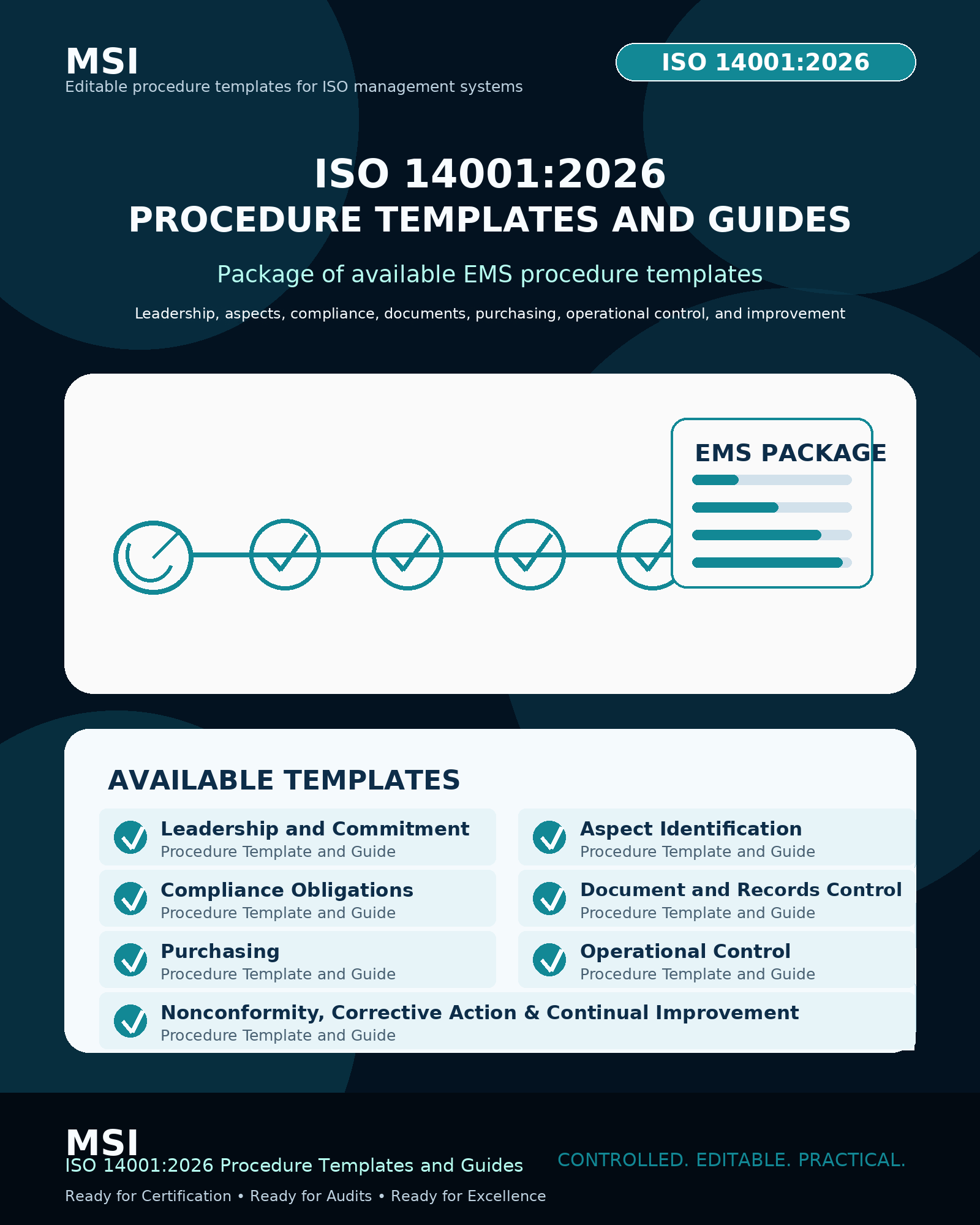
Move From 2015 to 2026 in a Week, Not a Quarter
Transition ISO 14001:2026 Procedure Templates and Guides
Written for experienced EHS managers who already run a certified system and do not need a tutorial. Seven editable procedures — leadership and commitment, aspect identification, compliance obligations, document and records control, purchasing, operational control, and nonconformity and continual improvement — already carry the 2026 language, which is where the conclusions from your ISO 14001 environmental conditions review have to land once the context work is done. You edit to fit your sites rather than drafting from a blank page, and most experienced teams finish the documentation update in a week.
How Do ISO 14001 Environmental Conditions Change Your Context Analysis?
Screen. Score. Record.
A certified organization does not need a new context process. It needs a second pass through the existing one, run in the opposite direction. MSI uses a seven-question screening protocol with certified clients working through ISO 14001 environmental conditions. Run it site by site rather than for the organization as a whole, because exposure is geographic and an enterprise-level answer hides the variation an auditor will look for.
- Location. What natural systems, water bodies, protected areas, and hazard zones exist within a defined radius of this site? Name them from a primary source.
- Dependency. What does this site draw from those systems — water volume, energy, biological inputs, waste-assimilation capacity?
- Sensitivity. If any of those inputs changed by a material amount, what happens to output, cost, quality, or headcount?
- Trajectory. Which direction are those conditions moving over the certificate cycle, according to published data rather than assumption?
- Supply chain. Which ISO 14001 environmental conditions reach you through suppliers rather than through your own footprint?
- Interested parties. Which customers, regulators, insurers, lenders, or communities are already asking about these conditions, and in what format?
- Consequence. Which of the above rise to the level of a risk or opportunity that belongs in Clause 6.1 planning, and which are documented and closed?
Question seven is the one that separates a compliant analysis from a decorative one. ISO 14001 environmental conditions that never flow into planning are conditions you have listed, not evaluated. The audit trail an assessor follows runs from context, into risks and opportunities, into objectives, into operational control. A break anywhere in that chain is visible.
Direct Answer
How much documentation do ISO 14001 environmental conditions require?
The standard requires documented information on the issues determined, not a standalone report. In practice, most certified organizations satisfy ISO 14001 environmental conditions with an expanded context record showing, for each site and each named condition, the source consulted, the conclusion reached, and where that conclusion went next. Length is not the measure. Traceability is. A four-page record that traces cleanly into the risk register outperforms a forty-page assessment that terminates in itself.
Where ISO 14001 Environmental Conditions Propagate Through the EMS
One clause. Seven consequences.
The mistake that produces the most rework is treating this as a Clause 4.1 edit. Context is an input clause. Change the input and everything downstream inherits the change. The table below is the propagation map MSI walks certified clients through, showing where ISO 14001 environmental conditions surface in a system that already exists.
| EMS Element | What Changes for a Certified Organization |
|---|---|
| Context (4.1) | Second-pass dependency screening per site; five named conditions each with a documented conclusion. |
| Interested parties (4.2) | Insurers, lenders, and customer sustainability teams enter the register as parties with environmental-condition requirements. |
| Aspects (6.1.2) | Life cycle perspective sharpens; upstream and downstream aspects tied to named conditions enter the register. |
| Risks and opportunities | Dependency exposures become documented risks with owners — a separate output from the aspects register, not a merged one. |
| Operational control (8.1) | Controls extend to externally provided processes where the exposure originates outside your fence line. |
| Emergency preparedness | Scenarios expand beyond spills and releases to include extreme weather, curtailment, and supply interruption. |
| Management review | Changes in ISO 14001 environmental conditions become a standing input, reviewed and minuted rather than assumed static. |
Two of these deserve emphasis. Emergency preparedness is the clause most systems under-revise: a certified organization typically has excellent spill procedures and nothing at all for a three-day power curtailment or a heat event that halts outdoor work. Management review is the clause that keeps ISO 14001 environmental conditions alive between audits, and it is a small amendment — one agenda line, minuted honestly, converts a static document into a maintained one. MSI’s work on ISO 14001 continual improvement traces the same loop.
Running 9001, 14001, and 45001 Together?
ISO Procedure Templates and Guides
If your context, risk, and management review procedures are shared across an integrated system, the dependency lens has to propagate into all three manuals or your documents will contradict each other at the next audit. The full template library covers the shared procedures across standards so the language stays consistent wherever ISO 14001 environmental conditions touch a common process.
What Evidence Will Auditors Expect for ISO 14001 Environmental Conditions?
Named. Sourced. Traced.
Across more than 200 audits attended, MSI has watched assessors converge on a consistent line of questioning whenever a new requirement lands. It is rarely “do you have a procedure.” It is “show me how you concluded that, and show me what happened next.” Applied to ISO 14001 environmental conditions, three failure patterns account for most findings.
Pattern one: the appended paragraph
A 2015 context document with a new paragraph listing the five named conditions, and nothing else changed. It reads as compliance and audits as omission, because the paragraph asserts consideration without evidencing analysis. The give-away is that no risk register entry, objective, or control anywhere downstream references the new paragraph.
Pattern two: the exemption assumption
“We are an office-based business, so ecosystem conditions do not apply.” Proportionality is real and the standard supports it, but proportionality is a documented conclusion, not a silent skip. A services firm still purchases, still occupies a location, still depends on grid power and municipal water. Reaching a low-relevance conclusion on some ISO 14001 environmental conditions is entirely acceptable when the reasoning is on the page.
Pattern three: assertion without source
“Water availability is not a concern at this facility.” Perhaps true. Where did that come from? Organizations that cite a named basin, a published stress score, and a date rarely get a second question. Organizations that assert get several. General statements draw findings; primary sources close them. The same logic applies to every one of the five ISO 14001 environmental conditions.
Direct Answer
What evidence proves you evaluated ISO 14001 environmental conditions?
Four artifacts satisfy most assessors on ISO 14001 environmental conditions: a per-site record naming the surrounding natural systems and hazard exposures from cited primary sources; a dependency statement for each named condition; risk register entries traceable back to those conclusions; and management review minutes showing the conditions were revisited. Verify that your certification body is accredited under Global ACI, which assumed the roles previously held by IAF and ILAC on January 1, 2026.
Accreditation status matters more than usual during a revision cycle, because certification bodies must themselves be accredited to the 2026 edition before they can grant transition. Confirm the scope with your registrar and cross-check against ANAB or your national accreditation body. The current committee catalogue is maintained by ISO/TC 207, and ASQ’s ISO 14001 overview remains a reliable plain-language reference for teams briefing non-specialists.
A 90-Day Sequence for Organizations Already Certified
Scope. Screen. Close.
Three years sounds generous until you count surveillance audits, internal audit cycles, and management review cadence backward from April 30, 2029. Organizations that finish the ISO 14001 environmental conditions work early get something valuable: a full improvement cycle of evidence before the transition audit, rather than a freshly written document with no operating history. The sequence below fits inside one quarter for most certified systems.
| Window | Work |
|---|---|
| Days 1–15 | Pull the current context record. Mark every entry as impact, dependency, or both. The unmarked column is your scope. |
| Days 16–40 | Run the seven-question screen site by site. Cite a primary source for every location and hazard claim. |
| Days 41–55 | Screen the supply chain: single-source suppliers, water-intensive inputs, biologically derived materials, higher-hazard geographies. |
| Days 56–70 | Promote material findings into risks and opportunities with owners and dates. Close the rest with documented reasoning. |
| Days 71–85 | Update aspects, operational controls, and emergency scenarios where the screen created a consequence. |
| Days 86–90 | Take ISO 14001 environmental conditions to management review as a standing input. Minute the decisions, not just the discussion. |
Direct Answer
How long does the transition work take for a certified organization?
For a single-site certified system, the ISO 14001 environmental conditions review is typically a quarter of part-time effort, with the documentation itself taking days rather than weeks when a structured template set is used. Multi-site organizations should plan per site, because exposure is geographic. The constraint is rarely the writing. It is scheduling the operations, procurement, and facilities input the dependency analysis requires, and then getting the results into a management review that has already been calendared.
For the Team Doing the Work
ISO 14001:2026 Transition Course
A structured walk-through of every clause that moved, built for people maintaining a live certificate rather than pursuing a first one. It covers how the named conditions thread from context into aspects, risk, and operational control — the exact chain assessors follow when they test ISO 14001 environmental conditions.
How ISO 14001 Environmental Conditions Look by Industry
Same clause. Different exposure.
Manufacturing
Process water allocation, grid reliability, thermal limits on equipment, and raw-material availability dominate. Plants in stressed basins should expect permit and allocation questions well before physical scarcity arrives. MSI’s ISO 14001 certification guide covers the underlying implementation mechanics.
Technology and data centers
Water for cooling, power availability, land use, and local opposition converge into a single siting question. Few sectors show the inward direction of ISO 14001 environmental conditions more plainly, as covered in MSI’s analysis of data center sustainability and ISO.
Food, agriculture, and supply chain
Soil health, pollinator populations, water, and weather variability are operating inputs rather than background topics. MSI’s piece on ISO for agriculture and its work on ISO 9001 logistics and ISO 14001 map the upstream and downstream exposure.
Healthcare, government, and services
Continuity of power and water, extreme-heat impacts on facilities and staff, and procurement exposure carry the analysis. These organizations most often reach proportionally low conclusions on some ISO 14001 environmental conditions — which is fine, provided the reasoning is documented rather than assumed.
Organizations with an existing sustainability program often discover they have already collected much of the underlying data, as MSI’s work on turning a sustainability program into ISO 14001 evidence describes. Disclosure frameworks help here too: the TNFD recommendations are built explicitly around dependencies as well as impacts, SBTN target-setting guidance covers nature targets, and the European Sustainability Reporting Standards use the same double-materiality logic your context analysis now needs.
ISO 14001 Environmental Conditions: Frequently Asked Questions
Asked. Answered. Sourced.
Does this replace our environmental aspects register?
When does our certificate actually need to transition?
We already did climate risk work in 2024. Do we start over?
Who should own this work internally?
Do we need consultants for this?
What is the single most common mistake?
Make the Transition Produce Something
Documented. Traced. Maintained.
A certified organization can satisfy ISO 14001 environmental conditions in two ways. One produces a document that passes an audit. The other produces an understanding of which external conditions your operation actually depends on, held in a form the business can use. The work is nearly identical. The difference is whether the analysis is allowed to reach the people who make siting, sourcing, and capital decisions.
Keep It Alive Between Audits
SureResults — Year-Round EMS Maintenance
Transition documentation ages quickly when nobody owns it. SureResults keeps the context record, risk register, internal audit program, and management review inputs current through the certificate cycle, so ISO 14001 environmental conditions stay maintained rather than rewritten the month before your audit.
Prefer to talk it through first? Call 760-434-9141 to book a planning session and map your current context record against the 2026 requirements.
Related Reading
ISO 14001:2026 Updates: Complete Guide to New Requirements and Changes
ISO 14001:2026 Clause 4.1 — What Auditors Will Expect
Ecosystem Health Under the 2026 Revision
Biodiversity and ISO 14001:2026
How to Implement ISO 14001 for Sustainable Business Practices
Risk Management Procedure Template
References and Primary Sources
- ISO/TC 207, Environmental management — committee catalogue of current standards. ISO/TC 207 catalogue
- ISO 14090, Adaptation to climate change — principles, requirements and guidelines. ISO announcement
- Global Accreditation Cooperation — successor to IAF and ILAC as of January 1, 2026. Global ACI
- ANAB — U.S. accreditation body for management system certification. ANAB
- FEMA National Risk Index — natural hazard exposure by county and census tract. National Risk Index
- FEMA — National Risk Index products and tools overview. FEMA products and tools
- NOAA Climate.gov — U.S. climate data and decision-support resources. NOAA Climate.gov
- World Resources Institute Aqueduct — basin-level water stress and risk mapping. Aqueduct Water Risk Atlas
- USGS National Water Information System — site-level surface and groundwater data. USGS NWIS
- U.S. EPA — ecosystem research and water quality. EPA ecosystem research
- U.S. EPA — Level III and IV ecoregions of the continental United States. EPA ecoregions
- U.S. EPA — water research program. EPA water research
- U.S. EPA — water quality data download and Water Quality Portal. EPA water quality data
- Convention on Biological Diversity — Kunming-Montreal Global Biodiversity Framework. CBD Global Biodiversity Framework
- Taskforce on Nature-related Financial Disclosures — dependency and impact disclosure recommendations. TNFD recommendations
- Science Based Targets Network — corporate target-setting for nature. SBTN target setting
- EFRAG — European Sustainability Reporting Standards and double materiality. ESRS
- ASQ — ISO 14001 plain-language overview. ASQ ISO 14001
About Management Systems International (MSI)
Diana Lynn is President and Principal ISO Consultant at Management Systems International (MSI), a veteran-owned, female-owned consulting firm she founded in 1998. With 28 years of experience, MSI’s track record includes 80+ certifications supported, 200+ audits attended, and 600+ professionals trained across manufacturing, technology, medical device, government, healthcare, and other regulated industries.
Today MSI implements ISO 9001, ISO 13485, ISO 14001, and ISO 45001, with an expanding focus on ISO 7101 healthcare quality.
msi-international.com · 760-434-9141
