
Direct Answer
ISO 14001:2026 is the new edition of the world’s leading environmental management system standard, published on April 15, 2026 and replacing ISO 14001:2015. The revision makes climate change and biodiversity mandatory context considerations, adds a formal change-management clause (6.3), requires a lifecycle perspective for scope, and extends controls across all externally provided processes. Certified organizations have a 36-month transition period — until April 30, 2029 — to update their environmental management system and pass a transition audit.
The Revision Is Here
What’s New in ISO 14001:2026?
Published. Mandatory. Manageable.
ISO 14001:2026 moves environmental management from intention to evidence, and the change is no longer theoretical: the standard was published by ISO on April 15, 2026, formally replacing the 2015 edition that more than 670,000 organizations worldwide rely on. For the roughly two-thirds of certified organizations whose certificates are now tied to a withdrawn standard, the practical question has shifted from “what might change?” to “what do we update first, and how much time do we have?” This guide answers both, clause by clause, so a quality manager, EMS coordinator, or executive sponsor can turn the revision into a working plan rather than a reading exercise.
Who needs to act? Any organization currently certified to ISO 14001:2015 is now working against a withdrawn standard and must transition before the deadline. Organizations pursuing first-time certification should simply build to the 2026 edition from the start. And teams running integrated systems — ISO 14001 alongside ISO 9001 or ISO 45001 — have an opportunity rather than a burden, because the revision’s adoption of the Harmonized Structure makes those standards fit together more cleanly than before. The practical first move is the same in every case: understand the changes, then map them against what your system already does. If you are new to the standards landscape entirely, MSI’s primer on what ISO is and why it carries trust is a useful starting point.
The headline is reassuring for organizations with a mature system: the ISO 14001:2026 changes are evolutionary, not a rebuild. The standard clarifies existing requirements far more than it invents new ones, and it adopts ISO’s Harmonized Structure (Annex SL) so that integration with ISO 9001 and ISO 45001 gets easier, not harder. But “moderate in scope” is not the same as “nothing to do.” The revision foregrounds environmental megatrends that boards and regulators can no longer treat as externalities — climate change, biodiversity loss, pollution, and resource scarcity — and it builds them into the standard’s planning machinery. The organizations that thrive in the transition will be the ones that treat ISO 14001:2026 as a strategy upgrade, not a paperwork tax.
The Case For Change
Why Was ISO 14001 Revised for 2026?
Relevant. Clearer. Aligned.
It had been a decade since the 2015 edition, and a great deal happened in those ten years. The revision, led by ISO Technical Committee TC 207, set out to do three things: keep the standard relevant to today’s environmental pressures, clarify requirements that auditors and organizations interpreted inconsistently, and align the text with the latest Harmonized Structure so multi-standard organizations stop maintaining three slightly different vocabularies. The 2024 Climate Action Amendment — which already required organizations to consider whether climate change was relevant to their EMS — is now woven directly into ISO 14001:2026 rather than bolted on as an addendum.
Direct Answer
ISO 14001 was revised for 2026 to address intensifying environmental conditions, to clarify requirements so they audit more consistently, and to fully adopt ISO’s Harmonized Structure. The ISO 14001:2026 revision deliberately limited new requirements and focused on sharpening existing ones, which keeps the transition manageable for organizations already certified to the 2015 edition.
There is also a lesson worth remembering from the wider 2026 revision cycle. ISO 9001 has completed its systematic review and now sits at the Final Draft International Standard stage, with publication expected in September 2026 — not the 2025 update some had assumed. The auditing guideline ISO 19011 was published in its 2026 edition on May 27, 2026, and the vocabulary standard ISO 9000 has been updated alongside it. MSI’s analysis of the ISO 9001:2026 update and its new ethics and culture emphasis traces how those quality-side changes interact with the environmental revision. The takeaway for environmental teams is simple: rely on official ISO and accreditation announcements, not rumor. For ISO 14001:2026, those official announcements are now in — the standard is published, the certification bodies have issued aligned transition guidance, and the transition arrangements administered by Global Accreditation Cooperation Incorporated (Global ACI) — the single body that assumed the roles of the former International Accreditation Forum and International Laboratory Accreditation Cooperation on January 1, 2026 — confirm the three-year window. This guide draws only on that published content and committee notes, not speculation.
The Big Picture
Summary of ISO 14001:2026 Changes at a Glance
Climate. Lifecycle. Leadership.
Before the clause-by-clause detail, here is the shape of the revision. Each of these ISO 14001:2026 changes is expanded later in this guide:
- Climate change and biodiversity become mandatory inputs to organizational context (Clause 4.1).
- Lifecycle perspective must shape how you set EMS scope (Clause 4.3).
- A new change-management clause (6.3) requires planned, evaluated, controlled management of EMS-related changes.
- Operational control extends from “outsourced processes” to all externally provided processes, products, and services (Clause 8.1).
- Emergency situations are evaluated separately from routine environmental aspects (Clause 6.1.2).
- Risk and opportunity planning is reorganized for clearer linkage to action (Clauses 6.1.4 and 6.1.5).
- Leadership accountability extends to all relevant roles, with explicit emphasis on resource conservation and ethical leadership (Clause 5).
- Performance evaluation requirements become more explicit, including defined internal audit objectives (Clause 9).
- Documented information language is standardized to distinguish required records from optional documentation (Clause 7).
- Continual improvement structure is consolidated to tighten the link from findings to action (Clause 10).
Independent transition guidance from accredited certification bodies — including BSI, SGS, Intertek, and DNV — converges on the same list, which is a good sign that the picture below is settled rather than speculative. The full family scope is catalogued on ISO’s environmental management page, with general implementation guidance in ISO 14004.
Clause By Clause
The 10 Major ISO 14001:2026 Changes Explained
Read. Map. Act.
1. Climate Change and Biodiversity Are Now Mandatory (Clause 4.1)
What changed: Organizations must explicitly consider environmental conditions — including climate change, pollution, biodiversity, and resource availability — when determining the context of the organization. Why it matters: This moves climate and nature from optional considerations to core strategy inputs. You can no longer treat environmental megatrends as someone else’s problem; they are now integral to understanding your own operating context. What to do: Update your context analysis to address climate-related risks and opportunities affecting operations, biodiversity impacts and dependencies, pollution concerns relevant to your sector, and resource constraints. Many organizations find that emerging climate-disclosure expectations from frameworks such as the ISSB, the TCFD recommendations, biodiversity reporting under the TNFD, and reporting through CDP already supply much of this analysis. MSI’s companion guide to biodiversity and ISO 14001:2026 works through the ecosystem side of the same clause in detail.
2. Lifecycle Perspective Required for EMS Scope (Clause 4.3)
What changed: Scope decisions must now reflect a lifecycle perspective, ensuring the upstream and downstream impacts you can control or influence are considered. Why it matters: Your EMS can no longer stop at the fence line. Supply-chain impacts and product end-of-life are squarely in view. What to do: Map your value chain to identify significant upstream and downstream impacts, determine where you have control versus influence, expand scope boundaries to reflect lifecycle thinking, and document the rationale for scope decisions. MSI’s deep dive on mastering ISO 14001 lifecycle assessment explains exactly how much rigor the clause expects (and where a full LCA is not required), while MSI’s guide to circular economy thinking within ISO 14001 and our overview of implementing ISO 14001 for sustainable practice are practical companions. The international ecodesign reference is ISO 14006.
3. New: Formal Change Management Requirements (Clause 6.3)
What changed: A genuinely new clause requires that EMS-related changes — regulatory, operational, or technical — be planned, evaluated, and controlled. Why it matters: Unmanaged change is where well-run systems quietly drift. A new line, a new supplier, a new solvent: each can undo environmental performance if it slips through without evaluation. What to do: Develop a formal change-management procedure, create evaluation criteria for proposed changes, establish approval before implementation, document change impacts on environmental performance, and cover both temporary and permanent changes. This is the single change most organizations have to build from scratch, and it is the area where an experienced ISO consulting partner saves the most rework. MSI’s playbook on ISO 9001 change-management automation shows how a single controlled-change workflow can satisfy quality and environmental requirements at once.
Direct Answer
The biggest new requirement in ISO 14001:2026 is Clause 6.3, formal change management. Organizations must plan, evaluate, and control EMS-related changes before implementing them, and document the environmental impact of each change. Most certified organizations will need to build a change-management procedure that did not exist under the 2015 edition.
4. Expanded Supplier and External Provider Controls (Clause 8.1)
What changed: Control extends beyond “outsourced processes” to all externally provided processes, products, and services. Organizations must define and document their level of control or influence over each. Why it matters: Supply-chain environmental impact is now scrutinized by regulators, investors, and customers — and it dwarfs most organizations’ direct footprint. CDP data has shown that supply-chain emissions can run many times higher than a company’s own operations, which is precisely why this clause expanded. What to do: Identify all externally provided processes, products, and services; assess and document your control or influence over each; set criteria for supplier environmental performance; and link supplier management to risk planning. MSI’s case-based guide on building climate-resilient supplier networks and our method for integrating climate risk into supply-chain strategy both map directly onto this requirement, the practical document work is covered in MSI’s guide to the purchasing and supplier control procedure, and the upstream emissions math is grounded in the GHG Protocol Scope 3 framework.
5. Enhanced Emergency Preparedness (Clause 6.1.2)
What changed: Determining potential emergency situations is now separated from routine environmental-aspect evaluation, and organizations are expected to identify “all potential” emergencies rather than only the “reasonably foreseeable.” Why it matters: Emergency scenarios receive dedicated attention instead of being buried in a general aspects register, which improves traceability and response readiness. What to do: Conduct separate emergency-scenario identification, link emergency preparedness to risk planning under Clause 6.1, update response procedures, and ensure clear traceability between each scenario and its response plan.
6. Strengthened Planning Structure (Clauses 6.1.4 and 6.1.5)
What changed: Planning text is reorganized for clarity — 6.1.4 addresses risks and opportunities, and 6.1.5 tightens the links between environmental aspects, compliance obligations, and planned actions. Why it matters: The reorganization removes long-standing ambiguity about how aspects, risks, opportunities, and obligations actually connect to concrete actions. It also breaks internal cross-references in most 2015-era document sets, which is a quieter problem than it sounds — a procedure that points at the old numbering still reads correctly and is still wrong. A procedure that works in practice has those threads tied together; a procedure that fails in practice leaves them dangling. What to do: Review planning documentation for structural alignment, renumber cross-references against the 2026 clause map, strengthen the linkage from aspect identification to action, and make sure compliance obligations visibly drive planned actions. MSI’s guide to the risk, aspect and hazard identification procedure covers how the environmental side differs from the quality side here.
7. Leadership Accountability Enhanced (Clause 5)
What changed: Top-management accountability is reinforced, with clearer expectations around ethical leadership and natural-resource conservation. Leadership support now extends to all relevant roles, not just management positions, and the term “meet” replaces “fulfil” for compliance obligations to align with the Harmonized Structure. Why it matters: Environmental responsibility is distributed across the organization rather than concentrated at the top, and the terminology shift smooths integration with ISO 9001 and ISO 45001. What to do: Extend leadership communication to all relevant roles, weave resource conservation into leadership messaging, and document leadership’s role in supporting continual improvement.
8. Performance Evaluation Made Explicit (Clause 9)
What changed: Environmental-performance evaluation requirements are more explicit, internal audit objectives must be clearly defined, and management-review inputs and outputs are reformatted for sharper focus. Why it matters: Clearer expectations raise the quality and consistency of evaluation and review. What to do: Define specific objectives for each internal audit, enhance your environmental-performance indicators, and restructure management-review agendas to match the new format. MSI’s resources on running an effective ISO management review and on internal audit follow-up translate this clause into a working cadence, and the measurement side depends on a working control of monitoring and measuring equipment procedure. The auditing guideline itself is ISO 19011.
9. Documented Information Clarity (Clause 7)
What changed: Consistent phrasing — “available as documented information” — distinguishes required records from optional documentation, and communication expectations now explicitly include empowering employees to contribute to continual improvement. Why it matters: This ends a decade of confusion about what must be documented versus what is merely recommended, which tends to reduce over-documentation rather than add to it. What to do: Review existing documentation to separate mandatory records from optional ones, update document-control procedures with the new terminology, and ensure your communication processes invite employee contribution. MSI’s guide to document and records control sets out the four decisions that have to be made before any other procedure can produce a defensible record.
10. Improved Continual Improvement Structure (Clause 10)
What changed: Consolidation and renumbering strengthens the corrective-action structure and tightens the link from findings to improvement. Why it matters: A streamlined structure makes it easier to demonstrate the chain from nonconformity to corrective action to genuine improvement. What to do: Update corrective-action procedures to reflect the new structure, strengthen documentation of improvement linkages, and review your improvement-tracking system for alignment. The substantially expanded guidance annex (Annex A) is worth reading in full, because it clarifies interpretation across Clauses 4 through 10 — especially on lifecycle, change management, environmental conditions, and supplier controls.
The Clock Is Running
ISO 14001:2026 Transition Timeline — How Long Do You Have?
Start. Sequence. Succeed.
Direct Answer
The ISO 14001:2026 transition period is three years from publication. The standard was published on April 15, 2026, and certification bodies are working to a final deadline of April 30, 2029, with a mid-point cut-off around October 30, 2027 after which no new ISO 14001:2015 certificates may be issued. Your own dates depend on your certificate’s issue date and your certification body’s schedule. After the final deadline, a 2015 certificate is no longer valid.
Confirm your own dates with your certification body rather than planning against a date read on a website — including this one. Milestones are administered through the accreditation framework and applied by each certification body against your certificate’s individual cycle.
Three years sounds generous until you remember the bottleneck: certification bodies and qualified auditors serve the whole market on the same clock, and auditor availability tightens sharply as 2029 approaches. ANAB and bodies such as TÜV SÜD consistently advise the same thing: start early. MSI’s breakdown of the arithmetic behind the 2026 transition deadline explains why a three-year window functions in practice as closer to two. Organizations that begin now spread the workload across normal business cycles, fold the changes into business-as-usual rather than a crash project, and avoid competing for scarce audit slots in the final months.
One Structure, Many Standards
How Does ISO 14001:2026 Align with the Harmonized Structure?
Integrate. Streamline. Simplify.
The 2026 revision fully adopts ISO’s Harmonized Structure (formerly Annex SL), the common skeleton — context, leadership, planning, support, operation, performance evaluation, improvement — that ISO uses across its management-system standards. For single-standard organizations the benefit is modest. For the many organizations running integrated systems, it is significant: consistent terminology reduces confusion, audits across multiple standards run more smoothly, and documentation can be shared rather than duplicated. MSI’s explainer on the ISO consulting “decoder ring” behind five standards shows how that shared ten-clause spine lets a quality skill set carry straight into an environmental project, and our piece on ISO structure for corporate development reframes it as durable organizational capability.
If you maintain ISO 9001 or ISO 45001 alongside ISO 14001, the 2026 alignment makes a single unified system more achievable than ever. MSI’s roadmap for achieving ISO 14001 by leveraging an existing ISO 9001 system and our step-by-step ISO 14001 integration guide for ISO 9001-certified organizations both show how that shared structure cuts implementation time — often by 40–50% versus starting from scratch. Organizations facing both revisions at once should read MSI’s combined ISO 9001 and ISO 14001 transition guidance, which treats the two as a single project rather than two. For organizations spread across locations, the same logic scales through multi-site ISO certification, and freight operators can see it applied in our guide to ISO 9001 and ISO 14001 in logistics.
The key terminology shifts to note: “meet compliance obligations” replaces “fulfil”; “this document” replaces standard-specific self-references; and “available as documented information” standardizes how documentation requirements are phrased. None of these change what you must do — they change how the requirement reads so it matches the rest of the ISO family.
From Changes To Plan
A Practical ISO 14001:2026 Transition Roadmap
Assess. Update. Audit.
A workable ISO 14001:2026 transition fits inside a 24-to-36-month window without becoming a fire drill. Here is the sequence MSI uses with certified organizations.
Step 1 — Planning session (Months 1–2). Begin with a structured planning session that compares your current EMS against ISO 14001:2026 clause by clause: review each clause for changes, identify documentation needs, assess process modifications, and estimate the resource requirement. This baseline determines everything that follows.
Step 2 — Priority updates (Months 3–6). Tackle the high-impact changes first: update context analysis (Clause 4.1) to add climate, biodiversity, pollution, and resource constraints; build the new change-management procedure (Clause 6.3); reassess EMS scope through a lifecycle lens (Clause 4.3); and strengthen supplier controls (Clause 8.1).
Step 3 — Process refinement (Months 7–12). Refine existing processes to match the clarified requirements: rebuild the environmental-aspects method with a lifecycle perspective, separate emergency preparedness from routine aspects, sharpen performance evaluation, and restructure the management-review format.
Step 4 — Training and communication (Months 13–18). Train leadership on enhanced accountability, educate all relevant roles on their EMS contribution, communicate the new change-management expectations organization-wide, and brief suppliers on the expanded control requirements.
Step 5 — Internal audit and refinement (Months 19–24). Test the updated EMS before the registrar sees it: run internal audits with clearly defined objectives (per Clause 9), surface implementation gaps, make corrections, and capture lessons learned. MSI’s internal audit services and internal auditor training are built for exactly this checkpoint.
Step 6 — Transition audit (Months 25–36). Schedule the transition audit with enough runway for any corrective actions. Where significant changes were required, a pre-assessment reduces surprises. Booking early matters more than usual, because the whole market competes for the same auditors near the deadline.
From Clauses To Documents
What ISO 14001:2026 Actually Asks You to Write
Procedures. Records. Evidence.
Everything above this point is analysis. At some stage a transition stops being a reading exercise and becomes a stack of documents that either exist or do not, and the auditor arriving for your transition audit will not ask whether you understood Clause 6.3. They will ask to see the procedure. This is the part of the ISO 14001:2026 transition that consumes the most calendar time and gets planned the least, because the changes are easy to summarize on a slide and genuinely hard to write down.
Direct Answer
A ISO 14001:2026 transition typically requires rewriting or newly authoring seven document sets: the change-management procedure (Clause 6.3, entirely new), the environmental aspects and impacts register with its significance method (6.1.2), the compliance obligations process (6.1.3), the context analysis (4.1), operational and external-provider controls (8.1), document and records control (7.5), and the performance-evaluation and management-review structure (Clause 9). Only one of the seven has no predecessor in the 2015 edition — and it is the one transition projects lose.
Why Clause 6.3 Disappears From Transition Plans
Consider how a transition project actually runs. Somebody builds a mapping table — old clause, new clause, our document, what changes — and works down it row by row. Context maps to context. Aspects map to aspects. Management review maps to management review. Every row has something in the left-hand column except one, and a row with an empty left column tends to get quietly deleted, because a mapping exercise is built to find changes to existing things rather than things that never existed before. Planning of changes is new in ISO 14001:2026. There is nothing to map it from.
This is not a hypothetical failure mode. It happened at scale in 2015, when ISO 9001 introduced a contingency-action requirement with no 2008 predecessor; a decade later most sales procedures still do not mention it, and no internal audit catches the omission because the auditor is working from the same mapped checklist that lost it in the first place. MSI’s analysis of the requirements that fall through transition correspondence tables traces exactly how that mechanism works. The defense is simple and rarely applied: audit the new standard’s clause list directly, not your mapping table.
Your Context Register Almost Certainly Runs One Direction
Clause 4.1 in the 2026 edition requires context issues to include environmental conditions affected by the organization or capable of affecting the organization. That second half is the change, and nearly every context register in circulation runs one direction only: here is our footprint, here is what we emit, here is what we consume. The reverse question is the one that connects an environmental management system to a business conversation. What does a drought do to our water permit? What does a floodplain reclassification do to our site? What does resource scarcity do to a raw material we have single-sourced? That direction is where management review stops being a compliance meeting and starts being a decision.
Aspects You Influence, Not Only the Ones You Control
The lifecycle perspective has been in the standard since 2015, and most aspect registers still stop at the property line. Upstream extraction, downstream use, end-of-life treatment, external provider practices — a register that omits them is incomplete in a way no internal audit will surface, because the auditor samples against the same register. A significance method that survives an ISO 14001:2026 transition audit needs stated thresholds rather than adjectives, and an override making any aspect that carries a compliance obligation significant regardless of its score. MSI’s work on aspect identification as an evidence engine and the guide to mapping an existing sustainability program onto ISO 14001 both address where registers usually stop short.
What Separates a Working Procedure From a Reworded Clause
A document that says changes affecting the environmental management system shall be planned has restated the clause and helped nobody. You still have to decide what counts as a change, who classifies it, what threshold sends it to review, what record proves it happened, and what to do when somebody changes something without telling you. Those decisions are the procedure. Across 200+ certification and surveillance audits attended, MSI has found that documents which hold up under examination share seven structural properties — a real trigger, one accountable owner, stated decision criteria, records produced as a byproduct of the work, a defined exception path, trainability in a single sitting, and a built-in review trigger. Most procedures in circulation carry four or five, and the missing two or three are reliably the same ones. MSI’s breakdown of the seven marks of an effective ISO procedure applies that test to any document already in your system.
Direct Answer
Documents written for the ISO 14001:2026 transition should be authored against the 2026 text rather than edited from 2015 originals. Risks and opportunities moved to Clause 6.1.4 with planning of action at 6.1.5, which breaks internal cross-references throughout most 2015-era document sets, and Clause 6.3 has no 2015 predecessor to edit from at all. A cross-reference table carrying both editions is what separates a controlled update from a silent gap.
The same discipline applies procedure by procedure, and several of these documents serve more than one standard at once. Whichever route you take — writing them yourself, adapting a proven set, or having them built alongside your team — the test at the transition audit is identical: can the person who does the work follow the document, and does the document produce the record the auditor asks for? MSI’s full library of ISO procedure templates and guides covers that ground across five standards, each written to its own clauses rather than adapted across.
 The Work You Can Finish This Month
Stop Reading About the Changes. Start From a Document That Already Made the Decisions.
Editable. Authored. Audit-Ready.
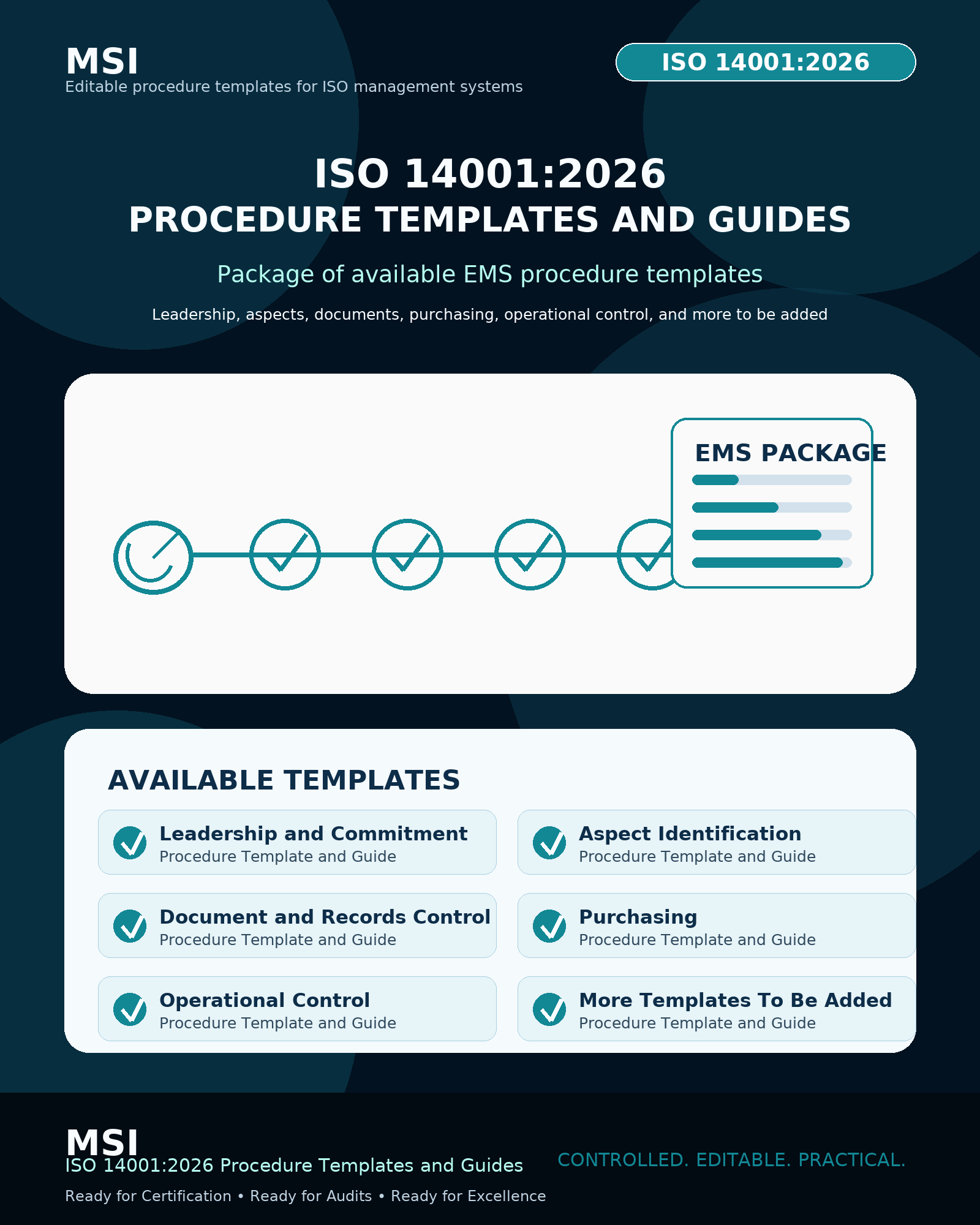
Transition help usually arrives in halves, and neither half finishes the job. A briefing tells you Clause 6.3 is new and then ends, leaving you in front of a blank document holding an accurate list of things you now have to write. A template restates the clause and hands back the easy twenty percent. MSI’s Transition ISO 14001:2026 Procedure Templates and Guides package puts both halves in the same box: complete, editable Word procedures written to the 2026 text — with scored significance thresholds, a bidirectional context method, a compliance obligations register, records tables with no blanks, and a full 2015-to-2026 cross-reference — plus the ISO 14001:2026 Transition course that explains the reasoning behind every decision inside them. Same author, same evidence, nothing to translate between the two.
When an auditor asks who set a threshold and why, because the template said so is not an answer. Every criterion in the set carries its reasoning and a course segment explaining it, drawn from 200+ audits attended across 28 years and 80+ certifications supported.
See the ISO 14001:2026 Templates & Course Package → Course Only →
Want the whole document set mapped to your operation instead? Call MSI at 760-434-9141 to book a planning session.
Worth More Than The Certificate
Benefits Beyond Compliance
Resilience. Advantage. Trust.
Meeting the requirement is the floor, not the ceiling. The ISO 14001:2026 changes create strategic upside for organizations that pursue them with intent rather than minimum effort:
- Enhanced risk management — explicit climate and biodiversity considerations improve resilience planning across the whole organization.
- Competitive advantage — early adopters demonstrate environmental leadership to customers and investors while peers are still scoping the work.
- Operational efficiency — lifecycle thinking routinely surfaces cost-saving opportunities in supply chains, a pattern organizations typically report after the first full cycle.
- Stakeholder confidence — stronger supplier controls and disciplined change management reduce the environmental incidents that erode trust.
- Regulatory preparedness — many requirements align with emerging climate-disclosure and due-diligence regulation, so the EMS work doubles as reporting readiness.
- Integration opportunity — Harmonized Structure alignment makes multi-standard management materially simpler.
There is also a transaction-value dimension that boards increasingly recognize. MSI’s analysis of ISO certification enterprise value — drawn from MSI’s experience across 200+ audits attended — shows how a mature ISO 14001 paper trail compresses environmental due diligence in the deal room and protects headline price. For the underlying operational business case, see MSI’s essential guide to ISO 14001 certification across industries and our corporate guide to reducing greenhouse-gas emissions through ISO standards. External frameworks such as the Science Based Targets initiative and GRI pair naturally with a 2026-aligned EMS, the EU’s Corporate Sustainability Reporting Directive increasingly drives demand for one, and the US EPA’s environmental management system resources and UN Environment Programme remain useful public references.
Do It Once, Do It Right
How an ISO Consulting Partner Accelerates the ISO 14001:2026 Transition
Guided. Documented. Certified.
A transition is mostly judgment: deciding how deep your context analysis needs to go, how to scope a change-management procedure that is rigorous without being bureaucratic, and where “influence” over a supplier becomes “control.” That judgment is where an experienced ISO consulting partner earns its keep. Management Systems International (MSI) is a veteran-owned, female-owned ISO consulting firm with 28 years of experience, 80+ certifications supported, 200+ audits attended, and 600+ professionals trained across manufacturing, technology, medical device, government, healthcare, and other regulated industries. Those are measurable signals of depth — and across that 200+-audit history, MSI client experience suggests the organizations that engage a structured partner early reach their transition audit with fewer findings and less rework than those improvising late.
MSI builds the procedural foundation that auditors look for, then helps your team operate it — including, where a software layer helps, the document-control and workflow capabilities provided through MSI’s alliance with CAQ AG Factory Systems and described in our guide to procedure-first ISO compliance automation. The principle MSI applies to every ISO consulting engagement is simple: design the management system to the standard’s intent first, then digitize and certify the validated system. Reversing that order — buying a platform before defining the procedure — almost always costs more, because every workflow gets built twice.
For organizations that want the whole journey handled end to end, SurePath delivers a turnkey path to certification, while SureResults keeps the system healthy year over year. Leadership teams weighing the transition strategically can watch MSI’s ISO Executive Decision Briefs, and you can learn more about the firm on the About MSI page.
Your Questions, Answered
Frequently Asked Questions About ISO 14001:2026
Ask. Understand. Decide.
Do I need to recertify to ISO 14001:2026?
Yes. During the transition period you must update your EMS and undergo a transition audit to move from ISO 14001:2015 to ISO 14001:2026. This is not starting over — it is updating an already-certified system, which is why a mature EMS transitions comparatively smoothly.
What happens if I do not transition in time?
Your ISO 14001:2015 certificate expires at the end of the ISO 14001:2026 transition period — April 30, 2029 at the latest — and is no longer valid. Recovering certification after that point typically requires a full certification audit rather than a transition audit, so missing the window costs both time and budget.
Can I wait to implement the ISO 14001:2026 changes?
Technically yes, until the deadline — strategically no. Starting your ISO 14001:2026 transition early spreads cost across normal cycles, lets you learn from early adopters, demonstrates environmental leadership, and avoids competing for scarce audit slots in the final months before April 2029.
What documents does the ISO 14001:2026 transition require?
Most organizations rewrite or newly author seven document sets for the ISO 14001:2026 transition: change management (6.3), the aspects and impacts register with its significance method (6.1.2), compliance obligations (6.1.3), context analysis (4.1), operational and external-provider controls (8.1), document and records control (7.5), and performance evaluation with management review (Clause 9). Only the change-management procedure has no 2015 predecessor, which is precisely why mapping-table transition plans lose it.
How much will the ISO 14001:2026 transition cost?
Cost for the ISO 14001:2026 transition varies with organization size and complexity, current EMS maturity, the distance between current practice and the new requirements, and whether you use internal resources, a template set, or a consulting partner. Because the changes build on an existing system, most organizations find the cost moderate — and lower still when the work is sequenced early rather than rushed.
Will my current certification be invalidated immediately?
No. ISO 14001:2015 certificates remain valid throughout the ISO 14001:2026 transition period. They simply cannot be renewed or reissued under the withdrawn 2015 edition after the October 2027 cut-off, and they lapse if not transitioned before the April 30, 2029 deadline.
What is the single biggest new requirement in ISO 14001:2026?
The genuinely new requirement in ISO 14001:2026 is the formal change-management clause (6.3). Most certified organizations will need to build a procedure to plan, evaluate, control, and document EMS-related changes — something the 2015 edition did not require explicitly.
Evolution, Not Revolution
Conclusion: A Catalyst, Not a Checkbox
Strengthen. Integrate. Lead.
ISO 14001:2026 represents a thoughtful evolution of environmental-management best practice rather than a wholesale rewrite. The changes are substantial enough to matter — explicitly addressing climate, biodiversity, lifecycle impact, and change management — but moderate enough to build on the EMS foundation you already have. Organizations with mature systems will find that many requirements simply formalize practices already emerging in response to stakeholder and regulatory pressure. The teams that come out ahead will be the ones that treat the revision as a catalyst for genuine environmental performance, start early, engage stakeholders, and sequence the work so the transition audit confirms a system that already runs well in practice. The environmental challenges facing organizations are intensifying; ISO 14001:2026 exists to keep your management system fit to meet them.
Ready To Start Your Transition?
Three Routes to ISO 14001:2026, Depending on Who Does the Writing
Documents. Turnkey. Briefing.
1. Your team writes it, starting from finished procedures. The Transition ISO 14001:2026 Procedure Templates and Guides package delivers editable Word procedures built to the 2026 edition, plus the transition course that explains every decision inside them. Best when you have the people and need the head start.
2. MSI runs the whole path. SurePath takes an organization from decision to certificate as a turnkey project, and SureResults keeps a certified system audit-ready through revision cycles exactly like this one. Best when the calendar is tighter than the budget.
3. Leadership needs to decide first. Watch the ISO Executive Decision Briefs — short, jargon-free videos that show an executive sponsor what the transition involves, what it costs, and what it returns. Best when the work is agreed in principle and not yet funded.
Not sure which route fits? A conversation is usually quicker than a rewrite. Speak with an MSI specialist directly: 760-434-9141 · msi-international.com
References & Authoritative Sources
- ISO — ISO 14001:2026 published (April 15, 2026)
- ISO — ISO 14001 environmental management family
- ISO/TC 207 — Environmental management technical committee
- ISO 14004 — EMS general implementation guidelines
- ISO 14006 — Ecodesign guidelines
- ISO 19011 — Guidelines for auditing management systems
- Global ACI — international accreditation cooperation (successor to IAF and ILAC, January 1, 2026)
- ANAB — ISO 14001:2026 key changes and how to prepare
- UKAS — EMS ISO 14001:2026 transition technical bulletin
- Amtivo — ISO 14001:2026 transition timeline and key dates
- RCA CERT — ISO 14001:2026 transition roadmap and deadlines
- ABS Quality Evaluations — ISO 14001:2026 transition roadmap
- DQS — ISO 14001:2026 transition guide and audit focus
- BSI — ISO 14001:2026 key changes and guidance
- DNV — ISO 14001:2026 published: what’s changed
- TÜV SÜD — ISO 14001:2026 now published
- SGS — ISO 14001:2026 key updates and transition guidance
- Intertek — ISO 14001:2026 key updates and transition guidance
- IFRS — International Sustainability Standards Board (ISSB)
- TCFD — Task Force on Climate-related Financial Disclosures
- TNFD — Taskforce on Nature-related Financial Disclosures
- CDP — environmental disclosure system
- GHG Protocol — corporate value chain (Scope 3) standard
- Science Based Targets initiative (SBTi)
- Global Reporting Initiative (GRI)
- EUR-Lex — Corporate Sustainability Reporting Directive (CSRD)
- US EPA — Environmental Management Systems
- UN Environment Programme (UNEP)
About Management Systems International (MSI)
Management Systems International (MSI) is a veteran-owned, female-owned ISO consulting firm founded in 1998. With 28 years of experience, MSI’s track record includes 80+ certifications supported, 200+ audits attended, and 600+ professionals trained across manufacturing, technology, medical device, government, healthcare, and other regulated industries.
Today MSI implements ISO 9001, ISO 13485, ISO 14001, and ISO 45001, with an expanding focus on ISO 7101 healthcare quality.
