
The ISO 2026 transition deadline is not the problem most organizations think it is. Almost everyone will make the date. The 2026 revisions of ISO 14001 and ISO 9001 each carry a three-year window, and three years is generous for updating a system you already run. The problem hides one layer down, in arithmetic that has nothing to do with the calendar on your certificate and everything to do with a resource that cannot be manufactured on demand: qualified auditor days. This article does the math out loud, because the organizations that see it early spend less, disrupt less, and finish the transition on their own terms.
Direct Answer: The ISO 2026 transition deadline refers to the fixed three-year windows created by the 2026 revisions — ISO 14001:2026 (published 15 April 2026, closing roughly April 2029) and the forthcoming ISO 9001:2026 (expected September 2026, closing roughly September 2029). The binding constraint is not the deadline itself but the number of accredited transition audits that must clear beforehand, drawn from a finite, non-scalable pool of auditors who must first be re-accredited to the new editions. That is why the ISO 2026 transition deadline rewards early movers and penalizes those who wait for the final year.
THE TWO CLOCKS
What is the ISO 2026 transition deadline?
Two Clocks. One Constraint.
The ISO 2026 transition deadline is really two deadlines running on offset clocks. ISO 14001:2026 was published on 15 April 2026, which started a three-year transition period; every ISO 14001:2015 certificate has to convert to the new edition by roughly late April 2029 or it lapses. ISO 9001:2026 is close behind: its Final Draft International Standard has been balloted and its technical content is frozen, with publication expected in September 2026 and its own three-year window running to approximately September 2029.
For an organization certified to just one of the two, the ISO 2026 transition deadline is a single date on a single system. For the many organizations certified to both quality and environmental management systems, the two deadlines land five months apart and draw on the same internal team, the same documentation spine, and — critically — the same certification bodies. MSI covers how to sequence a dual-standard move in its guide to running the ISO 9001 and 14001 transition as one plan. This article stays on the piece that guide only touches: the capacity math underneath the ISO 2026 transition deadline.
Direct Answer: There is no single ISO 2026 transition deadline date. ISO 14001:2015 certificates expire around April 2029; ISO 9001:2015 certificates around September 2029, once the 9001 revision publishes. Both are three years from their respective publication dates, and both are governed by the accreditation framework now coordinated by Global ACI.
One structural note matters before the arithmetic. Transition timelines are overseen by Global Accreditation Cooperation Incorporated (Global ACI), the body that unified the former International Accreditation Forum and International Laboratory Accreditation Cooperation on 1 January 2026. Your certification body answers to an accreditation body such as ANAB, which in turn answers to that global peer-evaluation system. No link in that chain can issue a transition certificate to the 2026 editions until it has itself been re-accredited to them — a detail that turns out to be the whole story.
THE NUMBERS
How many certificates face the ISO 2026 transition deadline?
Count. Divide. Understand.
Start with the population. The 2024 ISO Survey — the most recent global count of valid certificates — records more than 675,000 valid ISO 14001 certificates worldwide and nearly 1.5 million valid ISO 9001 certificates. Every one of those certificates is on a 2015-edition standard. Every one of them has to move to a 2026 edition inside a fixed window, or drop off the register. That is the raw scale behind the ISO 2026 transition deadline.
More than 675,000 ISO 14001 certificates. Nearly 1.5 million ISO 9001 certificates. Two fixed windows. And a single, finite pool of auditors who have to be re-accredited before they can issue a single transition certificate to either edition.
A fair caution on the ISO 14001 figure: the jump from the previous survey is driven largely by better reporting through the global certification database rather than by real growth, because one major economy withheld data the year before. The honest public figure is “more than 675,000,” and it is the right number to reason from. It is also large enough that the arithmetic works out the same whether the true count is a little higher or lower.
Direct Answer: More than 675,000 ISO 14001 and nearly 1.5 million ISO 9001 certificates worldwide must move to the 2026 editions before the ISO 2026 transition deadline. Because certification bodies cannot begin issuing transition certificates until their own auditors are re-accredited — most of a year after each standard publishes — the usable window is closer to two years than three, which is where the pressure comes from.
Now shorten the window at both ends, because the calendar deceives. A certification body cannot audit anyone to a 2026 edition until its own auditors are trained and accredited to it — realistically most of a year after each standard publishes. Independent trackers of the 9001 revision expect the first ISO 9001:2026 certificates no earlier than the third quarter of 2027, nearly a year after the September 2026 publication. And nobody schedules a transition audit for the final month before expiry. Strip a year off the front and a cushion off the back, and the realistic clearing window for ISO 14001 runs from roughly early 2027 to late 2028 — about two years, not three. The same compression applies to ISO 9001 on its own offset clock.
THE ARITHMETIC
Why the ISO 2026 transition deadline is really an auditor problem
Certificates. Audits. Auditors.
Here is the division that reframes the ISO 2026 transition deadline. Take the environmental standard on its own for a clean example. More than 675,000 ISO 14001 certificates, divided across a realistic clearing window of about two years, is roughly 340,000 transition audits per year — every year, for two years — from an auditor pool that is not growing to meet the number. That is not a deadline problem. It is a throughput problem, and throughput is set by the number of qualified people, not by the space left on the calendar.
Add ISO 9001 back in and the picture tightens rather than doubling neatly. The two standards do not queue politely one after the other; their windows overlap. The environmental transitions and the quality transitions compete for the same certification bodies’ capacity to schedule, audit, and issue — during the same eighteen-month stretch when those same bodies are spending scarce senior time getting themselves re-accredited to both editions. The ISO 2026 transition deadline, in other words, is a demand curve stacked on top of a supply curve that bends the wrong way at exactly the wrong moment.
Direct Answer: The ISO 2026 transition deadline is an auditor-capacity problem because more than 675,000 ISO 14001 transition audits alone must clear in roughly two usable years — about 340,000 a year — from a finite pool of accredited auditors. The scarce resource is qualified auditor days, and unlike calendar slots, they cannot be manufactured to meet demand.
Across 200+ audits attended over 28 years, the professionals at Management Systems International have watched this exact dynamic decide who transitions calmly and who transitions expensively. The certificates do not fail to move. What fails is the assumption that a slot will be there when you finally reach for it. Audit capacity behaves like any finite resource priced by scarcity: abundant and cheap early in the window, contested and expensive late in it. And it is not only auditors — the specialist consultants who help organizations prepare draw from the same finite bench, so when everyone reaches for help in the final year, that availability tightens too. The ISO 2026 transition deadline does not change that behavior — it schedules it.
WHY IT CANNOT STRETCH
Why the auditor pool can’t stretch to meet the ISO 2026 transition deadline
Trained. Accredited. Finite.
This is the part that makes the ISO 2026 transition deadline a real constraint rather than a scare. You cannot hire your way out of an auditor shortage. An environmental lead auditor represents years of formal training and logged audit days under supervision, plus demonstrated competence in the specific management-system discipline. You cannot reassign a quality auditor to sign off an environmental aspects register any more than you can ask a tax attorney to argue a patent case. The competence is specific, and it is scarce by design. It is also, quietly, shrinking: a large share of the profession’s most experienced auditors is approaching retirement, thinning the pool at exactly the moment transition demand peaks.
The people who will clear the 2028 backlog are already in the profession today. You cannot conjure a lead auditor in the final year of a window — the training alone takes longer than that.
Then add the multiplier that makes the ISO 2026 transition deadline uniquely tight. Before any auditor can issue a certificate to a 2026 edition, that auditor — and the certification body behind them — must be re-accredited to the new edition. That re-accreditation is not automatic; it consumes the same senior technical people who would otherwise be out conducting audits. And it has to happen for two standards at once, because ISO 9001:2026 lands roughly five months after ISO 14001:2026. The environmental auditors are not competing with the quality auditors for time. The certification bodies’ capacity to accredit and deploy anyone at all is being split two ways during the same eighteen months.
This is why the front of the window is quiet and the back of it is crowded. Certification bodies spend the first year after each publication training and getting accredited, issuing very few transition certificates. That compresses more than 675,000 environmental transitions — and eventually nearly 1.5 million quality transitions — into the back half of each window. The ISO 2026 transition deadline looks like a three-year runway and behaves like a two-year one. Understanding that gap is the difference between a structured update and a scramble, a point MSI develops in its guidance on internal audits and internal auditor competence.
THE PRECEDENT
What the last transition proves about the ISO 2026 transition deadline
Precedent. Not. Prediction.
The strongest argument for moving early on the ISO 2026 transition deadline is not a projection. It is a behavior pattern the world already demonstrated in the last major transition, when ISO 9001 and ISO 14001 moved to their 2015 editions on a three-year clock that closed in September 2018. The numbers from the halfway point are the ones every leadership team should sit with.
Direct Answer: The last transition is the single best predictor of the ISO 2026 transition deadline. At the end of December 2016 — fifteen months into the three-year window — only about 80,600 organizations had upgraded to ISO 9001:2015, against more than 1,025,000 still on the 2008 edition. Roughly 93% had not yet moved at the halfway mark, the back-half crunch was severe, and special provisions had to be issued for audits that could not finish in time.
Read those figures slowly. Fifteen months into a thirty-six-month transition — the halfway mark — the ISO Survey figures for the end of 2016 showed roughly 80,600 organizations transitioned to ISO 9001:2015 while more than 1,025,000 remained on ISO 9001:2008. That is about seven percent done at the point where, in theory, half the work should have been complete. The entire remainder had to clear in the back half of the window — and the crunch was real enough that the accreditation community formally intervened.
The system had to bend to absorb the crush. As the 2015 window entered its closing stages, the IAF — the body now unified into Global ACI — published a process for organizations whose transition audits had been started but could not be completed by the deadline. A special provision is not something a healthy, uncongested transition needs. It is what a capacity crunch forces.
Two honest wrinkles keep this argument credible, and they both strengthen it. First, the raw certificate counts are not perfectly comparable across transitions, because reporting methods changed — so the case rests on the behavior pattern, not on a claim that the backlog is numerically larger this time. Second, the 2026 revisions are a lighter content change than 2015 was. The 2015 cycle introduced the Harmonized Structure and risk-based thinking — a genuine restructure. The 2026 editions are closer to a refresh. That sounds reassuring, and it is exactly the trap: a lighter revision tempts organizations to leave it later, which loads even more demand into the same narrow back-half window. The failure mode this time will not be “the standard was too hard.” It will be “we assumed a light revision meant we could wait.”
Halfway mark, last time. ~7% of certified organizations had transitioned. ~93% had not started.
Back half of the window. The entire remaining population moved at once, and auditor availability tightened sharply near the end.
Closing stages. Special provisions were published for audits started but not finished — a documented sign of a capacity crunch, not a smooth transition.
You do not have to forecast a crisis for the ISO 2026 transition deadline. You can simply cite one that already happened, and note the two factors making this cycle tighter: more certificates in the population, and a lighter revision that invites people to wait longer. You already know how this movie ends, because the profession watched it end this way in 2018.
THE COST
What does waiting until the ISO 2026 transition deadline actually cost?
Fold. Or. Pay.
The cost of the ISO 2026 transition deadline is not a missed date — most organizations make the date. The cost is structural, and it lives in how transition audits are priced. A transition to a new edition is cheapest when it is folded into a surveillance visit you are already paying for and already have on the calendar. Your certification body is coming anyway; adding transition scope to that existing visit is efficient for everyone. That folding is the least expensive path through the window.
And that folding is the first thing to disappear when capacity tightens. Late in the window, when every organization is competing for the same auditor days, you are no longer negotiating a small add-on to a scheduled surveillance visit. You are buying a standalone transition audit at whatever the market charges near the ISO 2026 transition deadline — or waiting for a slot that pushes you uncomfortably close to expiry. MSI client experience suggests the organizations that sequence the work early spend materially less, and stress materially less, than those racing the final months. That is not a scare tactic; it is the predictable economics of a scarce, non-scalable resource.
Direct Answer: Waiting until late in the ISO 2026 transition deadline window costs money in a specific way: the cheapest route is folding the transition into a surveillance visit you already pay for, and that option vanishes when auditor capacity tightens. Organizations that move early fold the work in; those that wait buy standalone audits at premium rates or risk a slot too close to expiry.
There is a second, quieter cost. A transition audit does not certify a document; it certifies a system that has been operating. Your revised management system has to run long enough to generate real audit evidence — a completed internal audit cycle, a management review, corrective actions worked to closure — before a registrar will transition the certificate. That operating period sets a floor no amount of documentation speed can lower. Leave the ISO 2026 transition deadline to the final year and you compress not just the audit slot but the evidence window that has to precede it. Start early and that evidence accumulates naturally inside cycles you already run.
THE COLLISION
How two revisions collide before the ISO 2026 transition deadline
Quality. Environment. Together.
The reason the ISO 2026 transition deadline is tighter than a single-standard transition is the collision between two revision clocks. ISO 14001:2026 is published and running now. ISO 9001:2026 publishes around September 2026, five months later, and there is also new auditing guidance — ISO 19011:2026 — already in effect that shapes how internal audit programs must be built for both. Three related changes, overlapping in the same eighteen months, pulling on the same certification-body capacity and the same internal teams.
WHAT CHANGED IN EACH STANDARD — SEE THE PILLARS
This article is about capacity, not clause content. For the specific requirement changes, MSI maintains dedicated guides: the complete breakdown of ISO 14001:2026 new requirements and changes, the six essential edits driven by the ISO 19011:2026 internal audit revision, and the strategic overview in what the 2026 revisions mean for your certification strategy. The forthcoming ISO 45001 revision is further out on the horizon.
For a dual-certified organization, the collision is also an opportunity — which is the counterintuitive upside of the ISO 2026 transition deadline. Because both 2026 editions share the Harmonized Structure, an integrated system can update once, audit once, and transition both certificates through a single well-sequenced program rather than two overlapping scrambles. That is the argument MSI makes in detail for treating the quality and environmental transition as one plan, and it is reinforced by the discipline of genuine continual improvement that a mature system already practices. The organizations best positioned for the ISO 2026 transition deadline are the ones that see two clocks and build one program.
GETTING AHEAD OF IT
How to get ahead of the ISO 2026 transition deadline
Plan. Prepare. Prevail.
Getting ahead of the ISO 2026 transition deadline is less about speed and more about sequence. The math rewards early not because early is virtuous, but because early is where the cheap, folded-in audit slots and the naturally accumulating evidence both live. A practical sequence looks like this.
1. Run a current-state assessment now
Score your existing system against the 2026 editions to find the specific places the revisions moved — for ISO 14001 that is concentrated in context, lifecycle, change management, and audit objectives. Most of a mature system carries forward intact; a focused current-state assessment tells you exactly what does not. This is the single most useful thing you can do this year, and it costs nothing but attention.
2. Update documentation on your own schedule
Translate the assessment into revised procedures and records while there is no deadline pressure. Spread across normal cycles, the ISO 2026 transition deadline work is modest. Compressed into a final quarter, the same work becomes overtime, rework, and premium fees. MSI’s Transition ISO 14001:2026 Procedure Templates and Guides give you a documented spine to adapt rather than build from zero, while its essential guide to ISO 14001 certification and program-to-certificate mapping both show how much of the standard a working system has already satisfied.
3. Operate the revised system, then book early
Run a full internal audit and management review cycle on the updated system so the evidence exists, then schedule the transition audit into an existing surveillance visit — early, while folding is still possible. Booking early is the whole game near the ISO 2026 transition deadline, because the market competes for the same auditors as expiry approaches. Building audit capability in-house first — through the ISO Internal Auditor Online Workshop — means your internal cycle generates that evidence without waiting on outside availability. For organizations that want a turnkey path, SurePath runs the sequence end to end, and SureResults keeps the system current between visits.
THE WORK YOU CAN FINISH TODAY
Arrive at the Audit With the Work Already Done
Adapt. Document. Done.
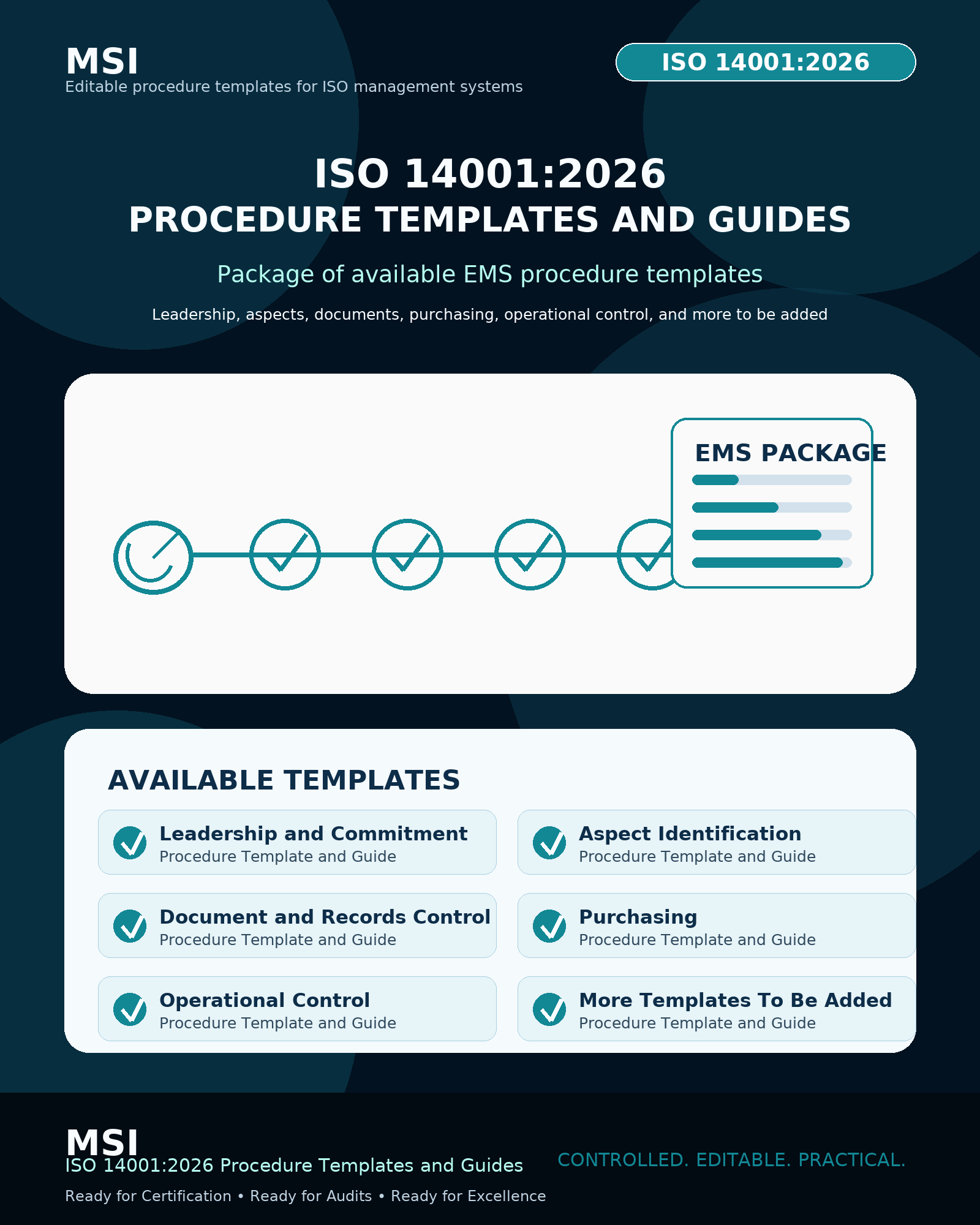
The documentation is the part of the ISO 2026 transition deadline you can complete now, on your own schedule, before the audit-slot crunch ever reaches you. MSI’s Transition ISO 14001:2026 Procedure Templates and Guides hand you the documented spine — revised procedures, worksheets, and step-by-step guidance mapped to every 2026 change — so your team adapts a proven, audit-ready set instead of drafting from a blank page. Built from 200+ audits attended over 28 years, they turn ten clause revisions into finished documents you can defend. Pair them with the ISO 14001:2026 Transition Course to walk your team through the changes clause by clause.
Get the ISO 14001:2026 Procedure Templates & Guides →
Add the Transition Course →
PREFER A GUIDED OR TURNKEY PATH
You Won’t Miss the Deadline. Don’t Overpay to Make It.
Sequence. Schedule. Save.
Want MSI to map your transition timing against your surveillance calendar and the two revision clocks, so you book while folding is still possible? Start with a planning session — a working conversation about scope and sequence, not a sales script. For an end-to-end route, SurePath runs the sequence for you.
Explore SurePath →
Work With an ISO Consultant →
Prefer to talk it through first? Call MSI at 760-434-9141 to plan a session.
FOR LEADERSHIP TEAMS WEIGHING THE TIMING
Need to make the case for moving early to your leadership? Watch MSI’s ISO Executive Decision Briefs — short, leadership-level videos on how standards decisions translate into cost, risk, and competitive position. Free, no pitch.
FREQUENTLY ASKED
ISO 2026 transition deadline: frequently asked questions
Ask. Answer. Apply.
When is the ISO 2026 transition deadline?
Why start early if the deadline is three years away?
What happens if I miss the ISO 2026 transition deadline?
Is the auditor shortage real, or just a sales angle?
Is the 2026 revision a big change to implement?
References & Primary Sources
1. International Organization for Standardization. The ISO Survey of certifications (2024 results). iso.org/the-iso-survey.html
2. ISO. ISO 9001 — Quality management systems (FDIS / 2026 revision). iso.org/standard/88464.html
3. ISO. ISO 14000 family — Environmental management. iso.org/standards/popular/iso-14000-family
4. ISO/TC 176/SC 2. ISO 9001:2015 transition period has ended (13 September 2018). committee.iso.org
5. UKAS. ISO 9001:2015 status and transition planning (technical bulletin). ukas.com
6. Global Accreditation Cooperation Incorporated (Global ACI). global-aci.org
7. ANAB — ANSI National Accreditation Board. anab.org
8. ISO/TC 176/SC 2 committee — quality management. committee.iso.org/home/tc176sc2
Certificate counts reflect the 2024 ISO Survey. Transition dates track ISO and Global ACI schedules and can shift; treat them as planning horizons.
About Management Systems International (MSI)
Diana Lynn is President and Principal ISO Consultant at Management Systems International (MSI), a veteran-owned, female-owned ISO consulting firm she founded in 1998. With 28 years of experience, MSI’s track record includes 80+ certifications supported, 200+ audits attended, and 600+ professionals trained across manufacturing, technology, medical device, government, healthcare, and other regulated industries. Today MSI implements ISO 9001, ISO 13485, ISO 14001, and ISO 45001, with an expanding focus on ISO 7101 healthcare quality.
msi-international.com · 760-434-9141
