
ISO 9001 compliance and aggressive technology adoption are usually framed as opposing forces — one pulling toward caution and paperwork, the other toward speed and disruption. On the factory floor, that framing is wrong. The manufacturers pulling ahead right now are the ones using ISO 9001 compliance as the structure that lets them deploy AI inspection, IoT sensors, cloud quality systems, and digital twins without losing control of quality. This guide shows you how to do the same: keep your certification intact, satisfy your auditors, and move faster because of your quality system, not in spite of it.
Direct answer: Maintaining ISO 9001 compliance while adopting new manufacturing technologies comes down to five disciplines applied to every deployment: risk assessment, validation, change control, documentation revision, and role-based training. ISO 9001’s risk-based thinking and process approach already give you the framework — you apply the same rigor you use for any process change to AI, IoT, cloud, and digital-twin systems. Done well, ISO 9001 compliance accelerates technology adoption rather than slowing it.
Whether you are rolling out cloud-based quality management, IoT-enabled production monitoring, AI inspection, or additive manufacturing, the path to ISO 9001 compliance is the same disciplined process. The timing matters more than usual right now: ISO 9001:2026 publishes on September 16, 2026, and the revision lands squarely on the themes that govern technology adoption. Below, MSI lays out that path step by step, the standards that intersect with it, what the 2026 revision changes, the questions auditors ask, and how to prepare while your certification stays intact.
THE STRATEGIC CASE
Why Does ISO 9001 Compliance Enable Technology Innovation?
Structure. Speed. Confidence.
Manufacturing has shifted from isolated production lines to interconnected ecosystems where quality, security, and sustainability all share the same data backbone. In that environment, ISO 9001 stops being a binder on a shelf and becomes the operating logic for change. Far from a bureaucratic hurdle, ISO 9001 compliance gives manufacturers a repeatable way to introduce new technology without introducing new risk.
The reason is simple. Every emerging technology — artificial intelligence, Internet of Things devices, digital twins, cloud platforms — changes how work gets done, which means it changes your processes. ISO 9001’s process approach is built precisely to manage process change in a controlled, evidence-based way. Manufacturers who fold compliance into their technology evaluation early avoid the expensive trap of retrofitting controls onto systems that are already live.
Across 28 years and more than 200 certification audits attended, MSI has observed a consistent pattern: the organizations that struggle with new technology are rarely the ones that move too fast — they are the ones that treated compliance as a separate workstream from innovation, and had to unwind decisions after the fact.
What ISO 9001 Compliance Actually Buys You
A mature quality management system turns innovation from a gamble into a managed bet. The risk-based approach at the heart of modern ISO 9001 compliance pushes you to identify, assess, and mitigate technology risks before deployment, which reduces failed rollouts and costly rework. The documentation discipline that many leaders resent quietly becomes institutional memory — technology specs, validation evidence, and training records that make the next deployment faster than the last.
There is a commercial dimension too. Global supply chains increasingly favor ISO-certified partners, and many digital nearshoring agreements now expect real-time compliance evidence from a digital QMS. Organizations typically report that certification becomes a market-access asset, not just an internal control — and that advantage grows as more of the supply chain digitizes. Need help mapping your technology roadmap against these requirements? MSI’s ISO Consulting team guides manufacturers through exactly this kind of transition, and MSI’s integrated management systems practice handles the cases where more than one standard is in play.
THE FOUNDATION
How Does ISO 9001 Compliance Support New Manufacturing Technology?
Flexible. Outcome-based. Future-ready.
ISO 9001 was written to describe outcomes, not methods — and that single design choice is what makes ISO 9001 compliance compatible with technologies the standard’s authors never imagined. The 2015 revision strengthened risk-based thinking and the concept of organizational context, giving manufacturers room to adopt modern tools as long as quality objectives are met. You are not asked to do things a particular way; you are asked to demonstrate that the way you chose works and is controlled. That principle survives intact into the 2026 edition.
The Clauses That Govern Technology Adoption
Four clauses do most of the work when you map a new technology against ISO 9001 compliance:
- Clause 4.4 (Process approach): Defines how processes are determined, controlled, and improved — your starting point for understanding where a technology touches your system.
- Clause 6.1 (Actions to address risks and opportunities): Establishes the risk-based thinking that underpins every responsible technology decision.
- Clause 7.1.3 (Infrastructure): Covers the equipment, hardware, and software your processes rely on, including new production technology.
- Clause 8.5.1 (Control of production and service provision): Governs how production is controlled — the clause most directly affected when automation or AI enters the line.
Reading any new technology through these four clauses tells you where adjustments are needed and where existing controls already cover you. That is the practical core of ISO 9001 compliance during change: you are not inventing a new system, you are extending a proven one. MSI’s ISO 9001 practice page walks through how those clauses map onto a working manufacturing QMS.
THE 2026 REVISION
What Does ISO 9001:2026 Mean for Your Technology Stack?
Dated. Confirmed. Manageable.
Direct answer: ISO 9001:2026 publishes on September 16, 2026, following a completed FDIS ballot. It is a targeted evolution, not a rewrite — the process approach, PDCA cycle, and risk-based thinking all remain. For technology-heavy manufacturers, the practical effect on ISO 9001 compliance is a sharper distinction between risks and opportunities, explicit treatment of quality culture and ethical behavior, and formal integration of climate change considerations. Your existing certification stays valid throughout the transition period.
For most of the last two years, planning around the next edition meant planning around a rumor. That is over. The Final Draft International Standard cleared its ballot, technical consensus is settled, and ISO lists the sixth edition as under publication with a fixed date. The ISO/TC 176/SC 2 committee is the authoritative source for further updates.
July 2023 — ISO reverses course and opens the revision after a 2021 decision to confirm the 2015 edition without change.
August 2025 — Draft International Standard released and approved by member bodies.
April 2026 — FDIS submitted for ballot within ISO and CEN; technical content frozen.
September 16, 2026 — Publication. The formal transition period begins.
Three years from publication — The anticipated transition window, consistent with recent management system revisions and subject to confirmation by the accreditation community.
What Changes, and What It Means for Connected Factories
Three shifts matter most if your quality system runs on automated data. First, quality culture and ethical behavior move from implied expectation into the requirements themselves, particularly around leadership, awareness, and the environment for the operation of processes. If you deploy AI in a quality-critical role, “we validated it” will increasingly need to sit alongside “and here is how we decided it was appropriate to use.” Second, the distinction between risks and opportunities is drawn more clearly, with each treated on its own terms rather than as a single compound obligation — useful discipline when a technology carries genuine upside and genuine exposure at once. Third, climate change considerations are formally integrated, echoing the change already made across the harmonized structure.
What did not happen is equally worth knowing. There is no new clause structure, no AI-specific annex, and no requirement to certify to anything additional. Manufacturers who feared a disruptive overhaul of their ISO 9001 compliance can relax on that point — and manufacturers hoping the revision would hand them a ready-made AI governance framework should plan to build one themselves. MSI’s analysis of the ethics and culture requirements, its boardroom governance briefing, and its wider view on what the 2026 revisions mean for certification strategy go deeper on each.
What to Do Before Publication Day
The single most useful thing you can do in the weeks before publication is inventory what you already have. Which procedures are technology-specific and will need touching? Where does your documented information describe a tool rather than an outcome? Which of your AI, IoT, and cloud deployments have validation records an auditor could follow end to end today? Answer those three questions now and the transition becomes an editing exercise instead of a rebuild. Do not, however, rewrite your quality manual against draft summaries — final implementation decisions belong to the published text.
Start the 2026 transition with your ISO 9001 procedures already written.
MSI’s ISO 9001 Procedure Template and Guide gives you the full procedure set in editable Word — with 28 years of judgment calls already made. Instead of drafting change control, documented information, and internal audit procedures from scratch, you start from a working baseline and adapt it to your technology stack. It is the fastest legitimate path to ISO 9001 compliance that holds up in front of an auditor.
Get the ISO 9001 Procedure Template and Guide →
Running more than one standard? Browse all ISO Procedure Templates and Guides — 15 procedure topics across five standards and combinations.
Buy any template package and the price is credited in full toward an MSI consulting project, SurePath, or SureResults. Terms apply.
THE STANDARDS LANDSCAPE
Which ISO Standards Matter for Manufacturing Technology Adoption?
Integrated. Interlocking. Intentional.
ISO 9001 provides the overall quality framework, but new technology rarely respects standard boundaries. A single IoT deployment can touch information security, environmental impact, worker safety, and measurement traceability at once. Treating each standard as a silo is where ISO 9001 compliance quietly breaks down — the most resilient manufacturers manage them as one integrated system.
The Standards That Intersect With Technology Risk
ISO/IEC 27001 — Information Security Management. As factories digitize, ISO/IEC 27001 moves from optional to essential. Connected production systems create new attack surfaces, and a single incident can compromise quality data integrity — directly threatening ISO 9001 compliance. For IoT, cloud, and integrated supply-chain platforms, ISO 27001 supplies the controls that protect production data and intellectual property.
ISO 14001 — Environmental Management. New technology carries environmental implications, from data-center energy use to electronic-component disposal. ISO 14001 keeps those impacts inside your management system — and it is already ahead of ISO 9001 on the revision curve. ISO 14001:2026 published on April 15, 2026, with a transition deadline of April 30, 2029, sharpening expectations around life cycle perspective, climate change, biodiversity, and ecosystem health. If your factory runs both standards, that clock is already running. MSI’s ISO 14001 practice page covers the implementation side.
Already certified to ISO 14001:2015? Your transition is live now.
MSI’s ISO 14001:2026 Procedure Templates and Guides were built for experienced EHS managers who need to move an existing 2015 system to the 2026 edition in about a week — not a quarter. Editable Word procedures, mapped to the new requirements, with the interpretation work already done.
ISO 45001 — Occupational Health and Safety. As robots, cobots, and automated cells spread, ISO 45001 ensures those technologies enhance rather than compromise worker safety — a consideration auditors increasingly expect to see addressed alongside your quality system. MSI’s ISO 45001 overview explains how it integrates.
ISO/IEC 17025 — Testing and Calibration Laboratories. For manufacturers running test labs with advanced measurement systems, ISO/IEC 17025 keeps automated measurement accurate and traceable to recognized standards.
ISO 13485 — Medical Devices. Medical device manufacturers adding technologies such as additive manufacturing must hold ISO 13485 alongside ISO 9001 compliance, with the U.S. FDA QMSR — effective February 2, 2026 — now incorporating it by reference into 21 CFR Part 820. Note that ISO 13485 uses a pre-Annex SL clause structure, so it does not share the harmonized ten-clause layout of ISO 9001; MSI’s ISO 13485 practice page covers what that means in an integrated system.
Why an Integrated Management System Wins
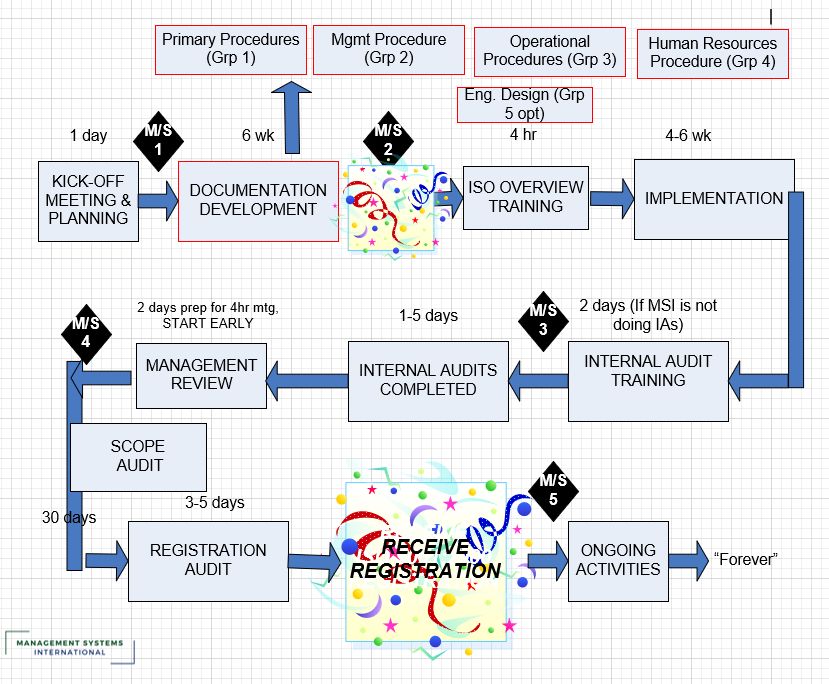
Rather than running each standard separately, leading manufacturers operate an integrated management system that addresses quality, security, environment, and safety together. This is not just tidier — it is how ISO 9001 compliance stays affordable as complexity rises. The benefits are tangible: less duplicated documentation, combined surveillance audits, consistent terminology across standards, and a single change process that covers every compliance domain a new technology touches. MSI’s guidance on risk assessment methodology shows how to anchor that integration in a defensible framework, and its ISO manual templates give the documentation layer a consistent spine.
THE PLAYBOOK
What Is the 5-Step Process for ISO 9001 Compliance With New Technology?
Assess. Validate. Control.
Direct answer: The five-step sequence for ISO 9001 compliance during a technology rollout is: conduct a comprehensive risk assessment, define validation requirements, establish change control procedures, revise documentation and procedures, and train your team by role. Applied in order, it produces exactly the evidence trail a certification auditor asks to see.
Maintaining ISO 9001 compliance through a technology rollout follows a repeatable five-step sequence. MSI client experience suggests that manufacturers who apply it consistently move faster on their second and third deployments, because the framework itself becomes reusable.
Step 1 — Conduct a Comprehensive Risk Assessment
Before anything goes live, assess how the technology affects product quality, process performance, data security, worker safety, and environmental compliance. This maps directly onto ISO 9001’s risk-based thinking. Document the methodology, the risks identified, their probability and severity, and your mitigations — that record is the evidence an auditor will want to see proving you controlled risk before deployment, not after. Under the 2026 edition’s clearer split between risks and opportunities, expect to show that you evaluated the upside deliberately too, not just the downside.
Pro tip: build standardized risk-assessment templates for common technology types — cloud platforms, IoT sensors, AI systems — so each new deployment starts from a proven baseline instead of a blank page.
Step 2 — Define Validation Requirements
Validation demonstrates that a technology consistently produces results meeting predetermined specifications under normal operating conditions. ISO 9001 compliance requires validation for processes that cannot be fully verified by later inspection — which describes most automated and AI-driven systems. Define your performance specifications, acceptance criteria, test scenarios, sample sizes, and the triggers that require revalidation. For complex systems like digital twins, expect to test across a wide range of conditions and document both your approach and your results.
Step 3 — Establish Change Control Procedures
Change control keeps modifications evaluated, approved, documented, and verified before they reach production — critical when software updates and configuration changes arrive continuously. Define what counts as a change, who approves it, and how impact is assessed for quality, security, and compliance. For cloud and continuously updated software, work with vendors to understand their release process so your ISO 9001 compliance is never quietly broken by an update you did not control. MSI’s deep dive on ISO 9001 change management automation covers the planning-of-changes and change-control requirements in detail.
Step 4 — Revise Documentation and Procedures
Identify every procedure, work instruction, and form the technology touches, then update them. This is a control point, not an administrative chore — it is how your quality system evolves with the technology while certification holds. Typical updates include process flowcharts, operating instructions, calibration and maintenance procedures, data-handling protocols, and failure-response steps. Organizations typically report that cloud-based document management with version control and approval workflows cuts update cycles dramatically and keeps distributed teams working from current information. Starting from a proven procedure set rather than a blank document is the single biggest time saver here.
Step 5 — Train Your Team by Role
Even sophisticated technology depends on trained people to keep ISO 9001 compliance intact. Build role-specific training: operators learn operation and basic troubleshooting; maintenance personnel learn calibration and diagnostics; quality staff learn validation verification and audit-evidence collection; management learns oversight and decision protocols. Document every session, map competencies against roles, and verify effectiveness through both assessment and practical demonstration. Across 600+ professionals trained, MSI has found role-mapped training holds up under audit far better than a single all-hands session — the ISO 9001 internal auditing course and the ISO Internal Auditor Workshop build exactly this verification discipline.
Map your technology rollout against ISO 9001 — before you deploy.
MSI’s QMS 9001 Kickoff & Strategic Planning Workshop builds risk-based thinking, change control, and validation into your quality system from day one — so adopting AI, IoT, and cloud tools strengthens your certification instead of threatening it.
Explore the QMS 9001 Kickoff Workshop →
Prefer to talk it through first? Call 760-434-9141 for a planning session.
DIGITAL TRANSFORMATION
How Do Cloud, IoT, and AI Affect ISO 9001 Compliance?
Connected. Controlled. Compliant.
Digital transformation blurs the lines between quality, information security, and operational technology — and each blurred line is a place where ISO 9001 compliance needs explicit attention. The three technologies that most often reshape a quality system are cloud computing, IoT, and AI. Each rewards the same disciplined treatment.
Cloud Computing and Data Integrity
Moving quality processes to the cloud demands attention to data integrity and security. Confirm where your quality data physically resides and whether that satisfies applicable regulations. Auditors increasingly request evidence of provider certifications such as SOC 2 or ISO 27001, so keep current documentation on file. Implement role-based access, multi-factor authentication, and audit logging, and make sure your contracts and service-level agreements explicitly address data ownership, portability, and compliance obligations — all of which become part of your ISO 9001 compliance record.
IoT and the Connected Factory
IoT sensors can capture quality data automatically and remove human transcription error — but every automated data path is a new validation obligation. The integrity of what the sensor records is now part of your ISO 9001 compliance, and auditors will ask you to prove it.
Calibrate and verify IoT sensors used for quality-critical measurements with the same traceability you apply to traditional instruments. Document the validation of any data transformation between sensor and quality system. Address network security under ISO 27001 through segmentation, encryption, and monitoring. Where IoT spans facilities or integrates supplier systems, apply ISO 9001’s externally provided process and supplier-control requirements deliberately.
AI and Machine Learning
AI presents the hardest validation challenge because its decision-making can be opaque. When AI sits in a quality-critical role, ISO 9001 compliance requires you to explain and document its decision parameters and validation methods. The practical disciplines are clear: document your training-data sources and quality checks, establish algorithm validation that proves consistent results across conditions, apply change control to model updates, preserve human oversight for critical decisions, and monitor for model drift over time. MSI’s look at AI and ISO 9001 in semiconductor manufacturing shows these principles in practice.
For governance structure, many manufacturers map their AI controls to the NIST AI Risk Management Framework, whose Govern–Map–Measure–Manage functions align cleanly with ISO 9001’s risk-based approach. Pairing the two gives you a defensible AI governance story — and with quality culture and ethical behavior moving into the 2026 requirements, the “why we chose to trust this system” half of that story matters as much as the validation data.
OBSTACLES & ANSWERS
What Are the Common ISO 9001 Compliance Challenges When Adopting Technology?
Anticipate. Mitigate. Document.
A handful of challenges recur across nearly every technology adoption. Knowing them in advance is half the battle for ISO 9001 compliance.
Balancing Innovation Speed With Compliance
Vendors push for fast deployment while thorough evaluation takes time. Resolve the tension by folding compliance into the technology evaluation itself rather than bolting it on afterward. Cross-functional evaluation teams, pre-approved technology categories with expedited paths, and pilot implementations let you protect ISO 9001 compliance without throttling innovation. MSI client experience suggests this structured-yet-flexible approach shortens implementation timelines compared with sequential, hand-off-heavy processes.
Securing Data Across Connected Systems
A single cybersecurity incident can corrupt quality data and jeopardize certification. Classify your data by sensitivity, assess vulnerabilities per technology component, layer your controls, monitor continuously, and rehearse incident response. Integrating your information security management system with your quality management system keeps security practices consistent — and keeps ISO 9001 compliance from depending on controls that live outside it. MSI’s overview of recent ISO standard updates situates this within the broader compliance picture.
Calibrating Advanced Equipment
Modern equipment often includes integrated measurement systems that resist traditional calibration. Develop calibration protocols per technology type with traceability to recognized standards where possible. For systems where conventional calibration is not feasible, use alternative verification — comparative analysis, process-capability studies, or known-good and known-defective samples for AI inspection — and document your rationale. Auditors accept well-documented alternative methods that demonstrably work.
Keeping Documentation Current
Rapidly evolving technology outpaces static documentation, and stale documents are a compliance risk. Implement dynamic, version-controlled systems, distinguish substantive changes that need formal approval from minor updates that can follow a streamlined path, and link documentation to training so people always access the current version. This keeps ISO 9001 compliance synchronized with technology that updates monthly.
Validating “Black Box” AI
When a deep-learning system’s reasoning is not fully explainable, focus validation on outcomes: prove the system consistently produces acceptable results across representative conditions. This outcome-based approach satisfies ISO 9001 compliance while accommodating AI complexity. Test extensively with diverse data, document acceptance criteria and results, monitor with statistical process control, and keep human review available for critical decisions. For organizations wrestling with the cultural side of adoption, MSI’s piece on overcoming innovation paralysis is a useful companion.
AUDIT READINESS
What Do Auditors Look For When ISO 9001 Compliance Meets New Technology?
Process. Data. Change.
Direct answer: Auditors examining technology-enabled operations concentrate on three things: process integrity, data integrity, and change control. Demonstrating ISO 9001 compliance means showing the documented evidence and the working system together — records alone are no longer enough when the process runs on software.
Auditors want to confirm that your digital systems hold the same level of control as the manual methods they replaced, that data stays accurate and secure, and that configuration changes are managed. The guidance behind that practice was itself revised recently: ISO 19011:2026 published on May 27, 2026, replacing the 2018 edition. Because it is guidance rather than requirements, there is no transition period — it applied on publication. Its expanded treatment of remote auditing methods and virtual locations is directly relevant to anyone whose quality data lives in the cloud, since more of your audit may now be conducted against systems rather than in a conference room.
The Questions Auditors Actually Ask
- Process integrity: How does this technology affect your ability to meet specifications, and what happens when it fails? Do you have fallback procedures?
- Data integrity: How do you ensure data is accurate, prevent unauthorized record changes, and demonstrate traceability from raw data to quality record?
- Change control: How do you manage software updates, who approves changes, and how do you verify a change did not harm quality?
Be ready to answer through documentation and a live demonstration. The strongest audit outcomes happen when you can show the records and the working system together — that combination is what convinces an auditor your ISO 9001 compliance is real rather than aspirational. MSI’s internal audit services exist to surface those gaps before a certification body does.
Documentation Auditors Expect
For each technology, expect to produce system specifications, validation documentation, risk assessments, standard operating procedures, training records, and change-control history. Auditors look for clear traceability between requirements, implemented features, and validation evidence. For AI systems, add documentation explaining algorithm operation, training-data selection, and decision verification. MSI’s guidance on FDA quality maturity for ISO-certified companies is especially relevant for regulated manufacturers. Authoritative references on auditing and accreditation practice are available from ASQ, from Global ACI — which assumed the roles of the International Accreditation Forum and the International Laboratory Accreditation Cooperation on January 1, 2026 — and from ANAB’s transition guidance.
Put Technology on the Management Review Agenda
Management review is where technology decisions become governance rather than IT projects — and it is a requirement across ISO 9001, ISO 13485, ISO 14001, and ISO 45001 alike. If your review agenda still reflects a pre-digital operation, that is a visible weakness in your ISO 9001 compliance. Bring the technology evidence into the room: validation status and revalidation triggers for every automated system, model drift and monitoring data for AI in quality-critical roles, cybersecurity incidents affecting quality records, calibration completion for connected measurement equipment, and the resource case for what comes next. Top management’s decisions on those inputs are exactly what the 2026 edition’s leadership and quality-culture emphasis is reaching for.
Run a management review your auditor cannot pick apart.
MSI’s ISO Management Review Toolkits give you the agenda, input checklists, presentation structure, and records format that satisfy the standard’s requirements — built from 200+ audits attended, so the inputs auditors actually probe are already on the page. Adapt them once and every review afterward runs on rails.
THE LONG GAME
How Do You Future-Proof ISO 9001 Compliance?
Flexible. Layered. Cultural.
Technology keeps moving, so ISO 9001 compliance has to be built to flex. Three moves make that possible: outcome-based procedures, a modular documentation structure, and an innovation culture that treats compliance as an enabler.
Write Outcome-Based, Technology-Agnostic Procedures
Define what must be achieved, not exactly how. Instead of “technician records temperature manually every two hours,” write “temperature shall be monitored and recorded at two-hour intervals, traceable to calibrated instruments.” Now an IoT upgrade updates a work instruction rather than triggering a procedure rewrite — and your ISO 9001 compliance absorbs the change without friction. Favor terms like “electronic records” and “automated data collection” that do not lock you to a specific tool. This is also the discipline that makes a standards revision cheap: outcome-based text survives an edition change far better than tool-specific text.
Build a Modular Documentation Structure
Layer your system so change lands at the right level: policies rarely change, processes change occasionally, procedures change when processes do, and work instructions change frequently with technology. Most technology rollouts then require updates only at the work-instruction level — keeping ISO 9001 compliance stable while the shop floor evolves. A forward-looking technology roadmap that flags compliance implications for each initiative makes this even smoother; MSI’s view on ISO consulting and confident certification audits shows how that planning pays off at audit time, and MSI’s case studies show it across 80+ certifications supported.
Sustain Compliance With Year-Round Maintenance
A digitally transformed QMS needs continuous upkeep, not an annual scramble before the audit. Standing reviews, technology-refresh planning, and a cross-functional team authorized to evaluate new tools keep ISO 9001 compliance current as the operation changes. Manufacturers who want that discipline handled for them often lean on a structured maintenance program rather than rebuilding momentum each cycle — particularly through a transition year, when the 2026 edition and your technology roadmap are both moving at once.
Keep your tech-enabled QMS audit-ready all year.
MSI’s SureResults ISO Maintenance Program keeps documentation, internal audits, and management reviews current as your technology stack evolves — so ISO 9001 compliance is something you maintain, not something you rescue.
FREQUENTLY ASKED QUESTIONS
ISO 9001 Compliance and New Technology: Your Questions Answered
Clear. Practical. Audit-ready.
When does ISO 9001:2026 publish, and how long is the transition?
Direct answer: ISO 9001:2026 publishes on September 16, 2026, and a three-year transition period is anticipated, consistent with recent management system revisions. Your existing ISO 9001 compliance and certificate remain valid throughout that window.
The exact transition deadline is confirmed by the accreditation community rather than by ISO itself, so watch for guidance from your certification body. Practically, most manufacturers will transition at a scheduled surveillance or recertification audit rather than booking a separate event.
Should I delay a technology rollout until ISO 9001:2026 publishes?
Direct answer: No. The disciplines that produce ISO 9001 compliance for new technology — risk assessment, validation, change control, documentation, training — are unchanged by the revision, so work done now carries forward intact.
What you should avoid is rewriting your quality manual against draft summaries or unofficial interpretations. Deploy the technology under your current system, keep the evidence trail clean, and align documentation to the published text once it is available.
Do I need to notify my certification body before implementing new technology?
Direct answer: Usually no formal notice is required, but for changes that substantially affect your processes, notifying your certification body protects your ISO 9001 compliance and avoids audit surprises.
Document your change-management process thoroughly and be ready to present it at your next surveillance audit. For major implementations — replacing your QMS software, automating a production line, or first-time use of emerging technology — consider requesting a pre-assessment to surface issues before the formal audit.
How often should I update my risk assessment when adopting new manufacturing technologies?
Direct answer: Update it whenever you implement new technology that could affect quality or process performance, and review it on a regular cycle — quarterly for fast-moving tech, annually at minimum — to keep ISO 9001 compliance current.
Event-driven triggers include new deployments, functional software updates, system integrations, supplier or cloud-provider changes, security incidents, and quality issues that may trace to technology. Train people to flag changes that warrant a formal reassessment rather than relying solely on the calendar.
Can ISO 9001 compliance actually speed up technology adoption?
Direct answer: Yes. ISO 9001 compliance provides structured decision-making, reduces rework through early validation, and turns documentation into reusable templates — all of which accelerate later deployments.
The risk-based approach helps you catch problems before full deployment, and the institutional knowledge captured in your documentation means each implementation builds on the last instead of starting over. Stakeholder confidence — from leadership, customers, and regulators — also speeds approvals.
What documentation is essential for AI and automation under ISO 9001 compliance?
Direct answer: For ISO 9001 compliance, document system specifications, validation protocols and results, risk assessments, data-governance procedures, algorithm descriptions, and role-based training records.
For AI specifically, capture how training data was selected and validated, how performance is monitored, and what controls ensure appropriate decisions across all operating conditions. Comprehensive test results across normal, boundary, and exception conditions satisfy both current and anticipated requirements.
How do I train employees on new technology while maintaining ISO 9001 compliance?
Direct answer: Integrate technology operation and compliance into one role-specific program, so ISO 9001 compliance is taught as part of how the technology is used — not as a separate topic.
Cover operation, the reasons procedures protect quality, compliance and audit expectations, problem recognition, and documentation duties. Verify competence with knowledge assessments and practical demonstrations, and build in refresher training for when systems change.
What if my vendor’s system doesn’t fully meet ISO 9001 compliance requirements?
Direct answer: Identify the specific shortfall, assess its risk, and close it with complementary controls. ISO 9001 compliance requires effective risk management, not one particular technology, so a vendor system plus mitigations can be fully compliant.
Separate true requirements from preferences, then mitigate — procedural controls, supplementary tools, or alternative methods that meet the intent. Document the requirement, how the system addresses it, the residual shortfall, and your mitigation. That record demonstrates mature quality management and typically satisfies auditors.
Does adopting new technology change how my ISO 9001 compliance is audited?
Direct answer: The criteria stay the same, but expect deeper scrutiny of validation, data integrity, and change control. ISO 9001 compliance for new technology is proven through both documentation and a live demonstration of the system.
Auditors want initial validation evidence and ongoing monitoring data, and they appreciate transparency about issues you identified and resolved. Tracking indicators like system uptime, process capability, and calibration completion gives you objective evidence on demand. With ISO 19011:2026 expanding guidance on remote and hybrid methods, more of that evidence may be reviewed against your live systems.
CONCLUSION
Your Next Step Toward ISO 9001 Compliant Innovation
Plan. Validate. Lead.
Maintaining ISO 9001 compliance while adopting new manufacturing technologies is not a constraint on progress — it is the discipline that makes progress durable. Apply the five-step process, manage the intersecting standards as one integrated system, and get your documentation into outcome-based shape before September 16, and the 2026 transition becomes a scheduled edit rather than an emergency. The manufacturers who win the next decade will be the ones who stopped treating innovation and ISO 9001 compliance as a trade-off.
MSI helps manufacturers walk that line every day, drawing on 28 years of practice, 200+ audits attended, 80+ certifications supported, and 600+ professionals trained across manufacturing, technology, medical device, government, healthcare, and other regulated industries. Whether you are planning your first AI deployment or maturing a connected factory, the path to ISO 9001 compliance starts with a conversation. Call 760-434-9141 to book a planning session, start from MSI’s ISO 9001 Procedure Template and Guide, or explore SureFinish six-week ISO advising if you need a finish line on the calendar.
Related reading from MSI
ISO 9001 Change Management Automation ·
Risk Assessment Methodology Guide ·
AI Innovation & ISO 9001 ·
ISO 9001:2026 for Boardrooms ·
ISO 14001:2026 Complete Guide ·
ISO Overview Training
References & Authoritative Sources
- ISO — ISO 9001 Quality Management
- ISO — ISO 9001:2026 (sixth edition, under publication)
- ISO/TC 176/SC 2 — Revision News and Updates
- ISO 19011:2026 — Guidelines for Auditing Management Systems
- ISO/IEC 27001 — Information Security Management
- ISO — ISO 14001 Environmental Management
- ISO — ISO 45001 Occupational Health & Safety
- ISO 13485 — Medical Devices Quality Management
- ISO/IEC 17025 — Testing & Calibration Laboratories
- ISO 31000 — Risk Management
- NIST — AI Risk Management Framework
- NIST — Cybersecurity Framework
- FDA — Quality Management System Regulation (QMSR)
- ASQ — ISO 9001 Resources
- Global ACI — Global Accreditation Cooperation Incorporated
- ANAB — Global ACI Transition Guide
About Management Systems International (MSI)
Management Systems International (MSI) is a veteran-owned, female-owned ISO consulting firm founded in 1998. With 28 years of experience, MSI’s track record includes 80+ certifications supported, 200+ audits attended, and 600+ professionals trained across manufacturing, technology, medical device, government, healthcare, and other regulated industries.
Today MSI implements ISO 9001, ISO 13485, ISO 14001, and ISO 45001, with an expanding focus on ISO 7101 healthcare quality.
msi-international.com · 760-434-9141
