
2026 Certification Strategy
The 2026 ISO revisions are no longer a forecast — they are happening now, and the smartest leadership teams are already adjusting their certification strategy around confirmed dates rather than rumors. ISO 14001 has been published, ISO 9001 arrives in September, ISO 45001 is moving toward a 2027 release, and the FDA has rewritten the rulebook for medical devices. This guide separates what is confirmed from what is still speculation, so you can plan with confidence instead of guesswork.
Direct answer: The 2026 ISO revisions are a wave of synchronized updates to the world’s most-used management standards. ISO 14001:2026 was published on April 15, 2026; ISO 9001:2026 is expected in September 2026; ISO 45001 is still in development for a 2027 release; and ISO 13485 stays at its 2016 edition even as the U.S. FDA’s new QMSR — effective February 2, 2026 — makes that standard the basis of medical-device law. The supporting standards have already landed: ISO 9000:2026 (vocabulary) and ISO 19011:2026 (auditing guidance) are both published. A sound certification strategy treats these as one connected transition built on a shared structure, not separate fire drills.
In management systems, staying ahead means staying accurate. A great deal of online commentary about the 2026 ISO revisions is months out of date — still calling published standards “expected,” still lumping in standards that are not actually revising this year. Over 28 years and 200+ audits, MSI has guided organizations through every recent ISO transition cycle, and the pattern holds: the organizations that prepare early on verified facts spend far less than those that scramble after publication. Let’s set the record straight on what is changing, when, and what it means for your strategy.
The Landscape
What the 2026 ISO Revisions Actually Are
Confirm. Clarify. Commit.
The International Organization for Standardization (ISO) updates its standards on a roughly five-year review cycle so they keep pace with technology, regulation, and global challenges. What makes the 2026 ISO revisions distinctive is their synchronization: several of the most widely held certifications are moving through their update cycles within roughly the same window, and they are converging on a shared set of themes — climate, culture, and a common clause structure.
It is worth being precise about which standards are actually revising in 2026 and which are not. The most common error in circulating articles is treating ISO 45001 as a 2026 update — it is not — or describing ISO 14001 as still “coming,” when it has already been published. Here is the verified status as of mid-2026.
Confirmed Status at a Glance
ISO 14001:2026 — Published April 15, 2026. Transition window of 36 months; 2015 certificates retire by April 30, 2029.
ISO 9001:2026 — FDIS issued in April 2026; publication expected September 2026; three-year transition to roughly September 2029.
ISO 45001 — Still at the 2018 edition. In Committee Draft; publication expected around 2027, not 2026.
ISO 13485 — Confirmed to remain at 2016. The change for U.S. firms is regulatory: the FDA QMSR took effect February 2, 2026.
ISO 19011:2026 — Published May 27, 2026, withdrawing the 2018 edition. Guidance only, so it applies immediately with no transition period.
ISO 9000:2026 — Published as the fifth edition of the fundamentals-and-vocabulary standard, aligning terminology with ISO 9001:2026.
Read together, the 2026 ISO revisions are evolutionary, not revolutionary. ISO has deliberately limited new requirements, favoring clarification of existing ones and tighter alignment across standards. For organizations with mature systems, that is good news: most of the work is interpretation and evidence, not rebuilding. The risk lies in waiting until the last surveillance audit to start.
Environmental Management
ISO 14001:2026 — Published and In Transition Now
Climate. Clarity. Performance.
The environmental management standard is the one to act on first because it is already in force. ISO 14001:2026 was published on April 15, 2026, replacing the 2015 edition and folding in the separate climate-change amendment that ISO issued in 2024. In practical terms, climate is no longer a bolt-on note — it is structural to how an environmental management system defines its context and obligations.
The revision sharpens expectations around biodiversity, resource availability, pollution, and life-cycle thinking, and it aligns the standard with ISO’s latest Harmonized Structure so it integrates cleanly with ISO 9001 and ISO 45001. Much of the new detail lives in an expanded, informative Annex A that clarifies intent without overloading the core clauses. MSI’s full breakdown of the change set is in our complete ISO 14001:2026 guide, and the deeper context-analysis implications are explored in our work on ecosystem health under Clause 4.1.
Certified organizations have a 36-month transition. All ISO 14001:2015 certificates must move to the 2026 edition by April 30, 2029, with transition audits typically folded into scheduled surveillance or recertification activity. The cleanest path for ISO 9001-certified organizations adding or transitioning environmental scope is an integrated one, which we map step by step in our ISO 14001 implementation guide for 9001-certified firms. The official text is available through ISO’s ISO 14001 page.
One point gets lost in most transition coverage: nothing on your certificate changes until your EMS documentation changes. The 2026 edition asks for a documented change process at Clause 6.3, a life-cycle perspective carried through the aspects register, and compliance obligations handled as a live process rather than a list — and each of those lands in a procedure somebody has to rewrite. That is the actual work of the transition, and it is the part most calendars underestimate.
Move a Live ISO 14001:2015 System to the 2026 Edition in About a Week
Built for experienced EHS managers who already run a working EMS and need the documents updated, not an education. MSI’s Transition ISO 14001:2026 Procedure Templates and Guides package is the complete editable EMS documentation set written to the 2026 edition — the aspects and impacts register, the compliance obligations process, operational control, and the new Clause 6.3 change process most transitions miss entirely. Editable Microsoft Word, with the judgment calls already made and the decisions that are genuinely yours clearly marked.
Would rather be walked through what changed before touching a document? The ISO 14001:2026 Transition Course covers the revision clause by clause — climate, biodiversity, life-cycle thinking, and the new context expectations.
Quality Management
ISO 9001:2026 — Arriving September 2026
Culture. Conduct. Continuity.
ISO 9001 is the most widely adopted standard in the world, so its update sits at the center of the 2026 ISO revisions. The timeline is well established: the Draft International Standard was released in August 2025 and approved by member bodies in December 2025, the Final Draft International Standard (ISO/FDIS 9001) was issued in April 2026, and publication is expected in September 2026. A three-year transition to roughly September 2029 is anticipated, subject to confirmation by Global ACI — the single international accreditation organization that unified the International Accreditation Forum and ILAC on January 1, 2026.
The headline shift is philosophical rather than procedural. ISO 9001:2026 elevates quality culture and ethical conduct — concepts well-run organizations already practice — while carrying the climate amendment forward as a permanent feature and preserving the familiar Annex SL Harmonized Structure. As with ISO 14001, much of the added value sits in a substantially expanded Annex A that turns interpretation guidance practitioners used to assemble from scattered sources into built-in notes and examples.
Direct answer: Among the 2026 ISO revisions, ISO 9001:2026 is the one most leaders should brief their boards on. It does not demand a rebuild of a working system, but it does ask leadership to make its commitment to quality culture and ethical behavior visible and recorded — in the quality policy, in management review minutes, and in awareness training. Organizations that document what they already do are most of the way there.
Because the change is about emphasis, the highest-leverage preparation is at the top of the organization. We unpack the governance angle in why ISO 9001:2026 is a boardroom issue, and the culture-and-ethics detail in our analysis of the ISO 9001:2026 ethics and quality-culture changes. For teams who want to understand what genuinely changes day to day, our piece on what ISO 9001 training teaches beyond the certificate is a useful starting point. Independent overviews are also available from ASQ and the responsible committee, ISO/TC 176/SC 2.
There is also a practical note for anyone building or replacing quality procedures between now and September: documentation written to ISO 9001:2015 does not become invalid when the new edition publishes, and the clause structure it sits on carries forward. MSI’s ISO procedure templates and guides include the updated document at no charge whenever the standard a template is built to is revised — which means work adopted today is not work repeated in the autumn.
Occupational Health & Safety
ISO 45001 — The 2027 Revision Still Taking Shape
People. Prevention. Participation.
Here is where careful sourcing matters. Many articles fold ISO 45001 into the 2026 ISO revisions, but the occupational health and safety standard remains at its 2018 edition. Its revision is real but earlier-stage: the technical committee released a second Committee Draft in January 2026, with the Draft International Standard and final publication expected to follow, putting a realistic publication date around 2027. Treat any “ISO 45001:2026” reference you see as a red flag for stale content.
The direction of travel is clear even if the text is not final. The revision is expected to expand attention on psychosocial risk and mental health — aligning more closely with the companion guidance in ISO 45003 — alongside stronger worker participation and a sharper role for leadership in building a culture of wellbeing. None of that requires action today, but it does belong in your multi-year planning, especially for organizations running integrated systems. The current standard and its development status are tracked on ISO’s ISO 45001 page. Where health-and-safety scope intersects with audit programs, our internal audit service already incorporates the context reviews these revisions reward.
Medical Devices
ISO 13485 and the FDA QMSR — The Standard Held, the Law Moved
Align. Document. Comply.
ISO 13485 is the outlier in the 2026 ISO revisions conversation: its systematic review confirmed the 2016 edition stays in place. Yet 2026 is arguably the biggest year in a generation for medical-device quality — not because the standard changed, but because U.S. law did. On February 2, 2026 the FDA’s Quality Management System Regulation (QMSR) took effect, amending 21 CFR Part 820 to incorporate ISO 13485:2016 by reference, with Clause 3 of ISO 9000:2015 for terminology.
That shift is significant. The decades-old Quality System Regulation is gone, and on the same date the FDA retired its longstanding Quality System Inspection Technique (QSIT) in favor of a new inspection program. ISO 13485:2016 now effectively carries the force of law for finished-device manufacturers in the U.S. market — though, importantly, ISO certification alone does not equal QMSR compliance, because the regulation keeps FDA-specific record and reporting provisions. We cover the mechanics in our explainer on the finalized FDA QMSR and ISO 13485 alignment and the practical move off the old framework in navigating the transition from QSIT to ISO 13485:2016.
Direct answer: Within the broader 2026 ISO revisions picture, ISO 13485 is the standard that did not change while the rules around it changed completely. Device makers should confirm their QMS satisfies the FDA’s QMSR — not just ISO 13485 in the abstract — because the regulation incorporates the standard by reference but adds U.S.-specific obligations and a new inspection model.
The authoritative texts are the FDA’s QMSR frequently-asked-questions page, the regulation itself in the eCFR (21 CFR Part 820), and ISO’s own ISO 13485 page.
The Connective Tissue
The Common Thread Across the 2026 ISO Revisions
Climate. Culture. Cohesion.
Looked at individually, each update is modest. Looked at together, the 2026 ISO revisions tell a single story: management standards are converging. Three threads run through all of them.
Direct answer: The 2026 ISO revisions share three connective threads — climate change is now structural rather than supplemental, ethical conduct and quality culture are explicit expectations of leadership, and the Harmonized Structure makes integrated, multi-standard systems easier to build and audit. Plan around these threads and a single transition program can serve every standard at once.
Climate Has Moved from Footnote to Foundation
The 2024 climate-change amendment was an interim measure to embed climate quickly across the ISO portfolio. The revisions now arriving make it permanent. In ISO 14001:2026 climate becomes a foregrounded environmental consideration; in ISO 9001:2026 the amendment carries forward as a fixed feature of context analysis. For organizations, this means climate-related risk belongs in your context and risk processes regardless of which standard you hold.
Culture and Ethics Are Now Leadership’s Job
ISO 9001:2026’s emphasis on quality culture and ethical conduct, and the wellbeing focus expected in the next ISO 45001, point the same way: standards increasingly ask leaders to demonstrate behavior, not just sign policies. This is where many systems are thinnest, because culture is harder to evidence than a procedure. The fix is rarely new bureaucracy — it is recording the leadership behavior that already happens.
One Structure to Rule Them All
Every revising standard is aligning to ISO’s Harmonized Structure, which keeps the high-level clause numbering consistent across quality, environment, and safety. The newly published ISO 19011:2026 auditing guideline reflects this same alignment. The payoff is real: shared context analysis, shared risk processes, and shared audits. Organizations running ISO 9001 alongside ISO 14001 or ISO 45001 can treat the 2026 ISO revisions as a single integrated upgrade rather than three disconnected projects — a structural advantage we explore further in our work on ISO structure for corporate development.
The Supporting Standards Have Already Landed
It is easy to fixate on the certifiable standards and miss two foundational documents that have already published as part of the same wave. ISO 9000:2026 — the fifth edition of the fundamentals-and-vocabulary standard, now retitled “Quality management — Fundamentals and vocabulary” — replaces the 2015 edition and refreshes the terminology and concepts that every other quality document builds on, aligning them with ISO 9001:2026. It is not certifiable and carries no requirements, but it is the shared dictionary that keeps the 2026 ISO revisions speaking the same language.
Just as significant for audit teams, ISO 19011:2026 was published on May 27, 2026 as the fourth edition of the auditing guideline, formally withdrawing ISO 19011:2018. Because it is guidance rather than a requirements standard, it applies immediately with no transition period — there is no certificate or deadline at stake, but it sets current good practice for how audits are planned and conducted, now fully embedding remote and hybrid auditing and elevating risk-based thinking to a core principle. MSI’s clause-by-clause read of the update is in our analysis of the ISO 19011:2026 changes.
By Industry
What the 2026 ISO Revisions Mean Sector by Sector
Context. Consequence. Course.
The shared structure of the 2026 ISO revisions means the headline themes are universal, but their weight varies by sector. The following composites reflect patterns MSI sees across the regulated industries it serves — useful for locating your own priorities quickly.
Direct answer: The 2026 ISO revisions land differently by industry: manufacturers feel the climate and supply-chain emphasis most, medical-device firms are driven by the FDA QMSR rather than a 13485 change, healthcare organizations should watch the culture themes alongside emerging ISO 7101, and technology and government bodies benefit most from the integration that the Harmonized Structure now makes routine.
Manufacturing
For manufacturers, the environmental dimension carries the most immediate change. ISO 14001:2026’s sharpened treatment of climate, resource availability, and life-cycle thinking pushes environmental performance into procurement and supplier decisions, not just facility management. Organizations holding both ISO 9001 and ISO 14001 are well positioned to absorb the 2026 ISO revisions as a single integrated update rather than two separate transitions. For a plant already certified to ISO 14001:2015, the practical starting point is the documentation itself — the ISO 14001:2026 transition procedure package carries the aspects and impacts register, the compliance obligations process, and the Clause 6.3 change process the 2026 edition adds.
Medical Device
Device makers should read the 2026 ISO revisions through a regulatory lens. ISO 13485 itself is unchanged, but the FDA QMSR now gives that standard legal force in the U.S. market and retires the old inspection model. The practical task is confirming the quality system satisfies both ISO 13485:2016 and the FDA’s additional provisions — a stronger position for firms that already maintain MDSAP-aligned systems.
Healthcare
Healthcare organizations gain from the leadership and quality-culture emphasis running through the revisions, which aligns naturally with the patient-centered focus of the emerging ISO 7101 healthcare quality standard. Building the culture-of-quality habit now positions clinical and operational teams for both the 2026 ISO revisions and the healthcare-specific framework taking shape alongside them.
Technology and Government
Technology firms and government bodies, often running matrixed and multi-standard operations, gain the most from the integration the Harmonized Structure enables. A single context analysis and risk process spanning quality, environment, and safety reduces duplicated effort across projects and contracts — turning the 2026 ISO revisions into an opportunity to consolidate rather than complicate.
Behind the Scenes
How ISO Standards Get Revised
Review. Refine. Release.
Understanding the revision pipeline helps you read the signals and time your preparation. ISO standards are living documents, reviewed and updated through a structured, multi-stage process you can follow on ISO’s own standards-development overview. Knowing which stage a standard is in tells you how firm the requirements are.
Here is the path every one of the 2026 ISO revisions followed, from routine review to published standard.
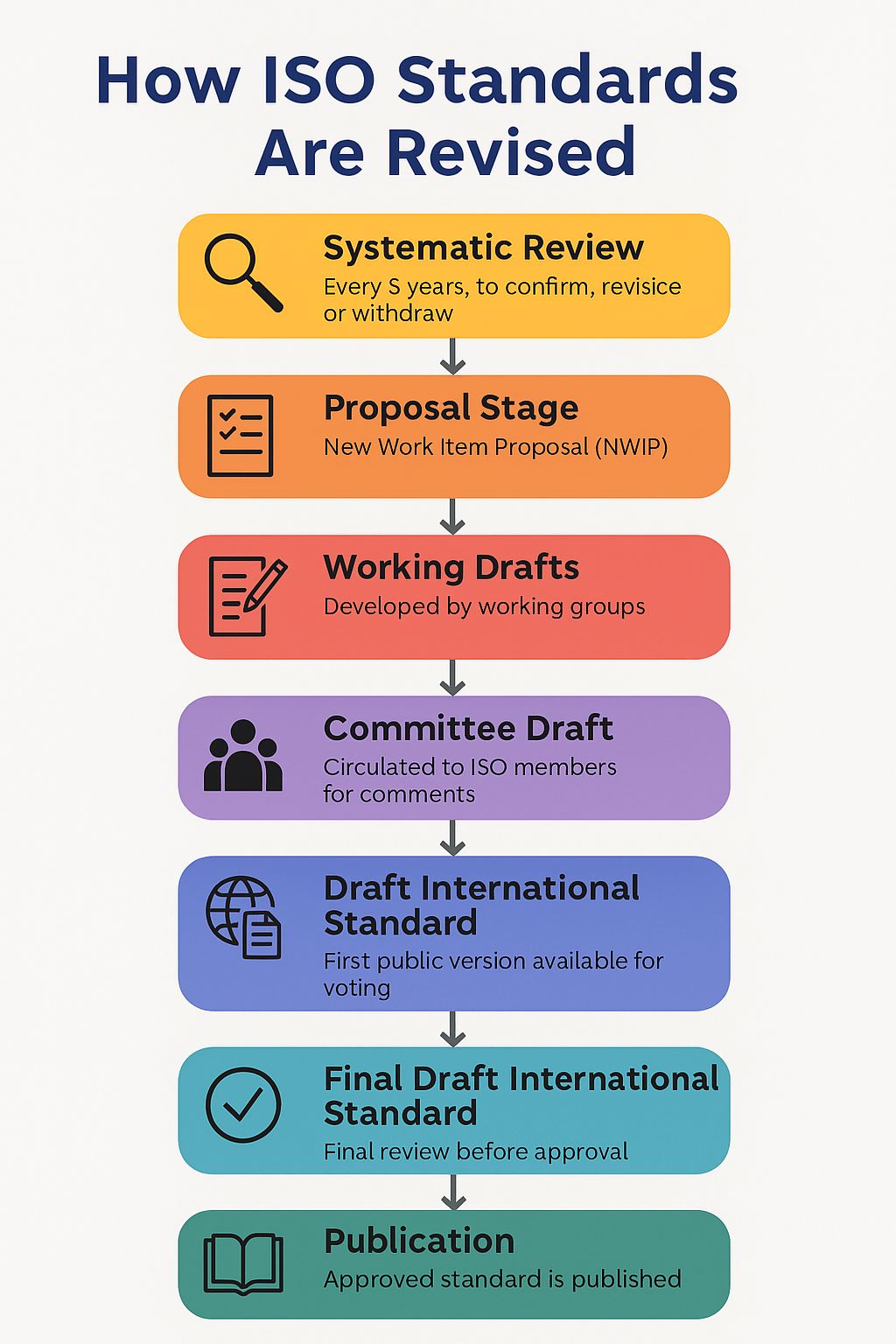
1. Systematic Review (every 5 years). The technical committee decides to confirm, revise, or withdraw the standard. ISO 9001:2015 entered review in 2020, which set the current cycle in motion.
2. New Work Item Proposal (NWIP). Members vote to confirm there is enough global interest to justify the effort.
3. Working Draft & Committee Draft (WD / CD). Technical experts in committees such as TC 176 (quality) and TC 207 (environment) draft and refine the text, circulating it for member comment.
4. Draft International Standard (DIS). The first public version. Countries vote and submit final technical comments — the point at which serious early preparation usually begins.
5. Final Draft International Standard (FDIS). The near-final text, requiring a two-thirds majority. ISO 9001 reached this stage in April 2026.
6. Publication & transition. The standard is published and replaces the prior edition, with a transition period — typically three years — for certified organizations to comply.
The practical takeaway: by the DIS stage the substance is stable enough to plan against, and by FDIS it is effectively locked. That is why MSI client experience suggests organizations that begin a readiness review at DIS consistently report calmer, lower-cost transitions than those that wait for publication day.
Keep Perspective
What Is Not Changing in the 2026 ISO Revisions
Steady. Stable. Sound.
It is just as important to know what stays the same, because misplaced fear drives unnecessary spending. The familiar high-level clause structure carries forward across the revising standards, so an organization that built its system on the 2015 editions is not facing a redesign. Core concepts — risk-based thinking, the process approach, leadership accountability, and continual improvement — remain the backbone of every standard touched by the 2026 ISO revisions.
Existing certificates also remain valid throughout the transition window. There is no cliff edge: organizations move to the new editions during scheduled surveillance and recertification, on a timeline measured in years rather than weeks. And because the revisions clarify more than they add, much of what looks new is really existing good practice written down more plainly. Reading the 2026 ISO revisions as a refinement of a proven framework — rather than a fresh burden — is the mindset that keeps transition costs proportionate and teams calm.
The disciplined response is simple: read the confirmed text, identify the few places your system genuinely needs to adjust, and fold those adjustments into work you were already going to do. That is the difference between a transition that strengthens the system and one that merely survives an audit.
Your Action Plan
Building Your 2026 ISO Revisions Certification Strategy
Assess. Align. Advance.
A certification strategy for the 2026 ISO revisions is less about reacting to each standard and more about sequencing one coordinated effort. Four moves cover most organizations.
1. Run a Readiness Assessment Against Confirmed Text
Start by comparing your current system to the published or FDIS-stage requirements — not to speculation. Because ISO 14001:2026 is published and ISO 9001:2026 is at FDIS, you can plan against firm text today. A focused readiness assessment identifies the handful of places your system needs to bend: usually context analysis, the quality policy, management review evidence, and awareness training. This is a planning session, not a documentation hunt.
2. Decide Integrated vs. Standard-by-Standard
Because every revising standard shares the Harmonized Structure, organizations holding multiple certifications should usually transition them together. One context analysis, one risk register, and one set of management reviews can satisfy quality, environment, and (eventually) safety. For multi-site or multi-standard operations, this is where the real cost savings live.
The decision becomes concrete at the document level, because two standards can share one process only if the points where they diverge have been decided rather than blurred. MSI’s integrated ISO procedure templates — ISO 9001 with 13485, ISO 45001 with 14001, and ISO 9001 with 14001 and 45001 — each carry an integration decision record naming every divergence, the decision taken, and the reason. When an auditor asks why one requirement was followed and not the other, the answer is already written down rather than reconstructed in the room.
3. Train Leaders and Teams on What Actually Changed
The culture and ethics expectations in ISO 9001:2026 cannot be delegated to the quality manager alone — they require visible leadership. Build awareness through the channels you already use: existing team meetings, onboarding, and management review. Targeted ISO training closes the gap between holding a certificate and running a system that delivers in practice.
4. Sequence the Work Across the Transition Window
With three-year transition windows on the published standards, there is time — but the worst strategy is to do nothing until the final surveillance audit. Map the work against your existing audit calendar so transition activity rides along with scheduled surveillance and recertification. Organizations maintaining several certifications often manage this through a year-round program such as MSI’s SureResults ISO maintenance program, and those starting fresh certification can shorten the path with a turnkey approach like SurePath.
Your Procedures Are Still Written to the 2015 Editions
Every plan for the 2026 ISO revisions eventually arrives at the same place: documents somebody has to rewrite. MSI’s ISO Procedure Templates & Guides are complete working procedures in editable Microsoft Word — written to ISO 9001, ISO 13485, ISO 14001, ISO 45001 or ISO 7101 rather than translated between them, with the judgment calls already made and annotated from 200+ audits attended. Not an outline with the hard parts left blank.
Two things matter for transition timing specifically. The ISO 14001 variants are already written to the 2026 edition, and every purchase includes the updated template at no charge when the standard it is built to is revised — so a procedure adopted this month is covered when ISO 9001 publishes in September. And if you want to know whether you need one at all, the maturity checks are free: your score and band appear immediately, without entering anything.
Lead the 2026 Transition from the Top
The biggest decisions about the 2026 ISO revisions are leadership decisions, not paperwork. MSI’s ISO Executive Decision Briefs give executives and boards a clear, jargon-free briefing on what each revision means for strategy, risk, and budget — so you set direction before the audit calendar sets it for you.
Why MSI
How MSI’s ISO Consulting Turns the 2026 ISO Revisions into an Advantage
Experience. Evidence. Execution.
The value of seasoned ISO consulting during a transition is mostly about judgment: knowing which changes demand real work and which are already satisfied by a well-run system. That judgment comes from volume. Across 28 years, MSI’s track record includes 80+ certifications supported, 200+ audits attended, and 600+ professionals trained across manufacturing, technology, medical device, government, healthcare, and other regulated industries — and that experience spans every recent ISO transition cycle, including the move to the 2015 editions now being superseded.
Direct answer: MSI helps organizations navigate the 2026 ISO revisions by translating confirmed standard text into a sequenced, low-disruption transition plan — running readiness assessments against published requirements, integrating multi-standard systems on the shared Harmonized Structure, and training leaders on the culture and ethics expectations that now carry the most weight.
What sets the work apart is accuracy and integration. MSI tracks each standard at the committee level, so guidance reflects today’s confirmed status rather than last year’s speculation — the same discipline behind this article. That same practice is what the procedure templates and guides are made of: they are the documents MSI writes on engagements, de-identified, generalized and annotated so an organization can use them without us. For organizations weighing how the revisions fit a wider business case, our overview of the industries we serve shows how the same management-system thinking adapts across regulated sectors. The result is a transition that strengthens the system you actually run, not just the certificate on the wall.
Map Your Transition in One Planning Session
Ready to turn the 2026 ISO revisions into a concrete plan? In a single planning session, MSI will assess where your system stands against the confirmed requirements and lay out the sequence that fits your audit calendar. Call 760-434-9141 to schedule.
Questions Leaders Ask
2026 ISO Revisions: Frequently Asked Questions
Ask. Answer. Act.
Which standards are part of the 2026 ISO revisions?
ISO 14001 (published April 15, 2026) and ISO 9001 (expected September 2026) are the genuine 2026 updates. ISO 45001 is revising on a later track toward a 2027 release, and ISO 13485 stays at its 2016 edition — though the FDA QMSR that took effect February 2, 2026 makes 2026 a pivotal year for medical-device makers regardless.
When will ISO 9001:2026 be published?
Publication is expected in September 2026. The Final Draft International Standard was issued in April 2026, following the DIS that member bodies approved in December 2025. A three-year transition to roughly September 2029 is anticipated, subject to confirmation by Global ACI, the unified international accreditation organization that took over the roles of IAF and ILAC on January 1, 2026.
Do the 2026 ISO revisions require rebuilding my management system?
No. The revisions are evolutionary — clarifications and tighter alignment rather than wholesale change. A well-run system typically needs updates in a few areas: context analysis, the quality policy, management review evidence, and awareness training. A readiness assessment identifies exactly where, so you avoid unnecessary work.
Which documents actually have to change for the 2026 ISO revisions?
Fewer than most teams expect, but they are specific. For ISO 14001:2026 the work concentrates in the aspects and impacts register, the compliance obligations process, operational control, and the documented change process at Clause 6.3. For ISO 9001:2026 it concentrates in the quality policy, management review inputs and minutes, and awareness training records, because that is where quality culture and ethical conduct become evidence. MSI’s ISO procedure templates and guides cover these as complete editable procedures, with the ISO 14001 variants already written to the 2026 edition.
How does the FDA QMSR relate to ISO 13485?
The FDA’s Quality Management System Regulation, effective February 2, 2026, incorporates ISO 13485:2016 by reference into 21 CFR Part 820 and replaces the old Quality System Regulation. ISO 13485 certification is a strong foundation, but it does not by itself prove QMSR compliance, because the regulation adds FDA-specific record and reporting provisions and a new inspection model.
When should we start preparing for the 2026 ISO revisions?
Now. ISO 14001:2026 is published and ISO 9001:2026 is at FDIS, so the requirements are firm enough to plan against. Beginning a readiness review early lets transition work ride along with scheduled surveillance audits, which MSI client experience suggests is far less costly than a last-minute push before recertification.
Can we transition multiple standards together?
Yes, and you usually should. Because the revising standards share ISO’s Harmonized Structure, one context analysis, one risk process, and one management-review cycle can serve quality, environment, and safety together — the most efficient way to handle the 2026 ISO revisions for a multi-standard organization.
Have ISO 9000 and ISO 19011 been updated too?
Yes. Both supporting standards have already published. ISO 9000:2026, the fundamentals-and-vocabulary standard, replaced its 2015 edition and aligns terminology with ISO 9001:2026. ISO 19011:2026, the auditing guideline, was published May 27, 2026, withdrawing the 2018 edition; because it is guidance rather than a requirements standard, it applies immediately with no transition period. Neither is certifiable, but both shape how the 2026 ISO revisions are interpreted and audited.
Related Reading From MSI
- ISO 14001:2026 Updates: Complete Guide to New Requirements
- ISO 9001:2026 Update: Ethics & Quality-Culture Importance
- Why ISO 9001:2026 Is a Boardroom Issue
- ISO 19011:2026 Changes: Why Smart Audit Teams Adapt Now
- FDA QMSR & ISO 13485 Alignment, Finalized
- ISO Procedure Templates & Guides: Editable Word, Five Standards
References & Authoritative Sources
- ISO — ISO 14001:2026 published (April 2026)
- ISO — ISO 14001 environmental management
- ISO — ISO/FDIS 9001 (quality management systems)
- ISO — ISO 9001 quality management
- ISO — ISO 9000:2026 (fundamentals and vocabulary)
- ISO — ISO 19011:2026 (guidelines for auditing management systems)
- ISO — Technical Committee ISO/TC 176/SC 2
- ISO — ISO 45001 occupational health and safety
- ISO — ISO 13485 medical devices
- ISO — How ISO standards are developed
- FDA — Quality Management System Regulation (QMSR)
- FDA — QMSR Frequently Asked Questions
- eCFR — 21 CFR Part 820
- Global ACI — Global Accreditation Cooperation Incorporated (unified IAF and ILAC, January 1, 2026)
- ASQ — ISO 9001 quality resources
- ANAB — ISO 9001 management systems accreditation
About Management Systems International (MSI)
Diana Lynn, President and Principal ISO Consultant at Management Systems International (MSI), a consulting firm she founded in 1998. With 28 years of experience, MSI’s track record includes 80+ certifications supported, 200+ audits attended, and 600+ professionals trained across manufacturing, technology, medical device, government, healthcare, and other regulated industries. Today MSI implements ISO 9001, ISO 13485, ISO 14001, and ISO 45001, with an expanding focus on ISO 7101 healthcare quality.
msi-international.com · 760-434-9141
