
ISO 9001:2026 · Transition · Free Checksheet
By Diana Lynn, President and Principal ISO Consultant, MSI · Updated October 3, 2026
ISO 9001:2026 changes are the revisions ISO made when the sixth edition replaced ISO 9001:2015 on September 16, 2026. Ask most quality managers what changed and you will hear two words: culture and ethics. That answer is correct, and it is the least surprising part of the revision.
The change that touches the most documents in your system is a single word that quietly disappeared. Two other words were removed in a way that looks like a gift and works like a trap. And a requirement most organizations believe they already meet now has a clause of its own that almost nobody has built.
None of this shows up in a headline summary. It shows up when you hold your own procedures, your own records tables and your own risk register next to the new text, line by line. That is exactly what MSI built the free ISO 9001:2026 Transition Checksheet to do, and it is available now.
Direct Answer: ISO 9001:2026 changes center on quality culture and ethical behavior, separate clauses for risks and opportunities, stronger change management, and records that must be “available as evidence” rather than retained. Global ACI gives certified organizations until September 30, 2029 to transition (as of October 3, 2026). The fastest way to see what the changes mean for your system is to test each one against your own documents and practices.
Key takeaways
- ISO 9001:2026 replaced ISO 9001:2015, including the 2024 climate amendment, on September 16, 2026.
- The word “retain” no longer appears in any records requirement; records must now be available as evidence.
- Clause 5.3 dropped “understood” and Clause 10.2.1 dropped “analysing,” but removing either from a procedure weakens the system.
- Opportunities now have their own Clause 6.1.3, with planning, integration and effectiveness evaluation separate from risk.
- Quality culture and ethical behavior reach every person doing work under the organization’s control, including contractors.
- Changes that depend on behavior take months to evidence, so they should be started first, well before the 2029 deadline.
The Revision at a Glance
What are the ISO 9001:2026 changes in plain terms?
Read. Compare. Decide.
The foreword of the standard names six main ISO 9001:2026 changes. Clause 3 now carries a limited set of core management system terms. Quality culture and ethical behavior are addressed inside the requirements, especially in leadership, awareness and the environment for operating processes.
The other headline ISO 9001:2026 changes sharpen how the system is run. Risks and opportunities are more clearly separated, with separate actions for each. Requirements for managing changes to the system have been reinforced. Annex A has been rewritten as explanatory, informative text. And Annex B, the old list of related ISO/TC 176 standards, has been removed.
ISO itself describes the edition as a framework strengthened for clarity, usability and relevance rather than a reinvention, and its ISO 9001 page highlights a stronger focus on leadership, quality culture and accountability. The American National Standards Institute has summarized the revision the same way. That framing is accurate, and it is also why so many teams underestimate the work.
An evolutionary revision is easy to skim. The six headline ISO 9001:2026 changes fit on one slide. The detail that decides whether your procedures still work in practice sits in individual words, and the only way to find it is to read the clause text against your own documents. MSI verified every clause reference in this article against the licensed text of ISO 9001:2026.
If you are earlier in the journey and building a system from scratch, MSI’s ISO 9001 implementation plan explains how to design for the 2026 edition from day one. The rest of this article is written for organizations that already hold a 2015 certificate.
What Experienced Teams Miss
Which ISO 9001:2026 changes surprise experienced quality managers most?
Notice. Test. Correct.
After 28 years of ISO consulting and 200+ audits attended, MSI has learned that the changes people talk about are rarely the ones that cause trouble. Here are the eight ISO 9001:2026 changes most likely to catch a well-run system off guard, each with the question to ask of your own documents.
Direct Answer: The ISO 9001:2026 changes that surprise experienced teams most are the records shift from retained to available, the removal of “understood” and “analysing,” a separate opportunities clause, analysed and evaluated risks, culture awareness for contractors, objectives for every audit, the climate determination, and the merger of Clause 10.3 into 10.1.
1. The word “retain” disappeared from every records requirement
In ISO 9001:2015, records were “retained documented information.” In the 2026 edition, every records requirement now reads “documented information shall be available as evidence of.” That phrase appears eighteen times. The word “retained” survives in exactly one requirement, Clause 7.1.6, and it describes organizational knowledge, not records.
Here is the surprise inside the surprise: this is not a relaxation. Annex A.2 explains that “available as evidence of” still refers to retaining objective evidence. What changed is the test. A record that exists somewhere but cannot be produced on request is not available. Every records table in every procedure is touched by this one word, which makes it the broadest of all the {K} in terms of documents affected.
Your test: does each row of each records table name an owner and a location, and could you retrieve a sample from every archive today? MSI’s free document and records control maturity check is a quick way to see where you stand before you open the procedures.
2. Two words were removed, and deleting them would make your system worse
Clause 5.3 now requires responsibilities and authorities to be assigned and communicated. The 2015 word “understood” is gone. Clause 10.2.1 b) 1) now says “reviewing the nonconformity,” where 2015 said “reviewing and analysing.”
Both read like lighter rules, and both are traps among the {K}. A responsibility nobody understands does not get performed, and a nonconformity nobody analyses comes back.
Root cause work is still required through Clause 10.2.1 b) 2), determining the causes. MSI recommends keeping both expectations in your procedures even though the literal text no longer forces them. MSI’s ISO 9001:2026 Leadership & Commitment QuickStart walks through why the Clause 5.3 drop is a trap rather than a shortcut.
3. Opportunities now have their own clause, and a column beside the risks no longer covers it
This is the quietest of the ISO 9001:2026 changes and among the most consequential. Clause 6.1.3 requires the organization to determine, analyse and evaluate opportunities that can have a desired effect on providing conforming products and services. It must then plan actions, plan how to integrate and implement them, and plan how to evaluate their effectiveness. Management review must consider that effectiveness under Clause 9.3.2 h).
MSI client experience suggests most certified organizations have the risk half built and almost nothing for the opportunity half. A spreadsheet with an “opportunity” column next to each risk rarely shows planned actions or an effectiveness result. MSI’s article on opportunity-based thinking explains why a combined register no longer proves conformity.
4. A list of risks is no longer a risk register
Clause 6.1.2 requires risks to be determined, analysed and evaluated. A register that names risks without evidence of analysis and evaluation fails that test on its face. The proportionality rule also moved its yardstick. In 2015, actions were proportionate to the potential impact on conformity of products and services. In 2026, they must be proportionate to the potential impact on the intended results of the quality management system.
A NOTE to Clause 6.1.2 adds that determined risks can include the ability to deliver during and after a disruption. NOTEs create no obligation, but registrars read them as a hint about what a thoughtful register considers. MSI’s free risk, aspect and job hazard maturity check scores how far your current method goes.
5. Culture and ethics reach contractors, not only the boardroom
Clause 5.1.1 i) requires top management to promote quality culture and ethical behavior, and Clause 7.3 e) requires that persons doing work under the organization’s control are aware of the organizational quality culture and ethical behavior. That phrase covers contractors, temporary staff and agency workers, not only employees.
Diana Lynn’s position is that quality culture and ethical behavior are every department’s issue, not only leadership’s. The standard agrees: awareness is assigned to everyone who does the work. MSI’s guide to auditing quality culture covers the evidence that holds up, and the 200 negative ethics actions list gives teams concrete examples to discuss.
“I have always felt that integrity is at the center of all ISO standards.”
— Diana Lynn, President and Principal ISO Consultant, MSI
6. Every internal audit needs its own objectives
Clause 9.2.2 a) now requires the organization to define the audit objectives, criteria and scope for each audit. The 2015 text asked only for criteria and scope. Of all the {K} aimed at auditors, this is the one most programs still lack. A calendar of audit dates is a schedule. A program that states why each audit exists is what the clause now describes.
The audit guidance standard moved too. ISO 19011:2026 replaced the 2018 edition in May 2026, and MSI summarizes what that means in its review of the ISO 19011:2026 changes. If you would rather have an independent team run your audits, MSI’s internal audit services can build each audit around a stated objective.
7. Climate change is a “shall,” and it now lives in the main text
Clause 4.1 states that the organization shall determine whether climate change is a relevant issue. The requirement arrived through the 2024 climate action amendments, which ISO’s Joint Technical Coordination Group published across 31 management system standards. A NOTE to Clause 4.2 adds that relevant interested parties can have climate-related requirements.
The surprise is how many organizations treated the amendment as optional. It is a requirement to make and record a determination. Recording a reason when the answer is “not relevant” is an MSI recommendation, not a requirement, and it is the difference between a decision and a gap. The Chartered Quality Institute offers a useful plan-do-check-act view of managing it.
8. Clause 10.3 folded into 10.1, and every cross-reference to it now points at nothing
Continual improvement moved into Clause 10.1, which now requires the organization to consider the results of monitoring, measurement, analysis and evaluation, and the results of management review, to determine opportunities. Any procedure, manual or form that cites Clause 10.3 now references a clause that no longer exists.
It is the smallest of the ISO 9001:2026 changes to fix and the easiest to forget. It is also a reliable sign of whether a transition was managed document by document or skimmed.
Requirement or Recommendation?
Which ISO 9001:2026 changes are requirements and which are guidance?
Shall. Should. Consider.
AI summaries and vendor blogs often blur the line between a requirement, a NOTE and an annex. A requirement uses “shall.” A NOTE is for consideration only and creates no obligation. Annex A is informative and adds no requirements. The table below labels each of the {K} discussed in this article.
| Item | Clause | Status |
|---|---|---|
| Records available as evidence | 7.5 and throughout | Requirement |
| Organizational knowledge retained, applied and shared | 7.1.6 | Requirement |
| Responsibilities assigned and communicated | 5.3 | Requirement |
| Confirm responsibilities are understood | 5.3 (removed) | MSI recommendation |
| Opportunities determined, analysed, evaluated and planned | 6.1.3 | Requirement |
| Risks analysed and evaluated; actions proportionate | 6.1.2 | Requirement |
| Risks during and after a disruption | 6.1.2 NOTE 1 | NOTE |
| Promote quality culture and ethical behavior | 5.1.1 i) | Requirement |
| Awareness of quality culture and ethical behavior | 7.3 e) | Requirement |
| Audit objectives, criteria and scope for each audit | 9.2.2 a) | Requirement |
| Determine whether climate change is relevant | 4.1 | Requirement |
| Interested parties’ climate-related requirements | 4.2 NOTE | NOTE |
| Record a reason when climate is “not relevant” | — | MSI recommendation |
| Complaints and social media as satisfaction sources | 9.1.2 NOTE | NOTE |
| Meaning of “available as evidence of” | A.2 e) | Informative Annex A |
| Management review considers effectiveness of opportunity actions | 9.3.2 h) | Requirement |
Treating a NOTE as a duty wastes effort. Treating a requirement as guidance creates a finding. Getting the label right is the first discipline of a clean transition.
Why Your Own Terms Matter
Why does understanding the ISO 9001:2026 changes on your own terms pay off?
Your documents. Your records. Your timeline.
A clause summary tells you what the standard says. It cannot tell you what the ISO 9001:2026 changes mean for the forty procedures, nine forms and one risk register your organization actually runs. Translating the revision into your own documents and practices is where the value sits, for three reasons.
First, you learn the true size of the job. Many changes are a records-table edit. A handful demand evidence of behavior over time. Without testing your own system, every change looks equally large, and teams either panic or procrastinate. With the test done, organizations typically report the workload is smaller than feared in some places and larger than expected in others.
Second, you separate paperwork from practice. Each of the {K} can fail in two different ways. A procedure can state a requirement that nobody performs, and a team can perform something no document describes. Scoring documentation and process separately shows which kind of gap you have, and each has a different fix.
Third, you can sequence the work. Once every change is tied to a specific document or practice, you can put the long-lead items first. That is the single biggest lever on a calm transition, and it is why MSI’s article on ISO transition planning builds the calendar backward from the audit dates you do not control.
“Having systems, acting on what the records are reporting, and never letting anyone deny the facts is what prevents good systems from deteriorating.”
— Diana Lynn, President and Principal ISO Consultant, MSI
Understanding the ISO 9001:2026 changes on your own terms also changes the conversation with leadership. MSI’s guide to the ISO 9001:2026 executive briefing shows how to translate your findings into cost, risk and opportunity, and the companion piece on ISO 9001:2026 for boardrooms covers the governance view for directors.
Original Tool
How should you sort the ISO 9001:2026 changes by lead time?
Edit. Evidence. Behavior.
Direct Answer: Sort the ISO 9001:2026 changes into three lead-time classes. Edits take days and can be done any time. Evidence needs one full management review cycle. Behavior takes months and cannot be backfilled, so it must start first. Every item you mark No on a checksheet belongs in one of the three.
The Lead-Time Sort is a simple decision table created for this article. It assigns each gap to a class by asking one question: can this be fixed by changing a document, or does it need records that only time can produce?
| Class | Typical lead time | Examples | Start by |
|---|---|---|---|
| Edit | Days | Records tables changed from retain to available; Clause 10.3 cross-references redirected to 10.1; “this International Standard” replaced with “this document”; audit plan template gains an objectives field | Any time before the transition audit |
| Evidence | One management review cycle | Management review inputs for 9.3.2 c), g) and h) and decisions under 9.3.3; opportunity actions with an effectiveness result; audit objectives recorded for each audit | Before the last management review ahead of your transition audit |
| Behavior | Months | Quality culture defined and promoted; ethical behavior demonstrated by top management; awareness reaching contractors and temporary staff; knowledge retained, applied and shared | Now |
Decision rules. If a gap can be closed by revising a document alone, it is an Edit. If closing it requires at least one completed record produced by a recurring process, it is Evidence. If closing it requires people across the organization to act differently, and someone to be able to observe it, it is Behavior. When a gap fits two classes, assign the longer one.
When teams sort the ISO 9001:2026 changes this way, most find their Edit list is the longest and their Behavior list is the most important. Start the Behavior items this quarter, schedule the Evidence items into your next management review, and batch the Edits into one controlled document revision. For a scored view of the timing risks around your registrar and sites, use MSI’s free ISO Transition Risk Scorecard alongside the ISO transition risk assessment article.
The Clock
When must the ISO 9001:2026 changes be in place?
Plan. Schedule. Transition.
Direct Answer: The ISO 9001:2026 changes must be in place by your transition audit. Under Global ACI requirements (as of October 3, 2026), accreditation bodies must be ready by March 31, 2027; new certifications are issued only to ISO 9001:2026 from March 31, 2028; and ISO 9001:2015 certificates must transition by September 30, 2029.
Transition dates are not set by ISO. They come from Global Accreditation Cooperation Incorporated (Global ACI), which took over the work of the International Accreditation Forum and the International Laboratory Accreditation Cooperation on January 1, 2026. Its transition requirements for ISO 9001:2026 are mandatory for accreditation bodies that sign its recognition arrangement and for the certification bodies they accredit.
September 16, 2026
ISO publishes ISO 9001:2026, replacing ISO 9001:2015 and its 2024 climate amendment.
Now (October 2026)
Test your system against every change; start the Behavior items in the Lead-Time Sort.
March 31, 2027
Accreditation bodies must be ready to assess against and support ISO 9001:2026.
March 31, 2028
New and initial accredited certifications may only be issued to ISO 9001:2026.
September 30, 2029
Organizations certified to ISO 9001:2015 must have completed their transition.
Three years sounds generous for the ISO 9001:2026 changes. It shrinks quickly once you count backward.
Your transition audit will most likely coincide with a surveillance or recertification visit you already have scheduled. Before that, you need at least one management review that carries the new inputs and results. Before that review, the Behavior items need enough months of practice to produce real evidence. Certification bodies such as DNV are already scheduling transition audits, and more than one million accredited certificates share the same window and the same auditor pool.
Organizations that hold both ISO 9001 and ISO 14001 face two overlapping clocks. MSI’s guide to running one ISO 9001 and 14001 transition explains how to sequence them under a single plan.
Available Now · Free
How does MSI’s Transition Checksheet test the ISO 9001:2026 changes?
Score. Summarize. Act.
Direct Answer: MSI’s free Transition Checksheet tests the ISO 9001:2026 changes in 114 rows, scoring documentation and process separately for each requirement. It adds MSI’s own audit questions where organizations most often fall short, and ends with a Gap Summary and Action Plan that assigns every No an owner and a due date.
The Transition Checksheet follows the standard clause by clause, from Clause 4 through Clause 10, covers all of the substantive {K}, and finishes with a dedicated section on the shift from “retain” to “available.” Each row is tagged so you can see the nature of the change at a glance: New, Elevated, Major, Updated, or an MSI audit question.
Four design choices make it different from a generic checklist:
- Two scores per row. Documentation complies when a procedure, form or records table states the requirement. Process complies when records, observation or interviews show it is being done.
- One thing per row. Where the standard joins two nouns, such as responsibilities and authorities, or analysed and evaluated, they are split into separate rows so neither is assumed.
- MSI audit questions. Rows marked MSI go beyond the literal text to test where organizations most often fall short, drawn from 200+ audits attended.
- Every No becomes an action. The Gap Summary and Action Plan records the clause, the gap, the action, the owner, the due date and the date closed.
Pair the result with the Lead-Time Sort above and you have a sequenced transition plan in an afternoon. If you also want a full current-edition picture, MSI’s article on the ISO 9001 gap analysis explains how to score conformity to both editions at once.
Free download · Recommended first step
Score your QMS against every 2026 change in one afternoon
114 rows, documentation and process scored separately, MSI’s own audit questions included, and a one-page action plan that turns every gap into an owner and a date. Built from MSI’s clause-by-clause change analysis.
Enter your name, email and company below. Your download starts right away, and a copy of the link is emailed to you so you can share it with your team.
After the Checksheet
How do you close the gaps the ISO 9001:2026 changes reveal?
Decide. Document. Demonstrate.
Once the checksheet is complete, most gaps fall into one of three buckets: procedures that need rewriting, a management review that needs new inputs and results, and more work than your team has hours. MSI built a resource for each.
Procedures that need rewriting
The slowest part of any transition is deciding what a revised procedure should say. MSI’s procedure templates arrive as finished, worked examples with the judgment calls already made and explained, annotated from 200+ audits. The ISO 9001 procedure templates and guides package adds ISO 9001:2026 versions free as each one releases, and the Leadership and Commitment procedure is already rewritten to the 2026 edition, including the culture and ethics duty and records as available rather than retained.
ISO Procedure Templates and Guides
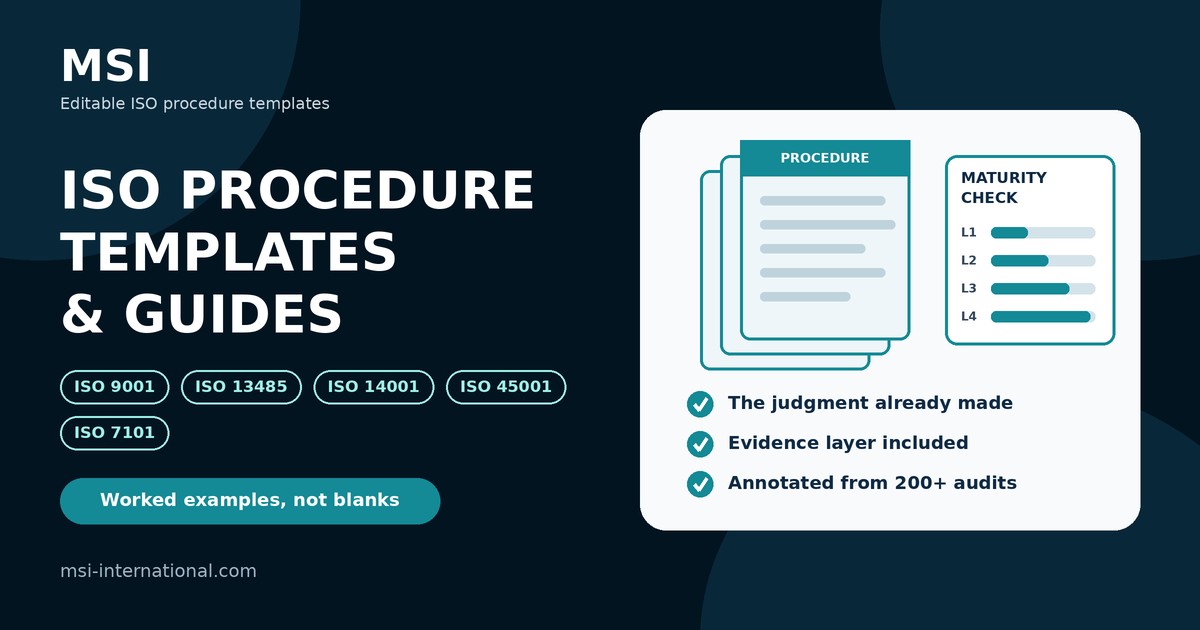
Stop rewriting procedures from a blank page
Complete, editable Word procedures for ISO 9001, 13485, 14001:2026, 45001 and 7101, with every record already carrying an owner, a location and a retention period. ISO 9001 buyers receive the 2026 rebuild of each procedure free as it releases, and free maturity checks show where to start.
A management review that needs new inputs and results
Management review is where several ISO 9001:2026 changes converge. Clause 9.3.2 now requires the review to consider changes in the needs and expectations of interested parties, opportunities for improvement in their own right, and the effectiveness of actions taken to address risks and opportunities. Clause 9.3.3 now calls the outputs “results” and requires decisions on continual improvement opportunities, needed changes to the system, and resource needs. An agenda written for 2015 will miss several of these.
ISO Management Review Toolkits
Run your next management review with every 2026 input already on the agenda
Matched agenda, presentation deck and minutes, with every section printed beside the clause it satisfies, so a missing input is visible on the page before the meeting rather than after it. Versions for ISO 9001, 13485, 14001:2026, 45001, 7101 and combined systems.
Running quality and environmental management together? The Q/EMS Management Review Tool Kit for ISO 9001 and 14001 covers both input sets in one meeting.
More gaps than your team has hours
Some organizations finish the checksheet with a long list and a short calendar. MSI’s ISO Documentation Program includes a procedure update service: you send your current documents, and MSI returns them updated to the 2026 edition, with a delta sheet that shows the change was managed. For strategic planning or year-round support, MSI’s SureResults ISO maintenance program can carry the transition alongside quarterly internal audits and management reviews.
Planning session · No obligation
Found more gaps than you have hours? Talk them through with Diana.
Bring your completed checksheet to a planning session. MSI will help you rank the gaps, decide what to do in-house and what to hand off, and map the order of work against your audit dates. Call 760-434-9141 and ask for Diana.
Dual-Certified Systems
What if you hold ISO 14001 as well?
Align. Combine. Transition.
ISO 14001:2026 published on April 15, 2026, and its 2015 certificates must transition by April 30, 2029, five months before the ISO 9001 deadline (as of October 3, 2026). Many of the ISO 9001:2026 changes have environmental counterparts, including the separation of risks and opportunities and the stronger handling of change, so a combined plan that handles the ISO 9001:2026 changes and the environmental revision together saves real effort.
ISO 14001:2026 Procedure Templates and Guides
Update your ISO 14001:2015 system to 2026 in a week
Built to help experienced EHS managers update their current ISO 14001:2015 system to the 2026 edition in a week’s time. Every EMS procedure is written to the 2026 clause structure, including planning of changes elevated to its own Clause 6.3, and the ISO 14001:2026 Transition course is included.
Measurable Readiness
How can you measure readiness for the ISO 9001:2026 changes?
Count. Track. Prove.
Readiness should be a number, not a feeling. Four measures, all drawn from the checksheet, give leadership a clear view and give you a defensible record of a managed transition.
- Documentation conformance rate: the share of the 114 rows marked Yes for documentation.
- Process conformance rate: the share marked Yes for process. A large gap between the two rates tells you whether your problem is paperwork or practice.
- Behavior items started: the number of Behavior-class gaps with an owner and a first action completed.
- Record retrieval time: how long it takes to produce a sample record from each archive, the practical test of “available as evidence.”
Track all four measures of progress on the ISO 9001:2026 changes at every management review until the transition audit closes. The trend becomes your evidence that the ISO 9001:2026 changes were managed as a planned change rather than a last-minute edit.
MSI holds itself to the same standard. Management Systems International (MSI) has 28 years of experience, 80+ certifications supported, 200+ audits attended and 600+ professionals trained across manufacturing, technology, medical device, government, healthcare and other regulated industries. Every clause claim in this article was checked against the licensed standard, and every MSI audit question in the checksheet comes from patterns observed in real systems. If you are weighing outside help, MSI’s article on choosing an ISO 9001:2026 consultant offers a timing test, and MSI’s ISO consulting page explains how engagements work.
Leaders who want to build the culture and ethics evidence early can join MSI’s ISO 9001:2026 Leadership Commitment Workshop, launching October 21, 2026. MSI’s piece on engagement of people and its guide to the ISO 9001 quality policy cover the two places culture shows up first.
Questions
Frequently asked questions about the ISO 9001:2026 changes
Ask. Answer. Apply.
What are the main ISO 9001:2026 changes?
The main ISO 9001:2026 changes are quality culture and ethical behavior in leadership and awareness, separate clauses for risks and opportunities, reinforced change management, core terms added to Clause 3, records that must be available as evidence, and an informative Annex A rewritten to explain intent.
Do the ISO 9001:2026 changes relax any requirements?
Some ISO 9001:2026 changes look like relaxations but are not. Clause 5.3 dropped “understood” and Clause 10.2.1 dropped “analysing,” yet root cause work is still required and unclear responsibilities still fail in practice. Annex A.2 confirms that “available as evidence” still means retaining objective evidence.
When do the ISO 9001:2026 changes have to be implemented?
The ISO 9001:2026 changes must be implemented before your transition audit. Under Global ACI requirements, as of October 3, 2026, ISO 9001:2015 certificates must transition by September 30, 2029, and new certifications are issued only to the 2026 edition from March 31, 2028.
Are the climate change requirements part of the ISO 9001:2026 changes?
Yes. The climate requirement from the 2024 amendment now sits in the main text of the ISO 9001:2026 changes: Clause 4.1 requires the organization to determine whether climate change is a relevant issue. A NOTE to Clause 4.2 adds that interested parties can have climate-related requirements, which is guidance rather than an obligation.
How do I find out which ISO 9001:2026 changes affect my system?
Test each of the ISO 9001:2026 changes against your own documents and practices. MSI’s free Transition Checksheet does this in 114 rows, scoring documentation and process separately and ending with an action plan that assigns every gap an owner and a due date.
Do the ISO 9001:2026 changes require a new quality manual?
No. None of the ISO 9001:2026 changes require a quality manual, and ISO 9001 has not required one since 2015. If you keep a manual, update its clause references, its “this International Standard” wording and any reference to Clause 10.3 as part of your document revision.
Next Step
Where should you start this week?
Download. Score. Sequence.
Get the free ISO 9001:2026 Transition Checksheet, score one clause with the people who run the process, and sort every No into Edit, Evidence or Behavior. Start the Behavior items now. Then decide whether you want to close the rest with MSI’s ISO procedure templates, with a refreshed management review toolkit, or with MSI beside you. For a planning session, call 760-434-9141 and ask for Diana.
Want a structured implementation instead of a do-it-yourself transition? SurePath is MSI’s turnkey route from current state to certificate.
References
- ISO 9001:2026, Quality management systems — Requirements, sixth edition, International Organization for Standardization (licensed text, clauses as cited). ANSI Webstore listing
- ISO — ISO 9001: Quality you can trust
- Global ACI — Transition Requirements for ISO 9001:2026
- Global Accreditation Cooperation Incorporated
- ANSI — ISO 9001:2026 Quality Management Systems Requirements
- ISO/TC 176/SC 2 — ISO 9001 revision updates
- ISO JTCG — Climate action amendments published
- ISO 10010:2022 — Guidance on organizational quality culture
- ISO 19011:2026 — Guidelines for auditing management systems
- Chartered Quality Institute — Taking action on climate change
- DNV — ISO 9001:2026 standard revision
Organizations looking for guidance on maturing culture beyond the minimum can consult ISO 10010, which the 2026 edition references in Annex A for quality culture.
About Management Systems International (MSI)
Diana Lynn, President and Principal ISO Consultant at Management Systems International (MSI), a consulting firm she co-founded in 1998. With 28 years of experience including extensive AS9100 work in MSI’s early years, MSI’s track record includes 80+ certifications supported, 200+ audits attended, and 600+ professionals trained across manufacturing, technology, medical device, government, healthcare, and other regulated industries. Today MSI implements ISO 9001, ISO 13485, ISO 14001, and ISO 45001, with an expanding focus on ISO 7101 healthcare quality.
Veteran-owned and female-owned · About MSI · msi-international.com · 760-434-9141
