
ISO 9001:2026 Implementation Planning
By Diana Lynn, President and Principal ISO Consultant, MSI · Updated October 4, 2026
Direct Answer
An ISO 9001 implementation plan is the scoped, owned, and dated schedule that takes an organization from decision to certification. It names the scope, process owners, documents, training, internal audits, management review, and certification audit. A realistic ISO 9001 implementation plan runs six to eighteen months. ISO 9001:2026 was published on September 16, 2026, so every plan started now should be built to the 2026 edition.
Start an ISO 9001 implementation plan this month and the date you are really planning against is not your registrar’s calendar. It is March 31, 2028 — the day new accredited certificates can only be issued to ISO 9001:2026. A nine-to-eighteen-month plan started in late 2026 lands its certification audit right on top of that line. Build to the wrong edition and you finish one project only to start another.
Most failed certification projects are lost long before that, though. They are lost in the first three weeks, when the plan is either never written down or written as a wish list: twelve tasks, no owners, no dates, and an audit booked against a calendar nobody tested. Across 28 years and 200+ audits attended, the pattern MSI observes is consistent. The organizations that certify on schedule are rarely the ones with the most resources. They are the ones whose plan was specific enough to argue with.
Key Takeaways
- ISO 9001:2026 was published on September 16, 2026, and replaces ISO 9001:2015 including its 2024 climate change amendment.
- From March 31, 2028, new and initial accredited certifications may only be issued to ISO 9001:2026, per Global ACI (as of October 4, 2026).
- A plan started today should be built to the 2026 edition, because its certification audit will likely fall near or after that cut-off.
- The quicker start is an end-in-mind management review: build the review slides first, fill in the data you have, and mark the rest TBD with a date and owner.
- The first full internal audit belongs at least three months before the certification audit, and management review at least six weeks before.
- Decision latency, not effort, is the most common reason a plan slips.
This guide covers the planning phase: everything that happens before implementation work starts, updated for the 2026 edition. For the full certification arc from kickoff through the three-year surveillance cycle, MSI’s ISO certification program guide walks that ground. What follows is narrower and, in practice, more decisive: how to build a plan that survives contact with your actual organization.
Definition
What Is an ISO 9001 Implementation Plan?
Scope. Sequence. Ownership.
An ISO 9001 implementation plan is not a project charter, and it is not a Gantt chart someone builds afterward to explain a delay. It is the working document that answers four questions before money is spent: what is in scope, who owns each process, what documentation must exist, and in what order evidence has to accumulate. Everything else in a quality management system project sits downstream of those four answers.
Direct Answer
A complete ISO 9001 implementation plan contains six elements: a certification scope, a process map with named owners, a documentation register, a training schedule, an internal audit calendar, and a management review date far enough before the certification audit to produce usable evidence. An ISO 9001 implementation plan missing any one of these will slip.
Why Does the Plan Come Before the Procedures?
The most common sequencing error is writing procedures first. It feels productive, because documents accumulate and the folder fills. But procedures written before scope is settled describe processes that may not be in scope, assign duties to roles nobody confirmed, and reference records nobody agreed to keep. An ISO 9001 implementation plan built first means every procedure is written once, against a known boundary, for a named owner. MSI’s article on the right ISO procedure order shows how that sequencing prevents rework.
ISO 9001 sets the same logic. Clause 4 asks the organization to determine its context, interested parties, and the boundaries of the quality management system before Clause 8 asks it to control operations. Your ISO 9001 implementation plan should follow the order the standard does, because that is the order in which decisions depend on one another. The ISO overview of the standard and MSI’s page on organizational context and structure both explain why the sequence matters.
What Is a Plan Not?
It is not a certification body’s checklist. Registrars audit the system you built; they do not design it.
It is not a software subscription, because tooling helps a good plan run and does nothing for a bad one. And it is not a document library. Buying procedures without deciding who owns them produces a shelf, not a system. The ISO Procedure Templates and Guides exist to shorten the writing, not to replace the deciding.
The 2026 Edition
How Does ISO 9001:2026 Change Your ISO 9001 Implementation Plan?
Published. Accredited. Required.
ISO 9001:2026 is the sixth edition of the standard. It cancels and replaces ISO 9001:2015 and incorporates the 2024 climate change amendment. Before publication, the sensible advice was to certify to the 2015 edition and absorb the revision later. The transition rules are now published, and they change that advice for anyone starting a plan today.
Direct Answer
An ISO 9001 implementation plan started in late 2026 should be built to ISO 9001:2026. Global ACI requires accreditation bodies to be ready for the new edition by March 31, 2027, and from March 31, 2028 new certifications may only be issued to it. An ISO 9001 implementation plan built to 2015 today would face a transition audit within a year or two of certifying.
What Are the Transition Dates Your Plan Must Respect?
Transition periods are set by the accreditation community, not by ISO. Since January 1, 2026 that community has been coordinated by Global ACI, which replaced IAF and ILAC. Its published transition requirements for ISO 9001:2026 set a three-year transition period and the dates below, current as of October 4, 2026.
SEPTEMBER 16, 2026
ISO 9001:2026 published. The three-year transition period begins.
MARCH 31, 2027
Latest date for accreditation bodies to be ready to assess against ISO 9001:2026.
JUNE 30, 2027 AND SEPTEMBER 30, 2027
Certification bodies submit transition declarations; accreditation bodies complete their transition decisions.
MARCH 31, 2028
New and initial accredited certifications may only be issued to ISO 9001:2026.
SEPTEMBER 30, 2029
Deadline for organizations certified to ISO 9001:2015 to complete their transition.
Certification bodies such as DNV and SGS describe the same timeline. Read it from the side of a new plan. An ISO 9001 implementation plan locked in November 2026 with a twelve-month schedule reaches Stage 2 in late 2027, when many certification bodies will have just completed their own transition. A slower plan reaches it after the March 2028 cut-off, when the 2015 edition is no longer an option at all.
Which Edition Should a New Plan Target?
Build the system to ISO 9001:2026 from day one. Then, when you shortlist certification bodies, ask each one a single question: on what date will you be accredited to certify to the 2026 edition? If that date falls before your planned Stage 2, certify to 2026 and you are done with transitions until the next revision.
If a customer contract forces a certificate before your registrar is ready, a 2015 certificate is still legitimate during the transition period. But build to 2026 anyway. The 2026 edition keeps the same ten-clause structure and carries the 2015 requirements forward, so a system built to it leaves little to add for a 2015 audit. The reverse leaves a transition audit waiting on your calendar.
What Actually Changed in ISO 9001:2026?
The revision is evolutionary. The foreword lists the main changes: core management system terms added to Clause 3, quality culture and ethical behaviour introduced into the requirements, risks and opportunities separated, management of change strengthened, Annex A expanded as informative guidance, and Annex B removed. Each one touches a specific line of your ISO 9001 implementation plan, and the table separates what is required from what is guidance or MSI recommendation.
| Plan item | Clause | Status |
|---|---|---|
| Determine whether climate change is a relevant issue | 4.1 | Requirement |
| Scope states the types of products and services covered | 4.3 | Requirement |
| Top management promotes quality culture and ethical behaviour | 5.1.1 i) | Requirement |
| Assign responsibility for maintaining QMS integrity during change | 5.3 f) | Requirement |
| Separate actions for risks and for opportunities | 6.1.2, 6.1.3 | Requirement |
| Plan how the effectiveness of QMS changes will be monitored and reviewed | 6.3 f), g) | Requirement |
| People are aware of the quality culture and ethical behaviour | 7.3 e) | Requirement |
| Review effectiveness of risk actions and opportunity actions separately | 9.3.2 g), h) | Requirement |
| Quality culture is reflected in shared values, attitudes, practices, actions | 5.1.1 NOTE 2 | NOTE (no obligation) |
| ISO 10010 as guidance on quality culture | A.5.1 | Informative Annex A |
| A quality manual | 7.5.1 | Not required; MSI recommendation only where it helps |
| Open the plan with a management review | 9.3 | MSI recommendation |
Notice what the table does not contain: a new clause structure, a new mandatory manual, or a new list of required procedures. That is why an ISO 9001 implementation plan designed around the 2026 requirements costs almost nothing extra to build. It simply makes three choices earlier: a quality policy written as behavior, awareness training built around judgment, and a management review run as a decision meeting.
Start With the Documents Already Decided
Skip the Blank Page: 28 Years of Judgment Calls, Already Made
The slowest part of any implementation is deciding what each procedure should say. MSI’s ISO Procedure Templates and Guides give you fifteen procedure topics across five standards and combinations, in editable Word, with every judgment call explained so your team adapts instead of guessing. Buy any template package and the price is credited in full toward an ISO consulting project, SurePath, or SureResults.
Phase Zero
Why Start an ISO 9001 Implementation Plan With a Management Review?
Review. Decide. Plan.
Most plans treat management review as a box near the end. MSI recommends the opposite, and it is the quicker start: begin with the management review as the end in mind, before the plan is locked. The standard is not requiring this of a system that does not exist yet. It is simply that the Clause 9.3 agenda is the best planning checklist ISO 9001 contains.
Direct Answer
Opening an ISO 9001 implementation plan with a management review works because Clause 9.3.2 already lists what leadership must look at: issues, interested parties, performance, resources, risks, and opportunities. Clause 9.3.3 requires decisions on changes and resource needs. Those decisions become the ISO 9001 implementation plan, and Clause 6.3 then requires the changes to be carried out in a planned manner.
How Does the End-in-Mind Management Review Give You a Quicker Start?
MSI’s recommended quicker start is to build the management review first and treat it as the end in mind. Create the review slides now, one slide per Clause 9.3.2 input, exactly as they will look at the review held before your certification audit. Then fill each slide with whatever data you already have in place.
Where data does not exist yet, do not leave the slide blank. Mark it TBD, add the date the data will exist, and name the owner who will produce it. The collection of TBD slides is your ISO 9001 implementation plan: every gap has a date, every date has an owner, and leadership has already seen the finished picture it is working toward.
| Slide (Clause 9.3.2 input) | Data most organizations already have | If not in place yet |
|---|---|---|
| Status of actions from previous reviews (9.3.2 a) | None yet: first review | Records this meeting’s decisions as the baseline |
| Changes in external and internal issues (9.3.2 b) | Customer requirements, market conditions, climate change relevance | Issues register, TBD + date + owner |
| Quality objectives met (9.3.2 d) 5) | Any KPIs you already track: on-time delivery, scrap, returns | Formal objectives, TBD + date + owner |
| Nonconformities and corrective actions (9.3.2 d) 1) | Complaint log, rework records, warranty data | Corrective action system, TBD + date + owner |
| Audit results (9.3.2 d) 3) | Customer or supplier audit reports, if any | First internal audit, TBD + date + owner |
| Performance of external providers (9.3.2 d) 7) | Late deliveries, rejected receipts | Supplier evaluation criteria, TBD + date + owner |
| Adequacy of resources (9.3.2 f) | Headcount, hours available, budget | Released hours confirmed, TBD + date + owner |
Three things happen in that first meeting that a spreadsheet plan never achieves. Leadership sees real numbers on day one, so the system starts from facts rather than assumptions. The TBD dates become commitments made in front of top management, which is the Clause 5 involvement registrars look for. And each later review simply replaces TBD slides with data, so by the pre-certification review the deck is complete and the evidence trail already exists.
The same deck works for a transition. An organization certified to the 2015 edition fills most slides from its current system and marks TBD only where the 2026 edition asks for something new, such as separate effectiveness reviews for risk actions and opportunity actions under 9.3.2 g) and h).
How Do the Clause 9.3 Inputs Become a Planning Agenda?
Clause 9.3.2 in the 2026 edition lists the status of previous actions, changes in external and internal issues, changes in the needs of interested parties, performance information in seven areas, opportunities for improvement, the adequacy of resources, and the effectiveness of actions on risks and on opportunities.
For an organization without a certified system, each item becomes a planning question. What issues shape our scope? Which customers require certification, and by when? What data do we already collect? What resources can we actually release?
The answers are exactly what Phase One needs. Running them through a management review format, with minutes, also creates the first record of top management directing the system, which is the Clause 5 evidence registrars look for first. MSI’s article on leadership and commitment explains what that involvement looks like day to day.
Why Is Management Review the Better Way to Plan a Transition?
For organizations already certified to the 2015 edition, management review is the most direct route into the transition. A new edition of the standard is a change in an external issue under 9.3.2 b). Customer expectations about the new edition are a change under 9.3.2 c). Clause 9.3.3 then requires decisions on any need for changes to the system, and Clause 6.3 requires those changes to be planned, resourced, communicated, and reviewed for effectiveness.
In other words, the transition plan is a management review output. Organizations that start there get leadership ownership on record from day one, instead of a quality manager’s spreadsheet that top management discovers in month six. The free ISO Transition Risk Scorecard makes a useful pre-read for that meeting.
“Having systems, acting on what the records are reporting, and never letting anyone deny the facts is what prevents good systems from deteriorating.”
— Diana Lynn, President and Principal ISO Consultant, MSI
Plan the Change in One Meeting
Run the Management Review That Writes Your Plan
MSI’s ISO Management Review Toolkits give you the agenda, input worksheets, data templates, and minutes format, built from 200+ audits attended. Every Clause 9.3 input has its own slot, so you can fill in the data you have today, mark the rest TBD with dates, and walk out of your first review with a plan, not just attendance. Versions cover ISO 9001, ISO 13485 combined with 9001, general purpose, and a combined ISO 9001 and ISO 14001 kit.
See the Management Review Toolkits →
Running 9001 and 14001? Get the Q/EMS Kit →
Phase One
How Do You Set Scope, Context, and Readiness?
Define. Bound. Confirm.
Scope is the single most expensive decision in an ISO 9001 implementation plan, and it is usually made in ten minutes by someone who does not know what it costs. Every site, product line, and function inside the scope statement generates procedures, training, audit hours, and certification-body days. Every one outside it generates none.
How Should You Set Certification Scope?
Clause 4.3 requires the scope to state the types of products and services covered, to justify any requirement treated as not applicable, and to be kept as documented information. Two tests keep the plan honest. Does the scope cover the work your customers are actually asking you to certify? And can you resource it? A first certification covering four sites carries roughly four times the internal audit burden of one, and audit capacity is the constraint most organizations discover last.
Phased scope is legitimate and often the right answer. Certify the core operation first, then extend at a later surveillance audit. That approach shortens the initial ISO 9001 implementation plan by months and gives the second phase a working system to copy. MSI’s page on defining roles and authorities from startup to growth covers how scope decisions compound as an organization grows.
How Do Context and Interested Parties Feed the Plan?
Clause 4.1 asks which internal and external issues affect your ability to achieve the system’s intended results, and the 2026 edition adds that the organization shall determine whether climate change is a relevant issue. Clause 4.2 asks which interested parties are relevant, what they require, and which of those requirements the system will address. Both clauses now say this information shall be monitored and reviewed. In a well-built ISO 9001 implementation plan this is where regulatory obligations, customer requirements, supply constraints, and workforce realities get written down before they surface in month seven.
How Ready Are You? Score It Before the Plan Locks
Before dates go on the calendar, establish what already exists. Four capabilities determine the schedule more than any others: document control, a working method for recording and closing problems, supplier evaluation, and internal audit. Score each one, along with two plan conditions, using the scorecard below.
| Capability | What a 2 looks like | Clause |
|---|---|---|
| Document control | One approved version of each document, findable by the people who use it | 7.5.2, 7.5.3 |
| Problem recording and closure | Problems logged, causes found, actions checked for effectiveness | 10.2 |
| Supplier evaluation | Criteria exist and suppliers are evaluated against them | 8.4 |
| Internal audit | Trained auditors who do not audit their own work | 9.2 |
| Released leadership time | Process owners have hours budgeted, not goodwill | 5.1.1 c) |
| Decision speed | Named approvers with standing review slots | 5.3 |
Decision rules: a total of 9 to 12 supports a six-to-nine-month plan. A total of 5 to 8 points to nine to twelve months. A total of 4 or less means the plan must build those capabilities before anything else, and twelve to eighteen months is realistic. Any single zero on internal audit or decision speed adds about three months on its own, in MSI client experience.
The scorecard is the reader’s own diagnostic. Where you want a second opinion, MSI offers a planning session: a working conversation, usually ninety minutes, with a consultant who has attended 200+ audits. You will learn which capabilities you have, which you think you have, and what that means for your dates. Call 760-434-9141, or compare your current practice against the clauses with MSI’s free ISO gap analysis resources.
Observed Pattern
Across 200+ audits attended and 80+ certifications supported, the most consistent cause of a slipped date is not effort. It is a plan whose internal audit and management review were scheduled too close to the certification audit to generate anything for the registrar to read.
Phase Two
Who Leads, Owns, and Funds the Work?
Commit. Assign. Fund.
Clause 5.1.1 lists twelve ways top management shall demonstrate leadership, and the 2026 edition ends the list with taking accountability for the effectiveness of the system. Item i) adds promoting quality culture and ethical behaviour. In practice, the ISO 9001 implementation plan reveals within about six weeks whether that accountability is real. The tell is not enthusiasm at kickoff. It is whether process owners are released from other work, and whether the answer changes when a shipment is late.
How Do You Name Process Owners?
A process owner is the person who can change how the process runs. That is a narrower group than the org chart suggests, and getting it wrong is why procedures describe work nobody performs. Name one owner per process, in writing, with that person’s agreement, and record who reviews and approves each document.
Most organizations also designate a coordinator, the role once titled management representative. Neither the 2015 nor the 2026 edition mandates that title, but Clause 5.3 still requires someone to be assigned responsibility for conformity, for reporting performance to top management, and, new in item f), for maintaining the integrity of the system when changes are planned and implemented. Budget that role at genuine hours, not as a duty added to a full workload.
How Should Leadership Prepare for Its 2026 Duties?
Leaders who have never worked inside a certified system usually need a short, practical grounding in what Clause 5 asks of them personally. MSI’s ISO 9001:2026 Leadership Commitment Workshop launches October 21, 2026, and anyone who registers before release receives immediate access to the Leadership and Commitment QuickStart, a $49 value. It is a sensible item to schedule in month one, before the quality policy is drafted.
What Does a Realistic Budget Include?
Four cost lines belong in every ISO 9001 implementation plan: internal labor hours, documentation development, training, and certification body fees for Stage 1, Stage 2, and three years of surveillance. Internal labor is the line most often left blank and is almost always the largest. Organizations typically report that the labor estimate built at kickoff is the number that moves most, which is an argument for estimating it deliberately rather than not at all.
Phase Three
Which Documentation Decisions Set the ISO 9001 Implementation Plan Timeline?
Decide. Draft. Deploy.
Documentation is where an ISO 9001 implementation plan either compresses or expands, and the variable is not writing speed. It is decision speed. Every procedure encodes choices: who approves, at what threshold, on what record, with what retention. Organizations writing from a blank page make those choices badly the first time and revise them twice.
Direct Answer
ISO 9001:2026 mandates no quality manual and no fixed list of procedures. Clause 7.5.1 requires the documented information the standard calls for, plus whatever the organization decides is necessary for effectiveness. A practical ISO 9001 implementation plan documents the processes whose consistency matters to the customer and stops there; most organizations land on eight to fifteen core procedures.
Why Keep a Documentation Register?
List every document you intend to create, its owner, its approver, and its due date, and hold that list inside the ISO 9001 implementation plan rather than in someone’s inbox. The register lets you see, in week nine, that document control and corrective action are both late and everything downstream depends on them. MSI’s guide to QMS documentation covers structure, and the ISO manual templates cover the top-level document for organizations that still want one.

Should You Buy, Adapt, or Write Your Procedures?
Writing every procedure internally is the slowest route and produces the most rework, because the decisions inside a procedure are the accumulated judgment of people who have seen many systems. Generic downloaded templates are the second-slowest, because they contain someone else’s decisions with no explanation. The fastest route is a template that shows its reasoning, adapted by the people who will use it. MSI’s article on the test of an effective ISO procedure explains what separates a procedure that works from one that only exists.
Start with the two procedures every other process leans on: document control and corrective action. MSI’s guide to writing a corrective action procedure covers the second in depth.
Cut Months From the Documentation Phase
The Complete ISO 9001 Procedure Set, Built for the 2026 Edition
MSI’s ISO 9001 Procedure Templates & Guides package gives you every core procedure in editable Word, each with a companion guide explaining the judgment behind every clause-driven choice. Your team adapts in days what would take months to write from scratch, and each document is ready to drop into your register with an owner and approver.
Phase Four
How Should Training and Awareness Be Sequenced?
Explain. Equip. Engage.
Training serves three audiences with three needs, and collapsing them into one session is why awareness training is so often endured rather than used. Leadership needs to understand what Clause 5 asks of them personally. Process owners need the clauses that govern their process. Everyone else needs to know what the quality policy means for their own decisions and what to do when something looks wrong.
What Does Clause 7.3 e) Add to Awareness Training?
Clause 7.3 in the 2026 edition adds a fifth awareness item: people doing work under the organization’s control shall be aware of the organizational quality culture and ethical behaviour. That reaches every department, not only the boardroom. An ISO 9001 implementation plan should build awareness sessions around real judgment calls, such as what to do when schedule pressure and a quality requirement collide. MSI’s reference list of unethical business practices gives trainers concrete scenarios to discuss.
When Should Each Training Activity Happen?
Awareness training delivered before procedures exist teaches theory nobody can apply. Delivered after go-live, it arrives too late to shape behavior. Train process owners early, roll awareness training out as each procedure is deployed, and reserve a short refresher for the fortnight before the certification audit. Internal auditor training belongs earlier than most plans put it, because auditors must be qualified before the audit calendar starts.
MSI has trained 600+ professionals across manufacturing, technology, medical device, government, healthcare, and other regulated industries. MSI’s ISO Internal Auditor training and Internal Auditor Workshop have been updated to 2026 content and are coming soon, with the ISO 9001:2026 and 13485 Internal Auditor Training launching November 11, 2026. The updated ISO 9001 Overview for general awareness releases November 18, 2026.
Phase Five
When Should Internal Audit and Management Review Happen in an ISO 9001 Implementation Plan?
Check. Decide. Improve.
This is the phase most plans get wrong, and the error always has the same shape: both activities are scheduled as boxes to tick just before the certification audit. A registrar reading an internal audit report dated eleven days before Stage 2, and management review minutes dated four days before, is reading a system that has not yet shown it works.
Direct Answer
A sound ISO 9001 implementation plan schedules the first full internal audit at least three months before the certification audit and management review at least six weeks before. That leaves room to raise findings, take corrective action, and verify effectiveness. Working backward from the certification date is the only reliable way to build an ISO 9001 implementation plan calendar.
How Should Internal Audits Be Scheduled?
Clause 9.2 requires audits at planned intervals to show whether the system conforms and is effectively implemented, with auditors selected to ensure objectivity and impartiality. In a first-cycle ISO 9001 implementation plan that usually means every process audited once before certification, by two or three trained internal auditors covering for each other. ISO 19011:2026, published in May 2026, is the guidance the standard points to for running the audit program, and MSI’s ISO 19011:2026 internal audit procedure article covers the edits that matter.
Where internal capacity genuinely does not exist, MSI conducts internal audits as a service. MSI’s article on mastering ISO internal auditing makes the case for building the capability in-house instead.
What Makes the Pre-Certification Management Review Count?
If the plan opened with an end-in-mind review, this is the same deck with its TBD slides now replaced by real data: audit results, nonconformity trends, customer feedback, and supplier performance. Clause 9.3.3 calls its outputs results, and they shall include decisions on improvement opportunities, needed changes, and resources. Minutes that record attendance and a slide deck are not results; minutes that record what leadership decided and resourced are.
Management review is not exclusive to ISO 9001. ISO 13485 requires it at Clause 5.6, and ISO 14001 and ISO 45001 require it at their own Clause 9.3. Organizations running more than one standard should design one review process from the start.
Phase Six
How Do You Choose a Registrar and Close Out Certification?
Select. Stage. Sustain.
Select certification bodies early: six months before you need them, not six weeks. Availability is real, quotations vary widely, and the body’s accreditation determines whether your certificate is recognized. Verify it through the accreditation body directly: ANAB in the United States or UKAS in the United Kingdom. ANSI remains the US member body to ISO.
In 2026 and 2027 there is one more selection criterion: when will the body be accredited to certify to ISO 9001:2026? Put that question in writing at the quotation stage, and let the answer set your Stage 2 date rather than the other way around.
How Far Apart Should Stage 1 and Stage 2 Be?
Stage 1 is a largely documentary readiness review. Stage 2 audits the system running. Leave a genuine gap between them, often four to eight weeks, because Stage 1 findings are the cheapest findings you will ever receive. MSI’s final-stage checklist covers what the closing weeks look like in detail.
What Happens After the Certificate Is Issued?
The certificate runs three years, with surveillance audits in years one and two and recertification in year three. Systems decay when the ISO 9001 implementation plan has no successor: no owner for the audit calendar, no standing management review date, no one maintaining documents. MSI’s SureResults maintenance program exists for that handover, and integrated management systems are the natural next step for organizations adding ISO 14001 or ISO 45001.
Timeline
How Long Does an ISO 9001 Implementation Plan Take?
Honest. Specific. Testable.
Direct Answer
An ISO 9001 implementation plan typically runs six to twelve months for a small single-site organization and twelve to eighteen months for a mid-sized or multi-site one. MSI client experience suggests the variable that moves an ISO 9001 implementation plan most is not headcount but decision latency: how long each documentation choice waits for approval.
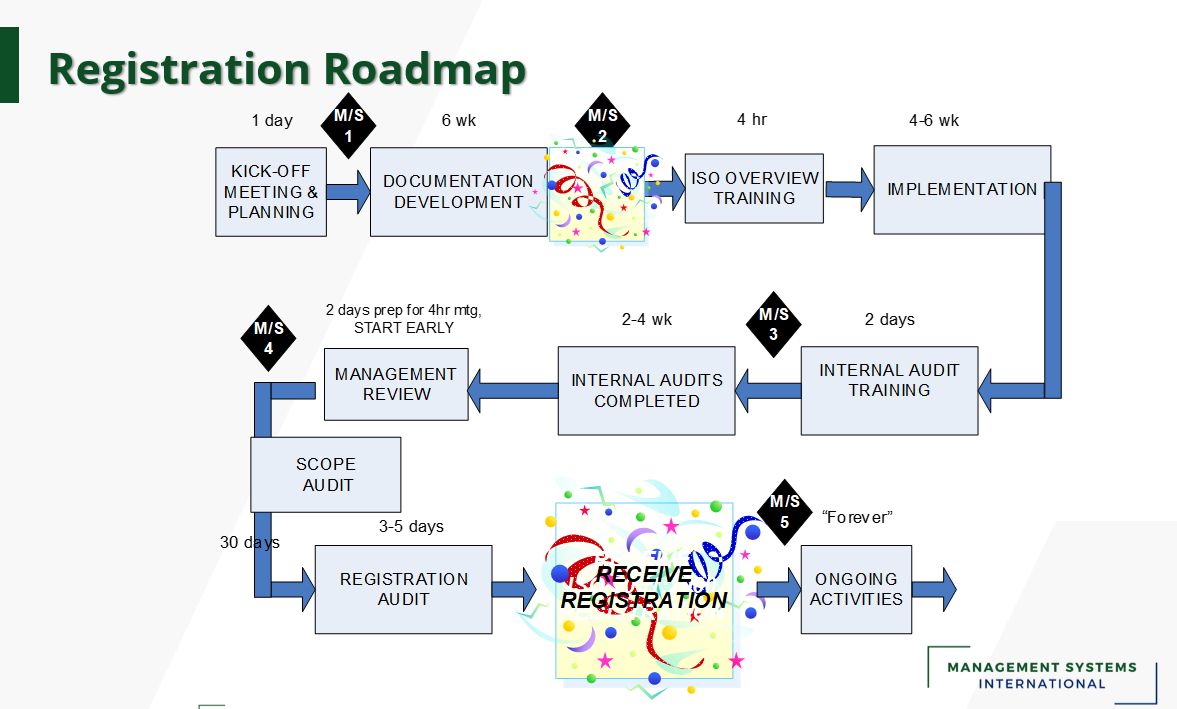
MONTH 1
End-in-mind management review deck with data and TBD dates, scope, context, interested parties, readiness scorecard, named owners, documentation register, and the certification body shortlist with each body’s 2026 accreditation date. The plan is locked at the end of this window.
MONTHS 2–6
Procedures drafted, approved, and deployed. Process owner and internal auditor training completed. Records begin accumulating, and this phase cannot be compressed past a floor, because records need elapsed time.
MONTHS 6–9
Full internal audit cycle, corrective actions raised and closed, effectiveness verified, and the pre-certification management review held with real data. Stage 1 scheduled.
MONTHS 9–12
Stage 1, remediation, Stage 2, findings closed, certificate issued. The plan hands over to a maintenance cadence.
Organizations that already hold another certification compress this considerably. A site certified to ISO 14001 or ISO 45001 inherits document control, internal audit, corrective action, and management review, because those standards share the harmonized clause structure. ISO 13485 does not share it, so medical device organizations plan separately, as MSI’s ISO 13485 standard page explains. For the standard itself, see MSI’s ISO 9001 quality standard overview.
Already Certified
What If You Already Hold an ISO 9001:2015 Certificate?
Review. Revise. Retain.
You do not need a new implementation project. You need a transition plan, and the steps above shrink to three: a management review that decides what must change, a document revision cycle, and an internal audit that confirms the changes work. Most organizations schedule the transition at a surveillance or recertification audit before September 30, 2029, though your certification body sets the practical dates.
MSI’s article on ISO transition risk assessment shows how to rank what to change first. When your procedures need updating, MSI’s ISO 9001:2026 Procedure Update Service brings your existing ISO 9001:2015 procedures up to the 2026 edition, so your team spends its time on the management review decisions rather than redlining documents.
Free Transition Checksheet
See Exactly Which 2026 Changes Touch Your System
The ISO 9001:2026 Transition Checksheet walks clause by clause through the 2026 edition so you can mark what you already meet and what needs work, then bring the result straight into your management review. Enter your details for an instant download and an emailed copy.
Outside Help
Where Does ISO Consulting Change the Math?
Shorten. Steady. Sustain.
The honest case for ISO consulting is narrow and specific. A consultant does not make your people work faster. What ISO consulting removes is the cost of learning by error: the scope set too wide, the procedure that describes an aspiration, the audit calendar with no room to close a finding. Those errors are individually small and collectively the difference between nine months and eighteen.
Management Systems International (MSI) is a veteran-owned, female-owned firm founded in 1998. Across 28 years, MSI’s track record includes 80+ certifications supported, 200+ audits attended, and 600+ professionals trained. Those numbers matter to a plan in one concrete way: they are the source of the pattern recognition that tells you, in week two rather than month seven, which assumptions will not hold. Engagements run from SureFinish six-week advising through SurePath turnkey certification projects, and MSI’s case studies show how those engagements play out.
Ninety Minutes, Before You Set Dates
Find Your Real Certification Date in One Planning Session
Bring your draft scope, your readiness score, and your target date. You will leave knowing which capabilities you actually have, where your plan is optimistic, and whether your registrar’s 2026 accreditation date fits your schedule. No obligation, and no cost.
Questions Answered
ISO 9001 Implementation Plan: Frequently Asked Questions
Ask. Answer. Act.
Should a new ISO 9001 implementation plan target ISO 9001:2015 or ISO 9001:2026?
Build an ISO 9001 implementation plan to ISO 9001:2026. From March 31, 2028, new accredited certifications may only be issued to the 2026 edition, and a 2015 certificate must transition by September 30, 2029. Ask each certification body when it will be accredited for the 2026 edition and set your Stage 2 date accordingly.
How many procedures does an ISO 9001 implementation plan need?
ISO 9001:2026 mandates no fixed number and no quality manual. Most organizations building an ISO 9001 implementation plan land on eight to fifteen core procedures covering document control, corrective action, internal audit, management review, purchasing, and the operational processes whose consistency matters to the customer.
Why start an ISO 9001 implementation plan with a management review?
Clause 9.3.2 lists the issues, interested parties, performance data, resources, risks, and opportunities leadership must consider, and Clause 9.3.3 requires decisions on changes and resources. Building those slides first, with current data filled in and TBD dates where data is missing, turns an ISO 9001 implementation plan into an end-in-mind picture with owners and dates on record from day one.
Who should own the ISO 9001 implementation plan?
One named coordinator holds and drives the ISO 9001 implementation plan, while top management takes accountability for effectiveness under Clause 5.1.1 l). Individual processes have individual owners, the people with authority to change how the work runs. The coordinator role needs budgeted hours, not goodwill added to a full workload.
When should internal audits be scheduled in an ISO 9001 implementation plan?
At least three months before the certification audit, with management review at least six weeks before. An ISO 9001 implementation plan that schedules either activity in the final fortnight produces records with no findings closed and no effectiveness verified.
What does an ISO 9001 implementation plan cost?
Four lines: internal labor hours, documentation development, training, and certification body fees for Stage 1, Stage 2, and three years of surveillance. Internal labor is usually the largest and most often omitted. An ISO 9001 implementation plan that estimates it explicitly at kickoff is far less likely to stall mid-project.
Can an ISO 9001 implementation plan cover only part of the business?
Yes. Clause 4.3 lets you set boundaries by site, product line, or function, provided the scope states the products and services covered and justifies any requirement treated as not applicable. A phased ISO 9001 implementation plan that certifies the core operation first is often faster overall.
What is the most common reason an ISO 9001 implementation plan slips?
Decision latency, not effort. Across 200+ audits attended, MSI observes that documents wait on approvals, approvals wait on meetings, and the delay surfaces at the internal audit stage when no room is left. An ISO 9001 implementation plan with named approvers and standing review slots removes most of it.
References and Further Reading
- International Organization for Standardization — ISO 9001 Quality Management
- ANSI Webstore — ISO 9001:2026 Quality management systems — Requirements
- ANSI Webstore — ISO 19011:2026 Guidelines for auditing management systems
- Global ACI — Transition requirements for ISO 9001:2026
- Global ACI — International accreditation recognition arrangements
- ISO/TC 176 — Quality management and quality assurance technical committee
- International Organization for Standardization — The ISO Survey of certifications
- American National Standards Institute — ANSI
- ANSI National Accreditation Board — ANAB accredited certification body directory
- United Kingdom Accreditation Service — UKAS
- American Society for Quality — ISO 9001 quality resources
- DNV — ISO 9001 revision transition rules and timeline
- SGS — ISO 9001:2026 key updates and transition guidance
- NQA — Transitioning to ISO 9001:2026
About Management Systems International (MSI)
Diana Lynn, President and Principal ISO Consultant at Management Systems International (MSI), a consulting firm she co-founded in 1998. With 28 years of experience including extensive AS9100 work in MSI’s early years, MSI’s track record includes 80+ certifications supported, 200+ audits attended, and 600+ professionals trained across manufacturing, technology, medical device, government, healthcare, and other regulated industries. Today MSI implements ISO 9001, ISO 13485, ISO 14001, and ISO 45001, with an expanding focus on ISO 7101 healthcare quality.
MSI is veteran-owned and female-owned. About MSI · msi-international.com · 760-434-9141
