ISO 14001 · Environmental Stewardship
By Diana Lynn, President and Principal ISO Consultant, MSI · Updated October 18, 2026
Environmental stewardship examples are the everyday choices, at home or at work, where people take responsibility for resources they borrow from the future. Centuries ago, a steward was the person who ran an estate he did not own. He kept the ledger, counted the grain, and answered to the owner for every loss.
That last part, answering for the results, is the piece most modern stewardship quietly drops. Ask a household or a company that calls itself environmentally responsible what it measured last month, and the room usually goes quiet. The recycling bin is full, the reusable bags are in the car, and the sustainability page on the website looks wonderful. Yet nobody can say whether water use went up or down.
This article closes that gap. It defines what stewardship really means, walks through commercial and residential environmental stewardship examples you can copy this week, and shows how ISO 14001:2026 turns good intentions into a system that keeps working after the enthusiasm fades. It also gives you an original self-check, the Stewardship-to-System Scorecard, that works for a kitchen as well as a factory floor.
Direct Answer
Environmental stewardship examples include fixing household leaks, composting, planting native species, repairing instead of replacing, and, in business, designing products for reuse, setting environmental purchasing requirements, and tracking energy, water and waste against measurable objectives. Stewardship means taking responsibility for resources and answering for the results.
Key Takeaways
- Environmental stewardship means managing resources you do not own as if you will be asked to account for them, because eventually you will be.
- The strongest environmental stewardship examples share three traits: a named responsibility, a measured result, and a habit that survives a change of people.
- ISO 14001:2026, published April 15, 2026, requires organizations to consider environmental conditions such as pollution levels, climate change, biodiversity and ecosystem health in Clause 4.1.
- Most stewardship programs fade not from lack of caring but from lack of a system that records, reviews and corrects.
- Management review under ISO 14001:2026 Clause 9.3 is where leadership turns stewardship data into decisions, resources and accountability.
The Meaning
What Are Environmental Stewardship Examples, and What Does Stewardship Really Mean?
Entrust. Answer. Endure.
Stewardship is an old word with a precise meaning. A steward managed property on behalf of someone else, and the job came with a ledger. The steward did not get to decide that a missing sack of grain did not matter. Every loss had to be explained.
Environmental stewardship applies that same logic to air, water, soil, energy, materials and living systems. None of us owns the watershed under our homes or the atmosphere above our plants. We borrow them from neighbors, from future customers and from our own grandchildren. The question stewardship asks is simple: are you leaving the estate in better condition than you found it, and can you prove it?
After 28 years of helping organizations build environmental and quality management systems, MSI has seen that genuine environmental stewardship examples pass three tests. Each one is worth checking against anything you currently call stewardship.
Test 1: Is someone responsible by name?
Shared intentions are nobody’s job. A household where “everyone” turns off lights is a household where the porch light burns all night. A company where “everyone” cares about waste is a company where the dumpster contract never gets renegotiated. Stewardship begins when one person owns the result.
Test 2: Is the result measured?
The original steward’s ledger is the heart of the idea. A water bill, a waste hauler’s tonnage report, or a monthly electricity reading is today’s ledger. Without a number, you have a belief, and beliefs are easy to keep while the facts drift in the other direction.
Test 3: Does the habit survive a change of people?
The champion who started the composting program moves away. The facilities manager who negotiated the recycling contract retires. If the practice disappears with the person, it was a personality, not stewardship. Durable environmental stewardship examples are written down, taught and reviewed, which is exactly what a management system does.
For a deeper look at stewardship as a moral calling, including how faith leaders have framed the duty to protect creation, read MSI’s reflection on Pope Francis’s legacy of environmental stewardship. This article stays practical: what stewardship looks like on a Tuesday afternoon in a plant, an office or a backyard.
Clearing Up the Vocabulary
How Is Stewardship Different From Compliance, Sustainability and Conservation?
Define. Distinguish. Decide.
These four words get used interchangeably, and the confusion costs organizations real money. Teams build a “sustainability” report when what leadership actually needed was a compliance calendar, or they chase permits while ignoring the opportunities that would cut costs. Each word answers a different question.
| Term | Question it answers | Typical owner | Weakness on its own |
|---|---|---|---|
| Compliance | Are we meeting the legal minimum? | EHS or legal | Stops at the floor; rarely improves anything |
| Conservation | Are we protecting a specific resource or place? | Land trusts, agencies, volunteers | Focused on one resource, not the whole operation |
| Sustainability | Can this continue without harming the future? | Strategy or communications | Easy to describe, hard to assign and measure |
| Stewardship | Who is accountable, and what did they deliver? | A named person, reviewed by leadership | Needs a system to outlast its champion |
ISO 14001:2026 frames this neatly in its introduction. It describes sustainable development as balancing the environment, society and the economy, and positions the environmental management system as the organization’s contribution to the environmental pillar. Stewardship is the behavior; the management system is the structure that keeps the behavior honest.
If your organization already runs a sustainability program without a certificate, you may have built more of the structure than you realize. MSI’s guide to turning a sustainability program into ISO 14001 shows how much of the work is usually already in place.
Direct Answer
Compliance meets the legal minimum, conservation protects a specific resource, and sustainability describes a long-term goal. Stewardship adds accountability: a named owner and a measured result. The best environmental stewardship examples combine all four, with stewardship holding them together.
At Work
What Do Commercial Environmental Stewardship Examples Look Like?
Design. Measure. Return.
The most instructive commercial environmental stewardship examples are not the ones with the biggest marketing budgets. They are the ones where a company made a public commitment, measured itself against it for years, and changed how it designs, buys or takes back products. Three well-documented environmental stewardship examples from public companies illustrate the pattern.
Interface: a quarter-century commitment with a ledger
Carpet tile maker Interface set its Mission Zero goal after its founder’s 1994 turning point, targeting zero negative environmental impact by 2020. In November 2019 the company announced it had reached Mission Zero ahead of schedule. The reported figures, which covered carpet tile production through 2018, included a 96% reduction in global greenhouse gas emissions and an 89% reduction in water use per unit of production.
What makes this one of the strongest environmental stewardship examples is not the size of the numbers. It is the quarter century of measurement behind them, plus a successor goal, documented in the company’s Climate Take Back fact sheet for the United Nations climate secretariat. A finish line was reached and a new one was drawn, which is continual improvement in its purest form.
Patagonia Worn Wear: making repair part of the business
Patagonia’s Worn Wear program, started in 2013, combines repair, trade-in and resale of used gear. Trade reporting in 2017 noted that its Reno, Nevada repair center averaged about 30,000 repairs a year. The lesson for any manufacturer is the use and end-of-life stages of the product life cycle are part of your footprint, even after the sale.
IKEA Buy Back & Resell: taking products home again
After piloting the idea at a Philadelphia-area store, IKEA expanded its Buy Back & Resell service to 33 U.S. stores in late 2021, giving loyalty members store credit for gently used IKEA furniture that was then resold in the stores’ as-is sections. Programs like this are practical applications of the circular economy principles promoted by the Ellen MacArthur Foundation: keep products and materials in use at their highest value.
Everyday stewardship inside ordinary management systems
You do not need a famous brand to produce credible commercial environmental stewardship examples. Across 200+ audits attended in manufacturing, technology, medical device, government, healthcare and other regulated industries, MSI client experience suggests the most durable stewardship lives in quiet operational decisions:
- Manufacturing: capturing rinse water from a finishing line for reuse, with the meter reading reviewed monthly instead of discovered at year-end.
- Medical device: substituting a less hazardous cleaning solvent, following the control hierarchy of elimination, substitution and administrative controls named in the ISO 14001:2026 Clause 8.1 NOTE.
- Technology and data centers: tracking power and cooling water per unit of computing, a topic covered in MSI’s article on data center sustainability.
- Healthcare: segregating pharmaceutical and sharps waste at the point of use so less general waste is handled as hazardous.
- Government facilities: maintaining stormwater controls and spill kits, backed by a tested emergency preparedness and response procedure.
- Purchasing in any industry: writing environmental requirements into supplier agreements, as described in MSI’s guide to ISO 14001 externally provided processes.
None of these environmental stewardship examples will make headlines. All of them pass the three stewardship tests: a named owner, a measured result, and a practice written down so it survives turnover. For more ideas you can adapt, browse MSI’s roundup of eco-friendly business innovations and the practical steps in reducing your carbon footprint.
Direct Answer
Commercial environmental stewardship examples include Interface’s quarter-century Mission Zero commitment, Patagonia’s Worn Wear repair program and IKEA’s furniture buy-back, along with everyday practices such as water reuse, safer chemical substitution and environmental requirements for suppliers, each with a named owner and measured results.
At Home
What Do Residential Environmental Stewardship Examples Look Like?
Notice. Fix. Plant.
Home is where most people first practice stewardship, and it is also where the three tests are easiest to see. These residential environmental stewardship examples are drawn from U.S. government and conservation programs, so every recommendation rests on a credible source rather than a trend.
1. Find and fix leaks
The U.S. Environmental Protection Agency’s WaterSense program reports that household leaks can waste nearly 10,000 gallons of water a year in the average home. A running toilet flapper or a dripping showerhead is the residential version of an unmonitored process. The fix is cheap; the discipline is reading the meter.
2. Choose certified efficient products when you replace
Stewardship does not mean throwing out working appliances. It means making the next purchase count. The ENERGY STAR product list and WaterSense-labeled fixtures give households a simple purchasing requirement, the same idea ISO 14001:2026 Clause 8.1 b) asks organizations to apply to procurement.
3. Compost food scraps and yard trimmings
The EPA’s guide to composting at home explains that composting keeps material out of landfills, improves soil health, helps soil hold water and stores carbon in the soil. It needs four ingredients: browns, greens, water and air. Like any process, it works best with a routine and a person who checks it.
4. Plant for wildlife
The National Wildlife Federation’s Garden for Wildlife certification says any small space with native plants and a water source can qualify, and it encourages a goal of at least 70% native plants. A backyard habitat is a household-scale answer to the biodiversity and ecosystem health conditions that ISO 14001:2026 now names in Clause 4.1. MSI’s article on biodiversity in ISO 14001:2026 explains the organizational version.
5. Handle household hazardous waste correctly
Old paint, solvents, batteries and pesticides do not belong in the trash or down the drain. The EPA’s guidance on household hazardous waste points residents to local collection programs. When cleaning products run out, the EPA’s Safer Choice label helps families choose products that meet stricter chemical criteria.
6. Repair, borrow and buy used
Every repaired chair and borrowed ladder is a product kept in use. This is the household side of the commercial environmental stewardship examples described above, and it supports the United Nations Sustainable Development Goal 12 on responsible consumption and production. MSI’s guide to contributing to the UN SDGs shows how organizations make the same connection.
Notice what separates the families who keep these habits from the ones who try them for a month. The successful households post the meter reading on the refrigerator, assign the compost bin to one person and put the hazardous-waste drop-off date on the calendar. In other words, the best residential environmental stewardship examples quietly run a tiny management system. For seasonal ideas the whole family can share, see MSI’s Earth Day 2026 guide.
Why does stewardship feel natural in some places and optional in others?
Where you live shapes which environmental stewardship examples feel normal. I have seen this in my own life across three very different places.
“I have lived most of my life in California, spent three years in Germany, and recently moved to the southern states. In California and Germany, recycling and composting are part of the culture. In the South, they are not part of the culture in the same way.”
— Diana Lynn, President and Principal ISO Consultant, MSI
The difference is not that people in one region care more than people in another. The difference is the system around them. In California, the state’s SB 1383 organic waste law requires every jurisdiction to provide organic waste collection to all residents and businesses, with a target of 75% less organic waste sent to landfills by 2025. In Germany, the national Circular Economy Act made separate collection of organic waste mandatory starting January 1, 2015.
In both places, the bin is at the curb, the rule is clear, and the routine is the same every week. The habit follows the system, and after a few years the habit becomes the culture. Where the bin, the rule and the routine are missing, even people who care deeply have to go looking for a drop-off site or build a compost pile on their own. Many do, but most quietly stop.
This is the same lesson every ISO management system teaches: culture is what the system makes easy. It matters for any organization with sites in more than one region. Do not assume that environmental stewardship examples from a California plant will carry over to a new site in the Southeast. Each site’s local conditions belong in its Clause 4.1 context, and each site’s people need the awareness training described in Clause 7.3. MSI’s article on multi-site procedure standardization explains how to keep one system consistent across very different locations.
Direct Answer
Residential environmental stewardship examples include fixing leaks that can waste nearly 10,000 gallons a year, buying ENERGY STAR and WaterSense products when replacing, composting, planting native species, using local household hazardous waste collection, and repairing or buying used goods instead of buying new.
The Real Problem
Why Do Good Stewardship Intentions Fade Before They Become Proof?
Record. Review. Refuse Denial.
Most stewardship programs do not fail because people stop caring. They fail because caring was never connected to a routine that records results, puts them in front of decision-makers and corrects course. The pattern repeats across environmental stewardship examples in homes and companies alike.
First comes enthusiasm: a green team forms, bins appear, a pledge goes on the website. Then comes drift: the champion gets busy, contamination creeps into the recycling stream and nobody checks the utility data. Finally comes denial. When someone points out that waste tonnage rose, the answer is that “we’re still doing the program.” The program exists; the results do not.
“Having systems, acting on what the records are reporting, and never letting anyone deny the facts is what prevents good systems from deteriorating.”
— Diana Lynn, President and Principal ISO Consultant, MSI
That is the difference between the environmental stewardship examples that last decades, like Interface’s, and the ones that vanish after one Earth Day. The lasting ones treat the ledger as sacred. Records are not paperwork; they are how a steward answers to the owner. MSI’s article on environmental risk as business risk explains why leadership teams increasingly treat that ledger as a strategic asset rather than an EHS chore.
Integrity is the thread that runs through all credible environmental stewardship examples. A stewardship claim that cannot be backed by records is, at best, a hope and, at worst, greenwashing. MSI explores this connection in ISO standards and integrity.
“I have always felt that integrity is at the center of all ISO standards.”
— Diana Lynn, President and Principal ISO Consultant, MSI
ISO 14001:2026
How Does ISO 14001:2026 Turn Stewardship Into a Management System?
Commit. Control. Continually Improve.
ISO 14001:2026 was published on April 15, 2026, according to the International Organization for Standardization. As of October 18, 2026, accreditation bodies have published transition plans that require certified organizations to move to the 2026 edition by April 30, 2029; the UKAS technical bulletin is one example, and ANAB notes that the transition period is set by Global ACI.
The standard never uses the word stewardship, and it never lists environmental stewardship examples. It does something more useful: it turns each stewardship test into a requirement. Responsibility becomes Clause 5.3 roles and authorities. Measurement becomes Clause 6.2 objectives and Clause 9.1 monitoring. Survival through turnover becomes Clause 7.5 documented information and Clause 9.3 management review.
Accuracy matters here, because the 2026 edition contains both requirements and NOTEs. A requirement uses “shall.” A NOTE is guidance for consideration and creates no obligation. Annex A is informative and adds no requirements. The table below labels each item so your team builds the right things, verified against the licensed ISO 14001:2026 text.
| Stewardship element | ISO 14001:2026 clause | Status |
|---|---|---|
| Consider environmental conditions such as pollution levels, natural resource availability, climate change, biodiversity or ecosystem health | 4.1 | Requirement |
| Interested parties may have expectations about those same conditions | 4.2, NOTE 1 | NOTE (guidance only) |
| Policy commitment to protect the environment, including prevention of pollution | 5.2 c) | Requirement |
| Specific commitments such as resource conservation, climate mitigation and adaptation, or protecting biodiversity | 5.2, NOTE | NOTE (guidance only) |
| Determine environmental aspects considering a life cycle perspective | 6.1.2 | Requirement |
| Environmental objectives that are measurable (if practicable) and monitored | 6.2.1 | Requirement |
| Carry out changes to the system in a planned manner | 6.3 | Requirement |
| Environmental requirements for procurement, communicated to external providers | 8.1 b) and c) | Requirement (“as appropriate”) |
| Apply controls following a hierarchy such as elimination, substitution, administrative | 8.1, NOTE | NOTE (guidance only) |
| Review environmental performance trends at management review | 9.3.2 d) | Requirement |
| Circular economy redesign as a beneficial opportunity | A.6.1.4 | Informative Annex A |
| Score stewardship maturity once a year using the Stewardship-to-System Scorecard | Supports 9.3 and 10.1 | MSI recommendation |
Two clarifications prevent common misunderstandings when teams map their environmental stewardship examples to the standard. Clause 6.3 on planning of changes was elevated to its own clause in the 2026 edition; change management existed in the 2015 edition, so it is not a brand-new idea. And the life cycle perspective does not require a formal life cycle assessment; Annex A explains that thinking carefully about what you can control or influence at each stage is often enough.
For deeper dives on the clauses above, see MSI’s articles on ISO 14001 Clause 4.1, ISO 14001 environmental conditions and ecosystem health in ISO 14001:2026. Organizations that set carbon targets will also want the GHG Protocol standards alongside MSI’s carbon neutrality guide.
For Experienced EHS Managers
Update Your ISO 14001:2015 System to 2026 in a Week
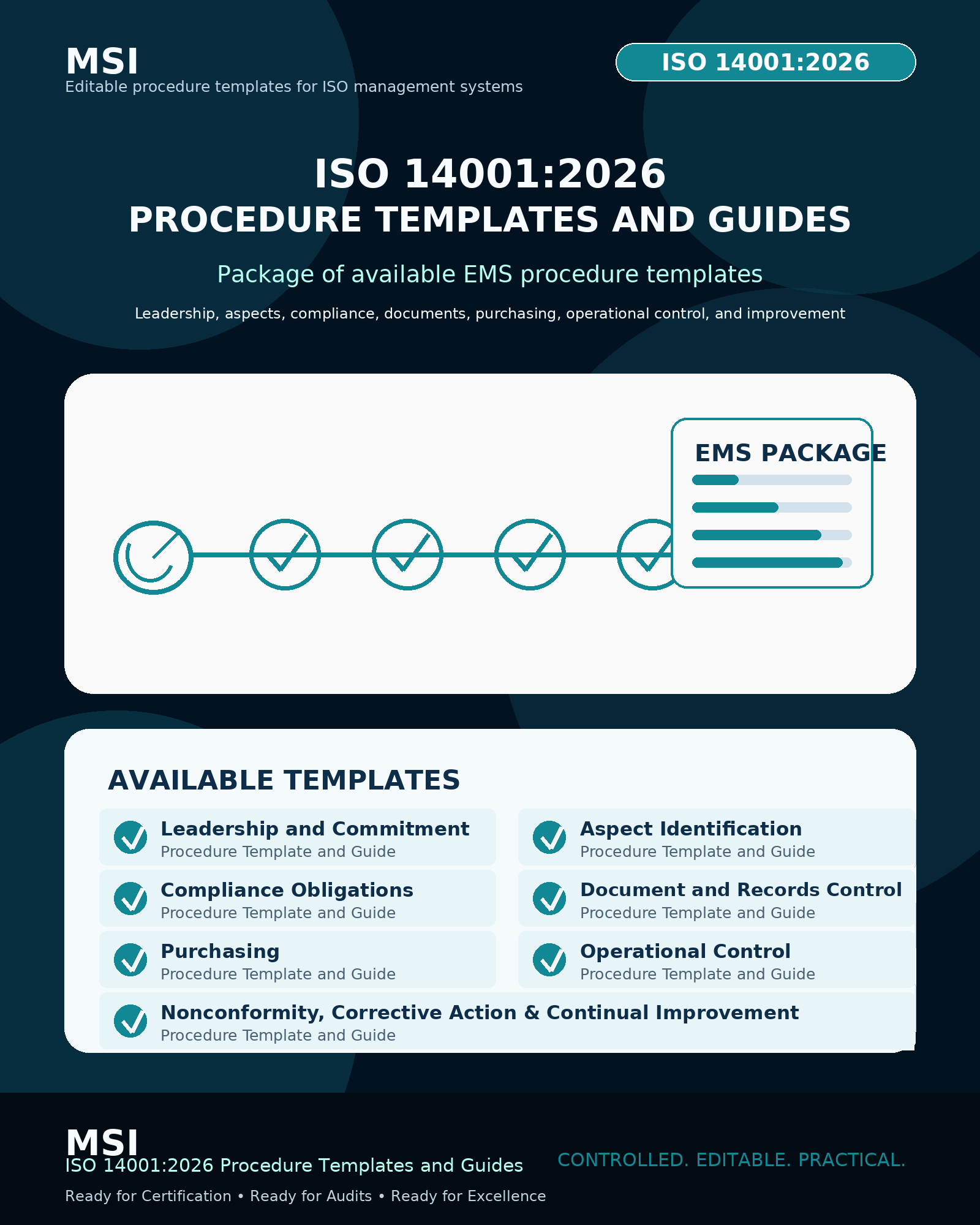
You already run an EMS. What you need is the 2026 wording, not a blank page. MSI’s ISO 14001:2026 Procedure Templates & Guides were built to help experienced EHS managers update their current ISO 14001:2015 procedures to the 2026 edition in a week’s time, so you update what already works instead of starting over.
See the ISO 14001:2026 Templates
Prefer to hand off the rewrite? The ISO 14001:2026 Procedure Update Service updates your existing documents for you. Want the full walk-through first? Take the ISO 14001:2026 Transition course.
From Kitchen to Plant Floor
How Do Home Habits Translate Into ISO 14001 Practice?
Same Habit. Bigger Ledger.
One reason residential environmental stewardship examples matter to business leaders is that they make the standard intuitive. Every employee already understands a leaking faucet. The map below connects habits people practice at home with the clause where the same idea lives in an environmental management system. Use it in awareness training under Clause 7.3 to make the EMS feel familiar instead of foreign.
| At home | At work | ISO 14001:2026 |
|---|---|---|
| Noticing the drought, heat or flood risk in your area | Determining environmental conditions that affect operations | 4.1 |
| Listing what uses water, power and gas in the house | Determining environmental aspects and impacts | 6.1.2 |
| Following local burn bans and disposal rules | Compliance obligations | 6.1.3 |
| “Cut the water bill 10% this year” | Measurable environmental objectives with owners and dates | 6.2 |
| Buying ENERGY STAR when the old fridge dies | Environmental requirements for procurement | 8.1 b) |
| Keeping a fire extinguisher and a spill plan for the garage | Emergency preparedness and response | 8.2 |
| Reading the meter every month | Monitoring, measurement, analysis and evaluation | 9.1 |
| The family conversation about what worked this year | Management review | 9.3 |
The parallel between home and workplace environmental stewardship examples is not a gimmick. Employees who practice stewardship at home bring that instinct to work, and organizations that build strong systems at work often see habits travel home. That two-way exchange is one of the most underrated benefits of an EMS, covered in MSI’s article on the benefits of environmental management systems. The people who write the job descriptions should know it too; see MSI’s environmental manager job description.
Original MSI Self-Check
How Mature Is Your Stewardship? The Stewardship-to-System Scorecard
Intention. Habit. System. Proof.
MSI created the Stewardship-to-System Scorecard for this article so any household, department or site can test its own environmental stewardship examples against the three stewardship tests. Score each statement 0 (not true), 1 (partly true), 2 (mostly true) or 3 (true, with records to prove it). It takes about ten minutes and works best when two people score separately and compare.
| # | Statement | Related clause | Score (0-3) |
|---|---|---|---|
| 1 | We know which local environmental conditions (water supply, heat, flooding, habitat) affect us. | 4.1 | |
| 2 | We have listed our biggest uses of energy, water and materials and the waste we create. | 6.1.2 | |
| 3 | Each stewardship practice has one named owner. | 5.3 | |
| 4 | We have at least one measurable target with a date. | 6.2 | |
| 5 | We consider environmental impact when we buy, not just price. | 8.1 b) | |
| 6 | Our practices are written down well enough that someone new could continue them. | 7.5 | |
| 7 | We record results at least monthly and can show the trend. | 9.1 | |
| 8 | Decision-makers review the results and assign actions when targets are missed. | 9.3 and 10.2 |
- 0 to 8, Intention: real caring, little structure. Start with statements 2 and 3: list what you use and name an owner.
- 9 to 16, Habit: good practices that depend on a few people. Write them down and set one measurable target.
- 17 to 21, System: the practices would survive turnover. Strengthen the review loop so results drive decisions.
- 22 to 24, Proof: you can answer for the estate, and for every one of your environmental stewardship examples, with records. This is where certification to ISO 14001 becomes a natural next step.
Organizations scoring in the Habit band usually have environmental stewardship examples worth celebrating but no procedures holding them in place. That is exactly the gap procedure templates close. Organizations preparing to transition an existing certificate can also run MSI’s free ISO Transition Risk Scorecard, explained in the companion article on ISO transition risk assessment.
Start Here: Turn Good Habits Into Written Procedures
Scored in the Habit band? You do not need to invent procedures from scratch. MSI’s ISO Procedure Templates & Guides hub is the starting point for ready-to-adapt procedures across the ISO standards MSI implements, each written from 28 years of consulting experience so your practices survive the next reorganization.
Leadership Accountability
How Should Leadership Review Environmental Stewardship Results?
Review. Resource. Redirect.
In the old estate, the steward reported to the owner. In an environmental management system, that moment is management review under ISO 14001:2026 Clause 9.3. Top management must review the system at planned intervals, and Clause 9.3.2 lists the inputs: changes in external and internal issues, interested party needs, significant aspects and risks; progress on objectives; and environmental performance trends, including nonconformities, monitoring results, compliance and audit results.
The outputs in Clause 9.3.3 are where stewardship gets teeth. Leadership must reach conclusions on suitability, adequacy and effectiveness, make decisions about improvement and resources, take action when objectives are not achieved, and consider implications for strategic direction. A review that only applauds the green team’s environmental stewardship examples is not a management review.
MSI promotes management review as the best place to start planning a transition, too. A quick “End in Mind” approach works well: put the data you already have on the review slides and mark missing data “TBD” with a date. The empty boxes become your project plan. MSI’s article on ISO 14001:2026 management review walks through the clause chain in detail, and the free PDF 5 Steps to a Decision-Ready ISO Management Review gives you a starting agenda.
Direct Answer
Leadership should review environmental stewardship examples and results at ISO 14001:2026 Clause 9.3 management review: compare performance trends with objectives, decide on resources and improvements, assign actions where targets were missed, and consider implications for strategic direction, with documented results.
Run a Management Review Leadership Will Actually Act On
Stop rebuilding the agenda every year. MSI’s ISO Management Review Toolkits give you a ready-made structure for turning environmental data into documented decisions, including a combined ISO 9001 and ISO 14001 kit for integrated systems.
Explore Management Review Toolkits
Running both standards? Go straight to the Q/EMS ISO 9001 and 14001 Management Review Tool Kit.
Review is only as good as the evidence behind it, which is why internal audits matter so much. Registrars across the industry expect every requirement of the standard to be internally audited each year. Organizations that want independent eyes on their stewardship records can use MSI’s internal audit services or the ongoing SureResults ISO maintenance program.
Measurable Authority
How Does ISO Consulting Turn Stewardship Into Measurable Authority?
Experience. Evidence. Endurance.
Customers, investors and neighbors increasingly ask organizations to prove their environmental claims. A certificate from an accredited registrar is the most widely recognized proof that a stewardship program is a real system. Good ISO consulting shortens the distance between the environmental stewardship examples you already have and that independent verification.
MSI’s track record gives readers concrete ways to judge that claim: 28 years of experience, 80+ certifications supported, 200+ audits attended and 600+ professionals trained. Diana Lynn’s view of what makes MSI different is the perspective that comes from sitting in more than 200 audits and seeing many of the findings first-hand from the registrar’s point of view. That vantage point shapes how MSI builds procedures that work in practice, not only on paper.
Based on MSI client experience, here is how environmental stewardship examples typically build into measurable authority:
- Baseline: twelve months of energy, water and waste data, with owners named.
- Objectives: two or three measurable targets tied to significant aspects.
- Procedures: written controls that survive turnover.
- Verification: internal audits and a documented management review.
- Certification: an accredited ISO 14001 certificate, then annual surveillance that keeps the ledger honest.
Organizations starting from zero can follow MSI’s step-by-step guide to implementing ISO 14001 or read the ISO 14001 certification guide for all industries. Those who want a turnkey path can explore SurePath, and budget questions are answered in MSI’s article on ISO certification cost. Supply chains are part of the picture as well; see climate-resilient supplier networks.
Integration is the other lever. As of October 18, 2026, ISO 9001:2026 has been published (September 16, 2026), so many organizations are updating quality and environmental systems together. MSI’s overview of ISO 9001:2026 changes helps teams plan one transition instead of two.
Talk Through Your Stewardship Program With an ISO 14001 Expert
Bring your Scorecard result to a free planning session. In one conversation, an MSI expert will help you see which of your current practices already satisfy ISO 14001:2026, what is missing, and the fastest realistic path to certification or transition. Call 760-434-9141 or learn more about MSI’s ISO consulting services.
Still deciding whether ISO 14001 is right for you? Watch the free ISO 14001 executive brief in MSI’s ISO Executive Decision Briefs.
FAQ
Frequently Asked Questions About Environmental Stewardship Examples
Ask. Answer. Act.
What are some environmental stewardship examples at home?
Common home environmental stewardship examples include fixing leaks, which the EPA says can waste nearly 10,000 gallons a year in the average home; choosing ENERGY STAR and WaterSense products when replacing; composting; planting native species; using household hazardous waste collection; and repairing or buying used goods.
What are environmental stewardship examples in business?
Business environmental stewardship examples include long-term reduction commitments such as Interface’s Mission Zero, product repair and take-back programs such as Patagonia Worn Wear and IKEA Buy Back & Resell, water reuse, safer chemical substitution, and environmental requirements in supplier agreements.
What is the difference between environmental stewardship and sustainability?
Sustainability describes the goal of meeting present needs without harming the future. Stewardship describes the accountability for getting there: a named owner, measured results and answering for them. An organization can talk about sustainability without practicing stewardship, but not the reverse.
Does ISO 14001 require environmental stewardship?
ISO 14001:2026 does not use the word stewardship, but its requirements build it in: a policy commitment to protect the environment (Clause 5.2 c), consideration of environmental conditions (4.1), measurable objectives (6.2), and management review of environmental performance (9.3).
Can a small business practice environmental stewardship without certification?
Yes. Some of the most practical environmental stewardship examples come from small businesses. Any organization can name owners, measure energy, water and waste, and review results. Certification adds independent verification, which customers and larger buyers increasingly expect. The Stewardship-to-System Scorecard in this article shows how close you already are.
When must certified organizations transition to ISO 14001:2026?
As of October 18, 2026, accreditation body transition plans require certified organizations to move to ISO 14001:2026 by April 30, 2029. The standard was published on April 15, 2026. Confirm specific dates with your certification body.
How does ISO consulting help a stewardship program?
ISO consulting connects the practices you already have to the requirements of ISO 14001, writes procedures that survive turnover, and prepares leadership for management review and certification. MSI brings 28 years of experience and 200+ audits attended to that work.
The Bottom Line
What Should You Do After Reading These Environmental Stewardship Examples?
Steward. Measure. Prove.
The steward’s job has not changed in a thousand years: manage what is entrusted to you, keep the ledger, and answer for the results. What has changed is the size of the estate and the number of people asking for an accounting. The environmental stewardship examples in this article, from a backyard habitat to a quarter-century corporate commitment, all share that discipline.
This week, score yourself on the Stewardship-to-System Scorecard. Pick the lowest statement and fix it. If you run an environmental management system, put stewardship results on the agenda of your next management review and let the records speak. For the bigger picture of why this matters to the economy, MSI’s articles on the $2 trillion climate opportunity and gross domestic regeneration are worth your time.
When you are ready to turn your own environmental stewardship examples into a system that keeps working long after the enthusiasm fades, call MSI at 760-434-9141 or start with the ISO Procedure Templates & Guides.
References
- ISO 14001:2026 Environmental management systems — Requirements with guidance for use — International Organization for Standardization, published April 15, 2026.
- UKAS Technical Bulletin: ISO 14001:2026 transition — May 7, 2026.
- ANAB: ISO 14001:2026 key changes and how to prepare — April 16, 2026.
- Interface announces Mission Zero success, commits to Climate Take Back — November 2019.
- UNFCCC fact sheet: Interface — 2020.
- Patagonia expands its Worn Wear repair and recycle program — Glossy, March 2017.
- IKEA expands resale program across 33 US stores — Retail Dive, 2021.
- The circular economy: overview — Ellen MacArthur Foundation.
- WaterSense Fix a Leak Week — U.S. EPA, March 20, 2023.
- ENERGY STAR product list — U.S. EPA and DOE.
- Composting at home — U.S. EPA.
- Garden for Wildlife: Create and Certify — National Wildlife Federation.
- California’s Short-Lived Climate Pollutant Reduction Strategy (SB 1383) — CalRecycle.
- Organic-waste treatment — German Environment Agency (Umweltbundesamt).
- Household hazardous waste — U.S. EPA.
- Safer Choice — U.S. EPA.
- Sustainable Development Goal 12 — United Nations.
- GHG Protocol standards and guidance — Greenhouse Gas Protocol.
About Management Systems International (MSI)
Diana Lynn, President and Principal ISO Consultant at Management Systems International (MSI), a consulting firm she co-founded in 1998. With 28 years of experience including extensive AS9100 work in MSI’s early years, MSI’s track record includes 80+ certifications supported, 200+ audits attended, and 600+ professionals trained across manufacturing, technology, medical device, government, healthcare, and other regulated industries. Today MSI implements ISO 9001, ISO 13485, ISO 14001, and ISO 45001, with an expanding focus on ISO 7101 healthcare quality.
Veteran-owned, female-owned · msi-international.com · 760-434-9141
