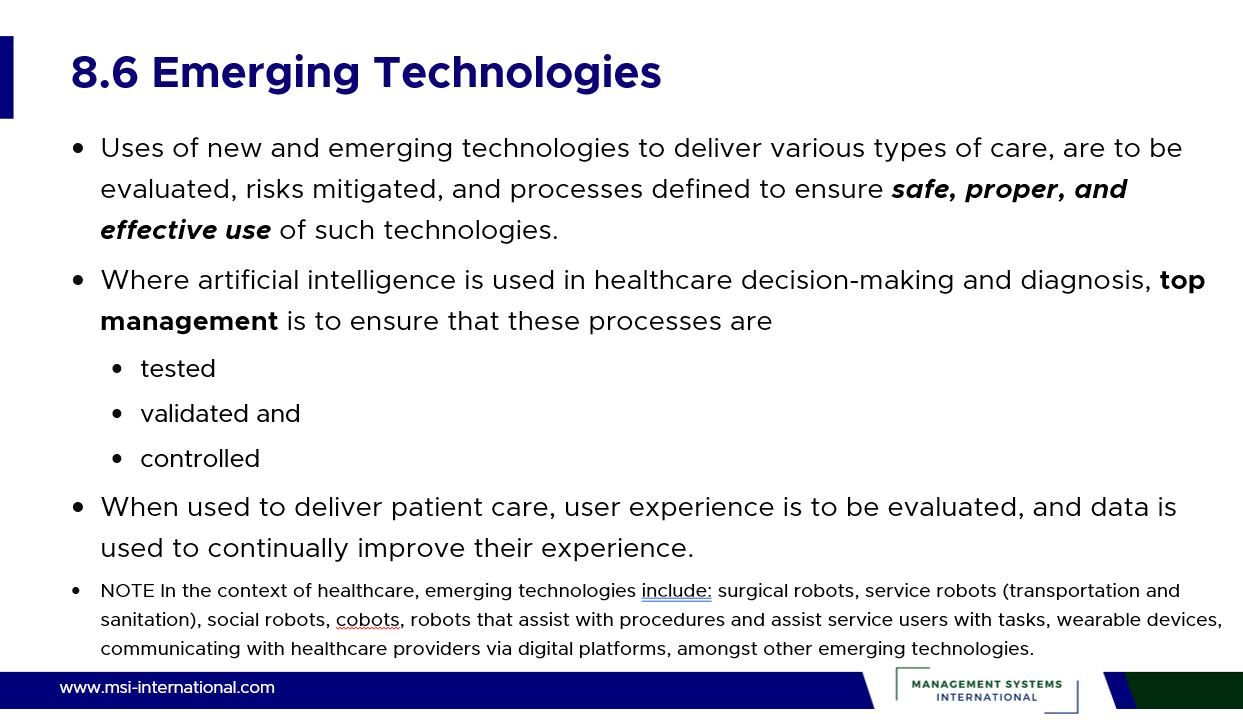
Direct Answer: Emerging technologies in healthcare — AI diagnostics, remote patient monitoring, wearables, telehealth, surgical robotics — are not exempt from your quality management system. ISO 7101:2023 treats every one of them as a process that must be planned, resourced, validated, controlled, monitored, and reviewed by top management. The organizations that get value from emerging technologies in healthcare are the ones that governed them like clinical processes from day one, not the ones that piloted first and documented later.
Emerging technologies in healthcare almost never fail because the technology was bad. They fail because nobody wrote down who owns the model, what “working correctly” means in measurable terms, what happens when it drifts, and which human being is accountable when the output is wrong. The algorithm arrives validated by the vendor. The workflow around it arrives improvised.
That gap is a management system problem, and it has a management system answer. ISO 7101:2023 — published in October 2023 as the first international consensus standard for healthcare quality management — is the framework that closes it. This guide walks healthcare quality leaders, clinical operations directors, and the health-technology providers who sell into them through exactly how the standard applies to emerging technologies in healthcare, clause by clause, with the control decisions spelled out.
What ISO 7101 Requires of Emerging Technologies in Healthcare
Plan. Control. Verify.
Direct Answer: ISO 7101 does not contain a clause titled “technology.” It contains requirements for planning, competence, operational control, monitoring, and management review — and emerging technologies in healthcare fall under every one of them. The standard’s demand is that new technology be introduced through the same disciplined route as any other care process: risks determined, criteria set, competence confirmed, performance measured, results reviewed by leadership.
ISO 7101 was built on the harmonized structure shared by ISO 9001, ISO 14001, and ISO 45001 — ten clauses, common core text, common terms. That matters more than it sounds. It means a hospital already running a quality system has somewhere to put a new AI triage tool. It also means the standard will ask the same questions of that tool that it asks of a medication reconciliation process.
The published scope of ISO 7101:2023 commits the organization to processes that deliver timely, safe, effective, efficient, equitable, and people-centred care. A predictive sepsis model that fires accurately for one demographic and poorly for another is not equitable care, regardless of its aggregate AUC. The standard makes that a conformity question, not just an ethics question.
Clause 6: Determining Risk Before the Pilot, Not After
ISO 7101’s planning clause requires the organization to determine risks and opportunities arising from its context and from the needs of interested parties. For emerging technologies in healthcare, “interested parties” is a wide net: patients, clinicians, nursing staff, IT security, the health system’s legal counsel, payers, and increasingly the regulator.
The practical failure mode is sequencing. A department runs a six-month pilot, likes the results, and then asks quality to “document it.” By that point the risk determination is retroactive — a paperwork exercise rather than a design input. MSI client experience suggests that projects which run the risks and opportunities determination before procurement reach steady-state operation faster than projects that reverse the order, largely because they avoid rebuilding workflows that were never designed to be controlled.
Risk determination for a new technology should produce written answers to a short, uncomfortable list:
- What clinical decision does this influence, and what is the consequence of the tool being wrong in each direction?
- Which patient populations are represented in the training or reference data, and which are not?
- What does the tool do when it encounters an input it was not designed for — fail loudly, or produce a confident wrong answer?
- Who is competent to override it, and is that person present at the point of use?
- What is the rollback plan if performance degrades mid-deployment?
None of those questions require a data scientist to answer. They require a process owner. That distinction is the whole argument for treating emerging technologies in healthcare as a quality function rather than an IT function.
Clause 7: Competence Is the Control You Cannot Buy
Every vendor of emerging technologies in healthcare sells training. Almost none of it satisfies a competence requirement, because competence under the harmonized structure means demonstrated ability to apply knowledge and skills to achieve intended results — not attendance at a webinar.
For emerging technologies in healthcare, the competence question splits three ways. Clinicians need to know when to trust the output and when to escalate. Technical staff need to know how to detect degradation. Leadership needs enough fluency to interrogate a performance report without being managed by it. Organizations typically report that the middle group is the one they under-resource, which is why drift gets discovered by a complaint rather than by a control chart.
A validated algorithm in the hands of an untrained user is an uncontrolled process wearing a certificate. The competence requirement exists precisely because the technology’s assurance does not transfer to the people operating it.
Clause 8: Operational Control and Documented Criteria
Operational control is where emerging technologies in healthcare most often come apart in practice. The clause asks for operating criteria and control of processes in accordance with those criteria. Translated: somebody has to write down what good looks like, in numbers, before go-live.
Operating criteria for a remote monitoring program are not “patients are monitored.” They are: which vitals, at what interval, transmitted within what latency, escalated to whom within what window, with what fallback when connectivity drops. Those are the numbers an internal audit can actually test. “Patients are monitored” is untestable, and untestable is the same as uncontrolled.
This is also where documented information earns its keep. Not a binder — a set of procedures that describe how the work is actually done, kept current, and available at the point of use. MSI’s ISO Procedure Templates & Guides exist because most organizations do not need to invent this structure from a blank page; they need a defensible starting point with the judgment calls already made.
Stop Writing Procedures From Scratch
Fifteen procedure topics, five standards and integrated combinations, editable in Word — with 28 years of consulting judgment already built into the wording. If your technology governance is stalled because nobody wants to draft the operational control procedure, this is the shortcut that does not cost you rigor.
Validating AI Among Emerging Technologies in Healthcare
Test. Trust. Track.
Direct Answer: Validating AI within emerging technologies in healthcare means proving the system performs as intended in your population, on your data, inside your workflow — then monitoring that performance continuously, because model behaviour changes as inputs change. Vendor validation is a starting point, never a substitute.
The distinction that trips up most implementations is between verification and validation. Verification asks whether the system was built correctly. Validation asks whether the correct system was built for this use, in this setting, for these patients. A model can pass verification perfectly and still be the wrong tool for your case mix.
Regulators have converged on the same logic. The FDA’s work on artificial intelligence in software as a medical device emphasizes a total product life cycle approach — design, validation, deployment, and post-market performance monitoring treated as one continuous obligation rather than a gate you pass once. The NIST AI Risk Management Framework organizes the same territory around four functions: govern, map, measure, manage. Neither document replaces ISO 7101. Both map cleanly onto it.
A Workable Validation Sequence
For an AI tool influencing clinical decisions, a defensible sequence looks like this:
- Define intended use narrowly. Not “imaging support” — “flagging suspected intracranial hemorrhage on non-contrast head CT for adult emergency presentations.” Scope creep after go-live is the single most common source of unvalidated use.
- Establish acceptance criteria in advance. Sensitivity and specificity thresholds, acceptable false-positive burden on the reading queue, maximum turnaround time. Written down before the first result is seen.
- Test on local retrospective data. Including the demographic subgroups your service actually treats. Subgroup performance reported separately, never averaged away.
- Run a shadow period. The tool produces outputs; clinicians do not see them. Compare against actual decisions. This is the cheapest risk control available and the one most often skipped for schedule reasons.
- Define the human control point. Who reviews, under what authority, with what documented disagreement pathway. An override that nobody records is not a control.
- Set the monitoring cadence and the trigger. What metric, reviewed how often, and at what threshold does the tool get pulled?
Step six is the one that converts a pilot into a controlled process. Without a documented pull trigger, degradation has no owner and no consequence — the tool simply keeps running while confidence quietly erodes. Among all emerging technologies in healthcare, adaptive AI is the category where this matters most, because the thing you validated is not guaranteed to be the thing running next quarter.
Bias Is a Conformity Issue, Not Only an Ethics One
ISO 7101 puts equity in the definition of quality care. That has a direct operational consequence: if your tool performs measurably worse for a population you serve, and you know it, and you deploy it anyway without a compensating control, you have a nonconformity — not a philosophical debate. The corrective action route through risk, corrective action, and improvement management is the same route you would use for any other process failure.
This reframing is useful in the room. Quality leaders often struggle to get traction on algorithmic equity because it sounds like a values conversation competing against a delivery schedule. Framed as a conformity finding with a corrective action owner and a due date, it moves.
Remote Patient Monitoring as a Controlled Process
Measure. Escalate. Close.
Remote patient monitoring is the most operationally demanding of the emerging technologies in healthcare, because it moves clinical data collection outside the walls where your controls live. The device is in someone’s kitchen. The connectivity is theirs. The adherence is theirs. Your accountability is not.
The failure pattern is almost always the same and it is not technical: alerts generate faster than the staffing model can absorb them, triage thresholds get informally loosened to cope, and within a quarter the program is producing data nobody acts on. That is a capacity design failure disguised as an alert-fatigue problem.
Design the Response Before the Device
Work the arithmetic before procurement, as you would for any of the emerging technologies in healthcare that generate continuous data. Expected alert volume per enrolled patient per week, multiplied by target enrollment, divided by available clinical review capacity. If the answer exceeds what your team can absorb, you have three levers — narrow enrollment criteria, raise alert thresholds, or add capacity — and you need to pull one deliberately rather than let the front line pull it informally.
Coverage documentation matters here too, since program design and reimbursement design interact. CMS telehealth coverage policy shapes which monitoring activities are billable and under what documentation conditions, and a monitoring workflow designed without reference to it tends to get redesigned within a year.
Equity of Access Is an Operating Criterion
A monitoring program that only works for patients with reliable broadband and a smartphone has quietly selected its population. Under ISO 7101 that is a quality characteristic you are expected to have considered, not an unfortunate side effect. Practical controls include cellular-enabled devices that do not depend on home wi-fi, interfaces that work at low literacy levels, and enrollment data reviewed by access category rather than in aggregate. The connection to co-production and patient-centred care is direct: a technology the patient cannot operate is not co-produced care.

Launch ISO 7101 Without the Eighteen-Month Detour
The Executive ISO 7101 HealthCare Quality Launch Program gives hospital and clinic leadership the sequenced plan for standing up a healthcare quality management system — scope, policy, process ownership, and the technology governance decisions that are hardest to unwind later. Built for the people who have to approve it, not just the people who have to run it.
Wearables, Telehealth, and the Data You Did Not Ask For
Define. Filter. Own.
Direct Answer: Consumer wearables sit in a different risk class from regulated medical devices, and treating them identically is a control error in both directions. Among emerging technologies in healthcare, the governance question for wearables is not accuracy — it is what clinical duty attaches to data your organization receives but never commissioned.
A patient arrives with twelve months of consumer smartwatch heart-rate data and an irregular-rhythm notification. What is your organization’s documented position? If clinicians can see it in the record, a duty arguably attaches. If it lands in a portal nobody reviews between visits, you have created an expectation you are not staffing.
Organizations resolve this cleanly by writing a two-tier policy: medical-grade device data enters the clinical record and carries defined review obligations, while patient-generated consumer data is accepted, labeled as unvalidated, and reviewed only within a defined encounter. That is not a technology decision. It is an operational control decision, and it belongs in a procedure.
Telehealth Service Design
Telehealth is the most established of the emerging technologies in healthcare, mature enough that the interesting problems have moved from “can we do it” to “is it equivalent.” Which presentations are appropriate for virtual assessment and which require escalation to in-person examination? What is the documented pathway when a virtual consultation reveals something the format cannot assess? How is clinical outcome compared across delivery modes?
These are process design questions with the same shape as any other integrated process management challenge. Organizations typically report that comparing outcomes across virtual and in-person delivery is the control they wish they had built at launch, because retrofitting the comparison requires data they were not capturing.

Privacy, Interoperability, and Documented Information
Protect. Share. Prove.
Every one of the emerging technologies in healthcare discussed so far generates protected health information, and the standard’s documented information requirements sit directly on top of the regulatory ones. The HIPAA Security Rule sets the administrative, physical, and technical safeguards; ISO 7101 asks whether your management system actually operates them consistently and can demonstrate it.
Interoperability is the newer pressure. National policy work on health information interoperability has moved data exchange from aspiration toward expectation, which changes the control question. It is no longer only “can we protect this data” but “can we release the right data, to the right party, in the right format, on request, without a manual scramble.”
Where Distributed Ledger Technology Genuinely Helps — and Where It Does Not
Of all the emerging technologies in healthcare, blockchain earned the most attention relative to the number of production systems it delivered. The honest assessment: distributed ledgers are strong at tamper-evident audit trails and consent management, and weak as a general-purpose clinical data store. If your problem is “we cannot prove who accessed what, when,” it is a candidate. If your problem is “our systems do not talk to each other,” established interoperability standards will solve it faster and cheaper.
Quality leaders add real value by asking that question early. Among emerging technologies in healthcare, the ones that quietly consume budget are usually the ones adopted before anyone stated the problem in falsifiable terms.
Where Emerging Technologies in Healthcare Meet Management Review
Report. Decide. Resource.
Direct Answer: Management review is where emerging technologies in healthcare stop being an IT project and become a governed part of the system. Top management reviews technology performance data, decides on continuation, expansion, modification, or withdrawal, and allocates resources accordingly — with the decision and its rationale recorded.
Management review is a requirement across ISO 7101, ISO 9001, ISO 13485, ISO 14001, and ISO 45001 — it is not an ISO 9001 peculiarity. What differs is what belongs on the agenda. For a healthcare organization running new technology, the technology-specific inputs are straightforward once you name them:
- Performance against the acceptance criteria set at validation, including subgroup breakdowns
- Override rate — how often clinicians disagreed with the tool, and what happened when they did
- Incidents, near-misses, and complaints attributable to the technology or its workflow
- Alert volume against review capacity, trended rather than snapshotted
- Equity of access data for any patient-facing technology
- Vendor changes: model updates, version changes, end-of-support notices
- Competence status of the people operating and supervising it
The override rate deserves special mention. It is the single most informative and most under-collected metric in clinical AI. A near-zero override rate usually means automation bias, not perfect performance. A very high one means the tool is not earning its place in the workflow. Neither is visible unless someone reports it upward, which is precisely what a properly built management review procedure forces to happen.
Run a Management Review Leadership Actually Uses
Agendas, input templates, data-collection worksheets, and minutes structures built from 200+ audits attended — so your review produces decisions and resource commitments instead of a slide deck nobody acts on. Toolkits available across the standards MSI implements.
What Health-Tech Providers Owe Their Healthcare Customers
Evidence. Traceability. Support.
If you build or sell emerging technologies in healthcare, your customers’ ISO 7101 obligations become your commercial requirements. Procurement conversations increasingly open with evidence requests that a marketing deck cannot satisfy.
Where the product is a regulated device, ISO 13485 is the operative quality management standard. It is worth being precise here: ISO 13485 uses a pre-Annex SL structure and does not share the harmonized ten-clause layout that ISO 7101, ISO 9001, ISO 14001, and ISO 45001 have in common. Providers who assume a clean clause-for-clause mapping between their 13485 system and their hospital customer’s 7101 system are usually surprised. In the United States, device quality system requirements are set out in 21 CFR Part 820, and the alignment work between that and 13485 is its own project.
The Evidence Package That Wins Procurement
Sophisticated buyers of emerging technologies in healthcare now ask for: intended-use statement with explicit limitations; validation dataset composition including demographic breakdown; subgroup performance figures reported separately; a change-management commitment describing how customers are notified before model updates; documented support and end-of-life terms; and security attestation. Providers who prepare that package once and maintain it shorten sales cycles considerably. Providers who assemble it per deal do not.
The change-notification commitment is the one most often missing and most consequential. A customer who has validated your model locally needs to know before it changes, not after their monitoring catches the shift. Building that into design and development controls is straightforward at the outset and painful to retrofit.
The Standards Landscape Is Shifting Underneath You
Track. Transition. Stay Current.
Governance of emerging technologies in healthcare does not happen against a static standards backdrop. Several changes landed recently or are confirmed and imminent, and any integrated system touches at least one of them.
ISO 9001:2026 — confirmed for publication on 16 September 2026. Healthcare organizations running an integrated quality system should plan the transition alongside, not after, technology governance work.
ISO 14001:2026 — published 15 April 2026, fourth edition, with a transition deadline of 30 April 2029. Relevant to health systems with environmental commitments and to the energy footprint of imaging and compute infrastructure.
ISO 19011:2026 — published 27 May 2026 with no transition period, withdrawing the 2018 edition. If your audit program documents cite the 2018 edition, they are citing a withdrawn standard.
Global ACI — the Global Accreditation Cooperation Incorporated replaced IAF and ILAC on 1 January 2026. Certification body verification now runs through global-aci.org.
The practical instruction is unglamorous: sweep your documented information for citations to withdrawn editions and superseded accreditation bodies. Auditors notice, and more importantly, staff following a procedure that cites a withdrawn standard have no way to know it. Organizations running integrated management systems should sequence these transitions deliberately rather than absorbing them one surveillance audit at a time.
A Governance Blueprint for Emerging Technologies in Healthcare
Scope. Sequence. Sustain.
Direct Answer: A working governance model for emerging technologies in healthcare has six moving parts: a technology register, a defined intake gate, risk determination before procurement, documented operating criteria, a monitoring cadence with pull triggers, and a standing management review slot. Most organizations already have the machinery — they have simply never routed technology through it.
Step One: Build the Register
List every one of the emerging technologies in healthcare currently influencing clinical decisions or patient-facing processes. Include the shadow ones — the departmental subscription, the free tier, the tool a consultant brought in. Record owner, intended use, validation status, and last performance review. This exercise alone routinely surprises leadership, and it is the cheapest hour of governance work available.
Step Two: Create an Intake Gate
One route in, with defined evidence requirements scaled to risk. A scheduling optimizer and a diagnostic algorithm should not face identical scrutiny. Tier the gate so low-risk tools move quickly and high-risk tools get the attention they need. A gate that treats everything as high-risk gets routed around, which is worse than no gate at all.
Step Three: Assign Real Ownership
Every technology needs a named process owner with authority to pull it. Not a committee — a person. Defining roles and authorities is the requirement that most directly determines whether the rest of the system functions, and it is the one most often left as an org-chart implication rather than a documented assignment.
Step Four: Write the Operating Criteria
Numbers, thresholds, escalation paths, fallback procedures. If it cannot be audited, it is not a criterion. This is where a template library pays for itself, because the structure of a good operational control procedure is stable across organizations even when the content is not.
Step Five: Audit It Like a Clinical Process
Technology governance belongs in the internal audit schedule with the same seriousness as medication management. Your auditors need enough fluency to ask whether validation was local, whether subgroup performance was examined, and whether the pull trigger has ever been tested. Internal audit skills transfer well here; what usually needs adding is domain vocabulary, not audit technique.
Step Six: Close the Loop at the Top
Standing management review agenda item covering the emerging technologies in healthcare on your register. Real data. Real decisions. Recorded. Without this step the first five are documentation, and documentation without a decision-making forum is exactly the kind of quality system that leadership stops believing in.
How MSI Approaches Emerging Technologies in Healthcare
Practical. Proven. Personal.
MSI has spent 28 years building management systems that hold up in operation — 80+ certifications supported, 200+ audits attended, and 600+ professionals trained across manufacturing, technology, medical device, government, healthcare, and other regulated industries. That mix matters for this subject specifically: the discipline that validates a piece of production equipment is the same discipline that validates a clinical algorithm, and the medical device work supplies the vocabulary that healthcare technology governance borrows.
Our ISO consulting approach on technology governance is deliberately unromantic. We start with the register, because you cannot govern what you have not listed. We write operating criteria that an auditor can test, because criteria that cannot be tested are decoration. And we build the management review inputs first, so the reporting line exists before the technology does — which is the reverse of how most programs get built and the reason most of them stall.
Whether you need a full turnkey certification project, focused six-week advising, ongoing system maintenance, or simply the ISO 7101 healthcare quality foundation done properly the first time, the path starts with a conversation about where your emerging technologies in healthcare actually sit today.
Book a Planning Session — 760-434-9141
Thirty minutes with someone who has attended 200+ audits and can tell you, specifically, which of your current technology deployments would survive scrutiny and which would not. No slide deck, no discovery phase — a direct read on where you stand and what the shortest defensible route forward looks like. Call 760-434-9141.
Emerging Technologies in Healthcare: Frequently Asked Questions
Ask. Answer. Act.
Does ISO 7101 have a clause specifically about technology?
No, and that is the point. Emerging technologies in healthcare are governed through the existing clauses — planning and risk determination, competence, operational control, monitoring and measurement, management review — rather than through a separate technology annex. Technology is a process like any other, and the standard’s structure deliberately refuses to give it an exemption.
Is vendor validation enough to satisfy the standard?
No. Vendor validation demonstrates the product works as designed in the vendor’s tested conditions. Your obligation for emerging technologies in healthcare is to demonstrate it works as intended in your population, your data environment, and your workflow — and to keep demonstrating it as conditions change. Vendor evidence is an input to your validation, not a replacement for it.
How often should AI tool performance be reviewed?
Cadence should scale to risk and to how fast the tool changes. A locked algorithm in a low-consequence workflow may warrant quarterly review; an adaptive model influencing diagnostic decisions warrants continuous monitoring with monthly formal review. For all emerging technologies in healthcare, the non-negotiable is that a threshold exists at which the tool comes out of service, and that someone owns pulling it.
Do we need ISO 13485 as well as ISO 7101?
Only if you manufacture medical devices. Healthcare organizations that deploy emerging technologies in healthcare without producing them need ISO 7101, not ISO 13485. Technology providers building regulated devices need ISO 13485 — and should note it uses a pre-Annex SL structure that does not align clause-for-clause with the harmonized ten-clause layout of ISO 7101.
What is the single most common technology governance failure?
No defined withdrawal trigger. Organizations put serious effort into approving emerging technologies in healthcare and almost none into deciding what would make them stop. Without a documented threshold and a named owner authorized to act on it, degraded performance has no route out of the system and simply continues until something visible goes wrong.
How do we handle patient-generated data from consumer wearables?
With a written two-tier policy. Medical-grade device data enters the clinical record with defined review obligations; consumer data is accepted, labeled as unvalidated, and reviewed only within a defined encounter. Among emerging technologies in healthcare this is the area where an undocumented position creates the most exposure, because patients reasonably assume data you can see is data you are watching.
Where do these technologies belong in management review?
As a standing agenda item with defined inputs: performance against acceptance criteria, override rates, incidents and complaints, alert volume versus capacity, equity of access, vendor changes, and competence status. Management review is where emerging technologies in healthcare receive resourcing decisions, and it is required across ISO 7101, ISO 9001, ISO 13485, ISO 14001, and ISO 45001 alike.
Can a small clinic realistically do this?
Yes, and often better than a large system, because the register is short and the decision-makers are in the same room. Governance of emerging technologies in healthcare scales down cleanly — a two-page register, a one-page intake checklist, and a quarterly standing agenda item deliver most of the control benefit at a fraction of the effort a large health system requires.
Related Reading From MSI
Learn. Apply. Improve.
- ISO 7101 in Action: Patient Safety and Operational Efficiency
- ISO 7101 Healthcare Empowerment and Patient-Centered Care
- Healthcare Management Systems: Digital Transformation Guide
- Creating the Healthcare Quality Policy
- Best Practices for Quality Healthcare and Better Patient Outcomes
- What Every Doctor Needs to Know About a Quality Management System
- Your First Medical Device Management Review
- Mastering Management Systems: From Basics to ISO Excellence
- Competitive Advantage Through Management System Integration
- Compliance Management Solutions That Meet ISO Requirements
- How to Learn and Apply Complex Technical Standards
- Sustained Success Through Leadership Performance
- ISO 9001 Design and Development Process Best Practices
- ISO Manual Templates and Guides
- ISO Internal Auditor Training
- ISO Internal Auditor Workshop
- ISO 9001 Quality Management
- ISO 14001 Environmental Management
- ISO Overview Training
- Industries We Serve
- MSI Case Studies
- About MSI — ISO Consultants Since 1998
- ISO 7101 Overview (HCQMS) Course
- ISO 13485 Overview Course
- ISO 13485 Launch Mastery
References and Authoritative Sources
- International Organization for Standardization — ISO 7101:2023, Healthcare organization management
- World Health Organization — Global Patient Safety Action Plan 2021–2030
- U.S. Food and Drug Administration — Artificial Intelligence in Software as a Medical Device
- National Institute of Standards and Technology — AI Risk Management Framework
- Agency for Healthcare Research and Quality — Patient Safety Network
- American National Standards Institute — Inside ISO 7101
- U.S. Department of Health and Human Services — HIPAA Security Rule
- Office of the National Coordinator for Health IT — Interoperability
- Centers for Medicare & Medicaid Services — Telehealth Coverage
- The Joint Commission — Accreditation and Standards
- Electronic Code of Federal Regulations — 21 CFR Part 820
- American Society for Quality — ISO 9001 Quality Resources
- Global Accreditation Cooperation Incorporated — Global ACI
- U.S. Federal Register — Federal Register
- National Center for Biotechnology Information — NCBI Literature
- International Organization for Standardization — ISO 13485 Medical Devices
- International Organization for Standardization — ISO 9001 Quality Management
About Management Systems International (MSI)
Diana Lynn is President and Principal ISO Consultant at Management Systems International (MSI), a veteran-owned, female-owned ISO consulting firm she founded in 1998. With 28 years of experience, MSI’s track record includes 80+ certifications supported, 200+ audits attended, and 600+ professionals trained across manufacturing, technology, medical device, government, healthcare, and other regulated industries.
Today MSI implements ISO 9001, ISO 13485, ISO 14001, and ISO 45001, with an expanding focus on ISO 7101 healthcare quality.
msi-international.com · 760-434-9141
