Direct Answer
ISO 14001 lifecycle assessment is the discipline of considering the environmental impacts of a product or service across its full life — from raw-material extraction, through design, production, distribution, and use, to end-of-life disposal — rather than only within your own site boundary. ISO 14001 does not require a formal, quantified Life Cycle Assessment (LCA) study; it requires a documented lifecycle perspective applied to your environmental aspects, operational controls, and objectives. Done well, an ISO 14001 lifecycle assessment turns environmental compliance into a supply-chain-wide performance advantage.

An ISO 14001 lifecycle assessment is one of the most powerful — and most misunderstood — elements of a modern Environmental Management System (EMS). Introduced as an explicit requirement in the 2015 revision and carried forward with sharper teeth into ISO 14001:2026, lifecycle thinking transforms environmental management from a narrow, site-focused exercise into a supply-chain-wide commitment. An ISO 14001 lifecycle assessment is the mechanism that connects your EMS to the real world of products, suppliers, and the planetary limits within which every business ultimately operates.
If your organization wants a credible, high-performing EMS, understanding how a lifecycle perspective integrates with the standard is not optional — it is foundational. This guide unpacks what an ISO 14001 lifecycle assessment actually means, why the standard demands it, how it differs from a formal LCA, the six lifecycle stages your EMS must consider, the practical steps to embed lifecycle thinking into daily environmental management, how it now reaches your management review, and what third-party auditors look for as evidence. MSI’s ISO consulting practice has carried this work through 200+ certification and surveillance audits across 28 years, and the patterns below reflect what actually holds up under certification scrutiny.
The Foundation
What Is an ISO 14001 Lifecycle Assessment?
Beyond the fence line. Across the whole life. Auditable throughout.
The 2004 edition of ISO 14001 focused largely on an organization’s direct operations — its site boundaries, its processes, and its immediate discharges. That made sense at the time, but it left the blind spot an ISO 14001 lifecycle assessment now exists to close: a company could achieve full compliance while outsourcing its dirtiest activities to suppliers entirely outside its EMS scope. The 2015 revision closed that gap by making lifecycle perspective a core requirement. The intent behind an ISO 14001 lifecycle assessment is simple and durable: environmental impacts do not respect organizational boundaries.
A product manufactured cleanly in your facility may still carry significant burdens from the mining of its raw materials, the logistics network that delivers it, or the landfill it ends up in when a customer disposes of it. An ISO 14001 lifecycle assessment forces those hidden impacts into view — where they can be managed, reduced, and proven.
The word assessment does a lot of quiet work here, and it is worth being precise about it. In common usage it implies measurement. In the standard it implies judgment: a structured, recorded consideration of where burden concentrates across a life, applied at the points where your organization actually makes decisions. That distinction is the difference between an EMS that satisfies the requirement and one that spends money answering a question nobody asked.
Quick Definition — Lifecycle Perspective
A systematic consideration of upstream and downstream environmental impacts when planning and controlling processes, designing products, and setting environmental objectives — proportionate to the organization, and documented as evidence rather than quantified as a laboratory study.
The Crucial Distinction
Lifecycle Perspective vs. Formal LCA: What ISO 14001 Actually Requires
Think it through. Document it. Skip the lab report.
The single most common source of confusion for organizations pursuing certification is the relationship between the lifecycle perspective required by the standard and a formal Life Cycle Assessment conducted under ISO 14040 and ISO 14044. They are not the same thing, and confusing them causes organizations to either over-invest in a study they do not need or under-deliver on the evidence they do. The table below draws the line.
| Aspect | ISO 14001 Lifecycle Perspective | Formal LCA (ISO 14040 / 14044) |
|---|---|---|
| Required by ISO 14001? | Yes | No |
| Quantitative data required? | No | Yes — detailed inventory data |
| Scope | Flexible — proportionate to the organization | Rigidly defined by study goal and system boundary |
| Methodology | Qualitative, risk-based consideration | Four phases: Goal & Scope, Inventory, Impact Assessment, Interpretation |
| Cost and complexity | Low to moderate | High — specialist expertise typically required |
| Output | Informed environmental management decisions | Quantified impact profile (e.g., kg CO₂e, MJ energy) |
| Audit requirement | Evidence of lifecycle consideration in EMS processes | Critical review for comparative public assertions |
A formal LCA — as distinct from an ISO 14001 lifecycle assessment — follows a structured four-phase methodology: goal and scope definition, life-cycle inventory (compiling inputs and outputs), life-cycle impact assessment (translating that inventory into impact categories such as climate change or water depletion), and interpretation. It is rigorous, data-hungry, and typically requires specialist expertise — which is exactly why ISO 14001 does not demand it. An ISO 14001 lifecycle assessment asks the same underlying question — where across the life of this product does environmental burden concentrate? — but answers it with structured, risk-based judgment rather than a quantified study.
A formal LCA can certainly support an ISO 14001 lifecycle assessment — and for larger organizations making significant product decisions, it is often a worthwhile investment. But smaller organizations, or those early in their sustainability journey, should not be deterred: a proportionate, documented lifecycle perspective is entirely sufficient for certification compliance. A service firm with no physical product might satisfy the requirement in a few well-reasoned pages; a global manufacturer might lean on LCA-grade data for its flagship products. Both are compliant — the obligation scales to the organization, not to a fixed template.
There is one trap worth naming. Organizations that commission a formal LCA sometimes assume the study itself discharges the requirement. It does not. An LCA report sitting in a drawer is data, not an ISO 14001 lifecycle assessment. The requirement is satisfied by what the organization did with the finding — the aspect it registered, the specification it changed, the objective it set. Evidence of consideration is the deliverable; the study is only one possible input to it.

Direct Answer
Does ISO 14001 require a full LCA? No. An ISO 14001 lifecycle assessment is a lifecycle perspective — a documented, proportionate consideration of upstream and downstream impacts — not a quantified LCA study under ISO 14040/14044. The lab study is optional; the thinking and the evidence are not.
Where It Lives
Where Lifecycle Perspective Lives in the ISO 14001 Standard
Aspects. Controls. Design.
The requirement for an ISO 14001 lifecycle assessment is woven throughout the standard, but two clauses carry the heaviest weight — and knowing exactly where the requirement sits is the difference between an EMS that satisfies an auditor and one that scrambles at surveillance.
Clause 6.1.2 — Environmental Aspects
When identifying and evaluating environmental aspects, organizations must consider a lifecycle perspective. An ISO 14001 lifecycle assessment means looking beyond your own operations to understand how your products and services interact with the environment at every stage of existence. A procurement team choosing between two materials, for instance, must weigh not just cost and quality but the environmental burdens each carries from extraction through processing. This clause is the analytical heart of any ISO 14001 lifecycle assessment — and MSI’s detailed treatment of ISO 14001 environmental aspects under the 2026 edition covers the register mechanics, the control-and-influence boundary, and the significance determination in full.
Clause 8.1 — Operational Planning and Control
Clause 8.1 is where an ISO 14001 lifecycle assessment gets its teeth. It requires organizations to determine environmental requirements for products and services across their lifecycle, communicate those requirements to suppliers and contractors, and consider the information needed for end-of-life treatment. This is the clause that most directly demands supply-chain engagement and product-design accountability. For organizations that design or develop products, the standard expects lifecycle-stage considerations to be built into the design process itself — turning lifecycle thinking into a driver of innovation rather than a documentation chore.
Note the structural point that catches most systems out: neither clause gives an ISO 14001 lifecycle assessment a home of its own. There is no “lifecycle procedure” the standard asks for. The obligation is distributed — a consideration inside aspects, a determination inside operational control, an input inside objectives. Systems that build a standalone lifecycle document and stop there generally find at audit that none of the three places the requirement actually lives can show it was applied.
What Changed — And Where To Read It
ISO 14001:2026 published on 15 April 2026, and certificates issued against the 2015 edition must convert by 30 April 2029. The new edition keeps this architecture intact but strengthens the lifecycle requirement: a note in Clause 6.1.2 reinforces lifecycle thinking across normal, abnormal, and emergency conditions, and operational control now extends from “outsourced processes” to all “externally provided processes, products and services.”
Those changes deserve their own treatment — MSI covers them in the complete guide to the ISO 14001:2026 updates, in the analysis of externally provided processes, and in the transition-focused ISO 14001 gap analysis read. This article stays on the lifecycle discipline itself, which is durable across every edition.
Direct Answer
Which clauses cover ISO 14001 lifecycle assessment? Lifecycle perspective lives primarily in Clause 6.1.2 (Environmental Aspects — identify aspects with a lifecycle perspective) and Clause 8.1 (Operational Planning and Control — determine lifecycle environmental requirements, communicate them to suppliers, and provide end-of-life information). Product design and development sit under Clause 8.1 as well, and the results surface again as a management review input under Clause 9.3.
The Documents That Carry This Requirement
Your 2015 EMS Rewritten to the 2026 Edition — in About a Week
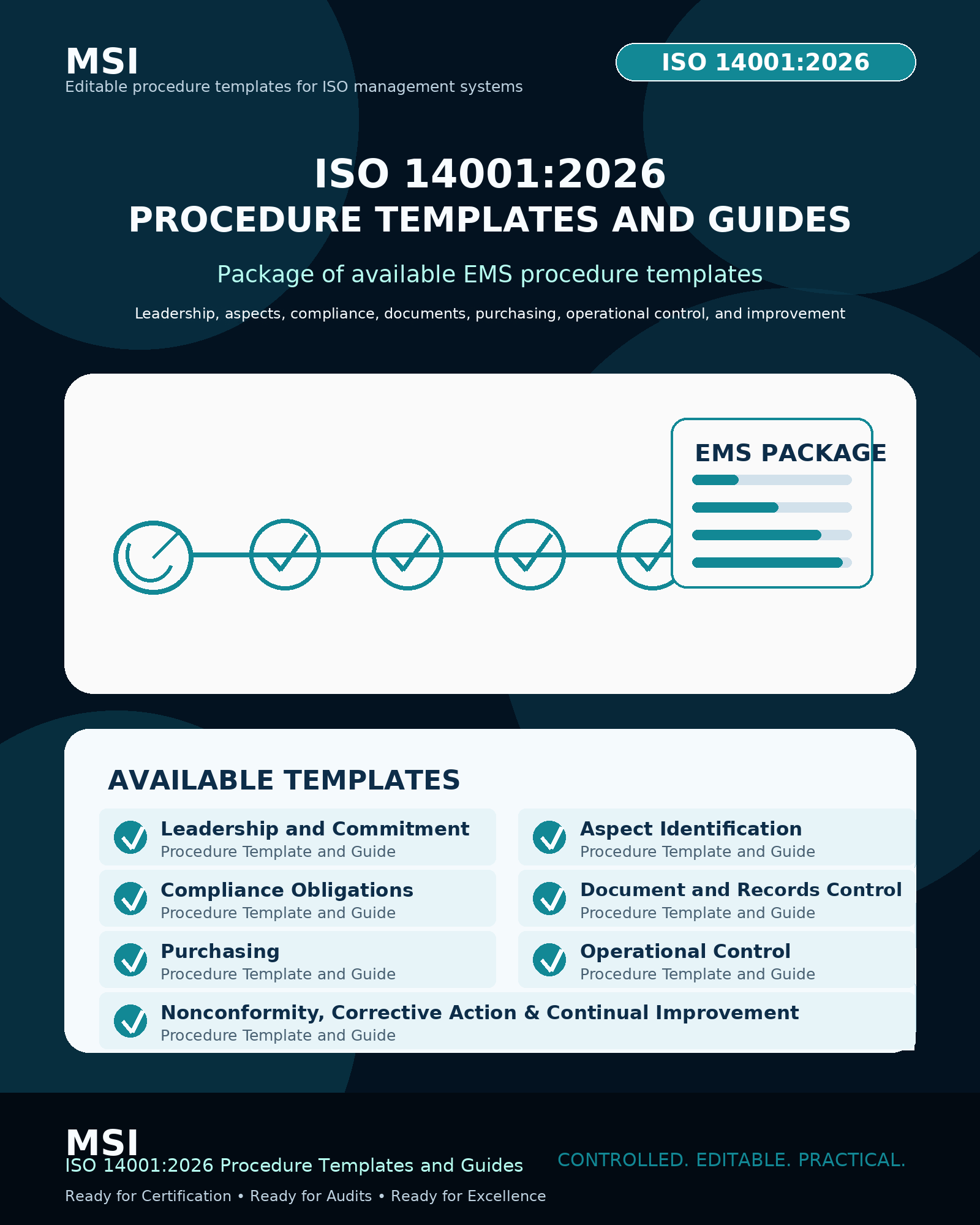
If you already run a certified environmental management system, you do not need a briefing telling you the lifecycle requirement got stronger. You need the documents. MSI’s ISO 14001:2026 Procedure Templates and Guides package was built for one specific person: the experienced EHS manager holding a live ISO 14001:2015 certificate, a transition deadline of 30 April 2029, and no spare month to write seven procedures from a blank page. Every 2026-edition EMS procedure, written to the published standard rather than adapted from 2015 documents — the aspects and impacts register carrying the life cycle perspective, operational control, compliance obligations, purchasing and supplier control, human resource management, and the new Clause 6.3 change process that mapping-table transitions silently delete. The transition course is included in the same purchase.
See the ISO 14001:2026 transition package →
Only need the one procedure that carries this clause? The ISO 14001:2026 Aspect Identification template is the Clause 6.1 document on its own — five registers, life cycle perspective built in, significance judged against the receptor rather than against volume.
The Map
The Six Lifecycle Stages Every ISO 14001 Lifecycle Assessment Should Map
Cradle. Gate. Grave.
An ISO 14001 lifecycle assessment is not built on a fixed model prescribed by the standard, but it aligns closely with the framework used in formal LCA methodology. For most organizations, the following six stages form a practical, comprehensive map for an ISO 14001 lifecycle assessment.
1. Raw Material Acquisition & Processing
Extraction, mining, harvesting, and primary processing. This upstream stage is where much of a product’s environmental burden — resource depletion, land-use change, water use, and embodied carbon — is locked in before you ever take delivery. It is also where supplier engagement pays the highest dividends.
2. Design & Development
The highest-leverage stage in any ISO 14001 lifecycle assessment. Design decisions commit the large majority of a product’s lifetime environmental impact before a single unit is manufactured. Eco-design principles — material efficiency, disassembly for recycling, and reduced hazardous substances — are the core tools of a lifecycle-aware EMS. A stage-two decision costs a meeting; the same decision at stage five costs a take-back scheme.
3. Production & Manufacturing
Your direct operations: energy use, water consumption, waste generation, air emissions, and chemical management. Most organizations already track this stage well — but lifecycle thinking demands it be considered in the context of what comes before and after, not as an isolated island of control.
4. Distribution & Transportation
The movement of goods generates fuel-combustion emissions, packaging waste, and logistical inefficiency. For organizations with global supply chains or wide distribution networks, transportation can represent a substantial share of total lifecycle impact — and it is frequently the stage where an ISO 14001 lifecycle assessment first produces a number that surprises the finance team.
5. Use & Maintenance by Customers
For many product categories — electronics, vehicles, appliances, chemicals — the use phase dominates lifecycle impact. A washing machine generates more environmental burden through decades of hot-wash cycles than through its manufacture. Lifecycle thinking asks: have we communicated responsible-use guidance, and have we designed for efficiency in operation?
6. End-of-Life Treatment, Reuse & Disposal
Landfill, incineration, recycling, remanufacturing, or reuse — each carries a distinct environmental profile. Clause 8.1 specifically calls out the need to provide information for end-of-life treatment, making this a compliance point, not just a sustainability aspiration. The EPA’s sustainable materials management resources are a useful reference for structuring this stage, and its extended producer responsibility material is where the regulatory pressure is building.
Direct Answer
What stages does an ISO 14001 lifecycle assessment cover? Six: raw-material acquisition, design and development, production and manufacturing, distribution and transportation, customer use and maintenance, and end-of-life treatment. Not every stage is significant for every organization — the discipline is identifying which ones dominate your impact and managing those first.
The Highest-Leverage Lever
Why Supplier Engagement Carries Most of the Lifecycle Load
Ask. Qualify. Improve together.
For most organizations, the single largest share of lifecycle impact sits upstream — in the raw materials and processing that happen before anything reaches your loading dock. That is why supplier engagement is the highest-leverage move an ISO 14001 lifecycle assessment can produce. Clause 8.1 makes it explicit: environmental requirements must be communicated to suppliers and contractors, and the level of control or influence you have over each must be defined and documented.
In practice, this does not mean auditing every supplier in your chain. It means having a defensible process: a supplier environmental questionnaire, pre-qualification criteria that weigh environmental performance alongside price and quality, and a prioritized focus on the vendors who sit at your highest-impact upstream stages. MSI client experience suggests that organizations which score suppliers on a handful of environmental criteria — and revisit the scores at each contract cycle — tend to surface real improvement opportunities that a site-only view never reveals.
The 2026 edition tightened the language here more than most transition briefings acknowledge, and the mechanics of the control-or-influence determination deserve more room than this article can give them. MSI’s dedicated treatment of ISO 14001 externally provided processes is the full read — what changed, what a defensible determination looks like, and the four returns organizations typically report. The procedure that operationalizes it is MSI’s ISO 14001:2026 Operational Control template, built around operating criteria with all four life cycle obligations and the control-or-influence determination written in.
One connection worth drawing: when a lifecycle map shows that a critical input depends on a single water-stressed region or a single high-emitting process, that is not only an environmental aspect — it is a business risk, and increasingly a disclosed one. The same supplier scorecards that satisfy Clause 8.1 feed the Scope 3 emissions data customers and investors now ask for. Organizations running a mature sustainability program mapped to ISO 14001 routinely find the lifecycle work they did for certification doubles as procurement intelligence.
The Playbook
How to Embed an ISO 14001 Lifecycle Assessment Into Your EMS — Five Steps
Map. Register. Design. Target. Communicate.
Translating an ISO 14001 lifecycle assessment into a working EMS activity requires structure. The following framework provides a practical pathway that stands up under audit. It pairs naturally with MSI’s step-by-step ISO 14001 implementation guide and the one-year ISO 14001 roadmap.
Step 1 — Map Your Significant Lifecycle Stages
Not every stage matters equally in an ISO 14001 lifecycle assessment. A service company with no physical product has a very different profile from a chemical manufacturer. Start by mapping the relevant stages for your key products or service lines, using the six-stage framework above as a guide. Record which stages you judged insignificant and why — an auditor accepts a reasoned exclusion far more readily than a silent one.
Step 2 — Extend Your Environmental Aspects Register
Expand your Clause 6.1.2 aspects register to explicitly capture upstream and downstream aspects. For each significant stage, ask: what inputs flow in, what outputs flow out, and which media are affected — air, water, soil, biodiversity, human health? This is where an ISO 14001 lifecycle assessment most directly feeds your core EMS. If you want a read on how your current register scores before you rebuild it, MSI’s free Risk, Aspect and Job Hazard maturity check returns a band immediately, with nothing to enter first.
Step 3 — Integrate Lifecycle Thinking Into Design
If your organization designs products or services, embed lifecycle checkpoints into your design-and-development procedure. Gate reviews carrying an ISO 14001 lifecycle assessment should include eco-design questions: material substitution, disassembly and recycling feasibility, use-phase energy demand, and end-of-life information requirements. A checkpoint that has no authority to stop a gate is a prompt, not a control — write it as a criterion the reviewer has to answer.
Step 4 — Set Lifecycle-Informed Objectives and Targets
Your environmental objectives under Clause 6.2 should reflect lifecycle insight. An organization that identifies packaging waste in the use phase as significant should set a target to reduce packaging material — not just improve on-site waste segregation. This is exactly the discipline MSI develops in its guide to ISO 14001 continual improvement, where objectives are judged by measurable results rather than by intent. The objective is also the artifact that carries your ISO 14001 lifecycle assessment into the management review.
Step 5 — Communicate End-of-Life Information
One of the most actionable — and frequently overlooked — requirements is the obligation to provide end-of-life information to relevant parties. This may mean recycling instructions on product labeling or a formal take-back scheme. It is also where lifecycle thinking connects directly to circular-economy design, and where several organizations discover they have been communicating the information informally for years with no record that they did.
Direct Answer
How do you implement an ISO 14001 lifecycle assessment? In five steps: map your significant lifecycle stages, extend your Clause 6.1.2 aspects register upstream and downstream, integrate lifecycle checkpoints into design, set lifecycle-informed objectives under Clause 6.2, and communicate end-of-life information to customers and partners.
Skip the Blank Page
Twenty-Eight Years of Consulting Practice, Written Down
Those five steps are the method. The documents are the work. MSI’s ISO Procedure Templates and Guides library covers ten procedure topics across ISO 9001, ISO 13485, ISO 14001:2026, ISO 45001 and ISO 7101 — complete working procedures in editable Word, with the judgment calls already made and the decisions that are genuinely yours clearly marked. Every one carries a records table with no blanks, a maturity ladder describing four levels of observable behavior, and MSI notes annotated from 200+ audits attended. Each topic also has a free maturity check attached, so you can find out where you stand before you spend anything.
Where It Surfaces Again
Your ISO 14001 Lifecycle Assessment Has to Reach the Management Review
Report it. Decide on it. Record it.
This is the step most systems stop short of, and it is the one that converts an ISO 14001 lifecycle assessment from a planning artifact into a governed one. Clause 9.3 requires top management to review the EMS at planned intervals against a defined set of inputs — including the extent to which environmental objectives have been met, changes in environmental aspects, and the adequacy of resources. Every one of those inputs is downstream of the ISO 14001 lifecycle assessment described above.
In practice that means three things have to arrive at the meeting. First, whether the upstream and downstream aspects you registered have changed — a new supplier, a substituted material, a new distribution model. Second, whether the lifecycle-informed objectives you set under Clause 6.2 actually moved. Third, whether the resource judgment you made when you scoped the assessment as proportionate still holds, because proportionality is a decision that ages.
The 2026 edition restructured this clause: Clause 9.3 is now split into three subclauses, review outputs became results, and Clause 9.2.2 a) asks for an audit objective the 2015 edition never required. If your management review agenda was assembled from last year’s agenda — as most were — the lifecycle line item is exactly the kind of input that was never on it in the first place and so cannot go missing visibly. The gap is invisible from inside the document.
Build the Agenda From the Clause, Not From Last Year
MSI’s ISO 14001:2026 Management Review Tool Kit is twenty-four numbered sections built from the clause itself, with the clause reference printed under every title and a ten-row comparison against the 2015 edition showing what moved. It ships as a matched pair — a PowerPoint deck to present from and a Word minutes form to record into, generated from the same section list, so the presenter and the recorder are never on different items. Where a section is MSI practice rather than a requirement, it says so, which means an auditor can tell the difference and so can you.
View the ISO 14001:2026 Management Review Tool Kit →
Running environment and safety together, or all three systems under one review? The full range — single-standard, HSE combined, and IMS — is on the ISO Management Review Toolkits page, and each combined edition carries an appendix recording every divergence and which standard governs it.
Direct Answer
Does an ISO 14001 lifecycle assessment belong in the management review? Yes. Clause 9.3 requires review of changes in environmental aspects, progress against environmental objectives, and adequacy of resources — and each of those inputs is produced by the lifecycle work. Three items belong on the agenda: changed upstream or downstream aspects, movement against lifecycle-informed objectives, and whether the proportionality judgment behind your assessment still holds.
The Audit Lens
What Auditors Look For as ISO 14001 Lifecycle Assessment Evidence
On paper is not enough. Show the decisions.
Third-party certification auditors pay close attention to lifecycle thinking during surveillance and recertification. Knowing what they look for lets an organization build the right ISO 14001 lifecycle assessment evidence base from day one. Across the 200+ certification and surveillance audits MSI has attended, reviewers consistently sample four things: the environmental aspects register for evidence that upstream and downstream stages were considered; procurement documentation for lifecycle requirements communicated to suppliers; design-and-development records for eco-design checkpoints; and environmental objectives for lifecycle realities rather than permit-limit compliance alone.
The most common finding is an ISO 14001 lifecycle assessment that exists on paper and has never been operationalized. MSI client experience suggests that organizations which fold lifecycle thinking into real decisions — supplier selection, product design, packaging specification, customer guidance — consistently outperform those that treat it as a documentation exercise. The tell is nearly always the same: the document is dated, correct, and has no downstream consequence anywhere in the system.
A qualified ISO 14001 internal auditor is usually the first person positioned to catch the distance between documented intention and operational reality; MSI’s internal audit services are built to surface exactly that before a registrar does. One accreditation point worth checking during a transition cycle: confirm your certification body is accredited under Global ACI, which assumed the roles previously held by IAF and ILAC on 1 January 2026. A body must itself be accredited to the 2026 edition before it can grant transition.
Direct Answer
What evidence proves an ISO 14001 lifecycle assessment to an auditor? Four artifacts: an aspects register covering upstream and downstream stages, procurement records showing environmental requirements communicated to suppliers, design records with eco-design checkpoints, and objectives that reflect lifecycle impacts — all traceable to real decisions, not just a policy statement.
Proof In Practice
Lifecycle Thinking, Circular Economy, and Real-World Leaders
The best already do this. Here is how.
Lifecycle thinking is not just a compliance concept — the world’s most respected brands treat it as a competitive differentiator. The publicly documented programs below are illustrative examples, not MSI engagements, but each shows what a mature lifecycle discipline looks like in practice, and each maps cleanly onto the ISO 14001 stages above. The frameworks they rely on — the GHG Protocol Scope 3 standard, the Ellen MacArthur Foundation‘s circular-economy model, and Science Based Targets — are the same ones your EMS can borrow.
Apple — LCA on Every Product
Apple publishes a detailed Product Environmental Report for every major device, quantifying the full lifecycle carbon footprint by phase — production, transport, use, and end-of-life — using formal LCA methodology. What makes the approach relevant here is how the data drives design: recycled content decisions, material impact scoring, and its Daisy disassembly robot for end-of-life recovery all trace back to lifecycle analysis rather than marketing.
Nike — Carbon, Water, Waste & Chemistry
Nike’s Move to Zero strategy tracks four lenses — carbon, water, waste, and chemistry — across the entire product lifecycle. Its own analysis identifies raw materials as the largest share of its footprint, which is why lifecycle-informed material substitution (recycled polyester, lower-carbon fabrics) sits at the center of both product design and supplier engagement targets.
Patagonia — Durability and Worn Wear
Patagonia connects the design stage directly to the use and end-of-life stages: poor durability shortens the use phase and raises impact per year of garment life. Its Worn Wear repair-and-resale program operationalizes lifecycle extension at scale, and its material targets are anchored to science-based emissions goals rather than aspiration.
IKEA — Democratic Design and Buy-Back
IKEA’s Democratic Design framework evaluates every product across form, function, quality, sustainability, and price simultaneously — with sustainability requiring lifecycle thinking at the design stage. Its furniture buy-back and resale program, and its move toward product-as-a-service leasing, are lifecycle thinking operationalized as a business model rather than a compliance exercise.
Unilever — Hotspot Analysis at Scale
Managing thousands of products, Unilever relies on lifecycle hotspot analysis — identifying which stage dominates impact for each category and targeting interventions accordingly. For many cleaning and personal-care products the use phase dominates, which is why concentrated formulations and cold-wash technologies became priorities. Upstream, agricultural sourcing drives its biggest land-use and biodiversity risks.
Interface — Environmental Product Declarations
The commercial carpet-tile manufacturer discloses the full lifecycle carbon footprint of every product through third-party-verified Environmental Product Declarations. Its long-running strategy — recycled inputs, energy efficiency, product-life extension, and adhesive-free installation — worked through each lifecycle stage systematically, and its reclamation program closes the raw-material loop. It is one of the most cited examples of lifecycle thinking reshaping an entire business.
The common thread: each organization started by pinpointing the one lifecycle stage responsible for the greatest share of its impact, then managed that first. That is the practical core of an ISO 14001 lifecycle assessment — and the same logic drives the Scope 1, 2, and 3 carbon-neutrality work and the practical measures that reduce a carbon footprint now expected under frameworks such as the Global Reporting Initiative, CDP, and the EU’s Corporate Sustainability Reporting Directive.
Wherever You Are With This
Four Routes Forward — One of Them Costs Nothing
Find out where you stand, free. The Risk, Aspect and Job Hazard maturity check scores your aspect process across eight elements in about six minutes. Score and band appear immediately, nothing to enter, and there is a genuine Controlled band that tells you when to stop. The Production and Operational Control check does the same for Clause 8.1.
Transitioning to the 2026 edition. The ISO 14001:2026 Procedure Templates and Guides package plus its transition course — first module free — is the week-long route rather than the quarter-long one.
Building an EMS from nothing. Talk it through on 760-434-9141 for a planning session, look at the SurePath turnkey program, or start with the EMS 14001 Launch Mastery course, which walks a new EMS from kickoff to audit-ready. Already certified and want the system held year-round? That is SureResults.
Still deciding whether certification is worth it. Watch the ISO Executive Decision Briefs — short leadership-level briefings on what a management system is supposed to produce. Free, no form.
Questions, Answered
ISO 14001 Lifecycle Assessment: Frequently Asked Questions
Ask. Answer. Apply.
What is an ISO 14001 lifecycle assessment?
Does ISO 14001 require a full formal Life Cycle Assessment (LCA)?
Which clauses in ISO 14001 cover lifecycle perspective?
What changed for lifecycle perspective in ISO 14001:2026?
How does lifecycle thinking improve an ISO 14001 EMS?
What is the difference between lifecycle perspective and a formal LCA?
Does small-organization size exempt you from an ISO 14001 lifecycle assessment?
How does an ISO 14001 lifecycle assessment connect to the circular economy?
References & Authoritative Sources
1. ISO — ISO 14001:2026 standard record
2. ISO — ISO 14001:2026 publication announcement
3. ISO — ISO 14001, Environmental management systems
4. ISO — ISO 14001:2015 standard record (withdrawn)
5. ISO — ISO 14040, LCA principles and framework
6. ISO — ISO 14044, LCA requirements and guidelines
7. ANSI — What changed in the 2026 edition
8. Global ACI — Global Accreditation Cooperation, successor to IAF and ILAC
9. U.S. EPA — Sustainability and environmental management systems
10. U.S. EPA — Sustainable Materials Management
11. U.S. EPA — Circular economy and extended producer responsibility
12. GHG Protocol — Corporate Value Chain (Scope 3) Standard
13. Ellen MacArthur Foundation — Circular economy resources
14. Science Based Targets initiative — SBTi
15. TCFD — Task Force on Climate-related Financial Disclosures
16. TNFD — Taskforce on Nature-related Financial Disclosures
17. CDP — Environmental disclosure system
18. Global Reporting Initiative — GRI Standards
19. European Commission — Corporate Sustainability Reporting Directive (CSRD)
Keep Reading
Related ISO 14001 Reading From MSI
• ISO 14001 Environmental Aspects: Essential 2026 Changes
• ISO 14001 Environmental Policy: The Proven 2026 Rewrite
• ISO 14001 Environmental Conditions: The Critical New Lens
• ISO 14001 Externally Provided Processes: Essential Now
• ISO 9001 and 14001 Transition: Why One Plan Wins
• ISO 14001:2026 Updates: Complete Guide to New Requirements
• ISO 14001:2026 Clause 4.1: The Critical Truth EMS Leaders Need
• ISO 14001 Certification: Essential Guide for All Industries
• ISO 14001 Implementation: From QMS to EMS Using Your ISO 9001 Foundation
• Biodiversity and ISO 14001:2026: Why Most Businesses Are Unprepared
• Ecosystem Health Under ISO 14001:2026
• ISO 14001: Turn Climate Action Into a $2T Opportunity
About Management Systems International (MSI)
Management Systems International (MSI) is a veteran-owned, female-owned ISO consulting firm founded in 1998. With 28 years of experience, MSI’s track record includes 80+ certifications supported, 200+ audits attended, and 600+ professionals trained across manufacturing, technology, medical device, government, healthcare, and other regulated industries.
Today MSI implements ISO 9001, ISO 13485, ISO 14001, and ISO 45001, with an expanding focus on ISO 7101 healthcare quality.
msi-international.com · 760-434-9141
